
Abigail Williams
Author of The Social Life of Books: Reading Together in the Eighteenth-Century Home
About the Author
Abigail Williams is Lord White Fellow and Professor of Eighteenth-Century Studies at St. Peter's College, University of Oxford.
Works by Abigail Williams
The Social Life of Books: Reading Together in the Eighteenth-Century Home (2017) 205 copies, 3 reviews
Reading It Wrong: An Alternative History of Early Eighteenth-Century Literature (2023) 17 copies, 1 review
Associated Works
Tagged
Common Knowledge
- Gender
- female
Members
Reviews
The Social Life of Books: Reading Together in the Eighteenth-Century Home (The Lewis Walpole Series in Eighteenth-Century Culture and History) by Abigail Williams
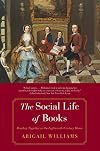
Summary: A study of reading together in the eighteenth-century home, looking at how books were used and contributed to social life.
In modern life, reading is by and large a silent and solitary activity. We may gather for an author reading or a bookclub. But most of our reading, even via audiobooks is a solitary activity. The big idea in this book was that reading was a social activity, in family and social gatherings in the home. It provided evening entertainment in the home as well as show more sustaining spiritual life through the reading of sermons and devotional works. Friends gathered to read plays or enjoy poetry. And with the advent of the novel, reading together served to head off the fears of the fantasy life that might be indulged in private reading.
Abigail Williams offers a study at once both scholarly and a fascinating read for anyone interested in reading practices. She draws on elocution manuals, marginalia, library catalogues and subscription lists, letters and diaries, to construct for us the eighteenth century practices for reading, particularly in England. And one of the first things plainly evident is that reading often meant reading aloud. This explains the importance of elocution manuals. She details how people learned to read aloud to convey the cadences, the content, and the feeling of a work, holding the listener’s attention.
She explores the spaces in which reading occurred, primarily around the setting of the home. Within the home, she traces the rise of the library and the furnishings that would go into one. But reading also occurred in taverns, coffeehouses and other settings. She also goes into matters as diverse as lighting, font sizes, and reading habits, which often show a great deal of skipping around.
How did people access books? This varied by class. Full-length books were often too expensive for many in the working classes. Chapbooks and pamphlets and serialized books helped with this. And then there was borrowing, whether from an employer, or a circulating library. People exchanged books, making them available to more than one household. People also created their own “commonplace” books, whether by writing out a poem, or clipping one from a newspaper.
Williams chronicles the rise of the novel. This brought questions of the appropriateness of private novel reading? In addition to saving people from the dangers of private reading, public readings could “edit” out more titillating or otherwise objectionable material. Novels also offered the chance to imagine other lives.
Finally, Williams considers religious reading. Sermons underwent a shift from more extemporaneous to more structured and elaborated as they were written and published. Elocution was vital both in the pulpit and the home, to hold attention. People read together for self-improvement. It could be the Bible, works of devotion, history and science. Williams acquaints us with the most popular books of the time.
The book includes an abundance of illustrations of paintings of different readers and settings, reproduction of various forms of books including commonplace books and diaries and letters. Williams breaks the stereotype of reading as anti-social, at least in the eighteenth century. The book also gestures at the opportunity for books to be shared entertainment in our day. She introduces us to what may be a lost art, except among actors, of elocution. And it made me wonder what future cultural historians might write about books and reading in our time. show less
In modern life, reading is by and large a silent and solitary activity. We may gather for an author reading or a bookclub. But most of our reading, even via audiobooks is a solitary activity. The big idea in this book was that reading was a social activity, in family and social gatherings in the home. It provided evening entertainment in the home as well as show more sustaining spiritual life through the reading of sermons and devotional works. Friends gathered to read plays or enjoy poetry. And with the advent of the novel, reading together served to head off the fears of the fantasy life that might be indulged in private reading.
Abigail Williams offers a study at once both scholarly and a fascinating read for anyone interested in reading practices. She draws on elocution manuals, marginalia, library catalogues and subscription lists, letters and diaries, to construct for us the eighteenth century practices for reading, particularly in England. And one of the first things plainly evident is that reading often meant reading aloud. This explains the importance of elocution manuals. She details how people learned to read aloud to convey the cadences, the content, and the feeling of a work, holding the listener’s attention.
She explores the spaces in which reading occurred, primarily around the setting of the home. Within the home, she traces the rise of the library and the furnishings that would go into one. But reading also occurred in taverns, coffeehouses and other settings. She also goes into matters as diverse as lighting, font sizes, and reading habits, which often show a great deal of skipping around.
How did people access books? This varied by class. Full-length books were often too expensive for many in the working classes. Chapbooks and pamphlets and serialized books helped with this. And then there was borrowing, whether from an employer, or a circulating library. People exchanged books, making them available to more than one household. People also created their own “commonplace” books, whether by writing out a poem, or clipping one from a newspaper.
Williams chronicles the rise of the novel. This brought questions of the appropriateness of private novel reading? In addition to saving people from the dangers of private reading, public readings could “edit” out more titillating or otherwise objectionable material. Novels also offered the chance to imagine other lives.
Finally, Williams considers religious reading. Sermons underwent a shift from more extemporaneous to more structured and elaborated as they were written and published. Elocution was vital both in the pulpit and the home, to hold attention. People read together for self-improvement. It could be the Bible, works of devotion, history and science. Williams acquaints us with the most popular books of the time.
The book includes an abundance of illustrations of paintings of different readers and settings, reproduction of various forms of books including commonplace books and diaries and letters. Williams breaks the stereotype of reading as anti-social, at least in the eighteenth century. The book also gestures at the opportunity for books to be shared entertainment in our day. She introduces us to what may be a lost art, except among actors, of elocution. And it made me wonder what future cultural historians might write about books and reading in our time. show less
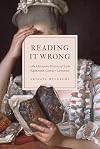
In a radio sketch from John Finnemore’s Souvenir Programme, a secondary-school teacher diplomatically attempts to negotiate the dubious interpretations of Macbeth offered by his students: ‘That’s an interesting reading …That’s a really interesting answer’ – and, at the suggestion that both Macbeth and Lady Macbeth are being sarcastic in their discussion of killing Duncan: ‘Well, I could not be more interested in that answer.’ Only once the lesson switches to maths is the show more teacher finally free to speak his mind:
‘No that’s wrong, that’s the wrong answer, and I will tell you the right answer, which I know and you should learn! God that felt good!’
As Abigail Williams argues in her new study of early 18th-century literature, despite the ‘death of the author’ and the apparent multiplication of meanings offered by postmodern literary theory, practices of pedagogy still seek – however indirectly and Socratically, like Finnemore’s teacher – to be expert guides that lead readers to the ‘right answer’. In such a context, Williams’ dedication of this book to her students at St Peter’s College, Oxford might seem as double-edged as Alexander Pope’s dedication of The Rape of the Lock to Arabella Fermor (the model for his heroine ‘Belinda’).
The literature of this period, with its pages full of blanked-out names and dense webs of political and topical reference, can make it a particular challenge for students who don’t know their occasional conformists from their Patriot Whigs. Many modern editions assume an ideal 18th-century reader who would have readily picked up on all these references and attempt to replicate this knowledge base through extensive annotations: the Longman edition of Pope’s Dunciad, for example, often drowns a single line of text in a full page of explanatory notes (though the more baffling of these, as Williams explains, were originally supplied by Pope himself in a multi-layered parody of contemporary scholarship).
Read the rest of the review at HistoryToday.com.
Natasha Simonova is a writer and researcher of 18th-century literature based in London. show less
‘No that’s wrong, that’s the wrong answer, and I will tell you the right answer, which I know and you should learn! God that felt good!’
As Abigail Williams argues in her new study of early 18th-century literature, despite the ‘death of the author’ and the apparent multiplication of meanings offered by postmodern literary theory, practices of pedagogy still seek – however indirectly and Socratically, like Finnemore’s teacher – to be expert guides that lead readers to the ‘right answer’. In such a context, Williams’ dedication of this book to her students at St Peter’s College, Oxford might seem as double-edged as Alexander Pope’s dedication of The Rape of the Lock to Arabella Fermor (the model for his heroine ‘Belinda’).
The literature of this period, with its pages full of blanked-out names and dense webs of political and topical reference, can make it a particular challenge for students who don’t know their occasional conformists from their Patriot Whigs. Many modern editions assume an ideal 18th-century reader who would have readily picked up on all these references and attempt to replicate this knowledge base through extensive annotations: the Longman edition of Pope’s Dunciad, for example, often drowns a single line of text in a full page of explanatory notes (though the more baffling of these, as Williams explains, were originally supplied by Pope himself in a multi-layered parody of contemporary scholarship).
Read the rest of the review at HistoryToday.com.
Natasha Simonova is a writer and researcher of 18th-century literature based in London. show less
The Social Life of Books: Reading Together in the Eighteenth-Century Home (The Lewis Walpole Series in Eighteenth-Century Culture and History) by Abigail Williams
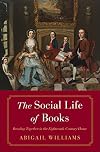
The author uses diaries, library records, and other papers as well as elocution guides to reconstruct who was reading what in the 18th century and how. Reading was much more of a shared activity with people reading aloud to each other from newspapers, periodicals, non fiction, joke books, and religious works, and a good reading voice was essential. Even with the rise of the novel during this time, reading was much more fragmentary with people reading extracts to elicit emotional responses show more rather than complete novels such as Behemoths like "Clarissa" or the more reasonably sized "Tom Jones".
Fascinating. show less
Fascinating. show less
The Social Life of Books: Reading Together in the Eighteenth-Century Home (The Lewis Walpole Series in Eighteenth-Century Culture and History) by Abigail Williams
Interesting ideas, but not an interesting writing style.
Lists
You May Also Like


Associated Authors
Statistics
- Works
- 4
- Also by
- 1
- Members
- 233
- Popularity
- #96,931
- Rating
- 4.2
- Reviews
- 4
- ISBNs
- 11