
Deborah Levy
Author of Hot Milk
About the Author
Image credit: The Booker Prize Foundation
Series
Works by Deborah Levy
Coffret trilogie Deborah Levy : autobiographie en mouvement - (Ce que je ne veux pas savoir + Le Coû (2021) 1 copy
Sarah Lucas: Sex Life 1 copy
Levy Deborah 1 copy
An Act of Love 1 copy
The Next Wave 1 copy
The Next Wave II 1 copy
Eva and Moses 1 copy
Associated Works
Lunatics, Lovers and Poets: Twelve Stories after Cervantes and Shakespeare (2016) — Contributor — 37 copies
Tagged
Common Knowledge
- Birthdate
- 1959-08-06
- Gender
- female
- Education
- Dartington College of Arts
- Occupations
- playwright
novelist
short story writer
director - Awards and honors
- Lannan Literary Fellowship (2001)
- Relationships
- Levy, Norman (father)
- Short biography
- Deborah Levy was born 6 August 1962 in Johannesburg, South Africa. Her father, an academic and historian, was a member of the African National Congress. The family emigrated to Wembley Park, London in 1968. She studied theater at Dartington College of Ars and became a playwright whose works have been staged by the Royal Shakespeare Company since 1981. She is also the author of several acclaimed novels, including Beautiful Mutants (1988), Swallowing Geography (1993), and Billy & Girl (1999). Her novel Swimming Home (2011) was shortlisted for the 2012 Man Booker Prize, the Jewish Quarterly-Wingate Prize, and was named a New York Times Notable Book of 2012. The title story in her short story collection, Black Vodka and Other Stories (2013) was shortlisted for the BBC International Short Story Award. Hot Milk was shortlisted for the 2012 Man Booker Prize, and The Man Who Saw Everything was selected for the 2019 Booker Prize longlist. She has been a director and writer for the MANACT Theatre Company in Cardiff, Wales, and a Creative Arts Fellow at Trinity College, Cambridge. She's a regular contributor of articles and reviews to newspapers and magazines including The Independent, The Guardian, and the New Statesman.
- Nationality
- England
UK - Birthplace
- Johannesburg, South Africa
- Places of residence
- Johannesburg, South Africa
Wembley Park, England, UK - Associated Place (for map)
- Wembley Park, England, UK
Members
Discussions
Swimming Home, by Deborah Levy in And Other Stories (January 2013)
Swimming Home by Deborah Levy in Booker Prize (September 2012)
Reviews
“ I smiled at his careful reconstruction of history, blatantly told in his favour …”
“I’m trying to cross the road …. Yes, she said, you’ve been trying to cross the road for thirty years but stuff happened on the way.”
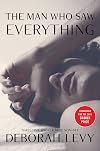
In 1988, Saul Adler, a young, Jewish historian, is getting photographed, crossing Abbey Road, like the famous Beatles album cover. His girlfriend, who just broke up with him, is taking the photo. He is then struck by a car. This is where the novel gets trippy, show more and timelines collapse and the narrative shifts to 2016, where Saul also finds himself recovering from an auto accident. He becomes a man in pieces, as he attempts to reconstruct his life and his past. There is a lot going on here and I am sure I have missed a metaphor or two, but I think the primary theme here, is how difficult it is examining and understanding our own lives and the lives of the people closest to us. The writing is excellent and Levy gives the reader plenty to chew on here. This is my introduction to her work and I was left quite impressed. show less
“I’m trying to cross the road …. Yes, she said, you’ve been trying to cross the road for thirty years but stuff happened on the way.”
In 1988, Saul Adler, a young, Jewish historian, is getting photographed, crossing Abbey Road, like the famous Beatles album cover. His girlfriend, who just broke up with him, is taking the photo. He is then struck by a car. This is where the novel gets trippy, show more and timelines collapse and the narrative shifts to 2016, where Saul also finds himself recovering from an auto accident. He becomes a man in pieces, as he attempts to reconstruct his life and his past. There is a lot going on here and I am sure I have missed a metaphor or two, but I think the primary theme here, is how difficult it is examining and understanding our own lives and the lives of the people closest to us. The writing is excellent and Levy gives the reader plenty to chew on here. This is my introduction to her work and I was left quite impressed. show less
7. [23091502::The Man Who Saw Everything] by [[Deborah Levy]]
reader: [[George Blagden]]
published: 2019
format: 6:05 audible audiobook (200 pages in hardcover)
acquired: January
listened: Jan 27 – Feb 5 (and again, Feb 7-13)
rating: 4
locations: London & Berlin
about the author South African born, half of Jewish-Lithuanian descent. Grew up in London since 1968. Born 6 August 1959.
A beautiful, mysterious, and sophisticated little book. Actually, you have to read it twice, so double the length, show more but you will get two very different books out of it.
I stumbled through the book the first time, carried on by the very odd narrator, historian Saul Addler, who had a very adventurous September 1988. A striking beauty, he, in quick succession, has multiple affairs with the different sexes and on different sides of the Iron Curtain. Sensual and quick to fall in love, Saul is also distant, I would guess somehow on the spectrum. He is spectacularly self-centered, to the point he has trouble really understanding or taking in the world around him, making the title a bit of a mockery. Instead he focuses on whatever he is drawn to. And he is most attracted to those obsessed with him, especially his girlfriend, Jennifer Moreau, who makes art out of photographs of him. He'll carry this from London to East Berlin, bringing, in place of requested, hard-to-get canned pineapples, a picture of himself crossing Abbey Road...because the sister of a translator he is working with is a huge Beatles fan.
We readers get a strange language that meshes well with his idea of a Stasi surveillance and his perspective of self-censorship. These worlds are confusing and yet fascinated through Saul's distorted, falsely precise view and absolute confidence. Then the book jumps to 2016 and seems to get more confusing. But, it still drew me because the language is elegant (and the reader is excellent), Saul and all his connections, and his girlfriend from 1988, are curiously fascinating and beautiful in their human flaws. There is a lot of human texture here. But I finished the book without understanding what I read.
So, I started hunting down published reviews - and the ones I found gave nothing away. All I could grasp was that, yes the book all makes sense and all ties together, that it might be a bit tragic, and that all readers, like this one reviewer I came across, should, upon finishing, immediately read it again. After a day I did try starting the audio over again. I immediately picked up many forgotten or overlooked details, but it took a while, and then it finally clicked, the key little aspect I was missing, and suddenly I had a completely different book. Equally beautiful and confounding, but absolutely different. I can't say, like that one reviewer, it all ties together, because I was left with a lot of loose ends. But, the book has left me thinking. It's sad, plays on longing, and leaves the reader wanting to hang around a bit. And details coalesce. There's a lot of oh!...but wait, now that I figured that out, what does it mean?
I hopefully won't give anything away here, because I really enjoyed the state of confusion listening to this book the first time, and that can't be replicated now. Now I'll always see the new picture.
Recommended to anyone this review interests. It's a terrific book, you'll be rewarded, as long as you have the patience to read it twice.
https://www.librarything.com/topic/315313#7067278 show less
reader: [[George Blagden]]
published: 2019
format: 6:05 audible audiobook (200 pages in hardcover)
acquired: January
listened: Jan 27 – Feb 5 (and again, Feb 7-13)
rating: 4
locations: London & Berlin
about the author South African born, half of Jewish-Lithuanian descent. Grew up in London since 1968. Born 6 August 1959.
A beautiful, mysterious, and sophisticated little book. Actually, you have to read it twice, so double the length, show more but you will get two very different books out of it.
I stumbled through the book the first time, carried on by the very odd narrator, historian Saul Addler, who had a very adventurous September 1988. A striking beauty, he, in quick succession, has multiple affairs with the different sexes and on different sides of the Iron Curtain. Sensual and quick to fall in love, Saul is also distant, I would guess somehow on the spectrum. He is spectacularly self-centered, to the point he has trouble really understanding or taking in the world around him, making the title a bit of a mockery. Instead he focuses on whatever he is drawn to. And he is most attracted to those obsessed with him, especially his girlfriend, Jennifer Moreau, who makes art out of photographs of him. He'll carry this from London to East Berlin, bringing, in place of requested, hard-to-get canned pineapples, a picture of himself crossing Abbey Road...because the sister of a translator he is working with is a huge Beatles fan.
We readers get a strange language that meshes well with his idea of a Stasi surveillance and his perspective of self-censorship. These worlds are confusing and yet fascinated through Saul's distorted, falsely precise view and absolute confidence. Then the book jumps to 2016 and seems to get more confusing. But, it still drew me because the language is elegant (and the reader is excellent), Saul and all his connections, and his girlfriend from 1988, are curiously fascinating and beautiful in their human flaws. There is a lot of human texture here. But I finished the book without understanding what I read.
So, I started hunting down published reviews - and the ones I found gave nothing away. All I could grasp was that, yes the book all makes sense and all ties together, that it might be a bit tragic, and that all readers, like this one reviewer I came across, should, upon finishing, immediately read it again. After a day I did try starting the audio over again. I immediately picked up many forgotten or overlooked details, but it took a while, and then it finally clicked, the key little aspect I was missing, and suddenly I had a completely different book. Equally beautiful and confounding, but absolutely different. I can't say, like that one reviewer, it all ties together, because I was left with a lot of loose ends. But, the book has left me thinking. It's sad, plays on longing, and leaves the reader wanting to hang around a bit. And details coalesce. There's a lot of oh!...but wait, now that I figured that out, what does it mean?
I hopefully won't give anything away here, because I really enjoyed the state of confusion listening to this book the first time, and that can't be replicated now. Now I'll always see the new picture.
Recommended to anyone this review interests. It's a terrific book, you'll be rewarded, as long as you have the patience to read it twice.
https://www.librarything.com/topic/315313#7067278 show less
This is not an easy book. The first half appears to be a fairly straightforward telling of young love and loss, careerism, and, of course, a minor accident at the famous Abby Road zebra crossing. But the second half becomes much more unsettling. Things are not what they seem, the timeline shifts back and forth, people come and go, characters you thought had died appear, etc. The reader learns details in snippets and never quite trusts the narrator's grasp of reality. One may be tempted to show more quit at this point, but that would be a mistake because Levy is masterfully evoking the kind of reality that one experiences in a morphine fog in an ICU. Saul Adler has had a second accident 28 years later and this time it was not minor. Friends and family visit, he slips in and out, and especially, his mind wanders, conjuring dreamlike memories in no particular order and with a surreal quality. Through it all, Saul struggles with feelings of guilt and regret.
Levy sets her novel in Europe during the 28 years (1988-2016) following the collapse of the Soviet Union and the emergence of Brexit. She brings us from the East German Stasi and the Beatles to digital cameras and alternative lifestyles. Not unlike the Beatles tune, Penny Lane, there is a lot going on here. Much of it is mundane but some is "very strange." show less
Levy sets her novel in Europe during the 28 years (1988-2016) following the collapse of the Soviet Union and the emergence of Brexit. She brings us from the East German Stasi and the Beatles to digital cameras and alternative lifestyles. Not unlike the Beatles tune, Penny Lane, there is a lot going on here. Much of it is mundane but some is "very strange." show less
Sigh. Deborah Levy is one of those writers who makes me green with envy. She's just so damn smart.
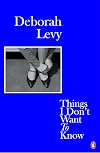
This is the first of her three-part memoir on writing and womanhood, and it's slim but perfectly formed. Arriving at a remote hotel in Majorca in the middle of a snowstorm, Levy, at a dark point in her life, has an unexpected dinner conversation which forces her to reluctantly look back at her turbulent childhood in South Africa and how it continues to shape her as a woman.
The prose is simply show more perfect, every sentence exquisitely crafted:
"Some mothers go mad because the world that made them feel worthless is the same world with which their children fall in love. The suburb of femininity is not a good place to live. Nor is it wise to seek refuge inside our children because children are always keen to make their way into the world to meet someone else. Yes, there had been many times I called my daughters back to zip up their coats. All the same, I knew they would rather be cold and free."
Ah, those last few sentences are so, so clever. I've photographed the page and sent it out en masse to my friends who are mothers.
4.5 stars - what a talent. show less
This is the first of her three-part memoir on writing and womanhood, and it's slim but perfectly formed. Arriving at a remote hotel in Majorca in the middle of a snowstorm, Levy, at a dark point in her life, has an unexpected dinner conversation which forces her to reluctantly look back at her turbulent childhood in South Africa and how it continues to shape her as a woman.
The prose is simply show more perfect, every sentence exquisitely crafted:
"Some mothers go mad because the world that made them feel worthless is the same world with which their children fall in love. The suburb of femininity is not a good place to live. Nor is it wise to seek refuge inside our children because children are always keen to make their way into the world to meet someone else. Yes, there had been many times I called my daughters back to zip up their coats. All the same, I knew they would rather be cold and free."
Ah, those last few sentences are so, so clever. I've photographed the page and sent it out en masse to my friends who are mothers.
4.5 stars - what a talent. show less
Lists
Awards


You May Also Like


Associated Authors
Statistics
- Works
- 38
- Also by
- 12
- Members
- 5,368
- Popularity
- #4,640
- Rating
- 3.6
- Reviews
- 246
- ISBNs
- 273
- Languages
- 20
- Favorited
- 10