
R. Buckminster Fuller (1895–1983)
Author of Operating Manual for Spaceship Earth
About the Author
Richard Buckminster "Bucky" Fuller, the innovative thinker, engineer, and inventor, was born July 12, 1895 in Milton, Massachusetts. Despite early failures and tragedies, including his being expelled from Harvard University twice and the death of his four-year-old daughter, Fuller went on to show more achieve many successes. He is best known for inventing the geodesic dome; his design has been used in structures all over the world. Besides Harvard, Fuller also attended the U.S. Naval Academy, and was a professor at Southern Illinois University. He is the author of Synergetics: Explanations in the Geometry of Thinking, a book that discusses the utopic role technology will play in the future. Critical Path is the book Fuller felt was his most important. It outlined his plan to rejuvenate earth through the use of technology. His last book, Grunch of Giants, summarizes his most important ideas. Fuller was awarded 28 United States patents and many honorary doctorates. In 1968 he was elected into the National Academy of Design as an Associate member. In 1970 he received the Gold Medal award from the American Institute of Architects. He also received the Presidential Medal of Freedom presented to him on February 23, 1983 by President Ronald Reagan. (Bowker Author Biography) show less
Works by R. Buckminster Fuller
Buckminster Fuller: Starting with the Universe (Whitney Museum of American Art Book) (2008) 57 copies
By R. Buckminster Fuller Operating Manual for Spaceship Earth (1st First Edition) [Mass Market Paperback] (1970) 4 copies
50 Years of the Design Science Revolution and the World Game: A Collection of Articles and Papers on Design (1969) 2 copies
2 Titles By R. Buckminster Fuller: & 'Earth, Inc," & "Utopia or Oblivion: The Prospects for Humanity," (1971) 2 copies
E3, Energy, earth and everyone: une stratégie énergétique globale pour le vaisseau spatial Terre ?: World Game, 1969-1977 (2012) 2 copies
Everything I know 1 copy
Basic biography 1 copy
Synergetics Folio: A Collection of 10 Posters & an Introductory Essay by R. Buckminster Fuller 1 copy
Designing a New Industry 1 copy
By R. Buckminster Fuller - Synergetics: Explorations in the Geometry of Thinking (1975-01-16) [Hardcover] (1975) 1 copy
Everything I Know 1 copy
Planetary Planning 1 copy
intuition 1 copy
Associated Works
Design for the Real World: Human Ecology and Social Change (1971) — Introduction, some editions — 578 copies, 4 reviews
TM: Discovering Inner Energy and Overcoming Stress (1975) — Introduction, some editions — 148 copies, 1 review
Non-being and somethingness: Selections from the comic strip Inside Woody Allen (1978) — Introduction, some editions — 25 copies
Tagged
Common Knowledge
- Canonical name
- Fuller, R. Buckminster
- Legal name
- Fuller, Richard Buckminster
- Other names
- Fuller, Buckminster
- Birthdate
- 1895-07-12
- Date of death
- 1983-07-01
- Gender
- male
- Education
- Milton Academy, Massachusetts, USA
Harvard University (expelled)
self-educated - Occupations
- visionary
inventor
systems theorist
architect - Organizations
- American Academy of Arts and Letters ( [1963])
Buckminster Fuller Institute
Mensa International (2nd pres.)
United States Navy (WWI) - Awards and honors
- American Institute of Architects' Gold Medal
Presidential Medal of Freedom (1983)
Humanist of the Year (1969) - Relationships
- Fuller, Arthur Buckminster (grandfather)
Fuller, Margaret (great-aunt)
Sadao, Shoji (colleague) - Short biography
- Richard Buckminster "Bucky" Fuller (July 12, 1895 – July 1, 1983)was an American architect, systems theorist, author, designer, inventor, and futurist.
Fuller published more than 30 books, coining or popularizing terms such as "Spaceship Earth", ephemeralization, and synergetic. He also developed numerous inventions, mainly architectural designs, and popularized the widely known geodesic dome. Carbon molecules known as fullerenes were later named by scientists for their resemblance to geodesic spheres.
Buckminster Fuller was the second president of Mensa from 1974 to 1983.
~Wikipedia - Nationality
- USA
- Birthplace
- Milton, Massachusetts, USA
- Places of residence
- Maine, USA
Chicago, Illinois, USA
North Carolina, USA
St. Louis, Missouri, USA - Place of death
- Los Angeles, California, USA
- Burial location
- Mount Auburn Cemetery, Cambridge, Massachusetts, USA
- Associated Place (for map)
- USA
Members
Reviews

I came to this 1969 cult 'classic' in the fervent hope that it might allow me, finally, to 'get' modern environmentalism for which this is a seminal text.
Part of my subsequent lack of enthusiasm is down to style. There is no doubt that Buckminster Fuller was a genius of sorts - at least as an engineer, planner and technologist - but he writes like a 'speak your weight' machine with a propensity for creating neologistic compound words that would put German philosophy to shame.
Far from show more inspiring, the man just cannot write imaginative prose and yet his subject cries out for imagination. I am sure that he says precisely what he means but it is next to impossible to sustain an interest while being hectored by a person, no doubt kindly in intention in his way, who is egotistical to the nth degree - a 'speech-talker', as my daughter would term such types.
Still, great thoughts are only made easier, no more, by great language skills. There are many prose poets whose ideas can be distilled down to mere mystical garbage when the beauty of the formulation has passed from one ear and out of the other.
Sadly, his are not such great thoughts either ... instead we get a self assured, somewhat egotistical, reasoning that patronises the reader in a step-by-step and apparently logical approach that blinds us with pseudo-science. If persons were just units of existence with blank slates for minds, he might conceivably have a point. But we are not and so he does not.
Buckminster Fuller is a sort of monster despite all his fine aspirations for humanity. He is so, in part, because he sees us all not truly as intrinsically flawed individuals (which we are and which makes us who we are at our best) but as units of existence who can be made nobler by planners. He is a planner and we are the crooked timber that must be used to fulfil the plan for our own good.
Where have we heard such sentiments before? Why, from pretty well every 'great' Western ideologue and thinker whose ego has extended itself to encompass the known human universe.
Far from being ready to consider deep globalist environmentalism (as opposed to human-centred localist environmentalism) as a reasonable possibility for humanity, Buckminster Fuller has converted me into its sworn enemy.
I now know, if there are others like him within the contemporary environmentalist movement (for we can see his influence in the 'Zeitgeist Movement' and in the eco-hysteria surrounding the circle of Al Gore), that, when we ordinary humans fail to meet the needs of the Plan, whatever his personal benignity, his heirs will make old Joe Stalin look like a pussy cat as they enforce their will on a global scale - always in the interests of us and of humanity, of course.
If you are the sort of personality who would have loved dear old Karl Marx before '36, then you'll just love Buckminster Fuller today!
This philosophical primitivism is a shame because there is a great deal of merit in his analysis of capitalism even if he seems loathe to be direct about his primary enemy lest he get accused of being a fellow-traveller with the equally flawed communist alternative that had divided up the world with Washington while he wrote.
He gets close to a truth in his myth of the Great Pirates (the one entertaining and worthwhile section of what is otherwise a monument to the turgid) but it is still not the truth.
The tale of the Great Pirates is a sound enough mythic critique of what we have inherited (as of 1969) but it is about as historically plausible as pretty well every other evangelical motivating myth that has come out of the Anglo-Saxon imperium, from those of the Mormons and Madame Blavatsky to those of Margaret Murray and L. Ron Hubbbard.
The history in this book is mostly just simplistic nonsense that seems to depend on the reading of a few geostrategists and very little experience of practical politics, the sort of simplistic populism, mixed with technocracy, that is standard fare when a certain type of engineer tries to make sense of human complexity and builds societies as he might build bridges.
Old political activists will know that the heart sinks when an engineer or scientist tries to apply engineering or scientific principles to knotty political problems ...
He does make us think, to his credit, about excessive cultural specialisation and about what 'wealth' actually means to humanity. On the latter, he adopts an American populist approach that is analytically correct even if it may not be pragmatically meaningful, given where we are today.
He has also done us a service in suggesting that we are going to be more socially productive and creative if we are given more freedom to think at leisure. The science of daydreaming suggests that our mind does benefit from idling.
And he did the West a great service by joining those who pointed out the effects of pollution within the capitalist world long before it was forced to the notice of Soviet planners by their bullied dissidents.
Failure to consider polluting effects was undoubtedly a major contributing factor to the fall of the Soviet Union and the discrediting of its Communist model - Buckminster Fuller's dissident voice helped the West adjust more effectively to the threat of environmental degradation.
Finally, the analysis of the way that wealth is easily created in war but not in peace is a criticism that stands today of how sovereign 'piratical' states have served the interests of their historically continuous institutions far more often than they have of their peoples.
Buckminster Fuller's somewhat stylistically suppressed righteous anger at global inequity, imperialism, elite corruption, planetary dispoliation and inefficiency leads him to some wise analytical conclusions but not to equally wise solutions.
The Spaceship Earth concept is, of course, seductive, like those of Gaia or the Clash of Civilisations or the End of History, but such book-selling catch-phrases are either so general as to have no meaning for humanity (unless you remove humanity from the equation altogether) or are grossly simplistic when it comes to trying to decide what humanity (which really means individual persons in societies and not some essentialist reified thing with one hive mind) is to do next.
The truism in Spaceship Earth (which we must accept) is that, as a species, we sink or swim with the planet. If it dies, we die - end of story. But there is one heck of a leap from that simple and true proposition to the determination for a planned world government of happy free people living in leisure guided by philosopher kings like our dear Buckminster Fuller.
Self-appointed Platonic Guardians have not had a great record in the humanity stakes. The Buckmister Fullerenes are unlikely to be much better if they actually get their hands on any directive power. I am, for example, not an 'Earthian' but a person who happens to live on Earth. So are you?
As for his faith in computers and automation, this is a belief and nothing more. A sort of instinctive scientific progressivism that over-estimates what computers can do to model our universe and underestimates the logic of an AI displacing us as soon as it can model it better than us.
In the end, one fears that this brave new world (and we are reminded of Huxley here) requires the behavioural normalisation of humanity on a mass scale in order to ensure that the computers can cope with the variables!
His advocacy of 'synergy' and general systems theory reminds one of nothing less than the contemporaneous Rand Corporation, the cold calculations of Hermann Kahn and the vicious number crunching of the latterly contrite Robert McNamara as he judged the success of a war by the body bags.
This is the world of American technocrats at the height of the Cold War and it is salutary to remember that the US lost the Vietnam War and that central planning ruined the Soviet Union just as it would no doubt eventually ruin the planet.
On top of this, there is in the introduction to the book by his grandson all the barely concealed hysteria that drives an environmental 'enthusiasm' that seems to owe as much to a peculiarly charismatic frame of mind in American small town populism as it does to genuine scientific endeavour.
This is a text that believers may love but that the rest of us should question more critically and ask how or why an engineer, who experimented with sleep patterns for himself and then was puzzled that his colleagues could not keep up, can or should have anything to say about the workings of the human soul.
Buckminster Fuller's genius lay in the observation, management and manipulation of matter - and he should not have strayed from that territory. show less
Part of my subsequent lack of enthusiasm is down to style. There is no doubt that Buckminster Fuller was a genius of sorts - at least as an engineer, planner and technologist - but he writes like a 'speak your weight' machine with a propensity for creating neologistic compound words that would put German philosophy to shame.
Far from show more inspiring, the man just cannot write imaginative prose and yet his subject cries out for imagination. I am sure that he says precisely what he means but it is next to impossible to sustain an interest while being hectored by a person, no doubt kindly in intention in his way, who is egotistical to the nth degree - a 'speech-talker', as my daughter would term such types.
Still, great thoughts are only made easier, no more, by great language skills. There are many prose poets whose ideas can be distilled down to mere mystical garbage when the beauty of the formulation has passed from one ear and out of the other.
Sadly, his are not such great thoughts either ... instead we get a self assured, somewhat egotistical, reasoning that patronises the reader in a step-by-step and apparently logical approach that blinds us with pseudo-science. If persons were just units of existence with blank slates for minds, he might conceivably have a point. But we are not and so he does not.
Buckminster Fuller is a sort of monster despite all his fine aspirations for humanity. He is so, in part, because he sees us all not truly as intrinsically flawed individuals (which we are and which makes us who we are at our best) but as units of existence who can be made nobler by planners. He is a planner and we are the crooked timber that must be used to fulfil the plan for our own good.
Where have we heard such sentiments before? Why, from pretty well every 'great' Western ideologue and thinker whose ego has extended itself to encompass the known human universe.
Far from being ready to consider deep globalist environmentalism (as opposed to human-centred localist environmentalism) as a reasonable possibility for humanity, Buckminster Fuller has converted me into its sworn enemy.
I now know, if there are others like him within the contemporary environmentalist movement (for we can see his influence in the 'Zeitgeist Movement' and in the eco-hysteria surrounding the circle of Al Gore), that, when we ordinary humans fail to meet the needs of the Plan, whatever his personal benignity, his heirs will make old Joe Stalin look like a pussy cat as they enforce their will on a global scale - always in the interests of us and of humanity, of course.
If you are the sort of personality who would have loved dear old Karl Marx before '36, then you'll just love Buckminster Fuller today!
This philosophical primitivism is a shame because there is a great deal of merit in his analysis of capitalism even if he seems loathe to be direct about his primary enemy lest he get accused of being a fellow-traveller with the equally flawed communist alternative that had divided up the world with Washington while he wrote.
He gets close to a truth in his myth of the Great Pirates (the one entertaining and worthwhile section of what is otherwise a monument to the turgid) but it is still not the truth.
The tale of the Great Pirates is a sound enough mythic critique of what we have inherited (as of 1969) but it is about as historically plausible as pretty well every other evangelical motivating myth that has come out of the Anglo-Saxon imperium, from those of the Mormons and Madame Blavatsky to those of Margaret Murray and L. Ron Hubbbard.
The history in this book is mostly just simplistic nonsense that seems to depend on the reading of a few geostrategists and very little experience of practical politics, the sort of simplistic populism, mixed with technocracy, that is standard fare when a certain type of engineer tries to make sense of human complexity and builds societies as he might build bridges.
Old political activists will know that the heart sinks when an engineer or scientist tries to apply engineering or scientific principles to knotty political problems ...
He does make us think, to his credit, about excessive cultural specialisation and about what 'wealth' actually means to humanity. On the latter, he adopts an American populist approach that is analytically correct even if it may not be pragmatically meaningful, given where we are today.
He has also done us a service in suggesting that we are going to be more socially productive and creative if we are given more freedom to think at leisure. The science of daydreaming suggests that our mind does benefit from idling.
And he did the West a great service by joining those who pointed out the effects of pollution within the capitalist world long before it was forced to the notice of Soviet planners by their bullied dissidents.
Failure to consider polluting effects was undoubtedly a major contributing factor to the fall of the Soviet Union and the discrediting of its Communist model - Buckminster Fuller's dissident voice helped the West adjust more effectively to the threat of environmental degradation.
Finally, the analysis of the way that wealth is easily created in war but not in peace is a criticism that stands today of how sovereign 'piratical' states have served the interests of their historically continuous institutions far more often than they have of their peoples.
Buckminster Fuller's somewhat stylistically suppressed righteous anger at global inequity, imperialism, elite corruption, planetary dispoliation and inefficiency leads him to some wise analytical conclusions but not to equally wise solutions.
The Spaceship Earth concept is, of course, seductive, like those of Gaia or the Clash of Civilisations or the End of History, but such book-selling catch-phrases are either so general as to have no meaning for humanity (unless you remove humanity from the equation altogether) or are grossly simplistic when it comes to trying to decide what humanity (which really means individual persons in societies and not some essentialist reified thing with one hive mind) is to do next.
The truism in Spaceship Earth (which we must accept) is that, as a species, we sink or swim with the planet. If it dies, we die - end of story. But there is one heck of a leap from that simple and true proposition to the determination for a planned world government of happy free people living in leisure guided by philosopher kings like our dear Buckminster Fuller.
Self-appointed Platonic Guardians have not had a great record in the humanity stakes. The Buckmister Fullerenes are unlikely to be much better if they actually get their hands on any directive power. I am, for example, not an 'Earthian' but a person who happens to live on Earth. So are you?
As for his faith in computers and automation, this is a belief and nothing more. A sort of instinctive scientific progressivism that over-estimates what computers can do to model our universe and underestimates the logic of an AI displacing us as soon as it can model it better than us.
In the end, one fears that this brave new world (and we are reminded of Huxley here) requires the behavioural normalisation of humanity on a mass scale in order to ensure that the computers can cope with the variables!
His advocacy of 'synergy' and general systems theory reminds one of nothing less than the contemporaneous Rand Corporation, the cold calculations of Hermann Kahn and the vicious number crunching of the latterly contrite Robert McNamara as he judged the success of a war by the body bags.
This is the world of American technocrats at the height of the Cold War and it is salutary to remember that the US lost the Vietnam War and that central planning ruined the Soviet Union just as it would no doubt eventually ruin the planet.
On top of this, there is in the introduction to the book by his grandson all the barely concealed hysteria that drives an environmental 'enthusiasm' that seems to owe as much to a peculiarly charismatic frame of mind in American small town populism as it does to genuine scientific endeavour.
This is a text that believers may love but that the rest of us should question more critically and ask how or why an engineer, who experimented with sleep patterns for himself and then was puzzled that his colleagues could not keep up, can or should have anything to say about the workings of the human soul.
Buckminster Fuller's genius lay in the observation, management and manipulation of matter - and he should not have strayed from that territory. show less
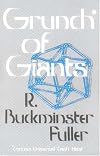
Bucky Fuller, as his fans affectionately call him, sat at a fascinating intersection of techno-utopianism and permaculture (although it didn't go by that name yet). Today, these fields are diametric.
This is the last book Fuller wrote, published the year of his death. It's short, and a bit of a mosaic or hodgepodge, covering ancient history, mathematics, politics, business, and number of other issues. It is part-autobiographical. Fuller believed that we had achieved a level of technological show more development that we would be able to shift from weaponry over to "livingry" over the next 50 years, and that all humans would be able to be sufficiently provisioned. Although he's right in regard to the physical realities of our world, he seems to have underestimated the cultural and financial customs society is unwilling to forgo, meaning that we now have a record number of impoverished people.
In the book, Fuller claims that inflation is due solely to corporate collusion. I've never heard this accusation before (it generally being blamed on the federal reserve), and is likely worth further consideration. At the same time, it seems that he believed in investment, and was suggesting that Social Security be invested in corporate stocks. show less
This is the last book Fuller wrote, published the year of his death. It's short, and a bit of a mosaic or hodgepodge, covering ancient history, mathematics, politics, business, and number of other issues. It is part-autobiographical. Fuller believed that we had achieved a level of technological show more development that we would be able to shift from weaponry over to "livingry" over the next 50 years, and that all humans would be able to be sufficiently provisioned. Although he's right in regard to the physical realities of our world, he seems to have underestimated the cultural and financial customs society is unwilling to forgo, meaning that we now have a record number of impoverished people.
In the book, Fuller claims that inflation is due solely to corporate collusion. I've never heard this accusation before (it generally being blamed on the federal reserve), and is likely worth further consideration. At the same time, it seems that he believed in investment, and was suggesting that Social Security be invested in corporate stocks. show less
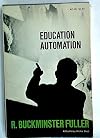
This book was created from the transcript of Buckminster Fuller's presentation to the Southern Illinois University's planning committee in 1961, after being invited as part of a group of experienced professionals called on as consultants for future development of the university.
Reading anything by Fuller can be a heady, almost trippy experience; Fuller was an inventor and innovator whose work was always immersed in his unyielding optimism for mankind's potential and future evolution, and any show more project undertaken by him always pointed towards this Utopian inevitability. Education Automation is no different, as it's main focus is on Fuller's wide-eyed predictions of how education would eventually become the country's (and world's) foremost business venture, with fully-funded advanced (and even lifetime) education to fulfill society's needs as the global labor-based economy gives way to a idea-based economy.
It's easy enough to dismiss some of Fuller's predictions and theories as wishful thinking or delusional prognostication, if for no other reason than the real world's inability - or unwillingness - to follow the trail laid out by him. However, his prescient ability to lay out an archaic version of today's internet, and accurately describe mankind's evolutionary path to the present (complete with historically accurate examples) that leads him to believe in the brightness of it's future, are strokes of genius that cannot be ignored, even if they do feel as if seen through rose-colored glasses.
If you are new to Buckminster Fuller, this is a great introduction to the man's thought process and vision, although even in this slim volume his explanations can be occasionally dense and convoluted. Be prepared to be more depressed than inspired, however, as comparing his hopeful vision of yesterday's tomorrow still bares little resemblance to the unflinching reality of today. show less
Reading anything by Fuller can be a heady, almost trippy experience; Fuller was an inventor and innovator whose work was always immersed in his unyielding optimism for mankind's potential and future evolution, and any show more project undertaken by him always pointed towards this Utopian inevitability. Education Automation is no different, as it's main focus is on Fuller's wide-eyed predictions of how education would eventually become the country's (and world's) foremost business venture, with fully-funded advanced (and even lifetime) education to fulfill society's needs as the global labor-based economy gives way to a idea-based economy.
It's easy enough to dismiss some of Fuller's predictions and theories as wishful thinking or delusional prognostication, if for no other reason than the real world's inability - or unwillingness - to follow the trail laid out by him. However, his prescient ability to lay out an archaic version of today's internet, and accurately describe mankind's evolutionary path to the present (complete with historically accurate examples) that leads him to believe in the brightness of it's future, are strokes of genius that cannot be ignored, even if they do feel as if seen through rose-colored glasses.
If you are new to Buckminster Fuller, this is a great introduction to the man's thought process and vision, although even in this slim volume his explanations can be occasionally dense and convoluted. Be prepared to be more depressed than inspired, however, as comparing his hopeful vision of yesterday's tomorrow still bares little resemblance to the unflinching reality of today. show less

Five stars for what this book is, a short explanation of the philosophy of technical optimism of R. Buckminster Fuller.
However, Fuller writes in a dense style that is sometimes hard to read.
By the way, this is not an operating manual at all, it focuses more on concepts rather than tactics. Spoiler alert - the key is that we work together and stop creating false differences between people (nations, rich and poor, races).
However, Fuller writes in a dense style that is sometimes hard to read.
By the way, this is not an operating manual at all, it focuses more on concepts rather than tactics. Spoiler alert - the key is that we work together and stop creating false differences between people (nations, rich and poor, races).
Lists
Awards

You May Also Like


Associated Authors
Statistics
- Works
- 74
- Also by
- 11
- Members
- 4,422
- Popularity
- #5,664
- Rating
- 3.9
- Reviews
- 37
- ISBNs
- 108
- Languages
- 4
- Favorited
- 19

