
Robert Anton Wilson (1932–2007)
Author of The Illuminatus! Trilogy
About the Author
Novelist, Teacher and Former Playboy Editor Robert Anton Wilson
Series
Works by Robert Anton Wilson
Right Where You Are Sitting Now: Further Tales of the Illuminati (Visions Series) (1982) 320 copies, 4 reviews
Ishtar Rising: Or, Why the Goddess Went to Hell and What to Expect Now That She's Returning (1974) 207 copies, 3 reviews
Robert Anton Wilson Explains Everything: (or Old Bob Exposes His Ignorance) (2001) 87 copies, 2 reviews
Natural Law, Or Don't Put A Rubber On Your Willy And Other Writings From A Natural Outlaw (2021) 8 copies
Psihologija evoljutsii : kak pereprogrammirovat sebja na dostizenije svobody i bessmertija (1998) 2 copies
Cosmic Trigger: Final Secret of the Illuminati: Down to Earth v. 2 of Robert Anton Wilson 2nd (second) Revised Edition on 01 January 1991 (2007) 2 copies
Cosmic Trigger Trilogy 1 copy
Schrodingers Cat Trilogy 1 copy
Schrödinger's cat trilogy 1 copy
The Horror on Howth Hill 1 copy
Evading Dogmatic Medicine 1 copy
Anarchism and Crime 1 copy
Associated Works
The Eye in the Triangle: An Interpretation of Aleister Crowley (1970) — Introduction, some editions — 307 copies, 3 reviews
Three-fisted Tales of "Bob": Short Stories in the Subgenius Mythos (1990) — Contributor — 188 copies, 1 review
Conversations on the Edge of the Apocalypse: Contemplating the Future with Noam Chomsky, George Carlin, Deepak Chopra, Rupert Sheldrake, and Others (2005) — Contributor — 75 copies
Green Egg Omelette: An Anthology of Art and Articles from the Legendary Pagan Journal (2009) — Contributor — 67 copies
Historia discordia : the origins of the Discordian Society (2014) — Introduction — 50 copies, 1 review
Gnostica: New of the Aquarian Frontier, Vol. 4 #3, Whole Number 27, November 1974 (1974) — Contributor — 3 copies
Gnostica: a Practical Guide to the Magick Within You, Vol. 5 #2, Whole Number 38 (1976) — Contributor — 2 copies
Gnostica: a Practical Guide to the Magick Within You, Vol. 5#3, Whole Number 39 (1976) — Contributor — 2 copies
Fortean Times 68 — Contributor — 2 copies
Fortean Times 58 — Contributor — 2 copies
Gnostica News, Volumes 1 & 2 — Contributor — 1 copy
Tagged
Common Knowledge
- Other names
- Wilson, Robert Edward (birth name)
- Birthdate
- 1932-01-18
- Date of death
- 2007-01-11
- Gender
- male
- Education
- New York University
Paideia University - Occupations
- writer
futurist - Organizations
- Association for Consciousness Exploration
Church of the SubGenius
Fully Informed Jury Association
Guns and Dope Party (founder)
Institute for the Study of Human Future (founder)
Maybe Logic Academy (show all 7)
Starflight Network (founder) - Awards and honors
- Prometheus Hall of Fame Award (Illuminatus! trilogy, 1986)
- Nationality
- USA
- Birthplace
- New York, New York, USA
- Places of residence
- Santa Cruz, California, USA
- Place of death
- Capitola, California, USA
- Associated Place (for map)
- California, USA
Members
Discussions
Infinitely wiggly in Good Show Sir! — bad science fiction and fantasy covers (August 2025)
Shirts vs Skins... in Good Show Sir! — bad science fiction and fantasy covers (July 2025)
Reviews

A conspiracy satire. I thought at first it might be a direct retelling of Call of Cthulhu which it isn't... but the Lovecraft influence is strong and not hidden, the necronomicon and lovecraft both appear in the tale but so does everyone else, machen, chambers, james bond, 20,000 leagues and many other things get referenced.
Knowledge of 70's america, the hippies, beats, riots etc all useful as might be watching the Public Enemies movie.
It never takes itself too seriously there's even a show more couple of reviews of the book in the book complaining about how terrible it is :) , the sections on conspiracy theories and numerology can be boring but again they feel like they are intended to annoy.
The best (and for some people, worse) thing about the book is its structure. You know the way some novels have this floaty omniscient narrator, well this story goes one step farther as all the characters are sort of connected on some psychic level and you follow the connection from place to place.
So you might have 5 different characters in different times and places doing different things all within a single paragraph. Or you might have Bleed. You'll be following two detectives in new york while you keep hearing a chant of We Will Not Be Moved, without knowing where its coming from, until the scene suddenly switches and you find yourself at a peace rally 3 years earlier. To make things even odder sometimes the characters themselves start hearing or seeing whats happening to each other.
Its all delightfully chaotic and i don't know whether its to my credit or shame that after a while most of starting making sense :P . If it was a complete story i think it would be five stars. Confusing, witty, filthy, non-pc with some lovecraftian elements and a porpoise named Howard whats not to like :) . show less
Knowledge of 70's america, the hippies, beats, riots etc all useful as might be watching the Public Enemies movie.
It never takes itself too seriously there's even a show more couple of reviews of the book in the book complaining about how terrible it is :) , the sections on conspiracy theories and numerology can be boring but again they feel like they are intended to annoy.
The best (and for some people, worse) thing about the book is its structure. You know the way some novels have this floaty omniscient narrator, well this story goes one step farther as all the characters are sort of connected on some psychic level and you follow the connection from place to place.
So you might have 5 different characters in different times and places doing different things all within a single paragraph. Or you might have Bleed. You'll be following two detectives in new york while you keep hearing a chant of We Will Not Be Moved, without knowing where its coming from, until the scene suddenly switches and you find yourself at a peace rally 3 years earlier. To make things even odder sometimes the characters themselves start hearing or seeing whats happening to each other.
Its all delightfully chaotic and i don't know whether its to my credit or shame that after a while most of starting making sense :P . If it was a complete story i think it would be five stars. Confusing, witty, filthy, non-pc with some lovecraftian elements and a porpoise named Howard whats not to like :) . show less

Masks of the Illuminati reads like a dark smart mystery -- a mystery penned by the combined and competing voices of James Joyce, Carl Jung, Albert Einstein, and perhaps, somehow narrated by (maybe astral projected by), above and beyond and throughout the sleuthing dueling clamor of its voices, the likes of a Tom Robbins. Which is to say the novel is zany and brainy.
That Robert Anton Wilson (RAW) could make so many disparate historical icons sound humorously real on the page is mystifying. show more Did he journey back in time and tape record them? That he could accomplish such a chameleon's feat without sinking toward what could've been easy-cheesy parody for writers gifted with lesser wit and talent than he, is a minor miracle. That he could meld so many writer's voices, styles, syntax, biographies, world views (whether faux or fact) and have enough creative chutzpah left to make the farfetched narrative, in its entirety, coalesce into a plot that's wild yet cogent, always compelling, tells me he could've conceptualized launching a land rover to Mars and then nailed its impossible landing. With his eyes closed. He's that good. The ferocity of RAWs imagination is matched only by its enormity. He takes complex ideas and compacts them into memorably whimsical truisms, such as "The Clue of the Quadrilateral Metaphor". Don't expect me to explain it. Would take too long. And while I'm no freemason myself (though if I was I'd confess I wasn't), whether or not RAW invented such opaque phraseology as that quoted above, or confabulated it, perhaps borrowed it verbatim from some cabalistic creed, I certainly can't tell. Not that my ignorance matters amongst such potential world-takeover-intrigue. Does anyone fully fathom the intentional obfuscation Umberto Eco encrypted within the first 100 pages of The Name of the Rose?
Regardless of any conspiracies, real or imagined, within or without the text of this ambitious novel, Masks of the Illuminati possesses that tastefully twisted, almost absurdly baroque ambiance about it, I so admire in freakish novels, in books that steadfastly refuse being altered in order to more easily fit inside some stock genre trope's predictable molds. Masks of the Illuminati isn't baroque due to some contrived technical gimmicks or preciously ornate structure to the novel, but because of its technical and ornate details regarding the occult; because of its massive and elaborate manner of communicating its esoteric systems of learning concisely, in clear and what seems like geometric harmony.
Envision that ancient merry prankster, Rabelais himself, having authored The Secret Teachings of All Ages, rather than the dry but ultra erudite, Manly P. Hall -- could serve as my nutshell review of Masks of the Illuminati. Though it would've been a less crass Rabelais, devoid of some, but not all, of his signature scatology ad nauseam, and you're getting a closer approximation, somewhat, of both Masks of the Illuminati's style and content. But don't think for a second by "less crass" that I mean Masks of the Illuminati isn't ribald and erotic -- for it assuredly is -- it just doesn't go over the top with it or experiment with language to quite the extremely opulent degree as Rabelais. But it's as comic, as Monty Pythonesque in its abundant and solemn tomfoolery. Conversely, it's as flip with the gravitas it gives its philosophical, psychological, and metaphysical foundation -- its idées fixes -- as it is with its compendium of arcana that anchors the vaulted mysticism hovering inside it; inside what RAW referred to as a "Dark Tower" or "Chapel Perilous." Paradox might as well be the exposed arches supporting the hilarious yet serious heights of this outstanding oddity of peculiar prose.
Despite its sometimes silliness, its deadpan self deprecation, the novel still retains enough of a subversive yet scholarly acumen concerning its paranormal precepts to make a Fox Mulder proud! Fans of Arthur Machen, Willy's Blake, Shakespeare, and Yeats, and particularly Aleister Crowley, should enjoy reading some delicious and decidedly occult takes on the lives of these writers and their works. Important to note, too, is that RAWs strange universe is populated mostly by mystic practitioners who prefer what's vague to what's concrete, which means readers seeking RAWs opinion or personal definition of whatever "occult canonicity" might mean, won't find any such orthodoxy here. For the heart and home of RAWs Illuminati; the pulsating abode for those few intrepid initiates on the painstakingly narrow path leading to "enlightenment" (a narrow path indeed, requiring two years of celibacy, including celibacy while in solitude!); that narrow path for those, moreover, who've willingly concealed their membership from every other member of their order so that they all remain essentially "invisible" to one another, camouflaged behind the "blindness" of their figurative "masks," beats to its own relative rhythms within the confines of each individual's personalized gnosticism.
Abandoning themselves behind their "masks," RAWs gnostics have removed their condescending pride (i.e., their "transcendental egotism") from their minds as if it were a parasite; the damnable parasite of self delusional pride, exemplified by the divisive and derogatory attitude that can childishly boast, "my Illumination is higher than your Illumination," so nanner-nanner. What sickening spiritual hubris! Left unchecked, that false sense of superiority in the novice makes him promptly powerless and unenlightened, thoroughly indistinguishable, for that matter, from the repugnant belligerent blathering of an unteachable and fanatic denominationalist bore. RAWs characters wear an interesting multitude of "masks" to say the least. We all wear masks, of course, but not masks like these.
Add magick, "constant suicides," and even that legendary, aquatic brontosaurus-like beast haunting Loch Ness to this surprisingly literary mix, and you've almost grasped what Masks of the Illuminati is. It's high-caliber literature for sure; a multiple-genre-bending Anomaly of Awesomeness to its convoluted core! Vainglorious marvel of a novel as treacherous to precisely peg as the elusive identities of its myriad denizens with their incantatory visions inspired by the secret society it depicts. Who can foil the cosmic conspiracy of an ancient order whose long lineage of mysterious membership can hide in a plain sight that's synonymous with invisibility? Could Sir John Babcock, our haunted, possibly hallucinating hero, be the right man...? show less
That Robert Anton Wilson (RAW) could make so many disparate historical icons sound humorously real on the page is mystifying. show more Did he journey back in time and tape record them? That he could accomplish such a chameleon's feat without sinking toward what could've been easy-cheesy parody for writers gifted with lesser wit and talent than he, is a minor miracle. That he could meld so many writer's voices, styles, syntax, biographies, world views (whether faux or fact) and have enough creative chutzpah left to make the farfetched narrative, in its entirety, coalesce into a plot that's wild yet cogent, always compelling, tells me he could've conceptualized launching a land rover to Mars and then nailed its impossible landing. With his eyes closed. He's that good. The ferocity of RAWs imagination is matched only by its enormity. He takes complex ideas and compacts them into memorably whimsical truisms, such as "The Clue of the Quadrilateral Metaphor". Don't expect me to explain it. Would take too long. And while I'm no freemason myself (though if I was I'd confess I wasn't), whether or not RAW invented such opaque phraseology as that quoted above, or confabulated it, perhaps borrowed it verbatim from some cabalistic creed, I certainly can't tell. Not that my ignorance matters amongst such potential world-takeover-intrigue. Does anyone fully fathom the intentional obfuscation Umberto Eco encrypted within the first 100 pages of The Name of the Rose?
Regardless of any conspiracies, real or imagined, within or without the text of this ambitious novel, Masks of the Illuminati possesses that tastefully twisted, almost absurdly baroque ambiance about it, I so admire in freakish novels, in books that steadfastly refuse being altered in order to more easily fit inside some stock genre trope's predictable molds. Masks of the Illuminati isn't baroque due to some contrived technical gimmicks or preciously ornate structure to the novel, but because of its technical and ornate details regarding the occult; because of its massive and elaborate manner of communicating its esoteric systems of learning concisely, in clear and what seems like geometric harmony.
Envision that ancient merry prankster, Rabelais himself, having authored The Secret Teachings of All Ages, rather than the dry but ultra erudite, Manly P. Hall -- could serve as my nutshell review of Masks of the Illuminati. Though it would've been a less crass Rabelais, devoid of some, but not all, of his signature scatology ad nauseam, and you're getting a closer approximation, somewhat, of both Masks of the Illuminati's style and content. But don't think for a second by "less crass" that I mean Masks of the Illuminati isn't ribald and erotic -- for it assuredly is -- it just doesn't go over the top with it or experiment with language to quite the extremely opulent degree as Rabelais. But it's as comic, as Monty Pythonesque in its abundant and solemn tomfoolery. Conversely, it's as flip with the gravitas it gives its philosophical, psychological, and metaphysical foundation -- its idées fixes -- as it is with its compendium of arcana that anchors the vaulted mysticism hovering inside it; inside what RAW referred to as a "Dark Tower" or "Chapel Perilous." Paradox might as well be the exposed arches supporting the hilarious yet serious heights of this outstanding oddity of peculiar prose.
Despite its sometimes silliness, its deadpan self deprecation, the novel still retains enough of a subversive yet scholarly acumen concerning its paranormal precepts to make a Fox Mulder proud! Fans of Arthur Machen, Willy's Blake, Shakespeare, and Yeats, and particularly Aleister Crowley, should enjoy reading some delicious and decidedly occult takes on the lives of these writers and their works. Important to note, too, is that RAWs strange universe is populated mostly by mystic practitioners who prefer what's vague to what's concrete, which means readers seeking RAWs opinion or personal definition of whatever "occult canonicity" might mean, won't find any such orthodoxy here. For the heart and home of RAWs Illuminati; the pulsating abode for those few intrepid initiates on the painstakingly narrow path leading to "enlightenment" (a narrow path indeed, requiring two years of celibacy, including celibacy while in solitude!); that narrow path for those, moreover, who've willingly concealed their membership from every other member of their order so that they all remain essentially "invisible" to one another, camouflaged behind the "blindness" of their figurative "masks," beats to its own relative rhythms within the confines of each individual's personalized gnosticism.
Abandoning themselves behind their "masks," RAWs gnostics have removed their condescending pride (i.e., their "transcendental egotism") from their minds as if it were a parasite; the damnable parasite of self delusional pride, exemplified by the divisive and derogatory attitude that can childishly boast, "my Illumination is higher than your Illumination," so nanner-nanner. What sickening spiritual hubris! Left unchecked, that false sense of superiority in the novice makes him promptly powerless and unenlightened, thoroughly indistinguishable, for that matter, from the repugnant belligerent blathering of an unteachable and fanatic denominationalist bore. RAWs characters wear an interesting multitude of "masks" to say the least. We all wear masks, of course, but not masks like these.
Add magick, "constant suicides," and even that legendary, aquatic brontosaurus-like beast haunting Loch Ness to this surprisingly literary mix, and you've almost grasped what Masks of the Illuminati is. It's high-caliber literature for sure; a multiple-genre-bending Anomaly of Awesomeness to its convoluted core! Vainglorious marvel of a novel as treacherous to precisely peg as the elusive identities of its myriad denizens with their incantatory visions inspired by the secret society it depicts. Who can foil the cosmic conspiracy of an ancient order whose long lineage of mysterious membership can hide in a plain sight that's synonymous with invisibility? Could Sir John Babcock, our haunted, possibly hallucinating hero, be the right man...? show less

With a quarter of the book being appendices and the characters realizing they're in a book this is where this series goes from metafiction into a winking declaration of Truth, or maybe fiction that might as well be fact. If you come into it expecting a conclusion that would make sense of the nonsense you've spent 600 pages trying to decipher you will be disappointed. Much like a koan, the book isn't supposed to make sense on the surface level, it's supposed to make sense to you, in a flash show more of enlightenment. Or illumination. show less
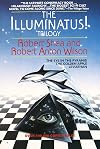
[This review is dedicated to the anarchist and occasional friend Steve Ash who sadly died last year. This book meant a great deal to him.]
Wrongly sold as science fiction, this is an anarcho-libertarian bit of mischief mashing up some serious indirect philosophy and psychology with popular cultural memes, conspiracy theory, erotica, the occult and a lot of dated political satire.
It is so deliberately occult in places as to become occasionally (and ironically) a bit pompous, much like its show more 'hero' Hagbard Celine, the Captain Nemo of the story. The satire is somewhat jaded and the three novels taken together are too long and sometimes over-written.
But, having said this, the book is mostly a great deal of fun and, once you get used to the technique of having apparently disconnected tales flow into each other without any clear sign that the narrator has changed, easy enough to get through.
It is a classic text because it introduced into popular culture an entire alternative way of thinking about the world which, though sometimes as absurd as the 'morning of the magicians', is genuinely liberatory and, ultimately, 'true' or 'as true' as anything else.
We have to remember the time when it was written - the depressingly reactionary period in early 1970s America that emerged in response to the counter-cultural liberatory aspects of the 1960s.
Yes, the 1960s were an era of unorganised narcissism whose final result was Hillary Clinton but, in that specific context, Shea and Anton Wilson provide us with a cogent popular explanation of why anarchic narcissism may be the only appropriate response to authority.
The themes in these book - Lovecraftian, erotic, science fiction, conspiracy, new age - have, for better or worse, embedded themselves in the minds of those who will not accept that state authority is anything other than oppressive.
In this respect, the seeds laid by Shea and Anton Wilson in the 1970s act as counterpoint to those laid by Saul Alinsky, as alternative democratic sub-socialist and anarchic sub-libertarian responses to Leviathan, the State - or rather to Man's determination to submit.
The dominant model of political organisation in relation to the American State on the American Left is a sort of 'femininised' or beta male baring of the arse in order to be buggered in the hope that eventually the old beast will die and the buggered beast will inherit.
The anarcho-libertarian model seems to abandon all notions of Right or Left (which confuses the traditionalists of the Left) and laud the trickster, freethinker, pirate and even criminal against the very notion of order.
It is a view of human nature as good in the very end - or at least as less bad than when it is in under orders. The politics may be questionable but the psychological and philosophical insights are less so, even if presented in quasi-Zen parables and obfuscatory occultism.
The Trilogy (and the 'serious' Appendices, with no more 'truth' in them than any other part of the books) offers us versions of a number of theories questioning the reality that we create out of our sense perceptions and, in particular, social reality.
This questioning of social reality will last far longer than the political satire and the book's somewhat stock appropriation of cultural memes, such as Lovecraftian monsters and Nazis waiting to rise to make blood sacrifices to 'immanentize the eschaton'.
The book is justified by its bringing these thoughts about social reality subliminally to thousands of young people in every generation although, sadly, for every one who gets it, ten or a hundred will not and cease to be as functional in their own interest as they might.
Many observers have not noted that, as a book of constant paradox, the Trilogy, with its twists and turns has inherent fascistic aspects too - the elite eroticism, the leadership principle underpinning Hagbard, the cyclical views of history, the appropriation of traditionalism.
There is also implicit in the vision a disturbing sense of history as elites manipulating masses but without any real outrage being expressed - the Discordians seem simply to wish to play in the game on equal terms, disrupting the forces of order to restore 'balance'.
In this world view, there is still a hierarchical view of humanity. The masses could have their eyes open, and the Discordians devoutly wish that this would happen, yet a deep conservative pessimism in the game players leads them to accept that it will not.
The clever trick played in the book is that the naive reader who thinks he has 'got it' is really being manipulated into the false belief that, because he has 'got it', he is now part of the same elite that gave 'it' to him. He is not. The authors warn but not directly.
Look hard and there is a paragraph in the Appendices where an argument for human sacrifice of a most primitive type is made too plausible to be ironical, a nod perhaps to Evola, yet contrasted with horror at the mass immolations of war and that 1970s preoccupation, the Holocaust.
This is where the 1960s Generation can be seen to be bifurcating into an authoritarian and ideological optimism on the one side and a tendency to inverted rage and pessimism. The slave now adopts guerrilla tactics to undermine what cannot be destroyed frontally.
Magick and the occult in particular are the tools of the frustrated and the outsider and this book is heavily imbued with magical thinking.
Contemporary anarchism, Goth culture, popular horror, fantasy and the occult are now very much combined as a model for libertarian resistance to Leviathan - and the fantastic aspects do not stop police raids even today on those who withdraw from the system and wear black.
Culturally this is an important book, a tour de force in terms of its organisation of literary references and even plot. Its weaknesses are those of its time and we can only understand it by referring back to that time.
Beyond the politics, the book must be marked out as a text that introduced radically new ways of thinking to a mass audience - even if its subtleties have bypassed and will bypass those who read the New York Times and the Guardian and think they represent reality.
Related Review
https://www.goodreads.com/book/show/6146412-grimoires - the history of magical grimoires and their use as forms of resistance show less
Wrongly sold as science fiction, this is an anarcho-libertarian bit of mischief mashing up some serious indirect philosophy and psychology with popular cultural memes, conspiracy theory, erotica, the occult and a lot of dated political satire.
It is so deliberately occult in places as to become occasionally (and ironically) a bit pompous, much like its show more 'hero' Hagbard Celine, the Captain Nemo of the story. The satire is somewhat jaded and the three novels taken together are too long and sometimes over-written.
But, having said this, the book is mostly a great deal of fun and, once you get used to the technique of having apparently disconnected tales flow into each other without any clear sign that the narrator has changed, easy enough to get through.
It is a classic text because it introduced into popular culture an entire alternative way of thinking about the world which, though sometimes as absurd as the 'morning of the magicians', is genuinely liberatory and, ultimately, 'true' or 'as true' as anything else.
We have to remember the time when it was written - the depressingly reactionary period in early 1970s America that emerged in response to the counter-cultural liberatory aspects of the 1960s.
Yes, the 1960s were an era of unorganised narcissism whose final result was Hillary Clinton but, in that specific context, Shea and Anton Wilson provide us with a cogent popular explanation of why anarchic narcissism may be the only appropriate response to authority.
The themes in these book - Lovecraftian, erotic, science fiction, conspiracy, new age - have, for better or worse, embedded themselves in the minds of those who will not accept that state authority is anything other than oppressive.
In this respect, the seeds laid by Shea and Anton Wilson in the 1970s act as counterpoint to those laid by Saul Alinsky, as alternative democratic sub-socialist and anarchic sub-libertarian responses to Leviathan, the State - or rather to Man's determination to submit.
The dominant model of political organisation in relation to the American State on the American Left is a sort of 'femininised' or beta male baring of the arse in order to be buggered in the hope that eventually the old beast will die and the buggered beast will inherit.
The anarcho-libertarian model seems to abandon all notions of Right or Left (which confuses the traditionalists of the Left) and laud the trickster, freethinker, pirate and even criminal against the very notion of order.
It is a view of human nature as good in the very end - or at least as less bad than when it is in under orders. The politics may be questionable but the psychological and philosophical insights are less so, even if presented in quasi-Zen parables and obfuscatory occultism.
The Trilogy (and the 'serious' Appendices, with no more 'truth' in them than any other part of the books) offers us versions of a number of theories questioning the reality that we create out of our sense perceptions and, in particular, social reality.
This questioning of social reality will last far longer than the political satire and the book's somewhat stock appropriation of cultural memes, such as Lovecraftian monsters and Nazis waiting to rise to make blood sacrifices to 'immanentize the eschaton'.
The book is justified by its bringing these thoughts about social reality subliminally to thousands of young people in every generation although, sadly, for every one who gets it, ten or a hundred will not and cease to be as functional in their own interest as they might.
Many observers have not noted that, as a book of constant paradox, the Trilogy, with its twists and turns has inherent fascistic aspects too - the elite eroticism, the leadership principle underpinning Hagbard, the cyclical views of history, the appropriation of traditionalism.
There is also implicit in the vision a disturbing sense of history as elites manipulating masses but without any real outrage being expressed - the Discordians seem simply to wish to play in the game on equal terms, disrupting the forces of order to restore 'balance'.
In this world view, there is still a hierarchical view of humanity. The masses could have their eyes open, and the Discordians devoutly wish that this would happen, yet a deep conservative pessimism in the game players leads them to accept that it will not.
The clever trick played in the book is that the naive reader who thinks he has 'got it' is really being manipulated into the false belief that, because he has 'got it', he is now part of the same elite that gave 'it' to him. He is not. The authors warn but not directly.
Look hard and there is a paragraph in the Appendices where an argument for human sacrifice of a most primitive type is made too plausible to be ironical, a nod perhaps to Evola, yet contrasted with horror at the mass immolations of war and that 1970s preoccupation, the Holocaust.
This is where the 1960s Generation can be seen to be bifurcating into an authoritarian and ideological optimism on the one side and a tendency to inverted rage and pessimism. The slave now adopts guerrilla tactics to undermine what cannot be destroyed frontally.
Magick and the occult in particular are the tools of the frustrated and the outsider and this book is heavily imbued with magical thinking.
Contemporary anarchism, Goth culture, popular horror, fantasy and the occult are now very much combined as a model for libertarian resistance to Leviathan - and the fantastic aspects do not stop police raids even today on those who withdraw from the system and wear black.
Culturally this is an important book, a tour de force in terms of its organisation of literary references and even plot. Its weaknesses are those of its time and we can only understand it by referring back to that time.
Beyond the politics, the book must be marked out as a text that introduced radically new ways of thinking to a mass audience - even if its subtleties have bypassed and will bypass those who read the New York Times and the Guardian and think they represent reality.
Related Review
https://www.goodreads.com/book/show/6146412-grimoires - the history of magical grimoires and their use as forms of resistance show less
Lists
Awards


You May Also Like


Associated Authors
Statistics
- Works
- 83
- Also by
- 22
- Members
- 21,335
- Popularity
- #1,015
- Rating
- 3.9
- Reviews
- 223
- ISBNs
- 258
- Languages
- 15
- Favorited
- 121


