
Roger Shattuck (1923–2005)
Author of Forbidden knowledge: from Prometheus to pornography
About the Author
Roger Shattuck taught for many years at Boston University and now resides in Vermont. He is the author, most recently, of "Candor & Perversion". (Bowker Author Biography)
Works by Roger Shattuck
The Banquet Years: The Origins of the Avant-Garde in France - 1885 to World War I (1958) 494 copies, 3 reviews
Henri Rousseau: [cat. exp., Galeries nationales du Grand Palais, Paris, 14 septembre 1984-7 janvier 1985, Museum of Modern Art, New York, 5 fevrier-4 juin 1985] (1984) 107 copies, 3 reviews
Proust's Binoculars: A Study of Memory, Time and Recognition in À la recherche du temps perdu (1964) 53 copies, 1 review
Henri Rousseau 21 copies
Half tame, poems 2 copies
Selected Works of Alfred Jarry — Editor — 1 copy
Associated Works
Tagged
Common Knowledge
- Canonical name
- Shattuck, Roger
- Legal name
- Shattuck, Roger Whitney
- Birthdate
- 1923-08-20
- Date of death
- 2005-12-08
- Gender
- male
- Education
- St. Paul's School, Concord, New Hampshire, USA
Yale College (BA|1947) - Occupations
- professor
author
cargo pilot - Organizations
- UNESCO
Association of Literary Scholars and Critics (Founding Member and President)
U.S. Army Air Corps (WWII)
University of Texas
University of Virginia
Boston University - Awards and honors
- American Academy of Arts and Letters Academy Award (1987)
Honorary Doctorate (University of Orleans)
Fellow, American Academy of Arts and Letters (1990)
National Book Award (1975) - Relationships
- White, Nora (wife)
- Nationality
- USA
- Birthplace
- Manhattan, New York, New York, USA
- Places of residence
- New York, New York, USA
Hartford, Connecticut, USA
Cambridge, Massachusetts, USA
Paris, Île-de-France, France
Richmond, Virginia, USA
Austin, Texas, USA (show all 7)
Boston, Massachusetts, USA - Place of death
- Lincoln, Vermont, USA
- Associated Place (for map)
- USA
Members
Reviews
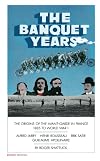
This is an outstandingly good work on the immediate origins of early 20th-century artistic movements/. A chapter of biography of one of the four figures--Rousseau le Douanier, Satie, Apollinaire, Jarry-- is followed by an evaluation of his work, but the book is so smoothly written that one scarcely notices the scheme of it.The lives are of course rivetingly interesting. Shattuck conveys the pathos in each one depressingly well but his joy in their works almost dispels the melancholy show more strain.
Despite its being a serious study the book is far from dry, and there's a good balance between the evocative and the informative. I only wish I had read this as a teenager, before I began to delve into writings and art of the following decades; I would have been spared a good deal of puzzlement. And if ever you've failed to 'get' early 20th-century art, the last two chapters in particular are an excellent introduction. show less
Despite its being a serious study the book is far from dry, and there's a good balance between the evocative and the informative. I only wish I had read this as a teenager, before I began to delve into writings and art of the following decades; I would have been spared a good deal of puzzlement. And if ever you've failed to 'get' early 20th-century art, the last two chapters in particular are an excellent introduction. show less
Biographies of Alfred Jarry, Henri Rousseau, Erik Satie, & Guillaume Apollinaire - all creative people in Paris active from 1885 to 'WWI'. I LOVED this bk. I had just turned 22 when I read it. I was substantially familiar w/ all the characters & was engrossed by them. Satie & Jarry were both esp important to me. Rousseau & Apollinaire not so much so but still of interest. Shattuck clearly knows & loves the subject & writes about it well. The intertwining of these personalities creates a show more meta-personality for Parisian culture that's god-like in its crazed creativity.
Shattuck does a great job of establishing the lasting significance of these people. It's reassuring to know that even the most obscure person can have a long-term impact just b/c of what keeps them in obscurity while they're alive: their full-blown 'inaccessible' inventiveness.
If someone were to pick 4 such people in Pittsburgh (or any other city) now, who wd they pick? I'd like to read a bk that gradually expands out from "The Banquet Years" - these 4, then 12 more, then 16 to the 16th - eventually describing in detail everyone alive in the city during those 3 decades. Is that too much to ask? show less
Shattuck does a great job of establishing the lasting significance of these people. It's reassuring to know that even the most obscure person can have a long-term impact just b/c of what keeps them in obscurity while they're alive: their full-blown 'inaccessible' inventiveness.
If someone were to pick 4 such people in Pittsburgh (or any other city) now, who wd they pick? I'd like to read a bk that gradually expands out from "The Banquet Years" - these 4, then 12 more, then 16 to the 16th - eventually describing in detail everyone alive in the city during those 3 decades. Is that too much to ask? show less
Proust's Way - a Field Guide to "the Search for Lost Time": A Field Guide to in Search of Lost Time by Roger Shattuck
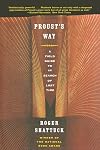
A close friend just started Proust for the first time, which excited me so much that I wanted to reading group it with him. But I don't have time, so I read this instead. Not as good as Proust! Surprise, surprise.
It suffers a bit from being two books, one for people who haven't read the Search yet, and one for people who have. The one for newcomers is a better book, being an actual book. The book for veterans is less good, because it's just a bunch of stuff Shattuck has written over the show more years. But if you've read Proust and want an intelligent man's understanding of the thing, this is enjoyable enough. Shattuck suggests that the book is about desire as much as it is memory; human beings fail to understand their own desires, which leads to suffering. A new vision of life (literary critics always end up with these wild generalities: why can't a book be about society and art? Why do they have to be about 'life' and 'love'?) follows.
More helpful was Shattuck's take on the 'memory' theme; he understands Search less as an investigation of memory than as showing how an objective observer can combine a vision of memory and the present to better understand the past and the future. I think. He also stands against the aestheticist view that the novel holds art up as superior to life. A worthy argument, for all its generality.
There are also completely unrelated bits on translation, editions, and an almost unbearable 'creative response' to the novel.
If you love Proust, this is worth reading; if you're about to read Proust, half of it is worth reading; if you've read Proust and might not read him again, this won't change your mind, and you should avoid it, because you should absolutely read Proust again. show less
It suffers a bit from being two books, one for people who haven't read the Search yet, and one for people who have. The one for newcomers is a better book, being an actual book. The book for veterans is less good, because it's just a bunch of stuff Shattuck has written over the show more years. But if you've read Proust and want an intelligent man's understanding of the thing, this is enjoyable enough. Shattuck suggests that the book is about desire as much as it is memory; human beings fail to understand their own desires, which leads to suffering. A new vision of life (literary critics always end up with these wild generalities: why can't a book be about society and art? Why do they have to be about 'life' and 'love'?) follows.
More helpful was Shattuck's take on the 'memory' theme; he understands Search less as an investigation of memory than as showing how an objective observer can combine a vision of memory and the present to better understand the past and the future. I think. He also stands against the aestheticist view that the novel holds art up as superior to life. A worthy argument, for all its generality.
There are also completely unrelated bits on translation, editions, and an almost unbearable 'creative response' to the novel.
If you love Proust, this is worth reading; if you're about to read Proust, half of it is worth reading; if you've read Proust and might not read him again, this won't change your mind, and you should avoid it, because you should absolutely read Proust again. show less
Roger Shattuck has provided readers of Proust's masterpiece with an invaluable guide and analytical touchstone for thinking through what we're reading. I found especially powerful the concept of a stereo-optic presentation of time for the way Proust presents remembering, recognition, memories and experiences. Having now read Shattuck's book, I can't imagine reading Proust without it and am glad to be so well prepared as I head into the next volumes.
Lists
Awards


You May Also Like


Associated Authors
Statistics
- Works
- 16
- Also by
- 9
- Members
- 2,571
- Popularity
- #9,989
- Rating
- 3.8
- Reviews
- 19
- ISBNs
- 52
- Languages
- 8
- Favorited
- 3