
Susie Dent
Author of Guilty by Definition
About the Author
Susie Dent is an editor and translator. She appears regularly on the TV word game Countdown in the UK
Image credit: Susie Dent
Series
Works by Susie Dent
Death Writ Large 2 copies
Tagged
Common Knowledge
- Other names
- Atkins, Susie
- Birthdate
- 1964-09-21
- Gender
- female
- Education
- University of Oxford (Somerville College) (BA) (Modern Languages)
Princeton University (MA) (German) - Occupations
- lexicographer
- Organizations
- Oxford University Press
- Nationality
- UK
- Birthplace
- Woking, Surrey, England, UK
- Associated Place (for map)
- England, UK
Members
Reviews
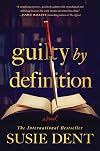
The story centers around a particular group of lexicographers associated with the production of the Clarendon English Dictionary (a thinly veiled renaming of the OED). There are four colleagues in the unit – Simon, Safiya, Alix and Martha. While everyone has their day-to-day challenges, Martha is the one most haunted by past events. Her sister – who had also worked for the Dictionary – disappeared some fifteen years prior and the family has never achieved any kind of closure around the show more event. Now there are cryptic anonymous letters arriving in the post that suggest that work on the case of Martha’s sister needs to be revived. All of the colleagues must be involved.
I was surprised by this book. I had no idea that the author, who has written numerous non-fiction books about British vocabulary and its origins, would be quite so skilled in developing her fictional narrative. Plot twists arrive at interesting points. Descriptions of Oxford (both present and past) establish the setting. Each of the characters is provided with a different voice. (There’s no confusion as to which is which.) Along the way, one is introduced to nuances of unfamiliar terminology. As an example, He turned toward her and offered a smile that was finely balanced between apology and sadness. Contristation, Martha thought, processing the emotions the only way she knew how.
The book flows along so well that when the final resolution is presented, tying up all the unanswered questions, the reader is caught off-guard. (Dent could likely phrase that sentence more elegantly than I am able to manage; the woman has a way with words.) show less
I was surprised by this book. I had no idea that the author, who has written numerous non-fiction books about British vocabulary and its origins, would be quite so skilled in developing her fictional narrative. Plot twists arrive at interesting points. Descriptions of Oxford (both present and past) establish the setting. Each of the characters is provided with a different voice. (There’s no confusion as to which is which.) Along the way, one is introduced to nuances of unfamiliar terminology. As an example, He turned toward her and offered a smile that was finely balanced between apology and sadness. Contristation, Martha thought, processing the emotions the only way she knew how.
The book flows along so well that when the final resolution is presented, tying up all the unanswered questions, the reader is caught off-guard. (Dent could likely phrase that sentence more elegantly than I am able to manage; the woman has a way with words.) show less

A captivating read: the writing style made the scenery and characters deeply vivid. While the lexicography workings were very much a fascinating aspect of the story, I couldn't easily interpret the chapter headings as related to the plot. This wasn't a negative for me, however. I thoroughly enjoyed the genre ~ a 'Linguistic Mystery' ~ my first of this sort of story.
The author's characterizations were delightfully idiosyncratic with never a cardboard, two dimensional feel to the people in show more this complex narrative. While it became evident to me at some point who the real culprit was regarding the sought-afterlost book which was related to the missing sister (Charlie), this realization didn't ruin the story. Some final reveals caught me by surprise, though.
Like some other reviewers, I am not a fan of the wrap up "confessions by the villain" development . Some of the final explanations at the end of the last chapter could well have been adroitly hinted at more strongly well before this dénouement. Despite these caveats, Susie Dent's novel is a warm-hearted win for me especially in terms of the 3 main characters (Martha, Alex, and Safi). Something about these women appealed to me so very much. This prompted my 4½-star rating. show less
The author's characterizations were delightfully idiosyncratic with never a cardboard, two dimensional feel to the people in show more this complex narrative. While it became evident to me at some point who the real culprit was regarding the sought-after
Like some other reviewers, I am not a fan of the wrap up "confessions by the villain" development . Some of the final explanations at the end of the last chapter could well have been adroitly hinted at more strongly well before this dénouement. Despite these caveats, Susie Dent's novel is a warm-hearted win for me especially in terms of the 3 main characters (Martha, Alex, and Safi). Something about these women appealed to me so very much. This prompted my 4½-star rating. show less
"Lexicographers sought out the thrill of the chase as much as detectives did.".
Martha Thornhill works for Clarendon English Dictionary, and she loves it. Her quiet life is shattered when the office receives letters that references the disappearance of her older sister Charlie. Working together with her coworkers, she attempts to uncover what actually happened all those years ago and find the mysterious project Charlie may have taken to her grave.
This book was both slow and fast paced, show more alternating every so often especially when switching perspectives mid chapter. I'm not against head-hopping, but there was no pattern to it. I was always a little surprised and had to reorient myself every time it happened. Martha, Alex, and Sofi, the three perspectives we get, were REALLY interesting as characters and honestly, I don't think this book would've been half as good if we only got Martha's perspective.
My big problem stemmed from how often a new theory was thrown around. The characters would spitball ideas and run off to follow it. Sure, there's a difference between disappearing and murder, but around 72% of the way through is when we should be starting to eliminate theories, not add to them. It felt as if some of their actions were only there because the plot needed them to figure it out. The mystery itself is pretty easy to solve, but that wasn't really a downside to me since I didn't feel like all the fun and intrigue was sucked out because of this.
I am a huge fan of Agatha Christie, Arthur Conan Doyle, and more modern detective stories. I'm also a fan of linguistics and may or may not have read the entire dictionary for fun as a child. If you're a fan of either of those too, you may enjoy this book.
Thank you to Netgalley and Sourcebooks Landmark for an ARC in exchange for an honest review. show less
Martha Thornhill works for Clarendon English Dictionary, and she loves it. Her quiet life is shattered when the office receives letters that references the disappearance of her older sister Charlie. Working together with her coworkers, she attempts to uncover what actually happened all those years ago and find the mysterious project Charlie may have taken to her grave.
This book was both slow and fast paced, show more alternating every so often especially when switching perspectives mid chapter. I'm not against head-hopping, but there was no pattern to it. I was always a little surprised and had to reorient myself every time it happened. Martha, Alex, and Sofi, the three perspectives we get, were REALLY interesting as characters and honestly, I don't think this book would've been half as good if we only got Martha's perspective.
My big problem stemmed from how often a new theory was thrown around. The characters would spitball ideas and run off to follow it. Sure, there's a difference between disappearing and murder, but around 72% of the way through is when we should be starting to eliminate theories, not add to them. It felt as if some of their actions were only there because the plot needed them to figure it out. The mystery itself is pretty easy to solve, but that wasn't really a downside to me since I didn't feel like all the fun and intrigue was sucked out because of this.
I am a huge fan of Agatha Christie, Arthur Conan Doyle, and more modern detective stories. I'm also a fan of linguistics and may or may not have read the entire dictionary for fun as a child. If you're a fan of either of those too, you may enjoy this book.
Thank you to Netgalley and Sourcebooks Landmark for an ARC in exchange for an honest review. show less
I received a copy of this novel from the publisher via NetGalley.
At first I wasn't sure I was going to be able to finish this book, as all the uses of obsolete archaic words and the discussions of the roots and first usages of modern words were inserted mostly quite heavy-handedly. However, I persevered and I am glad I did. I decided to skip over the linguistic clevernesses unless they interested me, and some of them started to, although I skipped plenty.
As for the actual story, I thought it show more was well-plotted and the solution made sense, although the idea that making up ridiculously complicated puzzles and sending anonymous letters as a means to achieve justice requires a lot of suspension of disbelief. I enjoyed the unpeeling of the mystery and character of the long-missing Charlie, and sister Martha and her team of sleuthing dictionary editors were a likeable bunch. I was saddened by the way Martha's father treated her and was more outraged by this than Martha seems to have been. show less
At first I wasn't sure I was going to be able to finish this book, as all the uses of obsolete archaic words and the discussions of the roots and first usages of modern words were inserted mostly quite heavy-handedly. However, I persevered and I am glad I did. I decided to skip over the linguistic clevernesses unless they interested me, and some of them started to, although I skipped plenty.
As for the actual story, I thought it show more was well-plotted and the solution made sense, although the idea that making up ridiculously complicated puzzles and sending anonymous letters as a means to achieve justice requires a lot of suspension of disbelief. I enjoyed the unpeeling of the mystery and character of the long-missing Charlie, and sister Martha and her team of sleuthing dictionary editors were a likeable bunch. I was saddened by the way Martha's father treated her and was more outraged by this than Martha seems to have been. show less
Lists
Awards


You May Also Like


Statistics
- Works
- 20
- Members
- 1,289
- Popularity
- #19,896
- Rating
- 3.9
- Reviews
- 39
- ISBNs
- 54
- Languages
- 2
