

Elizabeth Marshall Thomas
Author of The Hidden Life of Dogs
About the Author
Elizabeth Marshall Thomas is a noted anthropologist and is also the author of "The Hidden Life of Dogs" (Pocket 1996), "The Tribe of Tiger", "The Harmless People", "Warrior Herdsmen", & the novels "Certain Poor Shepherds", "Reindeer Moon", & "The Animal Wife". She lives in Peterborough, New show more Hampshire and the Boston area. (Bowker Author Biography) show less
Image credit: Elizabeth Marshall Thomas - Photo by The Paula Gordon Show 2008
Series
Works by Elizabeth Marshall Thomas
The Harmless People: The Absorbing Chronicle of an Expedition to the Bushmen of South-West Africa and the Hostile Desert in Which They Live (1959) 369 copies, 2 reviews
Warrior Herdsmen: The Absorbing Chronicle of an Expedition to the Tribesmen of Northern Uganda (1965) 38 copies, 2 reviews
Wild Discovery Guide to Your Cat: Understanding and Caring for the Tiger Within (1999) 28 copies, 1 review
Associated Works
Between Pets and People: The Importance of Animal Companionship (1983) — Foreword, some editions — 32 copies
Clan of the Wild Cats: A Celebration of Felines in Word and Image (1996) — Introduction, some editions — 16 copies
Tagged
Common Knowledge
- Canonical name
- Thomas, Elizabeth Marshall
- Other names
- Marshall, Liz
- Birthdate
- 1931-09-13
- Gender
- female
- Education
- Smith College
Radcliffe College - Occupations
- anthropologist
- Organizations
- Selectman, Town of Peterborough,N.H.
- Relationships
- Marshall, Lorna J. (mother)
- Nationality
- USA
- Birthplace
- Cambridge, Massachusetts, USA
- Places of residence
- Kalahari, South Africa
Northampton, Massachusetts, USA
Cambridge, Massachusetts, USA
Peterborough, New Hampshire, USA - Associated Place (for map)
- USA
Members
Discussions
Woman follows her dogs to understand pack behavior. Non-fiction. in Name that Book (August 2013)
Reviews
12 Books of Christmas
#8 Simplicity
People who love animal stories, of course, have always loved the story about animals talking on the night of Jesus’ birth. According to the legend, Jesus was born on the stroke of midnight, and the animals in the stable – oxen, for sure, the donkey that had carried Mary, sheep and goats maybe, even chickens and geese and ducks – suddenly are given the power of speech. When the shepherds arrive, they fall silent again. Only Mary and Joseph and the baby show more hear them. And so the story goes that each Christmas Eve, precisely at midnight, our farm animals talk, praising God and rejoicing in the baby’s birth. Only children can hear them, and they only on the stroke of midnight.
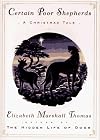
People who love that story – who would like to believe it’s true – will be enchanted by Certain Poor Shepherds by Elizabeth Marshal Thomas (Simon & Schuster, 1996). Book collectors love the book too, for its painstaking design, and for its stunning illustrations, woodcuts by Andrew Davidson.
With masterful use of cross-hatching, superb control of light and shadow, bold realism though with hints of an ethereal presence, the illustrations almost carry the story. I am especially intrigued by the angel astride the goat, the magi on their camels, the winged angel in the branch of an oak tree, and the last illustration in the book (which I can’t describe without giving away the denouement). But the most majestic one of all shows the magi with Mary and Joseph (and the sheep dog) clustered around the manger. The semi-symmetrical design around the blaze of heavenly light speaks eloquently. Davidson is not quite as good with motion as with static scenes, and the dog confronting the angels is stretched out too far, but these are minor complaints. The overall impression is grand.
The story is simple and engaging (as much as I despise the word as a generic adjective, I almost want to say sweet). The shepherds of the title, as you may have already guessed, are a sheep dog named Lila and a nanny goat named Ima. It is their responsibility to herd the sheep for their master. They are close companions, but each is lonely for others of her kind. One night they espy a strange new star in the sky – and you can imagine how the story proceeds from that point on. It has its suspense, its dangers, its twists and turns, and (rest assured) its “happy ending.”
Because Thomas herself is an anthropologist, the daughter of an anthropologist, and because she consulted another anthropologist who knows the Near East well, I am sure the characteristics attributed to the sheepdog and the goat are authentic – perhaps exaggerated a bit, but credible. The author has appended an afterword, which attempts to answer the question, “Do animals sense divinity?” I wish she had also commented on the sheep herding versatility of the dog and the goat and their collaboration. Is this a common practice? Is it rare, but genuine? Or does it edge toward anthropomorphism?
Be forewarned, too: the angels are hardly the stereotypical, otherworldly creatures we are accustomed to. Lila and Ima have seen them before on the mountain crests, but never so many at once. They are elfin creatures with wings, male and female, large and small – and they are hungry. They forage with the sheep and shake acorns from the oak tree.
Thomas adjusts her prose rhythms adroitly to fit the action. Let me close this review with two examples, one from the everyday life of the flock
”At the edge of the cultivated land, their master stopped. He had brought his animals to a wheat field by a grove of olive trees. The wheat and the olives had long since been harvested, but plenty of rich stubble remained on the ground. He whistled again, a signal for the dog to release the sheep so that they could graze there. . . . Whistling to his dog to tell her not to follow him, the master turned to leave. So the dog sat down to watch him walk away.” (p32)
Notice the everyday, prosaic language – just the facts, ma’am. But the other passage focuses on the “shepherds’” sensitivity to the angelic presence, and their master’s insensitivity. Immediately it strikes a different tone.
“[The master] would not investigate the scent-mark of a dangerous lynx, so he would not look at angels even though they were all around him. As far as he was concerned, they weren’t there. ¶ But sounds too high or low for human ears are nevertheless sounds; odors too faint or pure for human nostrils are nevertheless odors; and beings invisible to human eyes are nevertheless beings. Her master’s dense oblivion dismayed Lila. She watched him walk so near a crouching angel that he almost knocked her over. Insensible, he walked to the edge of the field and vanished among the olive trees.” (p34)
Note the poetic parallelism of the sentence about the angels and Lila’s dismay at her master’s “dense oblivion.” But then note how the language lapses back into the prosaic ordinariness as the master departs. Thomas’s style is never subtle or convoluted, but it matches the straightforwardness of the story. show less
#8 Simplicity
People who love animal stories, of course, have always loved the story about animals talking on the night of Jesus’ birth. According to the legend, Jesus was born on the stroke of midnight, and the animals in the stable – oxen, for sure, the donkey that had carried Mary, sheep and goats maybe, even chickens and geese and ducks – suddenly are given the power of speech. When the shepherds arrive, they fall silent again. Only Mary and Joseph and the baby show more hear them. And so the story goes that each Christmas Eve, precisely at midnight, our farm animals talk, praising God and rejoicing in the baby’s birth. Only children can hear them, and they only on the stroke of midnight.
People who love that story – who would like to believe it’s true – will be enchanted by Certain Poor Shepherds by Elizabeth Marshal Thomas (Simon & Schuster, 1996). Book collectors love the book too, for its painstaking design, and for its stunning illustrations, woodcuts by Andrew Davidson.
With masterful use of cross-hatching, superb control of light and shadow, bold realism though with hints of an ethereal presence, the illustrations almost carry the story. I am especially intrigued by the angel astride the goat, the magi on their camels, the winged angel in the branch of an oak tree, and the last illustration in the book (which I can’t describe without giving away the denouement). But the most majestic one of all shows the magi with Mary and Joseph (and the sheep dog) clustered around the manger. The semi-symmetrical design around the blaze of heavenly light speaks eloquently. Davidson is not quite as good with motion as with static scenes, and the dog confronting the angels is stretched out too far, but these are minor complaints. The overall impression is grand.
The story is simple and engaging (as much as I despise the word as a generic adjective, I almost want to say sweet). The shepherds of the title, as you may have already guessed, are a sheep dog named Lila and a nanny goat named Ima. It is their responsibility to herd the sheep for their master. They are close companions, but each is lonely for others of her kind. One night they espy a strange new star in the sky – and you can imagine how the story proceeds from that point on. It has its suspense, its dangers, its twists and turns, and (rest assured) its “happy ending.”
Because Thomas herself is an anthropologist, the daughter of an anthropologist, and because she consulted another anthropologist who knows the Near East well, I am sure the characteristics attributed to the sheepdog and the goat are authentic – perhaps exaggerated a bit, but credible. The author has appended an afterword, which attempts to answer the question, “Do animals sense divinity?” I wish she had also commented on the sheep herding versatility of the dog and the goat and their collaboration. Is this a common practice? Is it rare, but genuine? Or does it edge toward anthropomorphism?
Be forewarned, too: the angels are hardly the stereotypical, otherworldly creatures we are accustomed to. Lila and Ima have seen them before on the mountain crests, but never so many at once. They are elfin creatures with wings, male and female, large and small – and they are hungry. They forage with the sheep and shake acorns from the oak tree.
Thomas adjusts her prose rhythms adroitly to fit the action. Let me close this review with two examples, one from the everyday life of the flock
”At the edge of the cultivated land, their master stopped. He had brought his animals to a wheat field by a grove of olive trees. The wheat and the olives had long since been harvested, but plenty of rich stubble remained on the ground. He whistled again, a signal for the dog to release the sheep so that they could graze there. . . . Whistling to his dog to tell her not to follow him, the master turned to leave. So the dog sat down to watch him walk away.” (p32)
Notice the everyday, prosaic language – just the facts, ma’am. But the other passage focuses on the “shepherds’” sensitivity to the angelic presence, and their master’s insensitivity. Immediately it strikes a different tone.
“[The master] would not investigate the scent-mark of a dangerous lynx, so he would not look at angels even though they were all around him. As far as he was concerned, they weren’t there. ¶ But sounds too high or low for human ears are nevertheless sounds; odors too faint or pure for human nostrils are nevertheless odors; and beings invisible to human eyes are nevertheless beings. Her master’s dense oblivion dismayed Lila. She watched him walk so near a crouching angel that he almost knocked her over. Insensible, he walked to the edge of the field and vanished among the olive trees.” (p34)
Note the poetic parallelism of the sentence about the angels and Lila’s dismay at her master’s “dense oblivion.” But then note how the language lapses back into the prosaic ordinariness as the master departs. Thomas’s style is never subtle or convoluted, but it matches the straightforwardness of the story. show less

The story of an ordinary (if rather strong and feisty) young woman living sometime during the last ice age, as related by her after she has died and become a guardian spirit. Despite the supernatural element, which works surprisingly well, the story is mostly concerned with very ordinary things: births, deaths, the little scandals and quarrels of small groups of people living in close quarters, and the never-ending search for food. But it's consistently interesting and very readable, partly show more because it's just plain fascinating to try to imagine what kind of lives our ancestors might have led twenty thousand years ago, and partly because the characters feel so believable and so recognizably human.
The cover blurb declares that it's "for everyone who loved The Clan of the Cave Bear!" It's been a long, long time since I read that one, but I'm willing to venture the opinion that this book is the better of the two. It's certainly better than The Valley of Horses, which is the point where I gave up on Auel. show less
The cover blurb declares that it's "for everyone who loved The Clan of the Cave Bear!" It's been a long, long time since I read that one, but I'm willing to venture the opinion that this book is the better of the two. It's certainly better than The Valley of Horses, which is the point where I gave up on Auel. show less
The Old Ways
Imagine a digging stick as more important to humankind's existence than a mobile phone. Without an experienced frame of reference, many in today's world would brush aside the thought. Mentally, in our hubristic mind-set, we've pretty much removed ourselves from the natural world that sustains us, for the most part believing we are now in control despite the increasing consequences evidenced.
Over the history of life on earth there have been numerous extinction events (extinctions show more outpacing speciation), five of which are considered Great Extinctions. There have also been numerous species population bottlenecks, including humans, but current archaeological, paleontological, and genetic data are inadequate to provide conclusive evidence of specific events. We are currently living in an ongoing sixth Great Extinction that is caused by human activity, and at peril.
Why this is pertinent to this review is that at a minimum we are on a course to creating a more primitive environment in which to get by, one possibly not unlike that faced by our earliest ancestors as exemplified in this book.
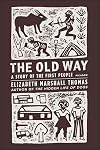
As late as the 1950s some small bands of hunter-gathers (the !Kung Bushmen) still existed in the Kalahari Desert (in Namibia and Botswana), living much as our ancestors must have fifteen hundred centuries ago. This book is about Laurence Marshall (co-founder of the Raytheon Corporation), with his wife (anthropologist Lorna Marshall), daughter and son, finding these hunter-gathers and documenting their lives. The author is Elizabeth Marshall Thomas, the daughter, and her thorough writing reads like a time travel experience.
An example of the documented !Kung Bushmen society is:
"In most ways, women were the equals of men, fully as respected, fully as important in decision making, fully as free to choose a spouse or get divorced or own a n!ore. Most men, after all, lived for at least part of their lives on the n!oresi of their wives, in service to their wives’ families. Men also were the equals of women, fully as tender toward their children, fully as ready to take part in daily tasks such as getting water or firewood. Yet there was a great dividing line between men and women that the Ju/wasi did not cross. For all their equality, they did not do as we do in industrialized societies—the Ju/wasi did not, for instance, have the equivalent of woman soldiers or male nurses—and the division had a biological element that, considering that the people lived in the Old Way, is no surprise. The division came down to childbearing and hunting. Matters of birth were only for women, and matters of hunting were only for men.
"Perhaps the passive power of women was the stronger of the two, but the active power of men was more apparent. It was the men, not the women, who confronted visiting lions, shaking burning branches at them and telling them to leave . . . Men always accompanied women on any trip that required an overnight stay, but only to protect them, not to supervise them.
"By and large, however, women provided the foods that sustained the people, which they did by normal gathering, and men provided the food that people liked the best and valued most highly, the meat of the important antelopes."
Also telling is, ". . . unlike agricultural and industrial peoples who want to influence the natural world, the hunter-gatherers wanted to join with it . . .”
The reader may notice interesting parallels between the !Kung Bushmen Old Ways society documented, those of some other indigenous peoples like the Hopi, and those of some of our cousins, like elephants, lions and bonobos.
Something that may bother some readers is that in the text there is a smattering of repeated material, usually in different contexts, because the author goes to great lengths in trying to explain the Old Ways.
Pay particular attention in chapter 16, and you may gain a better understanding of what we have lost.
"Where is the wisdom we have lost in knowledge? Where is the knowledge we have lost in information?" ~ T. S. Eliot, The Rock, 1934
"Since the 1950s, change has been rapid. The San [Bushmen] are no longer allowed to hunt the animals they once did and they have inevitably been caught up in the political changes that have taken place in Namibia and Botswana. They now have access to schools and hospitals, but poverty is their overwhelming lot."
The absurdities and harm we have heaped on these Bushmen in our ignorance reflect our own festering cultures — parallels easily seen now in the cultures of most all indigenous peoples.
All in all, this book was an interesting and informative read. One that shows how far we have digressed in our societies and what we have lost in our hubristic progress. Will we need to relearn the Old Ways again in the alien world we are rushing towards? show less
Imagine a digging stick as more important to humankind's existence than a mobile phone. Without an experienced frame of reference, many in today's world would brush aside the thought. Mentally, in our hubristic mind-set, we've pretty much removed ourselves from the natural world that sustains us, for the most part believing we are now in control despite the increasing consequences evidenced.
Over the history of life on earth there have been numerous extinction events (extinctions show more outpacing speciation), five of which are considered Great Extinctions. There have also been numerous species population bottlenecks, including humans, but current archaeological, paleontological, and genetic data are inadequate to provide conclusive evidence of specific events. We are currently living in an ongoing sixth Great Extinction that is caused by human activity, and at peril.
Why this is pertinent to this review is that at a minimum we are on a course to creating a more primitive environment in which to get by, one possibly not unlike that faced by our earliest ancestors as exemplified in this book.
As late as the 1950s some small bands of hunter-gathers (the !Kung Bushmen) still existed in the Kalahari Desert (in Namibia and Botswana), living much as our ancestors must have fifteen hundred centuries ago. This book is about Laurence Marshall (co-founder of the Raytheon Corporation), with his wife (anthropologist Lorna Marshall), daughter and son, finding these hunter-gathers and documenting their lives. The author is Elizabeth Marshall Thomas, the daughter, and her thorough writing reads like a time travel experience.
An example of the documented !Kung Bushmen society is:
"In most ways, women were the equals of men, fully as respected, fully as important in decision making, fully as free to choose a spouse or get divorced or own a n!ore. Most men, after all, lived for at least part of their lives on the n!oresi of their wives, in service to their wives’ families. Men also were the equals of women, fully as tender toward their children, fully as ready to take part in daily tasks such as getting water or firewood. Yet there was a great dividing line between men and women that the Ju/wasi did not cross. For all their equality, they did not do as we do in industrialized societies—the Ju/wasi did not, for instance, have the equivalent of woman soldiers or male nurses—and the division had a biological element that, considering that the people lived in the Old Way, is no surprise. The division came down to childbearing and hunting. Matters of birth were only for women, and matters of hunting were only for men.
"Perhaps the passive power of women was the stronger of the two, but the active power of men was more apparent. It was the men, not the women, who confronted visiting lions, shaking burning branches at them and telling them to leave . . . Men always accompanied women on any trip that required an overnight stay, but only to protect them, not to supervise them.
"By and large, however, women provided the foods that sustained the people, which they did by normal gathering, and men provided the food that people liked the best and valued most highly, the meat of the important antelopes."
Also telling is, ". . . unlike agricultural and industrial peoples who want to influence the natural world, the hunter-gatherers wanted to join with it . . .”
The reader may notice interesting parallels between the !Kung Bushmen Old Ways society documented, those of some other indigenous peoples like the Hopi, and those of some of our cousins, like elephants, lions and bonobos.
Something that may bother some readers is that in the text there is a smattering of repeated material, usually in different contexts, because the author goes to great lengths in trying to explain the Old Ways.
Pay particular attention in chapter 16, and you may gain a better understanding of what we have lost.
"Where is the wisdom we have lost in knowledge? Where is the knowledge we have lost in information?" ~ T. S. Eliot, The Rock, 1934
"Since the 1950s, change has been rapid. The San [Bushmen] are no longer allowed to hunt the animals they once did and they have inevitably been caught up in the political changes that have taken place in Namibia and Botswana. They now have access to schools and hospitals, but poverty is their overwhelming lot."
The absurdities and harm we have heaped on these Bushmen in our ignorance reflect our own festering cultures — parallels easily seen now in the cultures of most all indigenous peoples.
All in all, this book was an interesting and informative read. One that shows how far we have digressed in our societies and what we have lost in our hubristic progress. Will we need to relearn the Old Ways again in the alien world we are rushing towards? show less

An anthropologist's memoir of her experiences living with the Kung (!Kung) and Gikwe (Gǀwi) people of southern Africa.
The book is commendable for the respectful portrayal of the people the author encountered and lived with. Although the book takes the form of a personal travelogue, the author herself stays largely out of view, keeping the focus on the people she meets, their way of life, and the harsh yet beautiful landscape around them. Tragic events such as the kidnapping and enslavement show more of the people by European colonists, crippling injuries and deaths are described without excess sentiment, leaving the reader to form their own impressions. However, despite the dispassionate treatment of the subject matter, the book's tone is far from dry and academic. The narrative is enlivened by vibrant character sketches of the people the author meets, as well as lyrical descriptions of the landscape that serve to indirectly convey emotion and mood. This austere style of writing complements the book's subject, describing people who have managed to survive for thousands of years in extremely challenging natural conditions.
An excellent read for those interested in anthropology and ways of life different from our own. show less
The book is commendable for the respectful portrayal of the people the author encountered and lived with. Although the book takes the form of a personal travelogue, the author herself stays largely out of view, keeping the focus on the people she meets, their way of life, and the harsh yet beautiful landscape around them. Tragic events such as the kidnapping and enslavement show more of the people by European colonists, crippling injuries and deaths are described without excess sentiment, leaving the reader to form their own impressions. However, despite the dispassionate treatment of the subject matter, the book's tone is far from dry and academic. The narrative is enlivened by vibrant character sketches of the people the author meets, as well as lyrical descriptions of the landscape that serve to indirectly convey emotion and mood. This austere style of writing complements the book's subject, describing people who have managed to survive for thousands of years in extremely challenging natural conditions.
An excellent read for those interested in anthropology and ways of life different from our own. show less
Lists
Awards


You May Also Like


Associated Authors
Statistics
- Works
- 19
- Also by
- 6
- Members
- 4,110
- Popularity
- #6,123
- Rating
- 3.7
- Reviews
- 72
- ISBNs
- 178
- Languages
- 14
- Favorited
- 6