
Edgar Saltus (1855–1921)
Author of The Philosophy of Disenchantment
About the Author
Image credit: Quotezuki
Works by Edgar Saltus
The Philosophical Writings of Edgar Saltus: The Philosophy of Disenchantment & The Anatomy of Negation (2014) 9 copies
Tales before supper, from Théophile Gautier and Prosper Mérimée (1887) — Editor/Translator — 6 copies
Enthralled: A Story Of International Life Setting Forth The Curious Circumstances Concerning Lord Cloden And Oswald Quain (1894) 4 copies
The courts of love 1 copy
Associated Works
The Importance of Being Earnest / Lady Windermere's Fan / A Woman of No Importance / An Ideal Husband / Salomé (1892) — Introduction, some editions — 2,910 copies, 15 reviews
The Importance of Being Earnest / Salomé / Lady Windermere's Fan (1898) — Introduction, some editions — 760 copies, 3 reviews
Oscar Wilde: Collection of 300 Classic Works with Analysis and Historical Background (2013) — Contributor — 13 copies
Tagged
Common Knowledge
- Canonical name
- Saltus, Edgar
- Legal name
- Saltus, Edgar Evertson
- Other names
- Verelst, Myndart
- Birthdate
- 1855-10-08
- Date of death
- 1921-07-31
- Gender
- male
- Education
- Yale University
Columbia College - Occupations
- novelist
poet
essayist - Relationships
- Saltus, Francis Saltus (brother)
Saltus, Marie (wife) - Nationality
- USA
- Places of residence
- New York, New York, USA (birth, death)
- Burial location
- Sleepy Hollow Cemetery, Sleepy Hollow, New York, USA
- Associated Place (for map)
- USA
Members
Reviews

A genuine turkey, salvaged from demotion to reeking vulture by the odd fact that Saltus found a way to incorporate Hindu philosophy into this weird, adulterous romance in which all turns out for the best in the end (after a dog-mauling and a shooting or two).
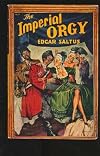
I’m reasonable acquainted with the history of Russia’s Tsars and Tsarinas, though this account takes a completely different approach to the other books I’ve read on this subject.
The author’s style is nothing whatsoever like the average historian’s. I’d never heard of Edgar Saltus before reading this volume, so his offbeat and humorous tone came as a refreshing change. Had I not been aware that this was first published in 1920, I would’ve guessed that it’d been written in show more 2015, such us the modern feel to the narrative style.
“The Imperial Orgy” brings to light many of the atrocities that occurred because of numerous rulers. Ivan the Terrible, Peter the Great, and Catherine the Great are the most prominent of those featured in this work. The author mocks the stupidity of such rulers being named as “Great”, as the likes of Peter brought death and misery to countless people. This is the sort of book one reads with morbid fascination.
Would’ve rated this work five stars, but the author’s style does at times become too confusing for my liking, and not just when he inserts the occasional line if untranslated French. Also, I would’ve liked a few date markers here and there. If I remember rightly, he only hints at what period of history that certain events occur on four occasion, and only once do we see a specific month and year. I don’t expect dates to be given to the exact day, but it’s helpful to know what year such-and-such thing happened. Mr Saltus is rather vague in this area!
But overall, this is a lively history book, worth checking out. show less
The author’s style is nothing whatsoever like the average historian’s. I’d never heard of Edgar Saltus before reading this volume, so his offbeat and humorous tone came as a refreshing change. Had I not been aware that this was first published in 1920, I would’ve guessed that it’d been written in show more 2015, such us the modern feel to the narrative style.
“The Imperial Orgy” brings to light many of the atrocities that occurred because of numerous rulers. Ivan the Terrible, Peter the Great, and Catherine the Great are the most prominent of those featured in this work. The author mocks the stupidity of such rulers being named as “Great”, as the likes of Peter brought death and misery to countless people. This is the sort of book one reads with morbid fascination.
Would’ve rated this work five stars, but the author’s style does at times become too confusing for my liking, and not just when he inserts the occasional line if untranslated French. Also, I would’ve liked a few date markers here and there. If I remember rightly, he only hints at what period of history that certain events occur on four occasion, and only once do we see a specific month and year. I don’t expect dates to be given to the exact day, but it’s helpful to know what year such-and-such thing happened. Mr Saltus is rather vague in this area!
But overall, this is a lively history book, worth checking out. show less
In some ways this novel reminds me of a novel by Edith Wharton--a glimpse of upper society in New York City in the early years of the 20th century. But it is a dark and threatening Edith Wharton. It begins: "It is just as well to say at the onset that the tragedy in which Tristrem Varick was the central figure has not been rightly understood. The world in which he lived, as well as the newspaper public, have had but one theory between them to account for it, and that theory is that Tristrem show more Varick was insane." In the book, Tristrem Varick falls in love with Viola Raritan, a beautiful and enigmatic woman. He idealizes her, pursues her, wins her, loses her, pursues her again, and all ends in the tragedy referred to at the outset of the novel. In all this, there are elements of mystery, adultery, incest and murder.
The author Edgar Saltus was a well-known writer in his time, and a friend of Oscar Wilde, although now he is an obscure and forgotten writer. He was American, and wrote "lurid" histories of Ancient Rome and Russia, in addition to his novels. One critic described his style as "unique" with prose that "wavers between the lurid excess of a romantic poem and the spare, dangerous staccato of a telegram." Saltus himself wrote: "{I}n literature only three things count: style, style polished, style repolished. Style may be defined as harmony of syllables, the fall of sentences, the absence of metaphor, the pursuit of repetition even unto the thirtieth and fortieth line, the use of the exact term no matter what the term may be." And Oscar Wilde said, "In Edgar Saltus's work passion struggles with grammar on every page."
I agree that the prose in this book is lush and unique. However, there's a darn good story here too. show less
The author Edgar Saltus was a well-known writer in his time, and a friend of Oscar Wilde, although now he is an obscure and forgotten writer. He was American, and wrote "lurid" histories of Ancient Rome and Russia, in addition to his novels. One critic described his style as "unique" with prose that "wavers between the lurid excess of a romantic poem and the spare, dangerous staccato of a telegram." Saltus himself wrote: "{I}n literature only three things count: style, style polished, style repolished. Style may be defined as harmony of syllables, the fall of sentences, the absence of metaphor, the pursuit of repetition even unto the thirtieth and fortieth line, the use of the exact term no matter what the term may be." And Oscar Wilde said, "In Edgar Saltus's work passion struggles with grammar on every page."
I agree that the prose in this book is lush and unique. However, there's a darn good story here too. show less
An interesting follow-up to reading "Lamb" by Christopher Moore, with another interesting perspective on the character of Mary Magdalene. This is a much more serious novel; the triangle relationship here is between Mary and Judas and Jesus, and is much darker and more obscure than Moore's "gospel according to Biff"; some beautiful passages; wonderfully strange scenes; I am glad I ran across this and that it was easily available as an e-book. I'll read more Saltus.
Lists
You May Also Like


Associated Authors
Statistics
- Works
- 49
- Also by
- 15
- Members
- 400
- Popularity
- #60,684
- Rating
- 4.1
- Reviews
- 6
- ISBNs
- 144
- Favorited
- 3