
Jonathan Kay
Author of Among the Truthers: A Journey Through America's Growing Conspiracist Underground
About the Author
Works by Jonathan Kay
Among the Truthers: A Journey Through America's Growing Conspiracist Underground (2011) 161 copies, 6 reviews
Associated Works
The Volunteer: The Incredible True Story of an Israeli Spy on the Trail of International Terrorists (2007) 88 copies, 3 reviews
Tagged
Common Knowledge
- Other names
- Kay, Jonathan Hillel
- Birthdate
- 1968-09-18
- Gender
- male
- Education
- McGill University
Yale University - Organizations
- Quillette
Foundation for Defense of Democracies
The Walrus - Nationality
- Canada
- Associated Place (for map)
- Canada
Members
Reviews
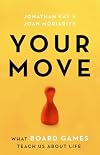
Your Move is a series of essays about boardgaming by Joan Moriarty, game sommelier at Toronto game cafe Snakes and Lattes, and Jonathan Kay, an avid hobbyist gamer, journalist, and currently editor at Quillette*. The essays are pretty populist and surface level. Table top games are fun because we can step inside a magic circle of play and commit fully without having to live with the consequences. They give us something to go with our friends, and offer levels of involvement from the show more minimally interactive Apples to Apples, to the elegant decision spaces of eurogames, to the grand strategies of complex supergames. Tabletop gaming experienced a massive renaissance in the 2010s, with the whole field growing several times over. Today, there are games for almost any taste!
The essays are best when they get away from the bland generalities. Kay likes Monopoly as an example of an unstable equilibrium, while Moriarty holds to the conventional wisdom that it's one of the worst games you'll ever play. Moriarty's deconstruction of Scattergories as a relationship killer which is actually about political skill in playing the table is brilliant analysis. Similarly, while Kay is not a fan of Scrabble, he has affection for the unique skills required at high level play. Nigel Richards won the French national Scrabble tournament by memorizing dictionaries, and still cannot speak French.
Where this book gets weird is when Kay starts inveigling against political correctness, even as Moriarty calls for a more diverse gaming community. I didn't discover the association with Quillette until after I had finished the book, but Quillette is a publication which spends a lot of time promoting discredited racist theories, employs Proud Boys information operative Andy Ngo, and generally is trying to make fascism an acceptable political viewpoint. So when Kay argues playing Phil Eklund's Greenland (and Eklund has his own issues), is a better way to gain respect for Indigenous people than the media growing out of Canada's Truth and Reconciliation Commission on Residential Schools, I roll to disbelieve.
So hey, its a decent set of introductory essays, except half the proceeds go to a guy who's making a career out of destroying Western democracy. I'm not one of those people who requires that every book I read match my politics: I gave five stars to Freedom's Forge, and the author is an American Enterprise Institute arch-conservative. It's just that even by culture war standards, Quillette fucking sucks. And to Libertarians and Conservatives out there, happy to have a discussion about regulatory overreach or anti-competitive tax policy or whatever it is, once you deal with all the racists and actual Nazis you call buddies. Show some actual integrity, and stop making everything about 'triggering the libs'. show less
The essays are best when they get away from the bland generalities. Kay likes Monopoly as an example of an unstable equilibrium, while Moriarty holds to the conventional wisdom that it's one of the worst games you'll ever play. Moriarty's deconstruction of Scattergories as a relationship killer which is actually about political skill in playing the table is brilliant analysis. Similarly, while Kay is not a fan of Scrabble, he has affection for the unique skills required at high level play. Nigel Richards won the French national Scrabble tournament by memorizing dictionaries, and still cannot speak French.
Where this book gets weird is when Kay starts inveigling against political correctness, even as Moriarty calls for a more diverse gaming community. I didn't discover the association with Quillette until after I had finished the book, but Quillette is a publication which spends a lot of time promoting discredited racist theories, employs Proud Boys information operative Andy Ngo, and generally is trying to make fascism an acceptable political viewpoint. So when Kay argues playing Phil Eklund's Greenland (and Eklund has his own issues), is a better way to gain respect for Indigenous people than the media growing out of Canada's Truth and Reconciliation Commission on Residential Schools, I roll to disbelieve.
So hey, its a decent set of introductory essays, except half the proceeds go to a guy who's making a career out of destroying Western democracy. I'm not one of those people who requires that every book I read match my politics: I gave five stars to Freedom's Forge, and the author is an American Enterprise Institute arch-conservative. It's just that even by culture war standards, Quillette fucking sucks. And to Libertarians and Conservatives out there, happy to have a discussion about regulatory overreach or anti-competitive tax policy or whatever it is, once you deal with all the racists and actual Nazis you call buddies. Show some actual integrity, and stop making everything about 'triggering the libs'. show less

Oh, man, this book. I usually don't finish books I dislike this much, but I kept telling myself I had gotten this far and I really wanted to write a good review so I persevered with it and was able to finish. I guess that's an accomplishment?
I picked this book up because I have an ongoing interest in reading about conspiracy theories and the people who believe in them. "Truthers," or people who believe in "9/11 Truth", the idea that the American government was secretly behind the terrorist show more attacks of September 11, 2001, are certainly an intriguing group whose viewpoint is so different from my own (and reality) that I wanted to know what made them tick. Kay's stated mission statement for this book is to not only profile individual Truthers but to also connect them with the greater tradition of conspiracy theories in history and offer "concrete solutions" to combat the growth of such theories in the future. Sounds great, right? Unfortunately, this mess of a book fails to live up to Kay's lofty ambitions.
First of all, before I get into any of my problems with Kay's ideas or politics, let's talk about the writing. Kay has a lively, journalistic style. You can tell that he has a background in reporting. However, this is not necessarily an asset when one is attempting to write a book that seriously analyzes a current movement, as well as broad swathes of history, and attempts to offer new ideas about psychology and politics. While Kay sometimes uses in-text citations, he just as often offers information without showing his source. There are no footnotes, no endnotes, nor even a bibliography. What's more, the language he uses often descends into jingoistic stereotypes. Structurally, he attempts to divide the book into three sections: the first giving a history of conspiracism, the second introducing us to the Truthers themselves, and the third examining the factors in society that enable such conspiracy theories to grow as well as offering solutions to restrict this growth. In reality, he doesn't stick to this format. He jumps from idea to idea and back through out the book, making for a confusing read.
Now, let's talk about the contents of the book. David Kay is a Canadian conservative. I have nothing wrong with this. My problem is with the fact that he never comes out and states that he is a conservative. The book jacket describes him as an editor and columnist for Canada's National Post newspaper. I wasn't familiar with this paper, and I am comfortable stating that the majority of American's probably aren't either. I had to look up the National Post to learn that it's a newspaper known, indeed founded, for its conservative editorial perspective. Kay's conservative views permeate the entire book. This isn't a shock; I don't expect anyone to be able to completely divorce themselves from their political opinions or viewpoint. I do, however, expect that when I am reading a nonfiction book or a piece of reporting, that the author will at least make an attempt at objectivity. Kay fails to do so. When he speaks of far-right conspiracists he is careful to call them "radical," "fringe," or at the very least "far right". When he talks about conspiracists on the opposite end of the spectrum, however, he describes them as "liberals", "left wing college activists--- the type who had constructed their image of America from books by Noam Chomsky or Howard Zinn," or the "university-educated, anti-American, left-wing side of the political spectrum."
One of the central tenets of Kay's book is that academics and the "Ivy League elitists" have pushed the idea that there is no literal, historical truth based on facts, that all truth is subjective. He, of course, knows better (much like the Truther and other conspiracists he profiles); there is inarguable, concrete truth, and it is Jonathan Kay's truth. Big government is evil and everyone knows it, whether they will admit it or not. Campuses have been overrun by "radical feminists" and the proponents of "radical identity politics" who insist on studying made up subjects like African-American or women's history. Anyone who questions Israel's actions towards Palestinians is an anti-Semite, hiding their hatred of Jews beneath the excuse of civil rights. This is like if I, as a liberal, were to right a book about conspiracy theories and label anyone who believe in laissez-faire capitalism or who opposes affirmative action as conspiracists. Kay comes dangerously close to embracing the kind of painting-with-a-broad-brush, blaming the world's ills on a singular group, thinking that he so despises in the conspiracists themselves. It's too bad, because Kay does have some kernels of interesting ideas regarding the psychology of those susceptible to conspiracy theories and how such ideas spread. His own biases and ranting against liberals make these valuable insights hard to take seriously though.
But then again, I'm probably just saying all of this because I am part of the problem, helplessly deluded with my "Marxist" political views and dangerous "anti-racist" thinking. It's all because I've read that nonsense by Chomsky and Zinn, you know.
Luckily for you, I have read a few other, better books about conspiracy theories and can recommend them to you. If you're looking for one tracing the history of conspiracy theories and their influence on politics, I recommend Voodoo Histories by David Aaronovitch. If you want interesting profiles of the people who hold these beliefs, read Jon Ronson's Them, which even features some of the same people interviewed by Kay, but in much more depth. show less
I picked this book up because I have an ongoing interest in reading about conspiracy theories and the people who believe in them. "Truthers," or people who believe in "9/11 Truth", the idea that the American government was secretly behind the terrorist show more attacks of September 11, 2001, are certainly an intriguing group whose viewpoint is so different from my own (and reality) that I wanted to know what made them tick. Kay's stated mission statement for this book is to not only profile individual Truthers but to also connect them with the greater tradition of conspiracy theories in history and offer "concrete solutions" to combat the growth of such theories in the future. Sounds great, right? Unfortunately, this mess of a book fails to live up to Kay's lofty ambitions.
First of all, before I get into any of my problems with Kay's ideas or politics, let's talk about the writing. Kay has a lively, journalistic style. You can tell that he has a background in reporting. However, this is not necessarily an asset when one is attempting to write a book that seriously analyzes a current movement, as well as broad swathes of history, and attempts to offer new ideas about psychology and politics. While Kay sometimes uses in-text citations, he just as often offers information without showing his source. There are no footnotes, no endnotes, nor even a bibliography. What's more, the language he uses often descends into jingoistic stereotypes. Structurally, he attempts to divide the book into three sections: the first giving a history of conspiracism, the second introducing us to the Truthers themselves, and the third examining the factors in society that enable such conspiracy theories to grow as well as offering solutions to restrict this growth. In reality, he doesn't stick to this format. He jumps from idea to idea and back through out the book, making for a confusing read.
Now, let's talk about the contents of the book. David Kay is a Canadian conservative. I have nothing wrong with this. My problem is with the fact that he never comes out and states that he is a conservative. The book jacket describes him as an editor and columnist for Canada's National Post newspaper. I wasn't familiar with this paper, and I am comfortable stating that the majority of American's probably aren't either. I had to look up the National Post to learn that it's a newspaper known, indeed founded, for its conservative editorial perspective. Kay's conservative views permeate the entire book. This isn't a shock; I don't expect anyone to be able to completely divorce themselves from their political opinions or viewpoint. I do, however, expect that when I am reading a nonfiction book or a piece of reporting, that the author will at least make an attempt at objectivity. Kay fails to do so. When he speaks of far-right conspiracists he is careful to call them "radical," "fringe," or at the very least "far right". When he talks about conspiracists on the opposite end of the spectrum, however, he describes them as "liberals", "left wing college activists--- the type who had constructed their image of America from books by Noam Chomsky or Howard Zinn," or the "university-educated, anti-American, left-wing side of the political spectrum."
One of the central tenets of Kay's book is that academics and the "Ivy League elitists" have pushed the idea that there is no literal, historical truth based on facts, that all truth is subjective. He, of course, knows better (much like the Truther and other conspiracists he profiles); there is inarguable, concrete truth, and it is Jonathan Kay's truth. Big government is evil and everyone knows it, whether they will admit it or not. Campuses have been overrun by "radical feminists" and the proponents of "radical identity politics" who insist on studying made up subjects like African-American or women's history. Anyone who questions Israel's actions towards Palestinians is an anti-Semite, hiding their hatred of Jews beneath the excuse of civil rights. This is like if I, as a liberal, were to right a book about conspiracy theories and label anyone who believe in laissez-faire capitalism or who opposes affirmative action as conspiracists. Kay comes dangerously close to embracing the kind of painting-with-a-broad-brush, blaming the world's ills on a singular group, thinking that he so despises in the conspiracists themselves. It's too bad, because Kay does have some kernels of interesting ideas regarding the psychology of those susceptible to conspiracy theories and how such ideas spread. His own biases and ranting against liberals make these valuable insights hard to take seriously though.
But then again, I'm probably just saying all of this because I am part of the problem, helplessly deluded with my "Marxist" political views and dangerous "anti-racist" thinking. It's all because I've read that nonsense by Chomsky and Zinn, you know.
Luckily for you, I have read a few other, better books about conspiracy theories and can recommend them to you. If you're looking for one tracing the history of conspiracy theories and their influence on politics, I recommend Voodoo Histories by David Aaronovitch. If you want interesting profiles of the people who hold these beliefs, read Jon Ronson's Them, which even features some of the same people interviewed by Kay, but in much more depth. show less
Not bad – Kay doesn’t try to correct conspiracy theorist fallacies about 9/11 (he says his initial draft had three chapters doing just that, but his publisher told him to cut it out, because “conspiracy theorists won’t believe you anyway and normal people don’t care, so you’ve got no audience”). Instead he sets out some interviews with various theorists and the changes that coming to the Truth movement has made in their lives, which is like nothing so much as religious show more conversion, and identifies the core of contemporary conspiracy theory, essentially a rehash of the old Protocols of the Elders of Zion fraud, altered to fit the bugbear of the individual theorist.
The book feels a bit unfocused at times, it roams around a lot and takes the odd eccentric detour, but he’s right about the nub of the theories and why they become very quickly boring if you don’t sign up – much like apocalyptic religion, you can only hear the same story (albeit with a different baddie) so many times before you switch off. Worth a look if this sort of thing interests you (maybe wait for the paperback though). show less
The book feels a bit unfocused at times, it roams around a lot and takes the odd eccentric detour, but he’s right about the nub of the theories and why they become very quickly boring if you don’t sign up – much like apocalyptic religion, you can only hear the same story (albeit with a different baddie) so many times before you switch off. Worth a look if this sort of thing interests you (maybe wait for the paperback though). show less

This is a very interesting collection of essays about board games, and what they teach us about ourselves and our society. It is co-written by Joan Moriarity, who has worked in the game industry in several capacities; and Jonathan Kay, a Canadian writer (formerly of The Walrus) and an avid gamer. Together they explore aspects of various popular games and how and why we play them. This is an easy-to-read, thought-provoking book that will appeal to gamers and to anyone interested in the show more dynamics of relationships.
The authors look at classics like Monopoly and Scrabble, as well as role playing games like Dungeons and Dragons. They also look at cooperative games. Sometimes they look at particular rules and why people follow them (or not); other times, they look at how relationships can affect strategies...all kinds of angles that made me think. show less
The authors look at classics like Monopoly and Scrabble, as well as role playing games like Dungeons and Dragons. They also look at cooperative games. Sometimes they look at particular rules and why people follow them (or not); other times, they look at how relationships can affect strategies...all kinds of angles that made me think. show less
You May Also Like


Associated Authors
Statistics
- Works
- 6
- Also by
- 2
- Members
- 220
- Popularity
- #101,714
- Rating
- 3.4
- Reviews
- 11
- ISBNs
- 6