
Marie von Ebner-Eschenbach (1830–1916)
Author of Krambambuli und andere Erzählungen
About the Author
Image credit: Courtesy of the NYPL Digital Gallery (image use requires permission from the New York Public Library)
Works by Marie von Ebner-Eschenbach
Erzählungen, autobiographische Schriften: [nach dem Text der ersten Gesamtausgabe von 1893] (1893) — Author — 5 copies
Ausgewählte Werke 2 copies
Der gute Mond — Author — 2 copies
Leseausgabe in vier Bänden 2 copies
Hamburger Lesehefte : Marie von Ebner-Eschenbach : Die Freiherren von Gemperlein (1986) — Text — 1 copy
[Krambambuli und andere Erzählungen] ; Krambambuli und andere Erzählungen (2023) — Author — 1 copy
Hamburger Lesehefte : Marie von Ebner-Eschenbach : Die erste Beichte + Der Muff + Die Sunderin — Text — 1 copy
The two countesses 1 copy
Gedichte 1 copy
Ausgewählte Erzählungen : 3 1 copy
Zwei Romane: Lotti, die Uhrmacherin; Glaubenslos? — Author — 1 copy
Tout un livre, toute une vie 1 copy
Die Freiherren von Gemperlein - Krambambuli : 2 Erzählungen — Author — 1 copy
Biographie 1 copy
Der Kreisphysikus 1 copy
Ausgewählte Erzählungen 1 copy
Meine Erinnerungen an Grillparzer: Aus einem zeitlosen Tagebuch [Reprint der Originalausgabe von 1916] (2007) — Author — 1 copy
Sämtliche Werke. 6 Bände (komplett): Erster Zweiter Dritter Vierter Fünfter Sechster Band (1920) 1 copy
Sämtliche Werke Erster Band 1 copy
Sämtliche Werke Zweiter Band 1 copy
Sämtliche Werke Dritter Band 1 copy
Sämtliche Werke Vierter Band 1 copy
Sämtliche Werke Fünfter Band 1 copy
Das Schädliche 1 copy
Ein kleiner Roman 1 copy
Associated Works
The Queen's Mirror: Fairy Tales by German Women, 1780-1900 (2001) — Contributor — 46 copies, 1 review
German Novellas of Realism II : Ebner-Eschenbach, Heyse, Raabe, Storm, Meyer, Hauptmann (1989) — Author — 16 copies
Halt auf freiem Felde : Eisenbahnabenteuer von Agatha Christie bis Tucholsky (1975) — Author — 2 copies
50 seltsame Geschichten — Contributor — 1 copy
Velhagen und Klasings Almanach 1909 — Contributor — 1 copy
Lebensgut — Ein deutsches Lesebuch für Mädchen — 5. Teil (9. Schuljahr) — Contributor — 1 copy
Tagged
Common Knowledge
- Other names
- Eschenbach, Marie von
Ebner-Eschenbach, Maria von
Třebomyslice, Marie Dubský von - Birthdate
- 1830-09-13
- Date of death
- 1916-03-12
- Gender
- female
- Occupations
- novelist
dramatist
salonniere - Organizations
- Pegnesischer Blumenorden
- Awards and honors
- Cross of Honour for Science and Art (1898)
Honorary Doctorate (University of Vienna, 1900) - Relationships
- Sophie von Waldburg-Syrgenstein (niece)
Andreas-Salomé, Lou (friend)
Druskowitz, Helene von (friend)
Dubský, Baron Franz (father)
Vockel, Baronesse Marie von (mother) - Short biography
- Marie Dubsky was born at Zdislawitz Castle in Moravia (now Czech Republic) to an aristocratic Austro-Hungarian family. She began writing in childhood. In 1848, at age 18, she married her cousin Baron Moritz von Ebner-Eschenbach, a military officer. The young baroness became a leader of a literary salon attached to the Imperial court of the Emperor Franz Joseph in Vienna. She wrote popular plays and novels. Considered to be the most prominent of 19th-century female Austrian writers, she was famous for her epigrams, and produced a work of Aphorismen (1880). Marie von Ebner-Eschenbach became the first woman to be awarded an honorary doctorate from the University of Vienna.
- Nationality
- Austrian Empire
- Birthplace
- Zdislawitz castle, Kremsier, Moravia, Austrian Empire
- Places of residence
- Zdislavice
Klosterbruck, South Moravia, Austrian Empire
Vienna, Austrian Empire - Place of death
- Vienna, Austrian Empire
- Burial location
- Zdislavice castle, Troubky-Zdislavice, Okres Kroměříž, Czech Republic
- Associated Place (for map)
- Austrian Empire
Members
Reviews

Aus Franzensbad:
Plot:
A countess is sent to the spa town Františkovy Lázně by her doctor. The countess is worried that she will be out of her mind with boredom there, so she convinces the doctor that she will fill her time with writing letters to him – letters that are supposed to be published as a travel memoir/guide. But the countess’ idiosyncratic approach to her writing leaves the doctor at a bit of a loss.
Aus Franzensbad was one of the earliest things Ebner-Eschenbach published show more and it has a youthfulness and dynamic energy that seems to reflect that. But I have to admit that I often felt that I lacked the necessary knowledge and background to really appreciate the many references often built into the text. It is still entertaining, though.
Read more on my blog: https://kalafudra.com/2023/07/29/aus-franzensbad-marie-von-ebner-eschenbach/
Das Gemeindekind:
Plot:
After robbing a church and killing a priest, Pavel’s father is sentenced to death, his mother who was forced by her husband to help with the crime is sentenced to ten years in prison. Pavel and his sister Milada are now the responsibility of the borough. Milada, who is pretty and cute, gets taken in by the local countess but Pavel (who is around 12 at the time) has to stay with an abusive foster family and endure the community’s shunning of him, since everybody assumes that he’s going to turn out like his parents.
Ebner-Eschenbach’s writing style is, of course, a little outdated. Her book is not. She writes sensitively and sensibly about the life of the poor at the end of the 19th century (and it seems pretty realistic to me), even though she herself was noble and pretty rich. And in Pavel, she examines the relationship between individual choice and biological determinism, which is a still unanswered and interesting question.
Read more on my blog: https://kalafudra.com/2010/04/22/das-gemeindekind-the-municipal-child-marie-von-... show less
Plot:
A countess is sent to the spa town Františkovy Lázně by her doctor. The countess is worried that she will be out of her mind with boredom there, so she convinces the doctor that she will fill her time with writing letters to him – letters that are supposed to be published as a travel memoir/guide. But the countess’ idiosyncratic approach to her writing leaves the doctor at a bit of a loss.
Aus Franzensbad was one of the earliest things Ebner-Eschenbach published show more and it has a youthfulness and dynamic energy that seems to reflect that. But I have to admit that I often felt that I lacked the necessary knowledge and background to really appreciate the many references often built into the text. It is still entertaining, though.
Read more on my blog: https://kalafudra.com/2023/07/29/aus-franzensbad-marie-von-ebner-eschenbach/
Das Gemeindekind:
Plot:
After robbing a church and killing a priest, Pavel’s father is sentenced to death, his mother who was forced by her husband to help with the crime is sentenced to ten years in prison. Pavel and his sister Milada are now the responsibility of the borough. Milada, who is pretty and cute, gets taken in by the local countess but Pavel (who is around 12 at the time) has to stay with an abusive foster family and endure the community’s shunning of him, since everybody assumes that he’s going to turn out like his parents.
Ebner-Eschenbach’s writing style is, of course, a little outdated. Her book is not. She writes sensitively and sensibly about the life of the poor at the end of the 19th century (and it seems pretty realistic to me), even though she herself was noble and pretty rich. And in Pavel, she examines the relationship between individual choice and biological determinism, which is a still unanswered and interesting question.
Read more on my blog: https://kalafudra.com/2010/04/22/das-gemeindekind-the-municipal-child-marie-von-... show less

Das Gemeindekind is Marie von Ebner-Eschenbach‘s most famous novel. Marie von Ebner-Eschenbach was a Czech-Austrian writer in the late 19th century.
Plot:
After robbing a church and killing a priest, Pavel’s father is sentenced to death, his mother who was forced by her husband to help with the crime is sentenced to ten years in prison. Pavel and his sister Milada are now the responsibility of the borough. Milada, who is pretty and cute, gets taken in by the local countess but Pavel (who show more is around 12 at the time) has to stay with an abusive foster family and endure the community’s shunning of him, since everybody assumes that he’s going to turn out like his parents.
Ebner-Eschenbach’s writing style is, of course, a little outdated. Her book is not. She writes sensitively and sensibly about the life of the poor at the end of the 19th century (and it seems pretty realistic to me), even though she herself was noble and pretty rich. And in Pavel, she examines the relationship between individual choice and biological determinism, which is a still unanswered and interesting question.
Read more about it on my blog: http://kalafudra.wordpress.com/2010/04/22/das-gemeindekind-the-municipal-child-m... show less
Plot:
After robbing a church and killing a priest, Pavel’s father is sentenced to death, his mother who was forced by her husband to help with the crime is sentenced to ten years in prison. Pavel and his sister Milada are now the responsibility of the borough. Milada, who is pretty and cute, gets taken in by the local countess but Pavel (who show more is around 12 at the time) has to stay with an abusive foster family and endure the community’s shunning of him, since everybody assumes that he’s going to turn out like his parents.
Ebner-Eschenbach’s writing style is, of course, a little outdated. Her book is not. She writes sensitively and sensibly about the life of the poor at the end of the 19th century (and it seems pretty realistic to me), even though she herself was noble and pretty rich. And in Pavel, she examines the relationship between individual choice and biological determinism, which is a still unanswered and interesting question.
Read more about it on my blog: http://kalafudra.wordpress.com/2010/04/22/das-gemeindekind-the-municipal-child-m... show less
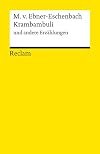
There are three of Ebner-Eschenbach's short stories in this collection, all revolving around dogs and/or loyalty, and all designed to extract the maximum amount of tears from me. The stories and her writing are really good, but you gotta be in the right mood to want to cry this much.
Read more about each of the stories on my blog: http://kalafudra.com/2018/03/06/krambambuli-und-andere-erzahlungen-krambambuli-a...
Read more about each of the stories on my blog: http://kalafudra.com/2018/03/06/krambambuli-und-andere-erzahlungen-krambambuli-a...
Lists
Awards


You May Also Like


Associated Authors
Statistics
- Works
- 96
- Also by
- 11
- Members
- 403
- Popularity
- #60,269
- Rating
- 3.6
- Reviews
- 3
- ISBNs
- 93
- Languages
- 7