
Marion Milner (1900–1998)
Author of A Life of One's Own
About the Author
Disambiguation Notice:
Joanna Field is the pseudonym of Marion Milner.
Works by Marion Milner
Tagged
Common Knowledge
- Canonical name
- Milner, Marion
- Other names
- Fielding, Joanna
Blackett-Milner, Marion - Birthdate
- 1900-02-01
- Date of death
- 1998-05-29
- Gender
- female
- Education
- University of London (psychology)
- Occupations
- psychoanalyst
memoirist
diarist
educationalist
painter - Organizations
- British Psychoanalytical Society
- Short biography
- Marion Milner was born Nina Marion Blackett in London, England. Her brother Patrick Blackett grew up to be a Nobel Prize-winning physicist. She graduated with a first class honors degree in psychology from University College, London in 1924. In 1927, she married Dennis Milner, with whom she had a son. She kept an introspective daily journal that became the basis for a critically-acclaimed book called A Life of One's Own (1934), published under the pen name Joanna Field. Also under this pseudonym, she published An Experiment in Leisure (1937). In 1940, she started training as a psychoanalyst and went into practice in 1943, working with both children and adults. She became a prominent member of the Independent school of the British Psychoanalystical Society. Among her works on psychoanalysis, the best-known is The Hands of the Living God (1969). An enthusiastic painter herself, she wrote about the benefits of painting in On Not Being Able to Paint (1950).
- Nationality
- UK
- Birthplace
- London, England, UK
- Places of residence
- London, England, UK
- Disambiguation notice
- Joanna Field is the pseudonym of Marion Milner.
- Associated Place (for map)
- London, England, UK
Members
Reviews
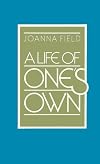
I've had this book on my "To Read" shelf for several years...ever since it was referred to in "Simple Abundance". I'm so glad I didn't get to it until now because I was fully receptive to the message and suggestions...it came at a time when it would really resonate with me. As I read it, two things amazed me...first, I swear I am a reincarnation of the author! It was a bit eerie to come across someone - a woman who was in her 20's in the 1930's - who thinks EXACTLY like me and has the EXACT show more struggles. Second, this book perfectly parallels Don Miguel Ruiz's "The Four Agreements", which I just read and am working hard to live by. "The Four Agreements" lets you know what you need to do, "A Life of One's Own" tells you how. Because it was the perfect "manual" for me and is helping me make some significant changes, it ranks as one of my all-time favorite books. It was, however, a tad difficult to read at times...but, every time I came to an "Ah Ha" moment, it made it all worth it! show less

Throughout much of the book’s yearnings and musings, I couldn’t help but think, “yes, dear, that’s because you’re young.” It was charming to read how hard this woman (26-34 years old at time of writing) was trying to determine what was truly worthwhile in terms of happiness, and take responsibility for her own approach to life; I have doubts anyone over the age of 45 will find it truly resonates as a whole but there are brief passages that reflect (perhaps not intentionally) a show more near universal experience. At worst, it is self-conscious navel gazing; at best, it may motivate the reader to engage in mindfulness and to think more seriously about what provides their own specific happiness, as opposed to mere pleasure or applauded duty. show less

On Not Being Able to Paint is divided into five sections, the first four all relating to Free Drawing. The fifth and final section is focused on painting. Words like "psychic creativity" and "moral education" are thrown around, which makes me think I'm in for the psychobabble ride reading of my life. I wasn't disappointed. There is a fair amount of deep psychology in On not Being Able to Paint. Even though the slim volume is less than 200 pages, it took me forever to read. In the end, I show more questioned if the obstacles which prevent one from painting are not the exact same "blocks" writers sometimes complain of experiencing when unable to write. Sure enough, Field is connecting free drawings with the self conscious.
As an aside, the first edition of On Not Being Able to Paint was written for educators. The second edition (my version) includes an appendix and Anna Freud's foreword. I appreciated that Field was able to recognize that emotional drawing is not completely devoid of influence and that she shouldn't be so fixated on depicting beauty for beauty's sake.
Confessional: I was a bit disappointed by Field's "art." The illustrations were childlike and well, for lack of a better word, weird. As Field explains, and I said earlier, they are "free drawings" that helped her connect to the self conscious. I hope she was successful. show less
As an aside, the first edition of On Not Being Able to Paint was written for educators. The second edition (my version) includes an appendix and Anna Freud's foreword. I appreciated that Field was able to recognize that emotional drawing is not completely devoid of influence and that she shouldn't be so fixated on depicting beauty for beauty's sake.
Confessional: I was a bit disappointed by Field's "art." The illustrations were childlike and well, for lack of a better word, weird. As Field explains, and I said earlier, they are "free drawings" that helped her connect to the self conscious. I hope she was successful. show less
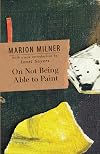
I found this book an interesting and challenging psycho-analytic journey through one artist’s attempts to define and unlock her own creativity. The analysis side bordered on oversharing, I thought, but clearly the process of analysing her own ‘free-drawings’ was an important part of the overall experience that Milner went on through the course of her own experiment in creativity.
You May Also Like


Statistics
- Works
- 12
- Members
- 747
- Popularity
- #34,027
- Rating
- 3.8
- Reviews
- 8
- ISBNs
- 65
- Languages
- 6
- Favorited
- 1