
Vikram Chandra
Author of Sacred Games
About the Author
Author Vikram Chandra was born in New Delhi, India in 1961. He attended college in the United States receiving a BA in English with a concentration in creative writing from Pomona College and attended the film school at Columbia University before dropping out to work on his first novel. His first show more novel, Red Earth and Pouring Rain, was inspired by an autobiography of a nineteenth century soldier named Colonel James "Sikander" Skinner. It won the Commonwealth Writers Prize for Best First Book and the David Higham Prize for Fiction. His next novel, Love and Longing in Bombay, won the Commonwealth Writers Prize for Best Book (Eurasia region) and was short-listed for the Guardian Fiction Prize. In 2000, he and Suketu Mehta co-wrote the Bollywood movie Mission Kashmir. He teaches creative writing at the University of California and currently divides his time between Berkeley, California and Mumbai. (Bowker Author Biography) show less
Works by Vikram Chandra
Mirrored Mind: My Life in Letters and Code [Hardcover] [Nov 01, 2013] Vikram Chandra (2013) 7 copies
Dharma 1 copy
Święte gry 1 copy
The Red Tent 1 copy
Associated Works
The Art of the Story: An International Anthology of Contemporary Short Stories (1999) — Contributor — 394 copies, 5 reviews
Tagged
Common Knowledge
- Canonical name
- Chandra, Vikram
- Birthdate
- 1961
- Gender
- male
- Education
- Pomona College (1984)
Mayo College, Ajmer, Rajasthan, India
St. Xavier’s College, Mumbai, India
Johns Hopkins University - Occupations
- novelist
creative writing teacher - Relationships
- Abrams, Melanie (wife)
- Nationality
- India
- Birthplace
- New Delhi, India
- Places of residence
- New Delhi, India
Mumbai, India
Oakland, California, USA - Associated Place (for map)
- India
Members
Reviews
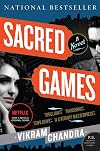
This doorstopper weighs 780 grams and has 947 pp. not including the glossary (which I am very thankful was included) or the other P.S. material included by Harper. However I never felt I was bogging down in detail or wishing it would just conclude. It was an eye-opening read about India and I am glad I finally read this book.
It's hard for me to condense this book into a paragraph or two but I'll give it a try. The main story involves a policeman in Mumbai, one Sartaj Singh. His father was show more also a policeman but he has been dead for some time. His mother, who was born in the Punjab which became part of Pakistan after Partition, was still alive but lived outside of Mumbai in a small hill town. As would be obvious to anyone from the Indian subcontinent Sartaj Singh is a Sikh. He is divorced so he spends most of his waking hours working. One day he gets a phone call in the early morning telling him where he can find the notorious crime boss Ganesh Gaitonde. This is quite a coup because Gaitonde was thought to be in hiding outside of India. Gaitonde is living in an almost indestructible underground bunker and before Sartaj manages to break down the upper structure he talks at some length to Sartaj. As Sartaj breaks in Gaitonde shoots himself; there is also the body of a woman in the bunker with him. Before Sartaj can really do a proper investigation the case is taken over by members of the Indian spy agency. However, Sartaj is asked to do some work on the case and doing so he discovers that the dead woman was JoJo Mascarenas, a television producer and agent for actors and actresses. This brings him into contact with JoJo's sister, Mary, with whom he falls in love. He also helps uncover a plot by the Pakistani government to flood the Indian economy with fake money and another plot by a religious zealot to explode a nuclear device in Mumbai. Sartaj also has more mundane duties like intervening in a marital dispute and picking up bribes for his superior officer. Sartaj is not a perfect person but the reader can't help but like him.
The main plot is interspersed with other narrative threads with one very significant exploration of Ganesh Gaitonde's life which his spirit narrates after his corporeal death. This is a look at the dark underbelly of Mumbai and beyond and it should have been highly distasteful but was somehow fascinating (sort of like looking at a traffic accident as you drive by). There was also a thread about how the Indian Partition affected Sartaj's mother and her family which was heartbreaking.
There are characters from all the different religions in India which I found particularly interesting. Chandra shows everyone as having good and bad qualities just as real people do. One comes away from reading this book with an admiration for how well the Indian society works despite all the different beliefs. show less
It's hard for me to condense this book into a paragraph or two but I'll give it a try. The main story involves a policeman in Mumbai, one Sartaj Singh. His father was show more also a policeman but he has been dead for some time. His mother, who was born in the Punjab which became part of Pakistan after Partition, was still alive but lived outside of Mumbai in a small hill town. As would be obvious to anyone from the Indian subcontinent Sartaj Singh is a Sikh. He is divorced so he spends most of his waking hours working. One day he gets a phone call in the early morning telling him where he can find the notorious crime boss Ganesh Gaitonde. This is quite a coup because Gaitonde was thought to be in hiding outside of India. Gaitonde is living in an almost indestructible underground bunker and before Sartaj manages to break down the upper structure he talks at some length to Sartaj. As Sartaj breaks in Gaitonde shoots himself; there is also the body of a woman in the bunker with him. Before Sartaj can really do a proper investigation the case is taken over by members of the Indian spy agency. However, Sartaj is asked to do some work on the case and doing so he discovers that the dead woman was JoJo Mascarenas, a television producer and agent for actors and actresses. This brings him into contact with JoJo's sister, Mary, with whom he falls in love. He also helps uncover a plot by the Pakistani government to flood the Indian economy with fake money and another plot by a religious zealot to explode a nuclear device in Mumbai. Sartaj also has more mundane duties like intervening in a marital dispute and picking up bribes for his superior officer. Sartaj is not a perfect person but the reader can't help but like him.
The main plot is interspersed with other narrative threads with one very significant exploration of Ganesh Gaitonde's life which his spirit narrates after his corporeal death. This is a look at the dark underbelly of Mumbai and beyond and it should have been highly distasteful but was somehow fascinating (sort of like looking at a traffic accident as you drive by). There was also a thread about how the Indian Partition affected Sartaj's mother and her family which was heartbreaking.
There are characters from all the different religions in India which I found particularly interesting. Chandra shows everyone as having good and bad qualities just as real people do. One comes away from reading this book with an admiration for how well the Indian society works despite all the different beliefs. show less
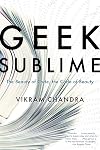
I am a computer programmer... I have designed and built computer circuit - LS7400 and wire-wrap! - written simple operating systems, I/O device drivers, and lots of application code. Half of Chandra's book is about hardware and software technology. It was well written and pulls in tasty morsels - e.g. a nice story of programming on a machine with drum storage, and using placement of instructions on the drum to introduce desired delay - so I was never bored or felt like skipping anything.
I am show more also a student of Indian philosophy. Chandra here dives into the rasa aesthetic theory of Abhinavagupta. I have heard a bit about that before but never in any depth at all. Chandra sketches out the basics very nicely. I felt like I really learned something.
I'm not exactly sure how these two parts of the book were intended to fit together. Certainly it was a delight to learn about Panini's grammar and how that has given Sanskrit a formal structure and a kind of timeless quality. But then the rasa theory shows how meaning is not really so timeless, since it depends on resonance with memories of the reader.
I think the idea is to contrast this time-dependent quality of literature with the mechanical timelessness of software. But really most software is hardly self-contained at all It's shot through with interfaces to other packages and services. That's a lot of why software needs to be maintained, because the other systems it's connected to are always changing. The meaning of software is also quite time-dependent! Or maybe that was Chandra's point and I just missed it? Or maybe, rasa-style, he just suggested it so it feels like I figured it out for myself? Not impossible!
The book felt like a short little wade on the edge of a vast ocean, maybe like in South Africa, where the Indian and Atlantic Oceans meet. show less
I am show more also a student of Indian philosophy. Chandra here dives into the rasa aesthetic theory of Abhinavagupta. I have heard a bit about that before but never in any depth at all. Chandra sketches out the basics very nicely. I felt like I really learned something.
I'm not exactly sure how these two parts of the book were intended to fit together. Certainly it was a delight to learn about Panini's grammar and how that has given Sanskrit a formal structure and a kind of timeless quality. But then the rasa theory shows how meaning is not really so timeless, since it depends on resonance with memories of the reader.
I think the idea is to contrast this time-dependent quality of literature with the mechanical timelessness of software. But really most software is hardly self-contained at all It's shot through with interfaces to other packages and services. That's a lot of why software needs to be maintained, because the other systems it's connected to are always changing. The meaning of software is also quite time-dependent! Or maybe that was Chandra's point and I just missed it? Or maybe, rasa-style, he just suggested it so it feels like I figured it out for myself? Not impossible!
The book felt like a short little wade on the edge of a vast ocean, maybe like in South Africa, where the Indian and Atlantic Oceans meet. show less
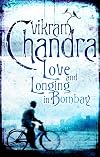
A while back, I read Vikram Chandra’s debut novel Red Earth and Pouring Rain, and loved it – it was everything Magical Realism always promises to be but so rarely really is – it combines a rich, sensual writing that lets the reader soak in the sights, sound and smells of a vivdly evoked reality with a fertile, proliferating imagination that transforms that reality into something even richer and stranger but which still gives us a perspective on our world as it is – distorts it into show more clarity, to appropriate a famous phrase from Bertolt Brecht.
Love and Longing in Bombay is a collection of five stories, and it is quite different in tone from the novel, in so far as for the most part it sticks with traditional realism… or at least appears to. To me at least, there seemed to be a certain amount of litary pastiche involved, in so far as each of the stories is framed, placed in a setting where it is told verbally by a narrator to an audience, in a manner that I found very reminiscent of Joseph Conrad’s Marlow (or possibly the short fiction of Rudyard Kipling, who was also rather fond of that narrative device).
Each of the stories is named after a concept taken from Hinduistic philosophy - of which I have to confess that I do not have the first clue. I had to look the terms up in Wikipedia, but even at such a superficial level, having some idea what the concepts mean does shed some additional light on the individual stories. Both the narrative frame and the titles offer a perspective on the stories from the outside looking in, some rudimentary explanation or interpretetation, and both seem to presuppose that the stories are an illustration of some larger concept, or an example for a truth about life. Rather interestingly though, they never are the same, whilte the narrator Mr. Subramaniam always offers the stories to illustrate some point, that point never seems to stand in any correlation to the title the author gave the stories - the perspectives intersect, but are not identical.
The final story in the collection, though, is markedly different from the others: its title refers not just to a concept, but also to a name, and it is only one in which the narrator himself, Mr. Subramaniam, plays an active part. As if that was not enough to raise it to a meta-lavel, its plot also mainly consists of its two protagonists telling each other stories (which are given inside the story, but never as told by their original narrator, always passed on through an intermediary). This story strays quite far from the realism of the others, and I very much doubt it is coincidence that it is also the only one that (for the most part) does not take place in Bombay – making it appear as if Bombay was the gravitational centre of realism – or even reality – in India, with things becoming increasingly more fantastic the farther one moves away from it. show less
Love and Longing in Bombay is a collection of five stories, and it is quite different in tone from the novel, in so far as for the most part it sticks with traditional realism… or at least appears to. To me at least, there seemed to be a certain amount of litary pastiche involved, in so far as each of the stories is framed, placed in a setting where it is told verbally by a narrator to an audience, in a manner that I found very reminiscent of Joseph Conrad’s Marlow (or possibly the short fiction of Rudyard Kipling, who was also rather fond of that narrative device).
Each of the stories is named after a concept taken from Hinduistic philosophy - of which I have to confess that I do not have the first clue. I had to look the terms up in Wikipedia, but even at such a superficial level, having some idea what the concepts mean does shed some additional light on the individual stories. Both the narrative frame and the titles offer a perspective on the stories from the outside looking in, some rudimentary explanation or interpretetation, and both seem to presuppose that the stories are an illustration of some larger concept, or an example for a truth about life. Rather interestingly though, they never are the same, whilte the narrator Mr. Subramaniam always offers the stories to illustrate some point, that point never seems to stand in any correlation to the title the author gave the stories - the perspectives intersect, but are not identical.
The final story in the collection, though, is markedly different from the others: its title refers not just to a concept, but also to a name, and it is only one in which the narrator himself, Mr. Subramaniam, plays an active part. As if that was not enough to raise it to a meta-lavel, its plot also mainly consists of its two protagonists telling each other stories (which are given inside the story, but never as told by their original narrator, always passed on through an intermediary). This story strays quite far from the realism of the others, and I very much doubt it is coincidence that it is also the only one that (for the most part) does not take place in Bombay – making it appear as if Bombay was the gravitational centre of realism – or even reality – in India, with things becoming increasingly more fantastic the farther one moves away from it. show less
Why did Ganesh Gaitonde, Mafia-style Indian crime lord, return to Mumbai to commit suicide?
This question is central to the plot of this very good police procedural. Two protagonists are driven to find the answer: Sartaj Singh, an divorced inspector with the Mumbai police department, and Gaitonde himself, who narrates his life story--after his suicide.
While true to its genre, Sacred Games is much more than a police procedural. The story could not have taken place outside of Mumbai; indeed, at show more one time or another, all the major characters talk about their love or need for this sprawling, dirty, polluted, completely corrupt city. The book abounds with descriptions of neighborhoods, important buildings, stores, restaurants, street vendors, and everything else that makes up the vital life of this city.
The same is true for the people as well; we meet them from every walk of life, from the beggars through the lowest criminal through socialites, businessmen--and film stars. What Chandra shows is the (to me) truly astonishing obsession Indians have with films, from the songs to the actors and actresses who star in them, and who occupy the fantasies of those in every stratum of Indian life. Bollywood and its culture play a major role in the story.
The book is structured in an interesting way: third person narrative of Sartaj Singh’s role with first-person narrative by Gaitonde. From time to time, Chandra inserts other related material in just that way: chapters he calls inserts.
I enjoyed the story and found the abundant information about Mumbai fascinating. Chandra liberally uses Hindi and other vocabulary, particularly street slang, throughout the book; while there’s a glossary in the back, it’s nowhere near adequate. Plus, this is a long, long book, 947 pages, and after a while, the need to check constantly with the glossary becomes annoying, especially when the word you’re looking for isn’t there. The length seems necessary given Chandra’s goals, but the book does tend to bog down in the middle. What keeps up the interest, though, is Gaitonde, who is a great character. Even while other parts lag, Gaitonde is always fascinating, as we learn about his life through his eyes, his intriguing spiritual quest, and his descent into his own particular hell. Without Gaitonde, the book would be mediocre, no matter how much detail of Mumbai life Chandra crams into the story.
If you are interested in indian life, and want to read more abut the way Indians look at Bollywood, then this is a good book; the police procedural part is nicely nested within all that information. But it is not a book I would recommend on either its literary or entertainment merits. show less
This question is central to the plot of this very good police procedural. Two protagonists are driven to find the answer: Sartaj Singh, an divorced inspector with the Mumbai police department, and Gaitonde himself, who narrates his life story--after his suicide.
While true to its genre, Sacred Games is much more than a police procedural. The story could not have taken place outside of Mumbai; indeed, at show more one time or another, all the major characters talk about their love or need for this sprawling, dirty, polluted, completely corrupt city. The book abounds with descriptions of neighborhoods, important buildings, stores, restaurants, street vendors, and everything else that makes up the vital life of this city.
The same is true for the people as well; we meet them from every walk of life, from the beggars through the lowest criminal through socialites, businessmen--and film stars. What Chandra shows is the (to me) truly astonishing obsession Indians have with films, from the songs to the actors and actresses who star in them, and who occupy the fantasies of those in every stratum of Indian life. Bollywood and its culture play a major role in the story.
The book is structured in an interesting way: third person narrative of Sartaj Singh’s role with first-person narrative by Gaitonde. From time to time, Chandra inserts other related material in just that way: chapters he calls inserts.
I enjoyed the story and found the abundant information about Mumbai fascinating. Chandra liberally uses Hindi and other vocabulary, particularly street slang, throughout the book; while there’s a glossary in the back, it’s nowhere near adequate. Plus, this is a long, long book, 947 pages, and after a while, the need to check constantly with the glossary becomes annoying, especially when the word you’re looking for isn’t there. The length seems necessary given Chandra’s goals, but the book does tend to bog down in the middle. What keeps up the interest, though, is Gaitonde, who is a great character. Even while other parts lag, Gaitonde is always fascinating, as we learn about his life through his eyes, his intriguing spiritual quest, and his descent into his own particular hell. Without Gaitonde, the book would be mediocre, no matter how much detail of Mumbai life Chandra crams into the story.
If you are interested in indian life, and want to read more abut the way Indians look at Bollywood, then this is a good book; the police procedural part is nicely nested within all that information. But it is not a book I would recommend on either its literary or entertainment merits. show less
Lists
All Things India (2)
Global Mysteries (1)
Awards


You May Also Like


Associated Authors
Statistics
- Works
- 12
- Also by
- 4
- Members
- 4,055
- Popularity
- #6,207
- Rating
- 3.8
- Reviews
- 84
- ISBNs
- 108
- Languages
- 10
- Favorited
- 10