
Derrick Jensen
Author of A language older than words
About the Author
Derrick Jensen is the best-known voice, of the growing deep ecology movement. Winner of numerous awards and honors including the Eric Hoffer Book Award, USA Today's Critic's Choice, and Press Action s Person of the Year, Jensen is the author of over fifteen books, including Endgame, A Language show more Older Than Words, What We Leave Behind (with Aric McBay) and Deep Green Resistance (with McBay and Lierre Keith). Philosopher, teacher, and radical activist, he regularly stirs packed auditoriums across the country with revolutionary spirit. Jensen holds degrees in creative writing and mineral engineering physics. He lives in Crescent City, California. show less
Image credit: derrickjensen.org
Series
Works by Derrick Jensen
Welcome to the Machine: Science, Surveillance, and the Culture of Control (2004) 154 copies, 2 reviews
Bright Green Lies: How the Environmental Movement Lost Its Way and What We Can Do About It (Politics of the Living) (2021) 69 copies, 12 reviews
Railroads and Clearcuts: Legacy of Congress's 1864 Northern Pacific Railroad Land Grant (1995) 32 copies
Endgame, Vols. 1+2 2 copies
Deep Green Resistance. Tome 2 - un Mouvement pour Sauver la Planete (Tome 2) (2019) 1 copy, 1 review
Ecologie en résistance Stratégies pour une Terre en péril Vol. 1: Stratégies pour une Terre en péril (French Edition) (2018) 1 copy
Unsettling Ourselves 1 copy
Associated Works
Mythmakers and Lawbreakers: Anarchist Writers on Fiction (2010) — Contributor — 111 copies, 1 review
Tagged
Common Knowledge
- Birthdate
- 1960-12-19
- Gender
- male
- Education
- Eastern Washington University
- Nationality
- USA
- Places of residence
- Crescent City, California, USA
- Associated Place (for map)
- California, USA
Members
Reviews

I keep trying to read and like Derrick Jensen, and I keep failing. My last serious attempt was with Endgame many, many years ago; and here I tried again.
Again, I found I agreed with much of it, but the parts I disagreed with were as close to batshit insane as one can get within the printed confines of a book. As Dreams progressed it gradually became more and more repetitive, grandiose, bizarre and incoherent. By the end I was grimly hanging on with my fingernails just to be able to say I show more finished the damned thing.
In Dreams, Jensen argues that (literal) dreams (as in, stuff that happens in your head while you are sleeping) are actual messages from the Other Sides that tells you what you should do, especially if what your dreams are telling you is that you should dismantle and destroy industrial civilization, which is what his dreams tell him that he should do. Why this is what dreams ought to tell you, or what should be done with dreams that do not tell one to dismantle and destroy industrial civilization, is never made clear. He spends much time pondering these creatures on Other Sides, and wondering why it is they haven't intervened themselves to dismantle/destroy industrial civilization already; this also is never satisfactorily resolved, possibly because it's a ridiculous question. Assuming that, should these Other Sides exist, whatever lives there has the same values, perspectives, lifespans, perspectives on time, etc., as we do is surely among the most narcissistic of conclusions, and he has no trouble drawing it.
Now: in the 80% of the book where he urges people to take more seriously their own dreams, regardless of their source, act in accordance with their deeper values (particularly environmental), develop a meaningful spirituality that includes non-human nature, etc., he wrote beautifully and I found myself agreeing with his general points. Certainly his very pointed critiques of technology and techno-fetishism were well done, and he has some interesting critiques of science as well (though they, too, later foundered into incoherence and absurdity: there is no objective methodology to distinguish between his eco-warrior dreams of taking on the flesh-eating zombies and a fundamentalist christian's dreams of establishing dominion over the earth; if one is to evaluate them on the criteria he establishes for his own dreams, they are equally worthwhile and therefore neither provide any meaningful guide. Only science would provide such a methodology, and he has no trouble using and relying on it when it suits him, and then dismissing it as yet another religion when it comes to a conclusion he doesn't like). It's unfortunate that the 80% of the book that makes sense is so overshadowed by the end by all of the crap. I say this, incidentally, as a committed environmentalist who works and volunteers to do everything I can to "keep this culture from killing the planet," and who has no trouble listening to and relying on dreams etc. Interesting that my dreams do not tell me to start blowing up dams. I must be having the wrong ones. show less
Again, I found I agreed with much of it, but the parts I disagreed with were as close to batshit insane as one can get within the printed confines of a book. As Dreams progressed it gradually became more and more repetitive, grandiose, bizarre and incoherent. By the end I was grimly hanging on with my fingernails just to be able to say I show more finished the damned thing.
In Dreams, Jensen argues that (literal) dreams (as in, stuff that happens in your head while you are sleeping) are actual messages from the Other Sides that tells you what you should do, especially if what your dreams are telling you is that you should dismantle and destroy industrial civilization, which is what his dreams tell him that he should do. Why this is what dreams ought to tell you, or what should be done with dreams that do not tell one to dismantle and destroy industrial civilization, is never made clear. He spends much time pondering these creatures on Other Sides, and wondering why it is they haven't intervened themselves to dismantle/destroy industrial civilization already; this also is never satisfactorily resolved, possibly because it's a ridiculous question. Assuming that, should these Other Sides exist, whatever lives there has the same values, perspectives, lifespans, perspectives on time, etc., as we do is surely among the most narcissistic of conclusions, and he has no trouble drawing it.
Now: in the 80% of the book where he urges people to take more seriously their own dreams, regardless of their source, act in accordance with their deeper values (particularly environmental), develop a meaningful spirituality that includes non-human nature, etc., he wrote beautifully and I found myself agreeing with his general points. Certainly his very pointed critiques of technology and techno-fetishism were well done, and he has some interesting critiques of science as well (though they, too, later foundered into incoherence and absurdity: there is no objective methodology to distinguish between his eco-warrior dreams of taking on the flesh-eating zombies and a fundamentalist christian's dreams of establishing dominion over the earth; if one is to evaluate them on the criteria he establishes for his own dreams, they are equally worthwhile and therefore neither provide any meaningful guide. Only science would provide such a methodology, and he has no trouble using and relying on it when it suits him, and then dismissing it as yet another religion when it comes to a conclusion he doesn't like). It's unfortunate that the 80% of the book that makes sense is so overshadowed by the end by all of the crap. I say this, incidentally, as a committed environmentalist who works and volunteers to do everything I can to "keep this culture from killing the planet," and who has no trouble listening to and relying on dreams etc. Interesting that my dreams do not tell me to start blowing up dams. I must be having the wrong ones. show less
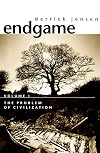
Jensen gets a ton of credit from me just having the balls (or ovaries, as he would qualify) to write this stuff. It is indeed a comprehensive and thorough analysis of the psychopathology of our civilization, perhaps the best I've read. He provides convincing arguments with such precision that it is difficult to refute them. His stance on violence has been revelatory for me, and has gone a long way toward helping me flesh out my own ideas on the subject.
That said, I do have problems with the show more book, mostly stylistic. The book is incredibly engaging for its length, but it gets bogged down at times, for various reasons:
-It is too long. He hammers the same points home over and over again (especially if you've already read [b:A Language Older Than Words|60970|A Language Older Than Words|Derrick Jensen|http://d.gr-assets.com/books/1348885063s/60970.jpg|2070741] and [b:The Culture of Make Believe|60973|The Culture of Make Believe|Derrick Jensen|http://d.gr-assets.com/books/1348888776s/60973.jpg|59301]), and I found myself skimming, especially toward the end of the book. I know that he's reserving it for the 2nd volume, but I got tired of hearing about how "we're going to get into" the stuff we can actually do to fix this, and never actually getting there over 450 pages.
-His narrative style is uneven. He vacillates between 1) a very informal and personal conversational style, bordering on cheesy, annoying or intrusive (including endnotes), and 2) erudite scholarship, showcasing his large vocabulary and impressive structure (even though pervasive use of words like "reification" and "palliate" were more confusing than clarifying). There seemed to be no real pattern between stylistic shifts, making it jarring and distracting.
-He comes across as not exactly arrogant, but maybe just pretentious and immature. This is most evident in his overuse of the [sic:] device, which is funny at first but then just becomes ridiculous. He should give his readers credit for being able to detect irony. Overall, Jensen strikes me as a fascinating guy, super-intelligent, and someone I'd definitely like to meet and have a conversation with. Though judging by his writing, any sort of regular social interactions would get annoying (there I go with some pretentiousness of my own).
-He does a good job of explaining (rationalizing?) his reluctance to blow up any dams himself, and I do admire his honesty and humility in confessing this. Nonetheless, it damages his credibility, and I imagine it will continue to do so until he eventually drops the keyboard and picks up the C4 (as he intimates he comes closer to doing every day). I respect and agree with his opinion that he is providing a unique service in his capacity as writer/speaker, but the credibility gap remains. When/if he takes the plunge, I'll certainly miss his writing, but be more impressed by his example. show less
That said, I do have problems with the show more book, mostly stylistic. The book is incredibly engaging for its length, but it gets bogged down at times, for various reasons:
-It is too long. He hammers the same points home over and over again (especially if you've already read [b:A Language Older Than Words|60970|A Language Older Than Words|Derrick Jensen|http://d.gr-assets.com/books/1348885063s/60970.jpg|2070741] and [b:The Culture of Make Believe|60973|The Culture of Make Believe|Derrick Jensen|http://d.gr-assets.com/books/1348888776s/60973.jpg|59301]), and I found myself skimming, especially toward the end of the book. I know that he's reserving it for the 2nd volume, but I got tired of hearing about how "we're going to get into" the stuff we can actually do to fix this, and never actually getting there over 450 pages.
-His narrative style is uneven. He vacillates between 1) a very informal and personal conversational style, bordering on cheesy, annoying or intrusive (including endnotes), and 2) erudite scholarship, showcasing his large vocabulary and impressive structure (even though pervasive use of words like "reification" and "palliate" were more confusing than clarifying). There seemed to be no real pattern between stylistic shifts, making it jarring and distracting.
-He comes across as not exactly arrogant, but maybe just pretentious and immature. This is most evident in his overuse of the [sic:] device, which is funny at first but then just becomes ridiculous. He should give his readers credit for being able to detect irony. Overall, Jensen strikes me as a fascinating guy, super-intelligent, and someone I'd definitely like to meet and have a conversation with. Though judging by his writing, any sort of regular social interactions would get annoying (there I go with some pretentiousness of my own).
-He does a good job of explaining (rationalizing?) his reluctance to blow up any dams himself, and I do admire his honesty and humility in confessing this. Nonetheless, it damages his credibility, and I imagine it will continue to do so until he eventually drops the keyboard and picks up the C4 (as he intimates he comes closer to doing every day). I respect and agree with his opinion that he is providing a unique service in his capacity as writer/speaker, but the credibility gap remains. When/if he takes the plunge, I'll certainly miss his writing, but be more impressed by his example. show less
Bright Green Lies: How the Environmental Movement Lost Its Way and What We Can Do About It (Politics of the Living) by Derrick Jensen
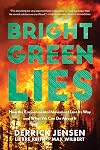
True environmentalists don’t buy into The Green New Deal. They think all the encouraging words from other environmentalists are bright green lies. Because at bottom, all the positive noises are simply a sop to industrialized society and the giant industries that run it. And according to Bright Green Lies, the book, it’s all about maintaining the current opulent lifestyle, and continuing to destroy the planet. No sacrifices will be made that might slow the consumer economy.
This dramatic, show more sane and passionate book lays out the lies with evidence like simple math and direct observation. It is a straightforward deconstruction of things like “renewable” energy, “sustainable” agriculture and pointless optimism that it is not too late if mankind would just take any kind of action right now. The book is wide-ranging and constantly challenging of common knowledge and perceptions. From hydropower to soil remediation, everything gets its moment to fail.
It is only not too late if mankind is willing to back away from 21st century luxuries. That means abandoning capitalism, because capitalism cannot stand retrenching. It is all about digging up resources without payment, while obtaining huge subsidies for doing it. And more. Always more.
Sadly, environmentalists are all about the subsidies too. Like all capitalists, they want government to foot the bill so they can succeed, financially. It is not about saving the planet at all, the authors have found. Lifestyle over ecology is the operating manifesto, whether they admit it or not say Derrick Jensen, Lierre Keith and Max Wilbert, the three authors of Bright Green Lies.
These three are clearly on the side of the planet. They even use the pronoun who for any animal, bird or insect, as if they were on the same plane as humans, a very nice touch in a relentless book of destructive practices bent on eliminating every other species and burning every bit of carbon:
-Extinctions have gone from just over a hundred a day to more than two hundred every day, just in our lifetime.
-Topsoil on the prairies has gone from 12 feet deep in the late 1800s, to inches today, requiring constant input of artificial fertilizers on what was once the most fertile land on the continent.
-“If your culture trashes your environment and destroys almost all the old growth forest in a couple of centuries, then your civilization is not sustainable.”
-Agriculture, the biggest crime of all, is “biotic cleansing”.
-Sustainable agriculture is an oxymoron.
-A green industrial facility is an impossibility.
A lot of the book is dedicated to debunking renewable systems. Solar, wind, tidal and geoengineering projects all require gigantic convoys of tax dollars, while providing no real reduction in greenhouse gases over fossil fuels. For one thing, all the mining, manufacturing, transporting, assembling and maintaining of these systems add tremendously to the environmental toll. Wind and solar are not dependable sources. And environmentalists lie about how they are taking over in some economies. Their math is bogus, cherry-picking short periods of otherwise slack demand on a sunny or windy off-day to report that renewables carried the burden almost entirely on their own. They then attribute dominance of renewables to the entire country. This, the book says, is how Germany got its reputation in wind and solar. The truth is much more pathetic. Environmentalists have learned to game the system.
There is an entire chapter on dams and hydropower, long considered the poster child for renewables and sustainables. The authors show how the dams (they say there are two million in the USA alone) wreak havoc with animals, birds, fish and insects as well as topsoil and air. The interruption of water flows prevents fish from doing what they must to contribute to the balance, with hundreds of other creatures dependent on them. Silts no longer flow downstream. Flooding no longer feeds the forests, meadows and plains. Species like the huge variety of salmon all over the world, now face extinction thanks to dams. The huge amount of natural resources commandeered to build and maintain the dams makes them far from benign players in the carbon buildup. Not to mention that they are responsible for nearly a quarter of the methane that escapes into the atmosphere from manmade sources. As with every method and means they explore, the chapter ends with the question – call this sustainable?
The same story applies in the chapters on wind and solar. It’s hard to tell which one is worse. They consume vast amounts of concrete, steel and rare earths. They are hugely expensive and are only competitive thanks to massive subsidies at every step. They kill endangered species. They are dependent on weather and so are not at all dependable sources of energy. There are scary stats to ponder: Scotland cleared 17,000 acres of 14 million trees to install wind energy systems. Was this a good trade?
Not for the first time, the authors show that mathematically, there just isn’t enough space, money or resources to make the whole civilization run on renewables. They say it would take 80 billion metric tons of extraction to effect the switch. The planet would basically have to devote everything it produces for years to come to pull off this conversion. And it wouldn’t be worth it because ultimately, renewables provide a net-zero reduction in carbon emissions per dollar. Not net zero as in carbon reduction, but net zero difference from fossil fuels. It’s an environmental con game for the authors.
Clearly, many environmentalists have been drinking the corporate Kool-Aid. They get agreement from Big Industry by softening their attacks and promising everyone can keep doing what they’re already doing while they somehow heal the planet. This is pie in the sky environmentalism. The truth is much more grim.
As long as corporations are considered people, they will hide their true calling – milking government and the planet for as much money as possible. And for anyone who has followed my reviews, it is clearly the corporations in their immoral quest to rule the world that all this rests on. The entire global economy is based on taking carbon out of the ground and putting it in the air by burning it. The cost of doing this is trivial; there is essentially no charge for it. Paying for the effects of it is not to be mentioned in the same breath as corporations.
One of the more insulting episodes is the ongoing LEED scam, in which high-priced engineers certify the environmental friendliness of buildings and factories. They give the example of the ideal home, displayed at a Las Vegas trade show in 2013. This LEED-certified platinum home is 7000 square feet, has a four-car garage and redundant energy systems. A perfect fit for the environmentally conscious American.
Another travesty I found is an energy report in The Economist. It projects that by just 2030, Saudi Arabia will consume as much energy just for air-conditioning as it sells in petroleum. This is nothing like sustainability. Sustainability is an urban legend – wishful thinking only.
For me, the most dramatic quote in the book comes from corporate anthropologist Jane Anne Morris. She wrote in Help! I’ve Been Colonized and I Can’t Get Up: “Corporate persons have constitutional rights to due process and equal protection that human persons, affected citizens, don’t have. For noncorporate human citizens, there’s a democracy theme park where we can pull levers on voting machines and talk into microphones at hearings. But don’t worry; they’re not connected to anything and nobody is listening except for us. What regulatory law regulates is citizen input, not corporate behavior.”
There is a remarkable chapter on recycling as well. The book examines the component parts of various recyclables, showing where they came from, what properties they have, how they are made, how they are saved, and how much of them can appear in new products. It is not very encouraging, though there are some bright spots. Bottles are recycled at the rate of 10%. Clothing is pretty much a disaster, with the average American consumer purchasing nearly 50 new pieces every year and disposing of others. Steel has a pretty decent story but it is clearly an exception.
When they speak publicly about their hard truths, the authors find there is quite naturally resistance. Participants refuse to consider solutions that would reduce their luxuries and their lifestyles. Their criticism is couched in - but that would hurt the economy! Which the authors take as further proof (if any were needed) that it is the economy that is destroying the planet.
There’s lots to argue about in these 400 pages. Just one example: they try to pin the death of birds on wind turbines, even to the drop in pressure from the blades that can burst the heart of a passing bird. The numbers they come up with amount to under two million, way down the list from the real killers.
Ordinary housecats annually kill 2.5 billion birds in North America alone. And for no reason other than boredom. The authors acknowledge this, but seem to think it is somehow natural, acceptable, and/or irrelevant, which it is not. The seven billion humans on this planet keep a billion cats as pets. Compare this to the 35 remaining Scottish wildcats the book mentions several times, or the 3000 total number of tigers left in the world. It is another instance of Man’s sheer weight upsetting yet another balance. We have domesticated the cat into a weapon of mass destruction for our own simple pleasure.
There are simply not enough fish in the ocean for a billion housecats, as we are finding out now. Housecats are not benign beings in the environment. Like Man, they are removed from the ecological system, not dependent on any other species and not participating in any other chain. Every other living thing is dependent on other beings for its existence and can only exist because of them. Not so Man. Or cats. These exceptions are proving to be intolerable to the health of the planet.
Their conclusion, they say, is simple: to stop destroying the planet, stop destroying the planet. They mean this literally. In the conclusions, they show that cleanup experiments from England to India show that nature rushes back in given half a chance. Grasses revitalize the soil, birds are attracted to the increased presence of insects, top predators keep the ruminants from destroying the plant growth, and the soil comes alive with literally trillions of interactions between species from bacteria on up the chain. Unexpected and unpredicted relationships show how quickly nature can restore the balance, but it means letting nature take control, and that is something Man will not even consider.
They take the 3Rs of environmentalism (Reduce, Reuse, Recycle) and add three of their own – Refuse, Resist, and Restore. These are fighting words and show the authors’ true colors.
Let there be no doubt, this is a tough book. The reality of restoring balance means Man sacrificing what he has built. Cities can never be carbon neutral. Vertical farming is a nice demo project, but it does not scale. Cities will always have to outsource to supply themselves, pushing the pollution and the carbon onto others, for a huge net loss – somewhere else. Industrial agriculture can never be sustainable. Nor can mining or manufacturing. As long as Man insists on transporting everything globally, the planet will suffer the consequences.
The book provides no acceptable path to success. It is either do it right now or suffer the consequences. But in a country where getting people to wear masks during a pandemic has failed miserably, and people protested for months when the government sought to eliminate incandescent light bulbs in favor of LEDs, any kind of sacrifice at all will not play. The authors show that stopping deforestation and restoring logged lands would remove more carbon from the air than is generated by all cars (over a billion of them). And a mere 2% increase in carbon sequestration in soil would offset 100% of greenhouse gas emissions. But there is zero will to do these things.
The prize will go to whomever figures out how to make palatable the sacrifices that are minimum requirements to save mankind from itself. Bright Green Lies isn’t it, but it does call out the environmental movement for its bogus positions and hypocrisy. Is that a help?
David Wineberg show less
This dramatic, show more sane and passionate book lays out the lies with evidence like simple math and direct observation. It is a straightforward deconstruction of things like “renewable” energy, “sustainable” agriculture and pointless optimism that it is not too late if mankind would just take any kind of action right now. The book is wide-ranging and constantly challenging of common knowledge and perceptions. From hydropower to soil remediation, everything gets its moment to fail.
It is only not too late if mankind is willing to back away from 21st century luxuries. That means abandoning capitalism, because capitalism cannot stand retrenching. It is all about digging up resources without payment, while obtaining huge subsidies for doing it. And more. Always more.
Sadly, environmentalists are all about the subsidies too. Like all capitalists, they want government to foot the bill so they can succeed, financially. It is not about saving the planet at all, the authors have found. Lifestyle over ecology is the operating manifesto, whether they admit it or not say Derrick Jensen, Lierre Keith and Max Wilbert, the three authors of Bright Green Lies.
These three are clearly on the side of the planet. They even use the pronoun who for any animal, bird or insect, as if they were on the same plane as humans, a very nice touch in a relentless book of destructive practices bent on eliminating every other species and burning every bit of carbon:
-Extinctions have gone from just over a hundred a day to more than two hundred every day, just in our lifetime.
-Topsoil on the prairies has gone from 12 feet deep in the late 1800s, to inches today, requiring constant input of artificial fertilizers on what was once the most fertile land on the continent.
-“If your culture trashes your environment and destroys almost all the old growth forest in a couple of centuries, then your civilization is not sustainable.”
-Agriculture, the biggest crime of all, is “biotic cleansing”.
-Sustainable agriculture is an oxymoron.
-A green industrial facility is an impossibility.
A lot of the book is dedicated to debunking renewable systems. Solar, wind, tidal and geoengineering projects all require gigantic convoys of tax dollars, while providing no real reduction in greenhouse gases over fossil fuels. For one thing, all the mining, manufacturing, transporting, assembling and maintaining of these systems add tremendously to the environmental toll. Wind and solar are not dependable sources. And environmentalists lie about how they are taking over in some economies. Their math is bogus, cherry-picking short periods of otherwise slack demand on a sunny or windy off-day to report that renewables carried the burden almost entirely on their own. They then attribute dominance of renewables to the entire country. This, the book says, is how Germany got its reputation in wind and solar. The truth is much more pathetic. Environmentalists have learned to game the system.
There is an entire chapter on dams and hydropower, long considered the poster child for renewables and sustainables. The authors show how the dams (they say there are two million in the USA alone) wreak havoc with animals, birds, fish and insects as well as topsoil and air. The interruption of water flows prevents fish from doing what they must to contribute to the balance, with hundreds of other creatures dependent on them. Silts no longer flow downstream. Flooding no longer feeds the forests, meadows and plains. Species like the huge variety of salmon all over the world, now face extinction thanks to dams. The huge amount of natural resources commandeered to build and maintain the dams makes them far from benign players in the carbon buildup. Not to mention that they are responsible for nearly a quarter of the methane that escapes into the atmosphere from manmade sources. As with every method and means they explore, the chapter ends with the question – call this sustainable?
The same story applies in the chapters on wind and solar. It’s hard to tell which one is worse. They consume vast amounts of concrete, steel and rare earths. They are hugely expensive and are only competitive thanks to massive subsidies at every step. They kill endangered species. They are dependent on weather and so are not at all dependable sources of energy. There are scary stats to ponder: Scotland cleared 17,000 acres of 14 million trees to install wind energy systems. Was this a good trade?
Not for the first time, the authors show that mathematically, there just isn’t enough space, money or resources to make the whole civilization run on renewables. They say it would take 80 billion metric tons of extraction to effect the switch. The planet would basically have to devote everything it produces for years to come to pull off this conversion. And it wouldn’t be worth it because ultimately, renewables provide a net-zero reduction in carbon emissions per dollar. Not net zero as in carbon reduction, but net zero difference from fossil fuels. It’s an environmental con game for the authors.
Clearly, many environmentalists have been drinking the corporate Kool-Aid. They get agreement from Big Industry by softening their attacks and promising everyone can keep doing what they’re already doing while they somehow heal the planet. This is pie in the sky environmentalism. The truth is much more grim.
As long as corporations are considered people, they will hide their true calling – milking government and the planet for as much money as possible. And for anyone who has followed my reviews, it is clearly the corporations in their immoral quest to rule the world that all this rests on. The entire global economy is based on taking carbon out of the ground and putting it in the air by burning it. The cost of doing this is trivial; there is essentially no charge for it. Paying for the effects of it is not to be mentioned in the same breath as corporations.
One of the more insulting episodes is the ongoing LEED scam, in which high-priced engineers certify the environmental friendliness of buildings and factories. They give the example of the ideal home, displayed at a Las Vegas trade show in 2013. This LEED-certified platinum home is 7000 square feet, has a four-car garage and redundant energy systems. A perfect fit for the environmentally conscious American.
Another travesty I found is an energy report in The Economist. It projects that by just 2030, Saudi Arabia will consume as much energy just for air-conditioning as it sells in petroleum. This is nothing like sustainability. Sustainability is an urban legend – wishful thinking only.
For me, the most dramatic quote in the book comes from corporate anthropologist Jane Anne Morris. She wrote in Help! I’ve Been Colonized and I Can’t Get Up: “Corporate persons have constitutional rights to due process and equal protection that human persons, affected citizens, don’t have. For noncorporate human citizens, there’s a democracy theme park where we can pull levers on voting machines and talk into microphones at hearings. But don’t worry; they’re not connected to anything and nobody is listening except for us. What regulatory law regulates is citizen input, not corporate behavior.”
There is a remarkable chapter on recycling as well. The book examines the component parts of various recyclables, showing where they came from, what properties they have, how they are made, how they are saved, and how much of them can appear in new products. It is not very encouraging, though there are some bright spots. Bottles are recycled at the rate of 10%. Clothing is pretty much a disaster, with the average American consumer purchasing nearly 50 new pieces every year and disposing of others. Steel has a pretty decent story but it is clearly an exception.
When they speak publicly about their hard truths, the authors find there is quite naturally resistance. Participants refuse to consider solutions that would reduce their luxuries and their lifestyles. Their criticism is couched in - but that would hurt the economy! Which the authors take as further proof (if any were needed) that it is the economy that is destroying the planet.
There’s lots to argue about in these 400 pages. Just one example: they try to pin the death of birds on wind turbines, even to the drop in pressure from the blades that can burst the heart of a passing bird. The numbers they come up with amount to under two million, way down the list from the real killers.
Ordinary housecats annually kill 2.5 billion birds in North America alone. And for no reason other than boredom. The authors acknowledge this, but seem to think it is somehow natural, acceptable, and/or irrelevant, which it is not. The seven billion humans on this planet keep a billion cats as pets. Compare this to the 35 remaining Scottish wildcats the book mentions several times, or the 3000 total number of tigers left in the world. It is another instance of Man’s sheer weight upsetting yet another balance. We have domesticated the cat into a weapon of mass destruction for our own simple pleasure.
There are simply not enough fish in the ocean for a billion housecats, as we are finding out now. Housecats are not benign beings in the environment. Like Man, they are removed from the ecological system, not dependent on any other species and not participating in any other chain. Every other living thing is dependent on other beings for its existence and can only exist because of them. Not so Man. Or cats. These exceptions are proving to be intolerable to the health of the planet.
Their conclusion, they say, is simple: to stop destroying the planet, stop destroying the planet. They mean this literally. In the conclusions, they show that cleanup experiments from England to India show that nature rushes back in given half a chance. Grasses revitalize the soil, birds are attracted to the increased presence of insects, top predators keep the ruminants from destroying the plant growth, and the soil comes alive with literally trillions of interactions between species from bacteria on up the chain. Unexpected and unpredicted relationships show how quickly nature can restore the balance, but it means letting nature take control, and that is something Man will not even consider.
They take the 3Rs of environmentalism (Reduce, Reuse, Recycle) and add three of their own – Refuse, Resist, and Restore. These are fighting words and show the authors’ true colors.
Let there be no doubt, this is a tough book. The reality of restoring balance means Man sacrificing what he has built. Cities can never be carbon neutral. Vertical farming is a nice demo project, but it does not scale. Cities will always have to outsource to supply themselves, pushing the pollution and the carbon onto others, for a huge net loss – somewhere else. Industrial agriculture can never be sustainable. Nor can mining or manufacturing. As long as Man insists on transporting everything globally, the planet will suffer the consequences.
The book provides no acceptable path to success. It is either do it right now or suffer the consequences. But in a country where getting people to wear masks during a pandemic has failed miserably, and people protested for months when the government sought to eliminate incandescent light bulbs in favor of LEDs, any kind of sacrifice at all will not play. The authors show that stopping deforestation and restoring logged lands would remove more carbon from the air than is generated by all cars (over a billion of them). And a mere 2% increase in carbon sequestration in soil would offset 100% of greenhouse gas emissions. But there is zero will to do these things.
The prize will go to whomever figures out how to make palatable the sacrifices that are minimum requirements to save mankind from itself. Bright Green Lies isn’t it, but it does call out the environmental movement for its bogus positions and hypocrisy. Is that a help?
David Wineberg show less

I loved the premise of this book- a group of knitting friends who discover they have all been raped at one time or another and all the rapists have got off scot free, so they decide to take justice into their well exercised hands. With a little help from their knitting needles...
The book is crazy funny but also cuts close to reality (as all good humour must). There's a female cop who is, of course, never listened to. There are groups of men who don't believe in rape because the Bible...and show more enough governmental acronyms to choke several horses, even if they were BCHs (bigClysedale horses). Tongue firmly in cheek, it blasts the gormless and violent men of the world- makes them ridiculous.
The final triumph is a duel, but I must say no more...
It's a light read, sometimes over the top, but my golly it is worth the time! show less
The book is crazy funny but also cuts close to reality (as all good humour must). There's a female cop who is, of course, never listened to. There are groups of men who don't believe in rape because the Bible...and show more enough governmental acronyms to choke several horses, even if they were BCHs (bigClysedale horses). Tongue firmly in cheek, it blasts the gormless and violent men of the world- makes them ridiculous.
The final triumph is a duel, but I must say no more...
It's a light read, sometimes over the top, but my golly it is worth the time! show less
Lists
Awards


You May Also Like


Associated Authors
Statistics
- Works
- 51
- Also by
- 2
- Members
- 4,423
- Popularity
- #5,663
- Rating
- 4.1
- Reviews
- 77
- ISBNs
- 97
- Languages
- 2
- Favorited
- 29

