
Vandana Shiva
Author of Stolen Harvest: the Hijacking of the Global Food Supply
About the Author
Vandana Shiva is a world-renowned environmental leader, activist, and scholar who has dedicated her life to defending the sovereignty of biological and Indigenous knowledge.
Works by Vandana Shiva
Who Really Feeds the World?: The Failures of Agribusiness and the Promise of Agroecology (2015) 94 copies
The Violence of the Green Revolution: Third World Agriculture, Ecology and Politics (1991) 92 copies, 1 review
Reclaiming the Commons: Biodiversity, Traditional Knowledge, and the Rights of Mother Earth (2020) 45 copies
Seed Sovereignty, Food Security: Women in the Vanguard of the Fight against GMOs and Corporate Agriculture (2015) 32 copies
Agroecology and Regenerative Agriculture: Sustainable Solutions for Hunger, Poverty, and Climate Change (2022) 18 copies, 1 review
Ecology and the Politics of Survival (United Nations university programme on peace & global transformation) (1991) 9 copies
The Seed Keepers 4 copies
Seeds of Suicide: The Ecological and Human Costs of the Globalization of Agriculture (2005) 3 copies
Food, Farming and Health: Respecting "Annam" - Agricultural Biodiversity and Traditional Indian Dietary Wisdom (2018) 2 copies
ANNADANA The Gift of God 1 copy
Eine Erde für alle! – Einssein versus das 1 %: Aufstehen gegen die Monokultur von Wirtschaft und Weltsicht (2021) 1 copy
සොරාගත් අස්වැන්න 1 copy
Seeds of Suicide The Ecological and Human Costs of Globalisation of Agriculture (2000) — Author — 1 copy
Roti Kapda aur Makaan: How 10 years of WTO have Robbed India of Lives and Livelihoods. (2006) 1 copy
Seed: the Untold Story 1 copy
Associated Works
The Feminist Standpoint Theory Reader: Intellectual and Political Controversies (2004) — Contributor, some editions — 69 copies
The Case Against Free Trade: GATT, NAFTA, and the Globalization of Corporate Power (1993) — Contributor — 58 copies, 1 review
Tagged
Common Knowledge
- Other names
- Shiva Navdanya, Vandana
- Birthdate
- 1952-11-05
- Gender
- female
- Education
- University of Western Ontario (PhD|Philosophy|1978))
University of Guelph (BS|Physics) - Occupations
- physicist
environmental activist
author - Organizations
- International Forum on Globalization
Chipko Movement
International Organization for a Participatory Society
La Fundación IDEAS - Awards and honors
- Right Livelihood Award (also known as the 'Alternative Nobel Prize' ∙ 1993)
Global 500 Award of the United Nations Environment Programme (UNEP ∙ 1993)
Earth Day International Award of the United Nations (UN ∙ 1993)
Order of the Golden Ark (Netherlands ∙ 1993)
International Award (Spain ∙ 1993)
The Golden Plant Award (International Award of Ecology ∙ 1997) (show all 8)
Save The World Award (2009)
...and numerous other awards from around the world! - Short biography
- Vandana Shiva (b. November 5, 1952, Dehra Dun, Uttarakhand, India), is a philosopher, environmental activist, eco feminist and author of several books. Shiva, currently based in Delhi, is author of over 300 papers in leading scientific and technical journals. She received her Ph.D. in physics from the University of Western Ontario, Canada, in 1978 with the doctoral dissertation:“Hidden Variables and Non-locality in Quantum Theory”. Shiva participated in the nonviolent Chipko movement during the 1970s. The movement, some of whose main participants were women, adopted the approach of forming human circles around trees to prevent their felling. She is one of the leaders of the International Forum on Globalization, (along with Jerry Mander, Edward Goldsmith, Ralph Nader, Jeremy Rifkin, et al.), and a figure of the global solidarity movement known as the alter-globalization movement. She has argued for the wisdom of many traditional practices, as is evident from her interview in the book "Vedic Ecology" (by Ranchor Prime) that draws upon India's Vedic heritage.
- Nationality
- India
- Birthplace
- Dehradun, Uttarakhand, India
- Places of residence
- Delhi, India
- Associated Place (for map)
- India
Members
Reviews
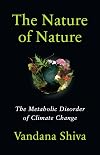
In The Nature of Nature, world-renowned environmental thinker and activist Vandana Shiva argues that food is the currency of life, a thread woven throughout the web of all life, indivisible from Earth and its natural systems. When this interdependence is ruptured—as it is now—the conditions for the “metabolic disorder” of climate change and countless other ecological imbalances come into being.
Proposals put forward by Big Ag and Big Tech to solve the intertwined climate and food show more crises will only exacerbate both. With clarity and a detailed analysis, Shiva unpacks the false promises made by technology-oriented, lab-intensive digital agriculture, revealing the dangers posed by fake and ultra-processed foods—dangers to the environment, to increasing greenhouse gas emissions, to the health of animals, and to our health and food security.
In The Nature of Nature, Shiva takes a powerful stand, arguing with urgency and passion for a food and climate future based not on techno-optimism, hallucination, and corporate delusions, but on the natural regeneration of biodiversity in partnership with the biosphere. show less
Proposals put forward by Big Ag and Big Tech to solve the intertwined climate and food show more crises will only exacerbate both. With clarity and a detailed analysis, Shiva unpacks the false promises made by technology-oriented, lab-intensive digital agriculture, revealing the dangers posed by fake and ultra-processed foods—dangers to the environment, to increasing greenhouse gas emissions, to the health of animals, and to our health and food security.
In The Nature of Nature, Shiva takes a powerful stand, arguing with urgency and passion for a food and climate future based not on techno-optimism, hallucination, and corporate delusions, but on the natural regeneration of biodiversity in partnership with the biosphere. show less

This book is classic of the environmental movement. In it, Vandana Shiva envisions a world beyond our current dependence on fossil fuels and globalization, and makes the compelling case that food crises, oil dependency and climate change are all inherently interlinked. Any attempt to solve one without addressing the others is therefore doomed to failure.Condemning industrial agriculture and biofuels as recipes for ecological and economic disaster, Shiva instead champions small independent show more farmers. What is needed most, in a time of hunger and changing climates, are sustainable, biologically diverse farms that are better able to resist disease, drought and flooding. Calling for a return to local economies and small-scale agriculture, Shiva argues that humanity's choice is a stark one: we can either continue to pursue a market-centred approach, which will ultimately make our planet unliveable, or we can instead strive for a people-centred, oil-free future, one which offers a decent living for all.This edition features a new introduction by the author, in which she outlines recent developments in ecology and environmentalism, and offers new prescriptions for the environmental movement. show less
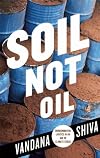
Vandana Shiva is the author and editor of countless books, including Water Wars and Stolen Harvest, and is a leader in the global movement towards sustainability. Her latest book Soil Not Oil: Environmental Justice in an Age of Climate Crisis gives readers an articulate and well-researched discussion of the politics of global warming.
While many contemporary books addressing global warming tend to focus on man-made vs. natural causes or “green lifestyle change”-oriented solutions, show more Shiva’s latest book is grounded in a deeper, more political context. Rather than discuss climate change in a vacuum, Shiva recognizes and explores the climate crisis’ intimate relationship to the compounding issues of peak oil and global food insecurity. The book adeptly shows how globalization, capitalism and industrialization worked together to directly produce a triple crisis that threatens our very survival as a species. Through impassioned prose and stark statistics, Shiva also demonstrates global warming’s disproportional impact on the global South, using her native India as an example. Rounding out her discussion of the underlying currents of climate change, Shiva critiques inadequate and counter-productive solutions to the problem, like carbon trading, nuclear energy and industrial biofuels.
Moving beyond a mere “doom and gloom” narrative of the woes of our current era, Shiva interlaces her sharp analysis with specific recommendations to counter the potentially devastating effects of climate change. Calling for a transition to local, post-oil economies rooted in ecological sustainability, Shiva clearly illustrates the logic of her philosophy of Earth Democracy. Insightful and eloquent as always, Vandana Shiva’s Soil Not Oil should appeal to anyone who wants to more fully understand the interlocking issues surrounding climate change, and anyone who wants to do something about it. show less
While many contemporary books addressing global warming tend to focus on man-made vs. natural causes or “green lifestyle change”-oriented solutions, show more Shiva’s latest book is grounded in a deeper, more political context. Rather than discuss climate change in a vacuum, Shiva recognizes and explores the climate crisis’ intimate relationship to the compounding issues of peak oil and global food insecurity. The book adeptly shows how globalization, capitalism and industrialization worked together to directly produce a triple crisis that threatens our very survival as a species. Through impassioned prose and stark statistics, Shiva also demonstrates global warming’s disproportional impact on the global South, using her native India as an example. Rounding out her discussion of the underlying currents of climate change, Shiva critiques inadequate and counter-productive solutions to the problem, like carbon trading, nuclear energy and industrial biofuels.
Moving beyond a mere “doom and gloom” narrative of the woes of our current era, Shiva interlaces her sharp analysis with specific recommendations to counter the potentially devastating effects of climate change. Calling for a transition to local, post-oil economies rooted in ecological sustainability, Shiva clearly illustrates the logic of her philosophy of Earth Democracy. Insightful and eloquent as always, Vandana Shiva’s Soil Not Oil should appeal to anyone who wants to more fully understand the interlocking issues surrounding climate change, and anyone who wants to do something about it. show less

This is probably one of the best books I've read about agricultural environmentalism, especially as far as solutions for change go. Shiva doesn't pretend that global food exports or genetically modified crops are going to save us, because they're not. Instead she advocates for purely local, non industrial solutions to the future of agriculture.
Do you want to know what sustainability really is? Read this book.
Do you want to know what sustainability really is? Read this book.
Lists
Awards


You May Also Like


Associated Authors
Statistics
- Works
- 107
- Also by
- 8
- Members
- 2,880
- Popularity
- #8,895
- Rating
- 3.8
- Reviews
- 25
- ISBNs
- 246
- Languages
- 15
- Favorited
- 5