
Abraham Foxman (1940–2026)
Author of Never Again?: The Threat of the New Anti-Semitism
About the Author
Abraham H. Foxman is the national director of the Anti-Defamation League (ADL) and one of today's preeminent voices against hatred, discrimination, and violence in the United States and worldwide. Born in Poland, he survived the Holocaust when his parents entrusted him to their Catholic nursemaid, show more who baptized him and raised him as her own son. Foxman has been with ADL for more than 35 years, and for nearly half of them he has served as the national director. He is the author of the Deadliest Lies: The Israel Lobby and the Myth of Jewish Control and Never Again?: The Threat of the New Anti-Semitism. Foxman has been awarded several honors including an Honorary Doctorate from Bar IIan University, Commendatore of the Italian Republic, the Raoul Wallenberg Humanitarian Leadership Award from the Center for Holocaust and Genocide Studies, and, in 2006, the Knight of the Legion of Honor, France's highest civilian honor. He lives in New York. show less
Works by Abraham Foxman
Mein Kampf 1 copy
Associated Works
Tagged
Common Knowledge
- Legal name
- Foxman, Abraham Henry
- Other names
- Fuksman, Avraham Chanoch Hanach (birth)
- Birthdate
- 1940-05-01
- Date of death
- 2026-05-10
- Gender
- male
- Education
- Yeshivah of Flatbush, Brooklyn, New York City
New York University School of Law - Occupations
- lawyer
activist - Organizations
- Anti-Defamation League (National director, 1987 to 2015)
Museum of Jewish Heritage, Center for the Study of Anti-Semitism, New York City (head, 2016) - Nationality
- USA
- Birthplace
- Baranovichi, Byelorussian SSR, USSR
- Associated Place (for map)
- Baranovichi, Byelorussian SSR, USSR
Members
Reviews

Discussing what to do about hate speech online is like discussing what to do about a genocidal dictator in a foreign country. Agreeing that it’s loathsome, and the world would be better off without it, is easy. Agreeing that getting rid of it will be a challenge (do it wrong, and the side-effects may turn out to be worse than the original problem) is also easy. Figuring out how to get rid of it, and what price you’re willing to pay in order to do so, is mind-bendingly hard.
The authors show more of Viral Hate spend roughly two-thirds of their 180 pages of text covering the easy stuff. They explain, with a lawyerly concern for precision and detail, what hate speech is, why it damages society, how government attempts to regulate it have collided with the First Amendment to the Constitution, and why private entities (which can limit speech as they see fit) have considerably more power and latitude to act. They catalog the extensive gray areas that make all but the most extreme forms of hate speech difficult to regulate, and outline the abundant reasons why overzealous regulation of hate speech has the potential to abridge freedom of speech, conscience, and assembly. All that, however, takes up a great deal of space, and leaves Foxman and Wolf correspondingly little time to articulate a solution. They outline the framework—“self-policing” of hate speech in online “public squares” by the users themselves, backed by companies willing to frame (and enforce) community norms—but the details are left as an exercise for the reader.
This unwillingness to engage with the details diminishes the book in two critical ways. First, it implies that the working-out of those details will be a straightforward, organic process: that unofficial governing bodies will emerge naturally from online communities numbering in the thousands or millions, that definitions of “hate speech” can (despite the gray areas) be crowd-sourced unproblematically, and that the side-effects of whatever mechanisms and definitions emerge will be negligible. Second, it implies that the self-regulation of speech in online communities has never been seriously attempted—that Wikipedia, Slashdot, Reddit, and the rest (as well as the work of those who have thought about them) have nothing to teach us. Neither is true, and readers with a serious interest in online communities and how they operate will be frustrated by Foxman and Wolf’s airy, seat-of-the-pants approach to problems that Sherry Turkle, Jaron Lanier, and Clay Shirky (among others) have been thinking about—seriously and systematically, with close attention to the fine texture of the real thing—for decades.
Foxman and Wolf come from the world of law and public policy, and they’ve written a book that delves deeply into what they know and glides lightly over what they don’t. That is, perhaps, to be expected, but it serves neither the needs of readers, nor the realities of a complex problem, well. Add a star to my rating if you’re brand-new to debates about free speech and censorship; subtract one if you know how Justice Potter Stewart defined pornography. show less
The authors show more of Viral Hate spend roughly two-thirds of their 180 pages of text covering the easy stuff. They explain, with a lawyerly concern for precision and detail, what hate speech is, why it damages society, how government attempts to regulate it have collided with the First Amendment to the Constitution, and why private entities (which can limit speech as they see fit) have considerably more power and latitude to act. They catalog the extensive gray areas that make all but the most extreme forms of hate speech difficult to regulate, and outline the abundant reasons why overzealous regulation of hate speech has the potential to abridge freedom of speech, conscience, and assembly. All that, however, takes up a great deal of space, and leaves Foxman and Wolf correspondingly little time to articulate a solution. They outline the framework—“self-policing” of hate speech in online “public squares” by the users themselves, backed by companies willing to frame (and enforce) community norms—but the details are left as an exercise for the reader.
This unwillingness to engage with the details diminishes the book in two critical ways. First, it implies that the working-out of those details will be a straightforward, organic process: that unofficial governing bodies will emerge naturally from online communities numbering in the thousands or millions, that definitions of “hate speech” can (despite the gray areas) be crowd-sourced unproblematically, and that the side-effects of whatever mechanisms and definitions emerge will be negligible. Second, it implies that the self-regulation of speech in online communities has never been seriously attempted—that Wikipedia, Slashdot, Reddit, and the rest (as well as the work of those who have thought about them) have nothing to teach us. Neither is true, and readers with a serious interest in online communities and how they operate will be frustrated by Foxman and Wolf’s airy, seat-of-the-pants approach to problems that Sherry Turkle, Jaron Lanier, and Clay Shirky (among others) have been thinking about—seriously and systematically, with close attention to the fine texture of the real thing—for decades.
Foxman and Wolf come from the world of law and public policy, and they’ve written a book that delves deeply into what they know and glides lightly over what they don’t. That is, perhaps, to be expected, but it serves neither the needs of readers, nor the realities of a complex problem, well. Add a star to my rating if you’re brand-new to debates about free speech and censorship; subtract one if you know how Justice Potter Stewart defined pornography. show less
 This review was written for LibraryThing Early Reviewers.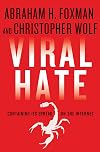
Two members of the Anti-Defamation League, a well-known watchdog group aimed at eliminating anti-Semitism in America, bring us a book about "viral hate," or the racism that spreads through social networking sites and the underbelly of the internet. The book provides examples of internet hatred, primarily racism and homophobia, and advises a number of methods for combating it.
I was surprised to find that this book is more of an advocacy work than a history or critical analysis of the rise of show more racism and other bigotry on the internet. While there are a number of interesting examples of what happens when internet racism and homophobia get out of control, I would have appreciated (and expected) more trend data. The authors seem to expect us to believe that the internet has catalyzed groups like neo-Nazis, without providing any trend data on these groups' activities or membership, and without engaging alternative explanations for their resurgence on the national scene, including the sharp reduction in factory jobs, the election of an African-American president, and the mainstream anti-immigrant rhetoric of the Republican party. Others have looked at these in connection with the recent rise of white supremacist groups, so it seemed a glaring omission to me that this book did not.
I should also note that for first amendment defenders such as myself, the arguments in this book aren't particularly persuasive. While the authors are clear in explaining the many things that private internet companies could do and clarifying that this is different from government action, which is bound by the Constitution, each time it came up, the argument seemed to circle back to, "But this is actually more important than free speech, and it'd be nice if we could make some headway without that pesky first amendment in the way." They fall all over the United Kingdom's ability to prosecute hate speech and say it's great that other countries don't have the same historical love for the concept of free speech. I was not exactly sold.
Also, I found the use of the term "hater" in this book to be distracting. For young folks, "hater" has a pop culture meaning, and I couldn't take it seriously as an interchangeable term to "bigot."
This book is worth reading for people who are interested in the topic of viral internet content and advocacy around hate speech/hate crimes. It isn't exactly revolutionary, but it's an interesting perspective for those of us who value the first amendment's free speech provision -- worth considering how "clear and present a danger" things like hate speech might be. Sadly, it will not satisfy your hunger for statistics or academic analysis. I am still looking for that. show less
I was surprised to find that this book is more of an advocacy work than a history or critical analysis of the rise of show more racism and other bigotry on the internet. While there are a number of interesting examples of what happens when internet racism and homophobia get out of control, I would have appreciated (and expected) more trend data. The authors seem to expect us to believe that the internet has catalyzed groups like neo-Nazis, without providing any trend data on these groups' activities or membership, and without engaging alternative explanations for their resurgence on the national scene, including the sharp reduction in factory jobs, the election of an African-American president, and the mainstream anti-immigrant rhetoric of the Republican party. Others have looked at these in connection with the recent rise of white supremacist groups, so it seemed a glaring omission to me that this book did not.
I should also note that for first amendment defenders such as myself, the arguments in this book aren't particularly persuasive. While the authors are clear in explaining the many things that private internet companies could do and clarifying that this is different from government action, which is bound by the Constitution, each time it came up, the argument seemed to circle back to, "But this is actually more important than free speech, and it'd be nice if we could make some headway without that pesky first amendment in the way." They fall all over the United Kingdom's ability to prosecute hate speech and say it's great that other countries don't have the same historical love for the concept of free speech. I was not exactly sold.
Also, I found the use of the term "hater" in this book to be distracting. For young folks, "hater" has a pop culture meaning, and I couldn't take it seriously as an interchangeable term to "bigot."
This book is worth reading for people who are interested in the topic of viral internet content and advocacy around hate speech/hate crimes. It isn't exactly revolutionary, but it's an interesting perspective for those of us who value the first amendment's free speech provision -- worth considering how "clear and present a danger" things like hate speech might be. Sadly, it will not satisfy your hunger for statistics or academic analysis. I am still looking for that. show less
This review was written for LibraryThing Early Reviewers.It's fascinating reading this book in the time of the alt-right, which has been a grassroots movement borne from the viral hate discussed in this book. I would love to read an updated version of this book in light of Trump's election and how viral hate movements made that possible and have now gone mainstream. This book touches upon some of the neo-Nazi movements we're seeing so prominently in action today and offers some concrete steps we can take to help fight these trolls, but again, it show more feels like that movement has spun so out of control that it's hard to deal with on a case-by-case basis. A timely topic but yeah, by now, the book is a bit dated. show less
This review was written for LibraryThing Early Reviewers.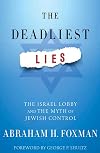
While not as engaging as Alan Dershowitz's Case... books on the subject, The Deadliest Lies is nevertheless a worthwhile book. Foxman manages to bring a few different perspectives to several of the issues and writes with a more easygoing style than does Dershowitz. At times Foxman got a bit repetitive and references to himself in the third person in one part of the book were a bit odd. Of course, the biggest problem with this book, like Dershowitz's Case... series, is that those who would show more most benefit from reading the arguments are probably least likely to read the book. On the other hand, the book does give Israel's supporters (as well as others who want to be able to argue against some of the lies or distortions that Foxman confronts) some ammunition to use to support their positions. show less
You May Also Like


Statistics
- Works
- 5
- Also by
- 1
- Members
- 242
- Popularity
- #93,892
- Rating
- 2.8
- Reviews
- 10
- ISBNs
- 12
- Languages
- 1
