

Donna Tartt
Author of The Secret History
About the Author
Donna Tartt was born in Greenwood, Mississippi on December 23, 1963. She wrote her first novel while attending Bennington College, where she graduated in 1986. The novel, The Secret History, was published in 1992. Her other works include The Little Friend, which won the WH Smith Literary Award in show more 2003, and The Goldfinch, which won the Pulitzer Prize in 2014 for Best Fiction, the National Book Critics Circle Award in 2013 and the Andrew Carnegie Medal for Excellence for Fiction. In 2014, Time named Tartt among their 100 Most Influential People. (Bowker Author Biography) show less
Works by Donna Tartt
Associated Works
Best of The Oxford American: Ten Years from the Southern Magazine of Good Writing {anthology} (2002) — Contributor — 45 copies
A Very Southern Christmas: Holiday Stories from the South’s Best Writers (2003) — Contributor — 35 copies, 1 review
Tagged
Common Knowledge
- Canonical name
- Tartt, Donna
- Legal name
- Tartt, Donna Louise
- Other names
- Tartt, Donna Louise (birth name)
- Birthdate
- 1963-12-23
- Gender
- female
- Education
- University of Mississippi
Bennington College - Occupations
- writer
- Awards and honors
- Pulltzer Prize (Ficton, 2014)
- Agent
- RCW Literary Agency
- Short biography
- Donna Tartt (born December 23, 1963) is an American author. Tartt's novels include The Secret History (1992), The Little Friend (2002), and The Goldfinch (2013). Tartt won the WH Smith Literary Award for The Little Friend in 2003 and the Pulitzer Prize for Fiction for The Goldfinch in 2014. She was included in Time magazine's 2014 "100 Most Influential People" list.
Tartt was born in Greenwood, Mississippi located in the Mississippi Delta, and raised in the nearby town of Grenada. Her father, Don Tartt, was a successful local politician, while her mother, Taylor, was a secretary. At age thirteen, Tartt was published for the first time when a sonnet was included in a Mississippi literary review.
Tartt enrolled in the University of Mississippi in 1981, where her writing caught the attention of Willie Morris while she was a freshman. Following a recommendation from Morris, Barry Hannah, then an Ole Miss writer-in-residence, admitted the eighteen-year-old Tartt into his graduate course on the short story. "She was deeply literary," said Hannah. "Just a rare genius, really. A literary star."
Following the suggestion of Morris and others, she transferred to Bennington College in 1982. At Bennington, Tartt studied classics with Claude Fredericks.
In 2002, Tartt was reportedly working on a retelling of the myth of Daedalus and Icarus for the Canongate Myth Series, a series of novellas in which ancient myths are reimagined and rewritten by contemporary authors. In 2006, Tartt's short story "The Ambush" was included in the Best American Short Stories 2006.
Tartt is a convert to Catholicism and contributed an essay, "The spirit and writing in a secular world", to The Novel, Spirituality and Modern Culture (2000). In her essay Tartt wrote that "...faith is vital in the process of making my work and in the reasons I am driven to make it". However, Tartt also warned of the danger of writers who impose their beliefs or convictions on their novels. She wrote that writers should "shy from asserting those convictions directly in their work". - Nationality
- USA
- Birthplace
- Greenwood, Mississippi, USA
- Places of residence
- Grenada, Mississippi, USA
- Map Location
- USA
- Associated Place (for map)
- Mississippi, USA
Members
Discussions
Thriller - group of friends killed their friend in Name that Book (October 2020)
The Goldfinch SPOILERS ALLOWED in Girlybooks (August 2014)
Reviews
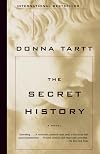
A bunch of kids do something dumb, and then their lives slowly deteriorate until they do something worse, then they deteriorate even more. All told with a weird detached intensity by someone whose own identity is unformed, but who so longs for family and friends and elevated conversation and a benign father-figure that all other considerations disappear when he discovers what has happened. Becoming central to an ongoing catastrophe and the suspension of conventional morality is show more psychologically devastating, but it makes him a part of something, a grand and tragic drama after which the rest of his life will pale. Absolutely riveting, mostly because it is so well-written, and narrated in the audiobook by the author, whose voice achieves an eerie androgyny, while her southern accent keeps making me think of Huckleberry Finn. Struck a chord when it came out, I'm sure many have written about why, but the world of privileged ennui and the brat-pack nature of the friend group were alien to me when I read it first, and it still captivated. show less
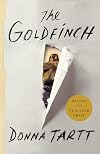
For me, this was nothing short of a masterpiece of fiction! No wonder it won the 2014 Pulitzer Prize for Fiction. Rich, emotional, and profound are just a few descriptors that come to my mind.
THE GOLDFINCH is not just well-written, but beautifully-written. Don't be put off by its length because you will fly through this page turning plot, with fully-drawn and resonating characters, believable dialog, and insightful perspective on us humans and our lives. It is also one of the saddest books show more I've ever read.
The book tells the story of Theo, a teenage boy journeying into adulthood, after the sudden and tragic death of his mother. "The Goldfinch" is the 17th Dutch century painting by Carel Fabritius that accompanies Theo on his journey. Moving in and out are an array of fascinating personalities and seemingly disparate strata of society- Russian emigres, furniture restoration, illegal drugs, child protective services, high society in NYC, loan sharks in Las Vegas, and art thieves in Amsterdam.
It's also a story about human vulnerability where a single random event can completely redirect one's life. About the core meaning of concepts like love, trust, and right and wrong. And about the role art plays for humanity.
You can't help but become deeply involved in Theo's life. You will feel his disappointment when those he depends on let him down. You will sympathize when he sometimes makes bad decisions. And you will worry about him until the very last page. Enjoy! show less
THE GOLDFINCH is not just well-written, but beautifully-written. Don't be put off by its length because you will fly through this page turning plot, with fully-drawn and resonating characters, believable dialog, and insightful perspective on us humans and our lives. It is also one of the saddest books show more I've ever read.
The book tells the story of Theo, a teenage boy journeying into adulthood, after the sudden and tragic death of his mother. "The Goldfinch" is the 17th Dutch century painting by Carel Fabritius that accompanies Theo on his journey. Moving in and out are an array of fascinating personalities and seemingly disparate strata of society- Russian emigres, furniture restoration, illegal drugs, child protective services, high society in NYC, loan sharks in Las Vegas, and art thieves in Amsterdam.
It's also a story about human vulnerability where a single random event can completely redirect one's life. About the core meaning of concepts like love, trust, and right and wrong. And about the role art plays for humanity.
You can't help but become deeply involved in Theo's life. You will feel his disappointment when those he depends on let him down. You will sympathize when he sometimes makes bad decisions. And you will worry about him until the very last page. Enjoy! show less
Perpetual outsider Richard finds himself (rather implausibly, in my opinion) attending an elite New England college and accepted by a clique of classics majors. Not surprisingly, the members of this tight-knit group have dark and shameful secrets. After they try to recreate an ancient Greek ritual, they find themselves dealing with unforeseen consequences that lead up to the murder of one of their own.
This novel has remained amazingly popular since its publication over twenty years ago. It's show more not hard to see why. The plot sounds like the set up for a teen horror movie, yet the author's erudition gives the proceedings a highbrow sheen. The characterizations of the students, their families and their teacher verge on caricature. No one in real life is quite as repulsive as Bunny and his family, and yet they are entertaining in their repulsiveness.
Despite my reservations, I enjoyed the experience of reading this novel. It is a page-turner, surprisingly effective and absorbing. Tartt's insightful tracking of the moral and physical declines of the students in the wake of their depraved acts brings to mind Aristotle's definition of "tragedy" as found in his Poetics: "it arouses [both] pity and fear.” show less
This novel has remained amazingly popular since its publication over twenty years ago. It's show more not hard to see why. The plot sounds like the set up for a teen horror movie, yet the author's erudition gives the proceedings a highbrow sheen. The characterizations of the students, their families and their teacher verge on caricature. No one in real life is quite as repulsive as Bunny and his family, and yet they are entertaining in their repulsiveness.
Despite my reservations, I enjoyed the experience of reading this novel. It is a page-turner, surprisingly effective and absorbing. Tartt's insightful tracking of the moral and physical declines of the students in the wake of their depraved acts brings to mind Aristotle's definition of "tragedy" as found in his Poetics: "it arouses [both] pity and fear.” show less
The Goldfinch reportedly took its author 10 years to complete; it has taken me nearly half that time to finish reading it. I seem to recall the author appeared on Late Night with Seth Meyers, who revealed he’d read the entire book and was quite enthusiastic about it. Other sources compared it to Dickens and that was probably the approximate cause that got me started reading; I’ve liked Dickens since I was in high school. The Goldfinch wasn’t quite that.
Pip in Great Expectations learns show more that his whole life has been based on an illusion about who is pulling the strings. Theo is haunted throughout most of his adult life by several levels of illusion of which he is acutely self-aware from the git go, but, thanks to Boris, the foundation of his illusion turns out to be itself an illusion. Meanwhile, the love of Theo’s life is “Pippa.” (Her name suggests that he is in love, like Narcissus, with his own PTSD image.) But surely the disillusionment theme combined with the work of art and memory as an organizing principle seems to have been purloined from Proust.
At the center of the novel is a con job, involving objets d’art. On the one hand furniture is restored or repaired using parts of the original combined with parts that might be cannibalized from contemporary objets, as well as brand new ones. Hobie, the restorer, takes justified pride in the skills needed to create these pastiches which he creates not to deceive but as an homage to and a means of recapturing the aura of the original. On the other hand, Theo sells the pastiches as “the real thing” using convoluted rationalizations for the fraud. Both honest work of secondary art and deception; the left hand doesn’t know what the right hand is doing. Does the reader?
Fictional theft of a real artifact. Pastiche of Dickens, Proust, Henry James, Edith Wharton, Dostoyevsky, Pulp Fiction – God or Tartt knows what else. Rationalizing literary theft by analyzing the technique of a Dutch realist, technique that is both trompe l’oeil and (upon closer examination) shows that the eye has been trumped by artistic technique. The novel even has a final chapter that substitutes for the Reader’s Guide appendix found in popular trade paperbacks. But the imprisoned bird that was the basis of the painting was once real. The character who can rationalize his imprisonment in a life of misery as a work of art by God or Bozo the Clown is not real.
The novel could be read as a pastiche of jokes on the reader or as an ethical exercise. Impatient with Theo’s self-destruction? Feel superior to him because I have the good judgment not to make a series of interminable stupid decisions characteristic of PTSD victims and drug addicts, and they’re boring and I will just ignore them? I close the book on him just as I close the book on the other wretches I encounter IRL. Frustrated, as I was, with the innumerable digressions and shaggy dog stories that always seem to be postponing the revelation of What I Really Need to Know? Should hire Lee Child’s editor. Or maybe the digressions are the point? A 21st century Tristram Shandy? Source of these are a hoard of notebooks Theo has been filling since the age of 13! Heard the one about the guy who couldn’t kill himself because he couldn’t write a suicide note that wasn’t sentimental or mawkish? Which ending Is more ridiculous: the Tarentino shoot out or the sketchy tip that makes everyone a millionaire! Is the whole work a shaggy dog story, a con? Aesthetically true, authentic – or not – it’s possible to read it – or, now, re-read it – over a long period of time because the broadly drawn characters and coincidence-bloated events are easy to recall even after a long interval and those digressions that might be the novel’s reason for being. show less
Pip in Great Expectations learns show more that his whole life has been based on an illusion about who is pulling the strings. Theo is haunted throughout most of his adult life by several levels of illusion of which he is acutely self-aware from the git go, but, thanks to Boris, the foundation of his illusion turns out to be itself an illusion. Meanwhile, the love of Theo’s life is “Pippa.” (Her name suggests that he is in love, like Narcissus, with his own PTSD image.) But surely the disillusionment theme combined with the work of art and memory as an organizing principle seems to have been purloined from Proust.
At the center of the novel is a con job, involving objets d’art. On the one hand furniture is restored or repaired using parts of the original combined with parts that might be cannibalized from contemporary objets, as well as brand new ones. Hobie, the restorer, takes justified pride in the skills needed to create these pastiches which he creates not to deceive but as an homage to and a means of recapturing the aura of the original. On the other hand, Theo sells the pastiches as “the real thing” using convoluted rationalizations for the fraud. Both honest work of secondary art and deception; the left hand doesn’t know what the right hand is doing. Does the reader?
Fictional theft of a real artifact. Pastiche of Dickens, Proust, Henry James, Edith Wharton, Dostoyevsky, Pulp Fiction – God or Tartt knows what else. Rationalizing literary theft by analyzing the technique of a Dutch realist, technique that is both trompe l’oeil and (upon closer examination) shows that the eye has been trumped by artistic technique. The novel even has a final chapter that substitutes for the Reader’s Guide appendix found in popular trade paperbacks. But the imprisoned bird that was the basis of the painting was once real. The character who can rationalize his imprisonment in a life of misery as a work of art by God or Bozo the Clown is not real.
The novel could be read as a pastiche of jokes on the reader or as an ethical exercise. Impatient with Theo’s self-destruction? Feel superior to him because I have the good judgment not to make a series of interminable stupid decisions characteristic of PTSD victims and drug addicts, and they’re boring and I will just ignore them? I close the book on him just as I close the book on the other wretches I encounter IRL. Frustrated, as I was, with the innumerable digressions and shaggy dog stories that always seem to be postponing the revelation of What I Really Need to Know? Should hire Lee Child’s editor. Or maybe the digressions are the point? A 21st century Tristram Shandy? Source of these are a hoard of notebooks Theo has been filling since the age of 13! Heard the one about the guy who couldn’t kill himself because he couldn’t write a suicide note that wasn’t sentimental or mawkish? Which ending Is more ridiculous: the Tarentino shoot out or the sketchy tip that makes everyone a millionaire! Is the whole work a shaggy dog story, a con? Aesthetically true, authentic – or not – it’s possible to read it – or, now, re-read it – over a long period of time because the broadly drawn characters and coincidence-bloated events are easy to recall even after a long interval and those digressions that might be the novel’s reason for being. show less
Lists
To Read (1)
2025 (1)
. (1)
First Novels (1)
READ in 2024 (1)
Page Turners (1)
Thrillers (1)
. (1)
2010s (1)
BBC Big Read (1)
sad girl books (1)
Gen X Library (1)
Women Writers (1)
Autumn books (1)
Movies/Shows (1)
Winter Books (1)
Urban Fiction (1)
Books to Read (1)
Scolaire (1)
Overdue Podcast (1)
DELETE (1)
Southern Fiction (1)
Unread books (1)
Wish List (1)
Put a Bird On It (1)
Secret Histories (1)
BBC Big Read (1)
Booktok Books (1)
Read with Jenna (1)
Female Author (2)
. (1)
Romans (1)
Favourite Books (1)
sad girl books (1)
AP Lit (1)
Five star books (2)
Secrets Books (2)
Read These Too (2)
el (2)
Read in 2014 (1)
USA Road Trip (1)
1990s (1)
Nineties (1)
100 New Classics (1)
upcoming (1)
Cult Classics (1)
A Novel Cure (1)
Books with Twins (1)
Fiction For Men (1)
ORCID Book list (1)
Franklit (1)
Coming of Age (1)
Sense of place (1)
Awards


You May Also Like


Associated Authors
Statistics
- Works
- 16
- Also by
- 14
- Members
- 51,741
- Popularity
- #294
- Rating
- 4.0
- Reviews
- 1,686
- ISBNs
- 341
- Languages
- 26
- Favorited
- 159


