
Jeffrey Eugenides
Author of Middlesex
About the Author
Jeffrey Eugenides was born in Detroit, Michigan on March 8, 1960. He received a B.A. from Brown University and an M.A. in English and creative writing from Stanford University in 1986. His first novel, The Virgin Suicides, was published to in 1993 and was made into a feature film. His other works show more include Middlesex, which won the 2003 Pulitzer Prize for Fiction, and The Marriage Plot. He is a professor of creative writing at Princeton University. (Bowker Author Biography) show less
Image credit: Courtesy of Allen and Unwin
Works by Jeffrey Eugenides
Find the Bad Guy 9 copies
Extreme Solitude 5 copies
2003 3 copies
Associated Works
Lost Classics: Writers on Books Loved and Lost, Overlooked, Under-read, Unavailable, Stolen, Extinct, or Otherwise Out of Commission (2000) — Contributor — 319 copies, 6 reviews
Object Lessons: The Paris Review Presents the Art of the Short Story (2012) — Introduction — 254 copies, 9 reviews
Tagged
Common Knowledge
- Canonical name
- Eugenides, Jeffrey
- Legal name
- Eugenides, Jeffrey Kent
- Birthdate
- 1960-03-08
- Gender
- male
- Education
- University Liggett School (Grosse Point, Michigan)
Brown University (B.A. | 1983)
Stanford University (M.A. | Creative Writing) - Occupations
- short story writer
teacher
editor
novelist - Organizations
- Princeton University
- Awards and honors
- Whiting Writers' Award (1993)
Granta's Best Of Young American Novelists (1996) - Nationality
- USA
- Birthplace
- Detroit, Michigan, USA
- Places of residence
- Chicago, Illinois, USA
Berlin, Germany
Princeton, New Jersey, USA - Map Location
- USA
Members
Discussions
The Virgin Suicides in Someone explain it to me... (July 2013)
Reviews

An unsettling, beautifully written fever dream of adolescence and the unknowability of another's life and mind. One of my book clubs chose this, and we all loved it, despite finding it a difficult read. There is so much to unpack in the 250 pages of the novel that it made for a far-reaching and very meaty conversation. Our discussion focused on the themes of voyeurism, the male gaze, adolescence, and emotional and psychological abuse, among other things. Eugenides' prose is rich and lush, show more and I highlighted dozens of phrases and passages that struck me with their perfection.
4 stars show less
4 stars show less

The characterization in this book is amazing. These people are as fully developed as any I've ever read, all flawed and all sympathetic. Even the secondary characters are better drawn than the main characters of many mediocre books I've read. The author's skewering of college literary discussion or American spiritual seekers in India or young wanderers in their hostels is brilliant. In a book that is heavy and rarely happy, I found myself reading parts aloud to my husband because the satire show more was too perfect to keep to myself. His description of bipolar disorder, from the perspective of the patient and his family, is amazing. It is possibly the best description of mental illness I've read. His description of family dynamics, both healthy and not, is also remarkable. I got bogged down occasionally in the anxious headspace of the characters, Mitchell in particular whom I liked less than the other two, and the ending was appropriate and realistic but not satisfying. I would have preferred a more hopeful ending than the not-completely-devoid-of-hope ending that we got, though a better ending would have been unconvincing without either changing almost the entire second half of the book or adding another hundred pages. I would have read those hundred pages to leave these characters in a better place. As it is, while I marvel at this author's skill of observation and description, I don't think I have the heart to read more of his writing. show less

The Virgin Suicides is one of those critically-acclaimed books that, after you read it, you stand back and say “Huh?” And then start beating yourself up for not being intellectual enough or perceptive enough to winkle out the deep and profound meaning, the extended metaphors, and the classical allegory of the novel.
Either that, or the emperor has no clothes.
Eugenides’ debut novel, apparently set in the 70s (as determined by the pop songs and teen fashions being referenced), traces the show more story of five sisters in one family who all kill themselves over a one-year period of time. That’s not a spoiler, as it's referenced fairly early on while the novel’s structure is being set up. The story is told in flashback from the viewpoint of several young men (their exact number and specific identities are never clarified) who were hormone-laden contemporaries of the Lisbon sisters and lusted for them in various ways during the last year of their lives.
One could, I suppose, expound upon the fact that the interior lives and ultimate motivations of the girls are never shown from the girls’ viewpoints. Perhaps this is intended to reflect the notion that women exist only to reflect the ideas of men, or that adolescents are routinely destroyed by the expectations of the adult world. Or maybe that modern families have become so insular that a community no longer sees, or is expected to step in (so much for “it takes a village”) when one nuclear family begins to implode.
One could pretend that the metaphor of the gradual disintegration of the Lisbon home is a brilliant and original way to represent the disintegration of the family and their intertwined manifestations of obsession and madness, except that it’s neither brilliant nor original. Most of the metaphors, in fact – the brief lifespan of the fish-flies whose annual cycle of emergence and death bracket the year-long span of the story, the slow dying of the stately elm trees whose beauty and dignity enhanced the neighborhood – are labored and obvious.
Or one could simply throw up one’s hands and move on to a more satisfying read, where characters develop, interact, and advance the basic plot as they reveal themselves and their relationships. Because one will find none of those qualities in this book. show less
Either that, or the emperor has no clothes.
Eugenides’ debut novel, apparently set in the 70s (as determined by the pop songs and teen fashions being referenced), traces the show more story of five sisters in one family who all kill themselves over a one-year period of time. That’s not a spoiler, as it's referenced fairly early on while the novel’s structure is being set up. The story is told in flashback from the viewpoint of several young men (their exact number and specific identities are never clarified) who were hormone-laden contemporaries of the Lisbon sisters and lusted for them in various ways during the last year of their lives.
One could, I suppose, expound upon the fact that the interior lives and ultimate motivations of the girls are never shown from the girls’ viewpoints. Perhaps this is intended to reflect the notion that women exist only to reflect the ideas of men, or that adolescents are routinely destroyed by the expectations of the adult world. Or maybe that modern families have become so insular that a community no longer sees, or is expected to step in (so much for “it takes a village”) when one nuclear family begins to implode.
One could pretend that the metaphor of the gradual disintegration of the Lisbon home is a brilliant and original way to represent the disintegration of the family and their intertwined manifestations of obsession and madness, except that it’s neither brilliant nor original. Most of the metaphors, in fact – the brief lifespan of the fish-flies whose annual cycle of emergence and death bracket the year-long span of the story, the slow dying of the stately elm trees whose beauty and dignity enhanced the neighborhood – are labored and obvious.
Or one could simply throw up one’s hands and move on to a more satisfying read, where characters develop, interact, and advance the basic plot as they reveal themselves and their relationships. Because one will find none of those qualities in this book. show less
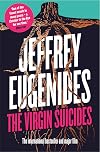
A weird but terribly compelling tale, set in a middle class town in 1970s Michigan. Narrated not by any one character but by a 'Greek chorus' of the local boys; every event told from the 'we' perspective. They recall the Lisbon family - schoolteacher father, overprotective Catholic mother and their five lovely daughters. After the youngest - and strangest - commits suicide, the family begins to crack up. We never really know what propels the other daughters to eventually follow suit: the show more loss of their sister? their abnormal home life? something genetic? The whole narrative is kind of Gothic, dreamy, other-worldly; just as we never get a real handle on the several narrators, so too the girls are seen only through their eyes and their recollections and opinions- like watching them in a mirror rather than really knowing them.
I've never read anything like this, an incredible feat of writing. show less
I've never read anything like this, an incredible feat of writing. show less
Lists
Cult Classics (1)
Secrets Books (1)
. (1)
First Novels (1)
"We" narration (1)
. (1)
USA Road Trip (1)
Five star books (1)
To Read (1)
sad girl books (1)
LOVE LOVE LOVE (1)
sad girl books (1)
Elegant Prose (1)
Books for Birute (1)
Overdue Podcast (2)
1990s (1)
Gen X Library (2)
Unread books (2)
A Novel Cure (2)
Favourite Books (2)
el (2)
My TBR (2)
AP Lit (1)
Best First Lines (1)
Romans (1)
2000s decade (1)
Epic Fiction (1)
Florida (1)
Awards


You May Also Like


Associated Authors
Statistics
- Works
- 34
- Also by
- 11
- Members
- 51,026
- Popularity
- #300
- Rating
- 4.0
- Reviews
- 1,287
- ISBNs
- 330
- Languages
- 26
- Favorited
- 175


