
Alan Arkin (1934–2023)
Author of The Lemming Condition
About the Author
Series
Works by Alan Arkin
Little Murders [1971 film] — Director — 5 copies
Short Science Fiction Collection 059 2 copies
The Amazing Grandy 1 copy
Catch 22 (1970) ( Catch Twenty Two ) [ NON-USA FORMAT, PAL, Reg.4 Import - Australia ] (2019) 1 copy
The Hard Work Day 1 copy
Associated Works
The Second City: Backstage at the World's Greatest Comedy Theater (2000) — Foreword — 325 copies, 2 reviews
The Magazine of Fantasy and Science Fiction August 2001, Vol. 101, No. 2 (2001) — Contributor — 11 copies
4 Film Favorites: Harrison Ford (The Fugitive, Presumed Innocent, Firewall, The Mosquito Coast) (2012) — Actor — 7 copies
The Return of Captain Invincible [1983 Film] — Actor — 6 copies
Hearts of the West [1975 film] 6 copies
Last of the Red Hot Lovers [1972 film] — Actor — 6 copies
The Muppet Show: Season 4 3 copies
Bad Medicine [1985 Film] — Actor — 2 copies
PETER FALK 4-FILM COMEDY COLLECTION/BD — Actor — 1 copy
Tagged
Common Knowledge
- Legal name
- Arkin, Alan Wolf
- Birthdate
- 1934-03-26
- Date of death
- 2023-06-30
- Gender
- male
- Education
- Franklin High School (Los Angeles)
Los Angeles City College
Bennington College, Vermont - Occupations
- actor
director
musician
singer - Organizations
- The Tarriers (member)
- Awards and honors
- Academy Award (best supporting actor, 2007)
BAFTA Film Award (Best Actor in a Supporting Role, 2007)
Tony Award - Relationships
- Avi (cousin)
Leider, Emily Wortis (cousin)
Arkin, David I. (father) - Short biography
- Alan Arkin has been married three times.
- Nationality
- USA
- Birthplace
- Brooklyn, New York, USA
- Places of residence
- Brooklyn, New York, USA (birth)
Los Angeles, California, USA
New Mexico, USA - Map Location
- USA
Members
Reviews
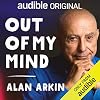
Alan Arkin is a different kind of actor. He has a stage presence so strong he often appears to be a total mismatch with the rest of the cast, observing more than participating. So with his short book Out Of My Mind.
In the book, Arkin relates a bunch of stories of inexplicable events. There is a sudden memory of himself approaching a scaffold in revolutionary France. There are hot flashes and blinding lights, crippling fear and sudden cures. His normally totally concrete-reality mother show more suddenly revealed his dead father appeared before her shortly after his death. And she never spoke of it again. Mostly, the stories seem to reflect his study of East Asian religions, with their extensions into reincarnation and life forces. They have cured of him of going to a therapist.
These kinds of events and stories are often told, and usually have no explanation. In this case, Arkin wants there to be no explanation. He says as a young man his was adamant that what he believed should be imposed on the whole world, even as his views changed. Today, he insists he has no such belief system or ideology. He takes it as it comes, meditates a lot, and attempts to be at peace. He says he tried to write down all the things that he was absolutely sure of and could only come up with two for all eternity: Everything changes, and there is no such thing as too much garlic. If that helps.
The Alan Arkin we see on TV, films and plays is like that – slightly removed from the vortex, and observing it as an education. Usually with pained incomprehension. That he is actually like that in person is a revelation to me. I first saw him in a TV drama/special called The Lovesong of Barney Kempinsky. It aired just once, in 1967, and I have not only not forgotten it, it has made me want to see everything he showed up in ever since. I have not been disappointed.
This little (100 page) book of semi-memoirs on the unexplainable is a finetuned insight into the man. It will not likely change the reader’s outlook on life, but it explains quite a bit of his.
David Wineberg show less
In the book, Arkin relates a bunch of stories of inexplicable events. There is a sudden memory of himself approaching a scaffold in revolutionary France. There are hot flashes and blinding lights, crippling fear and sudden cures. His normally totally concrete-reality mother show more suddenly revealed his dead father appeared before her shortly after his death. And she never spoke of it again. Mostly, the stories seem to reflect his study of East Asian religions, with their extensions into reincarnation and life forces. They have cured of him of going to a therapist.
These kinds of events and stories are often told, and usually have no explanation. In this case, Arkin wants there to be no explanation. He says as a young man his was adamant that what he believed should be imposed on the whole world, even as his views changed. Today, he insists he has no such belief system or ideology. He takes it as it comes, meditates a lot, and attempts to be at peace. He says he tried to write down all the things that he was absolutely sure of and could only come up with two for all eternity: Everything changes, and there is no such thing as too much garlic. If that helps.
The Alan Arkin we see on TV, films and plays is like that – slightly removed from the vortex, and observing it as an education. Usually with pained incomprehension. That he is actually like that in person is a revelation to me. I first saw him in a TV drama/special called The Lovesong of Barney Kempinsky. It aired just once, in 1967, and I have not only not forgotten it, it has made me want to see everything he showed up in ever since. I have not been disappointed.
This little (100 page) book of semi-memoirs on the unexplainable is a finetuned insight into the man. It will not likely change the reader’s outlook on life, but it explains quite a bit of his.
David Wineberg show less

An interesting and engaging concise spiritual memoir (akin to Catching the Big Fish: Meditation, Consciousness, and Creativity ) with its focus on the value of long-term mediation. He has a fascinating inside into filming Escape from Sobibor (1987) about the prison actors were kept in garb and separate from the similar treated guards. This forced meeting while filming caused such emotional stress that breakdowns, etc. occurred. This is an insightful event and recalls the Stanford prison show more experiment and the Milgram experiment. From there, he takes us to his beliefe in psychic surgery and past lives. The faith healer that made such an impact was Zé Arigó.
Despite any criticisms, Arkin's avuncular delivery and controlled passion on his message make this a book worth recommedning. show less
Despite any criticisms, Arkin's avuncular delivery and controlled passion on his message make this a book worth recommedning. show less
A nice mini autobiography of actor Alan Arkin. He narrates his journey of challenging everything he was initially taught and how he views the world. He began studying eastern philosophy and meditating. I loved the ending when he talked about what he has learned about himself and knowledge gained from meditating for the past 50 years.

I'm hesitant to choose a star rating for this book because I can't help but feel like it is not the book's fault, but the publication. Whoever line edited this must have done it drunk. There is literally a typo or missing word every other page throughout the whole thing (my edition was first edition, from what I see it was never reprinted.) That being said it SHOULD be reprinted. Someone at Harper Collins ought to pick this back up, actually edit it this time and reprint it. (Also, I'm show more looking for an editing job if they need help with this project.)
Seriously, this book has potential. It could be Jonathan Livingston Seagull or Ishmael. It has the philosophy dripping through it for fresh minds just being introduced to the topics of great thinkers of past. It's also an entertaining story. My wife and I read this aloud over a few nights and we were laughing together throughout it. I thoroughly enjoyed it.
So four stars because of the author. No stars to whoever didn't pay attention to what the typist was doing. show less
Seriously, this book has potential. It could be Jonathan Livingston Seagull or Ishmael. It has the philosophy dripping through it for fresh minds just being introduced to the topics of great thinkers of past. It's also an entertaining story. My wife and I read this aloud over a few nights and we were laughing together throughout it. I thoroughly enjoyed it.
So four stars because of the author. No stars to whoever didn't pay attention to what the typist was doing. show less
Awards

You May Also Like


Associated Authors
Statistics
- Works
- 20
- Also by
- 65
- Members
- 522
- Popularity
- #47,609
- Rating
- 3.7
- Reviews
- 13
- ISBNs
- 56
- Languages
- 2