
Maurice Genevoix (1890–1980)
Author of Ceux de 14
About the Author
Image credit: Maurice Genevoix en 1914/1915
Series
Works by Maurice Genevoix
'Neath Verdun: the Experiences of a French Soldier During the Early Months of the First World War (1916) 6 copies
Gai-l'amour 2 copies
L'assassin 2 copies
Parlez mieux écrivez mieux 2 copies
Canada. 2 copies
Maurice Genevoix. Sous Verdun août-octobre 1914. Préface d'Ernest Lavisse, de l'Académie française 1 copy
Dunoyer de Segonzac... 1 copy
The story of Reynard 1 copy
Les immortels chefs-d'oeuvre - Raboliot, suivi de Images pour un jardin sans murs - Tome 2 (1972) 1 copy
Cyrille. Les Mains vides 1 copy
Jeanne Robelin. La joie 1 copy
L'Assassin. Gai-l'Amour 1 copy
Marcheloup. Tête baissée 1 copy
Rroû. La Dernière Harde 1 copy
Jeux de glaces 1 copy
Derrière les collines 1 copy
Pages choisies 1 copy
Η Ελλάς του Καραμανλή 1 copy
Laframboise et Bellehumeur 1 copy
Jours de la Marne 1 copy
Les deux lutins 1 copy
Associated Works
Tagged
Common Knowledge
- Canonical name
- Genevoix, Maurice
- Legal name
- Genevoix, Maurice-Charles-Louis
- Birthdate
- 1890-11-29
- Date of death
- 1980-09-08
- Gender
- male
- Education
- Lycée d'Orléans
Lycée Lakanal, Sceaux, France
Ecole Normale Supérieure, Paris, France - Occupations
- author
- Organizations
- Académie française (1946)
French Army (WWI) - Relationships
- Genevoix, Sylvie (Fille)
- Cause of death
- Naturelle (Vieilesse)
- Nationality
- France
- Birthplace
- Decize, Nièvre, France
- Places of residence
- Châteauneuf-sur-Loire, France
Paris, France
Vernelles, Loiret, France - Place of death
- Alcudia-Cansades, Alicante, Espagne
- Burial location
- Cimetière de Passy, Paris, Île-de-France, France
Panthéon, Paris (20 20-11-11) - Map Location
- France
- Associated Place (for map)
- France
Members
Reviews
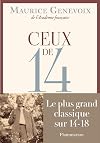
The biggest, most detailed and least well-known book that France produced about the First World War, Ceux de 14 contains, like the war itself, vast stretches of tedium shot through with moments of acute nausea, terror and misery. Maurice Genevoix was deployed at the very start of mobilization in August 1914, and he made it nine months before three German bullets saw him wounded and subsequently discharged. This book – or books, rather, as it originally appeared in five separate volumes show more between 1916 and 1923 – is simply his journal of those nine months, in intricate and horrifying detail.
In one of my updates I referred to it as ‘literature of immersion’ and I still haven't thought of any better way to put it. It is a big book. I lived with it for a month and found the experience extremely oppressive, exhausting really, although it seems somehow distasteful to say so since reading it can only ever be the faintest echo of the original experience. Nevertheless.
The evocation of trench warfare has surely never been more thorough. If you are looking for the grisly details, you will certainly find those: Genevoix takes careful note, for instance, of one of his men whose jaw has been blown off:
Le moitié inférieur du visage n'est plus qu'un morceau de chair rouge, molle, pendante, d'où le sang mêlé à la salive coule en filet visqueux. Et ce visage a deux yeux bleus d'enfant, qui arrêtent sur moi un lourd, un intolérable regard de détresse et de stupeur muette.
[The lower half of the face is nothing more than a piece of red flesh, soft, pendulous, from which a mixture of blood and saliva flows in a viscous stream. And this face has two blue, childlike eyes, which present me with a heavy, unbearable look of distress and mute stupor.]
In the trenches on the key strategic slope of Les Éparges, things are even worse. There is no ‘fighting’, just the long endurance of shelling in appalling conditions. Genevoix writes of receiving endless ‘packets of human entrails’ in the face as the mortar shells drop all around his dugout; on one occasion a human tongue, ‘to which the pharynx was still attached’, lands on his hand. As day dawns one morning, he notices that the inside of his dugout has become wallpapered in ‘rags of skin covered with dark hairs’. Men with minor injuries simply drown in the mud outside, too weak to extricate themselves.
There are also astonishing, uninventable moments such as the soldier who, while running away from German gunfire,
s'arrête, s'agenouille dos à l'ennemi, face à nous, et le pantalon grand ouvert, sans hâte, retire de ses testicules la balle qui l'a frappé, puis, de ses doigts gluants, la met dans son porte-monnaie.
[stops, kneels down with his back to the enemy, facing us, and with his trousers wide open, unhurriedly removes from his testicles the bullet that had struck him, and then, with sticky fingers, deposits it in his wallet.]
It should be said, though, that the scenes of violence and live fire are the least part of this book, concentrated as they are in the last section, Les Éparges. The rest is an equally intense recreation of the daily boredom and monotony of army life – the cycle of marches between front lines and reserve lines and billets in villages, digging trenches, night time patrols. All of the French language's many words for ‘mud’ are called upon – boue, vase, glaise. The all-consuming joy of occasionally being able to sleep in a real bed – though shared with a fellow officer – instead of on the floor. The relationships struck up with villagers, chance encounters, the sound of church bells, the deep camaraderie between characters whom we come to know with extraordinary familiarity – all of this is set down with a fidelity that could be described as relentless.
Most striking of all, perhaps, are the odd moments of open comedy – the radio operator, for example, with a doubtful grasp of French orthography:
Au mont Roudnik… Roud-nik ! R, comme Ernestine ; o, comme homard… Attends ! Attends ! J'ai cassé mon crayon.
[On Mount Roudnik…Roud-nik! R for aardvark, O for ’opeless…Wait! Wait! I've broken my pencil.]
It really is an extraordinary mix. And amid all the death and mayhem, there are still infantrymen that can be heard saying, Faut pas qu'on s'plaigne…as we'd say in England, Mustn't grumble…what a thing to say in the middle of the trenches. I wanted to laugh but I felt sick.
Genevoix was always the sort of soldier who trusted the orders coming down to him and believed in the necessity to fight. But even his faith is obliterated in the indiscriminate slaughter he sees at Les Éparges, where he has to watch many of his friends – people that we have been reading about for 800 pages – die around him. His disillusion is particularly powerful because of how long it took him to get there.
J'ai vu trop de choses dégoûtantes pour être dupe encore des mots. Pourquoi nous battons-nous, maintenant et de cette façon ? Pour défendre quoi ? Gagner quoi ? […] Derrière la colline des Éparges, la montagne de Combres se dressera face à nous. Et derrière Combres, d'autres collines… Dix mille morts par colline, est-ce que c'est ça qu'on veut ? Alors ?…
[I have seen too many disgusting things to be fooled by words any longer. Why are we fighting, now and in this way? What are we trying to defend? What are we trying to gain? Behind the hill of Les Éparges, the mountain of Combres will then be facing us. And behind Combres, more hills. Ten thousand deaths per hill, is that what we want? So what then…?]
It is hard to recommend this book, exactly. Much of what it does well is done more efficiently by Henri Barbusse in Le Feu (which beat the first volume of Ceux de 14 to the 1916 Prix Goncourt). And yet there is something so utterly engrossing in the depth of this account, you really come out the other end feeling drained, feeling enlightened, completely soaked in this world.
Incredible to think that all of this rich detail and accumulated experience is just one side of the conflict. And this is particularly clear in this specific case: among those facing Genevoix on the other side of the lines at Les Éparges was a young German officer called Ernst Jünger. show less
In one of my updates I referred to it as ‘literature of immersion’ and I still haven't thought of any better way to put it. It is a big book. I lived with it for a month and found the experience extremely oppressive, exhausting really, although it seems somehow distasteful to say so since reading it can only ever be the faintest echo of the original experience. Nevertheless.
The evocation of trench warfare has surely never been more thorough. If you are looking for the grisly details, you will certainly find those: Genevoix takes careful note, for instance, of one of his men whose jaw has been blown off:
Le moitié inférieur du visage n'est plus qu'un morceau de chair rouge, molle, pendante, d'où le sang mêlé à la salive coule en filet visqueux. Et ce visage a deux yeux bleus d'enfant, qui arrêtent sur moi un lourd, un intolérable regard de détresse et de stupeur muette.
[The lower half of the face is nothing more than a piece of red flesh, soft, pendulous, from which a mixture of blood and saliva flows in a viscous stream. And this face has two blue, childlike eyes, which present me with a heavy, unbearable look of distress and mute stupor.]
In the trenches on the key strategic slope of Les Éparges, things are even worse. There is no ‘fighting’, just the long endurance of shelling in appalling conditions. Genevoix writes of receiving endless ‘packets of human entrails’ in the face as the mortar shells drop all around his dugout; on one occasion a human tongue, ‘to which the pharynx was still attached’, lands on his hand. As day dawns one morning, he notices that the inside of his dugout has become wallpapered in ‘rags of skin covered with dark hairs’. Men with minor injuries simply drown in the mud outside, too weak to extricate themselves.
There are also astonishing, uninventable moments such as the soldier who, while running away from German gunfire,
s'arrête, s'agenouille dos à l'ennemi, face à nous, et le pantalon grand ouvert, sans hâte, retire de ses testicules la balle qui l'a frappé, puis, de ses doigts gluants, la met dans son porte-monnaie.
[stops, kneels down with his back to the enemy, facing us, and with his trousers wide open, unhurriedly removes from his testicles the bullet that had struck him, and then, with sticky fingers, deposits it in his wallet.]
It should be said, though, that the scenes of violence and live fire are the least part of this book, concentrated as they are in the last section, Les Éparges. The rest is an equally intense recreation of the daily boredom and monotony of army life – the cycle of marches between front lines and reserve lines and billets in villages, digging trenches, night time patrols. All of the French language's many words for ‘mud’ are called upon – boue, vase, glaise. The all-consuming joy of occasionally being able to sleep in a real bed – though shared with a fellow officer – instead of on the floor. The relationships struck up with villagers, chance encounters, the sound of church bells, the deep camaraderie between characters whom we come to know with extraordinary familiarity – all of this is set down with a fidelity that could be described as relentless.
Most striking of all, perhaps, are the odd moments of open comedy – the radio operator, for example, with a doubtful grasp of French orthography:
Au mont Roudnik… Roud-nik ! R, comme Ernestine ; o, comme homard… Attends ! Attends ! J'ai cassé mon crayon.
[On Mount Roudnik…Roud-nik! R for aardvark, O for ’opeless…Wait! Wait! I've broken my pencil.]
It really is an extraordinary mix. And amid all the death and mayhem, there are still infantrymen that can be heard saying, Faut pas qu'on s'plaigne…as we'd say in England, Mustn't grumble…what a thing to say in the middle of the trenches. I wanted to laugh but I felt sick.
Genevoix was always the sort of soldier who trusted the orders coming down to him and believed in the necessity to fight. But even his faith is obliterated in the indiscriminate slaughter he sees at Les Éparges, where he has to watch many of his friends – people that we have been reading about for 800 pages – die around him. His disillusion is particularly powerful because of how long it took him to get there.
J'ai vu trop de choses dégoûtantes pour être dupe encore des mots. Pourquoi nous battons-nous, maintenant et de cette façon ? Pour défendre quoi ? Gagner quoi ? […] Derrière la colline des Éparges, la montagne de Combres se dressera face à nous. Et derrière Combres, d'autres collines… Dix mille morts par colline, est-ce que c'est ça qu'on veut ? Alors ?…
[I have seen too many disgusting things to be fooled by words any longer. Why are we fighting, now and in this way? What are we trying to defend? What are we trying to gain? Behind the hill of Les Éparges, the mountain of Combres will then be facing us. And behind Combres, more hills. Ten thousand deaths per hill, is that what we want? So what then…?]
It is hard to recommend this book, exactly. Much of what it does well is done more efficiently by Henri Barbusse in Le Feu (which beat the first volume of Ceux de 14 to the 1916 Prix Goncourt). And yet there is something so utterly engrossing in the depth of this account, you really come out the other end feeling drained, feeling enlightened, completely soaked in this world.
Incredible to think that all of this rich detail and accumulated experience is just one side of the conflict. And this is particularly clear in this specific case: among those facing Genevoix on the other side of the lines at Les Éparges was a young German officer called Ernst Jünger. show less
J'ai lu pas mal de livres sur la guerre, la 1ère incluse. Mais rien d'aussi choquant que ce rapport personnel. Après avoir lu, on comprend beaucoup plus et beaucoup moins en même temps pourquoi ces hommes communs se sont faits massacrer dans une guerre qui doit leur avoir paru comme un jeu d'échecs avec eux comme pions. Très imoressionant, aussi à cause d'une narration empathique et expressive.

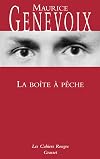
A huge black cat with bright yellow eyes, sitting on a chimney pot, stares at you as you pick up the book. I had no choice but to buy it.
Awards


You May Also Like


Associated Authors
Statistics
- Works
- 118
- Also by
- 1
- Members
- 547
- Popularity
- #45,592
- Rating
- 3.4
- Reviews
- 16
- ISBNs
- 119
- Languages
- 3


