
About the Author
Works by Joel Salatin
Folks, This Ain't Normal: A Farmer's Advice for Happier Hens, Healthier People, and a Better World (2011) 451 copies, 14 reviews
Everything I Want To Do Is Illegal: War Stories From the Local Food Front (2007) 395 copies, 10 reviews
You Can Farm: The Entrepreneur's Guide to Start & Succeed in a Farming Enterprise (1998) 343 copies, 2 reviews
The Marvelous Pigness of Pigs: Respecting and Caring for All God's Creation (2016) 130 copies, 1 review
Polyface Designs: A Comprehensive Construction Guide for Scalable Farming Infrastructure (2021) 46 copies
Redeeming the Earth 3 copies
Associated Works
Food Inc.: A Participant Guide: How Industrial Food is Making Us Sicker, Fatter, and Poorer-And What You Can Do About It (2009) — Contributor — 542 copies, 3 reviews
The Homesteader's Herbal Companion: The Ultimate Guide to Growing, Preserving, and Using Herbs (2018) — Preface, some editions — 83 copies
Tagged
Common Knowledge
- Legal name
- Salatin, Joel F.
- Birthdate
- 1957
- Gender
- male
- Education
- Bob Jones University
- Occupations
- farmer
- Organizations
- Polyface Farm
- Awards and honors
- Growing Green Awards (2009|Finalist)
Heinz Award (2009) - Relationships
- Salatin, Teresa (wife)
Salatin, Daniel (son)
Salatin, Rachel (daughter)
Salatin, Sheri (daughter-in-law) - Nationality
- USA
- Places of residence
- USA
Argentina
Swope, Virginia, USA - Associated Place (for map)
- Virginia, USA
Members
Reviews
Folks, This Ain't Normal: A Farmer's Advice for Happier Hens, Healthier People, and a Better World by Joel Salatin
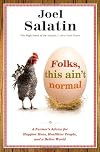
Oh, Joel Salatin, you fascinating curmudgeon. If the mild and joyful farmer’s memoirs leave you wanting more, jump into the thick of the agribusiness food debate with Joel. He’s challenging, interesting, and highly opinionated. I can almost guarantee that something in this book will tick you off, but some other part will almost certainly prove totally compelling. You may not agree with him, but he’ll certainly give you plenty to think about.
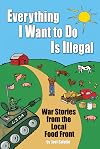
This is a book that would make Robert Heinlein rolled over in his grave, yet he would completely agree with it. It is a book to make me, the mildly rebellious anti-authority person I am, become a raving Libertarian. It also will make you think twice, if not three times, before you buy meat at the grocery store again.
The author of this book is a farmer in Virginia. He is trying to run a small farm and sell the products from his farm. Most of the things he wants to do, sell eggs, fresh chicken show more and other meat, raw milk, are, in one way or another, illegal. The laws that in theory were set up to "protect" are just promoting the industrialization of food production. This month, with a mass hysteria over peanut products, we can see how safe the industry is. Unfortunately the result will be more regulation, resulting in more centralization and more areas where a large company can ignore the regulators and small ones can't get in at all.
The best part of this book is that the author is not writing a theoretical tract. He is no animal rights activist who has never seen animals in the wild, he is not a professor, years from getting mud on his shoes, he is a farmer first. He has become an activist only because of the years of fighting the system.
While the details of how ridiculous the regulations involving the production of food were, the parts of the book that really got to me were the places he discusses the ideology behind the regulations. For example:
One of my icons, Wendell Berry, makes the excellent point in his classic The Unsettling of America that ultimately the rabid environmentalist and the rabid factory farmer are cut from the same cloth: they both idolize a landscape devoid of humans. Ultimately they both hate people. . . Asked to supply a picture of the ideal landscape, neither group will include humans in the portrait.
Or this point,
As these types of laws proliferate, all of us find fewer and fewer spots of autonomy left. Being able to make self-directed decisions is critical for expressing our humanness. Not that any individual expression is okay. . . but these basic moral codes are a far cry from the kind of micro-behavioural codes emanating from today's politicians. The Romans had a saying that the better the government, the fewer the laws.
or this one,
Teddy Roosevelt used to say that nothing in government happens by accident. There is always an agenda. And especially today, the agenda usually involves more power and money to large corporate and bureaucratic interests with a parallel disempowering and impoverishing of smaller public and private entities.
I especially like that last paragraph, as he neatly skewers both the Left and the Right. This is a man who has thought deeply about our political process and the practical applications of it. All he wants to do is feed his neighbors and his family, the government will not allow it. While I think that a part of his problem is living in the East, even in the West more kneejerk reaction laws are passed every year. If I had a lot of money, I would buy this book for every person I know, as it is, get this from the library and read it, remember it when election time comes around and every time you have to deal with any sort of government bureaucracy. show less
The author of this book is a farmer in Virginia. He is trying to run a small farm and sell the products from his farm. Most of the things he wants to do, sell eggs, fresh chicken show more and other meat, raw milk, are, in one way or another, illegal. The laws that in theory were set up to "protect" are just promoting the industrialization of food production. This month, with a mass hysteria over peanut products, we can see how safe the industry is. Unfortunately the result will be more regulation, resulting in more centralization and more areas where a large company can ignore the regulators and small ones can't get in at all.
The best part of this book is that the author is not writing a theoretical tract. He is no animal rights activist who has never seen animals in the wild, he is not a professor, years from getting mud on his shoes, he is a farmer first. He has become an activist only because of the years of fighting the system.
While the details of how ridiculous the regulations involving the production of food were, the parts of the book that really got to me were the places he discusses the ideology behind the regulations. For example:
One of my icons, Wendell Berry, makes the excellent point in his classic The Unsettling of America that ultimately the rabid environmentalist and the rabid factory farmer are cut from the same cloth: they both idolize a landscape devoid of humans. Ultimately they both hate people. . . Asked to supply a picture of the ideal landscape, neither group will include humans in the portrait.
Or this point,
As these types of laws proliferate, all of us find fewer and fewer spots of autonomy left. Being able to make self-directed decisions is critical for expressing our humanness. Not that any individual expression is okay. . . but these basic moral codes are a far cry from the kind of micro-behavioural codes emanating from today's politicians. The Romans had a saying that the better the government, the fewer the laws.
or this one,
Teddy Roosevelt used to say that nothing in government happens by accident. There is always an agenda. And especially today, the agenda usually involves more power and money to large corporate and bureaucratic interests with a parallel disempowering and impoverishing of smaller public and private entities.
I especially like that last paragraph, as he neatly skewers both the Left and the Right. This is a man who has thought deeply about our political process and the practical applications of it. All he wants to do is feed his neighbors and his family, the government will not allow it. While I think that a part of his problem is living in the East, even in the West more kneejerk reaction laws are passed every year. If I had a lot of money, I would buy this book for every person I know, as it is, get this from the library and read it, remember it when election time comes around and every time you have to deal with any sort of government bureaucracy. show less
Folks, This Ain't Normal: A Farmer's Advice for Happier Hens, Healthier People, and a Better World by Joel Salatin
I love Joel Salatin. He is a crazy libertarian organic farmer in Virginia. I have his EVERYTHING I WANT TO DO IS ILLEGAL; and I've read his YOU CAN FARM. The latter is his attempt to inspire and instruct young people considering embarking on a life of farming. I loved it, even though there is no way I am ever going to become a farmer.
Here, Salatin rants about how far we have gotten away from "normal" (hence the title) with our industrial food system. He ends each chapter with positive show more suggestions, some more realistic than others, for taking individual action to end the insanity and start doing something normal again - growing a tomato plant, keeping chickens as pets, etc.
This totally resonated with me. The crazy thing I've always thought about books along the lines of "My Year of Growing All My Own Food" and such, is that they treat what used to be normal as a miracle - indeed, case in point, the title of Barbara Kingsolver's ANIMAL, VEGETABLE, MIRACLE. What we think is fodder for an entire book used to just be LIFE. Of course your grew your own food. People of 200 years ago would be might puzzled that anyone would want to read or write a book about it.
It's NORMAL. Salatin uses the word "birthright" in this book; it was actually in reference to hunting, but I like to think of it in relation to the whole shebang of agriculture and enjoying nature. It's our BIRTHRIGHT.
The book is repetitive and ranty, not exactly a masterpiece of literature, but it has been so inspiring to me, I go with 5 stars. I'm inspired to actually double down on my local food intake. I'm researching local grain and upgrading my dairy; I'm using more butter in place of vegetable oils (big sacrifice there, not); just putting a lot more thought into it. And I wasn't exactly unconscious to begin with.
Salatin even ends the book by confiding in us an experience where he actually broke down in tears as he was about to leave his homestead for a month or two, a very long stretch of traveling for him. He had to stop the car and cry before he had even left the lane leading to his house. I'm touched, I really am.
And although I no longer identify as libertarian - and was not interested in the rants against the government which at times lurked just below surface, and at other times reared their ugly heads - I have to say simply that there's something refreshing in reading arguments for organic, back-to-the-land living coming from a place other than basic hippie liberal. It's just different and enlightening and proves that these things don't have to be "polarized." Everyone benefits from better food. It's ridiculous that this should be a politically one-sided issue - like climate change. show less
Here, Salatin rants about how far we have gotten away from "normal" (hence the title) with our industrial food system. He ends each chapter with positive show more suggestions, some more realistic than others, for taking individual action to end the insanity and start doing something normal again - growing a tomato plant, keeping chickens as pets, etc.
This totally resonated with me. The crazy thing I've always thought about books along the lines of "My Year of Growing All My Own Food" and such, is that they treat what used to be normal as a miracle - indeed, case in point, the title of Barbara Kingsolver's ANIMAL, VEGETABLE, MIRACLE. What we think is fodder for an entire book used to just be LIFE. Of course your grew your own food. People of 200 years ago would be might puzzled that anyone would want to read or write a book about it.
It's NORMAL. Salatin uses the word "birthright" in this book; it was actually in reference to hunting, but I like to think of it in relation to the whole shebang of agriculture and enjoying nature. It's our BIRTHRIGHT.
The book is repetitive and ranty, not exactly a masterpiece of literature, but it has been so inspiring to me, I go with 5 stars. I'm inspired to actually double down on my local food intake. I'm researching local grain and upgrading my dairy; I'm using more butter in place of vegetable oils (big sacrifice there, not); just putting a lot more thought into it. And I wasn't exactly unconscious to begin with.
Salatin even ends the book by confiding in us an experience where he actually broke down in tears as he was about to leave his homestead for a month or two, a very long stretch of traveling for him. He had to stop the car and cry before he had even left the lane leading to his house. I'm touched, I really am.
And although I no longer identify as libertarian - and was not interested in the rants against the government which at times lurked just below surface, and at other times reared their ugly heads - I have to say simply that there's something refreshing in reading arguments for organic, back-to-the-land living coming from a place other than basic hippie liberal. It's just different and enlightening and proves that these things don't have to be "polarized." Everyone benefits from better food. It's ridiculous that this should be a politically one-sided issue - like climate change. show less
Folks, This Ain't Normal: A Farmer's Advice for Happier Hens, Healthier People, and a Better World by Joel Salatin
Caution: this book is a thought-provoker. If you are not intellectually qualified to discern fact from philosophy and integrate that information into your brain without barfing it out because it challenges conceptions made from incomplete knowledge or pre-existing philosophical leanings, you will likely flounder in this book.
The short of it: this is the story of a small-time, 100% locally based farmer. He gives examples and philosophies from those examples on the hows and whys of modern show more agriculture--an unhealthy industrial paradigm--and the hows and whys of traditional agriculture--a better capacity for a healthy industrial paradigm. This is not a stereotypical food book of a hippie broadcasting his or her ideals. Joel Salatin does make philosophical statements as he does not take an academic approach to this book (though he does include some statistics), but he grounds the book by his experiences trying to compete in an industry essentially reserved for big companies and his, frankly, ingenious yet pragmatic alternatives.
The long of it: This book has had some negative reviews. There is a reason for this, and you'll see it in personal interactions if you're the sort to ask questions and speculate: most people don't like it when you step on their toes. Most people like things simple. They like to not have to think about non-leisurely things. They don't like to be told to take a step back and ask questions. They don't like to consider something that they took for granted.
Joel Salatin likes to step on toes. He doesn't write with a "my way or the highway" attitude, but he does expect those who pick up the book to contemplate the things we prefer to let others--even strangers--think about and act upon. It's okay. It's a book. It can't kill you. We can only learn if we challenge our existing ideas. There is no requirement to agree with him, but there is a requirement to see things from a different perspective.
Joel Salatin is an old-fashioned farmer: he has poultry, swine, and bovine commercial livestock and grows his own self-sustaining crop garden. Save for the egg mobiles the chickens live in at night, these animals are free ranging. Three-quarters of his property is forest. He and another farmer run a local abattoir (meat-processing facility).
He expresses non-agriculture-related philosophies built from the life he has lived at times that will irk the average reader. (We all have perspective limitations, and his include assuming that all video games are bad and science destroys spirituality, yet simultaneously and he respects what science is capable of as long as it's not tainted by economic influence.)
At such times I wanted to rate this book a two or a three. However, rest assured this man has the inside story on the hows and whys of the small-time farmer failing in our modern culture and how we can be far more ecologically and economically more responsible. His insights are no-nonsense and his "alternative" ideas are so common sense you want to cry for the human stupidity (or laziness) that led our society to live in a non-responsible manner. This information is so valuable I wish everyone, consumers and workers in the industry, would read and openly consider. If anything, the advice in this book is built on experience, not the hippie idealism that most books in this genre follow without considering the pros and cons of their philosophy and others. show less
The short of it: this is the story of a small-time, 100% locally based farmer. He gives examples and philosophies from those examples on the hows and whys of modern show more agriculture--an unhealthy industrial paradigm--and the hows and whys of traditional agriculture--a better capacity for a healthy industrial paradigm. This is not a stereotypical food book of a hippie broadcasting his or her ideals. Joel Salatin does make philosophical statements as he does not take an academic approach to this book (though he does include some statistics), but he grounds the book by his experiences trying to compete in an industry essentially reserved for big companies and his, frankly, ingenious yet pragmatic alternatives.
The long of it: This book has had some negative reviews. There is a reason for this, and you'll see it in personal interactions if you're the sort to ask questions and speculate: most people don't like it when you step on their toes. Most people like things simple. They like to not have to think about non-leisurely things. They don't like to be told to take a step back and ask questions. They don't like to consider something that they took for granted.
Joel Salatin likes to step on toes. He doesn't write with a "my way or the highway" attitude, but he does expect those who pick up the book to contemplate the things we prefer to let others--even strangers--think about and act upon. It's okay. It's a book. It can't kill you. We can only learn if we challenge our existing ideas. There is no requirement to agree with him, but there is a requirement to see things from a different perspective.
Joel Salatin is an old-fashioned farmer: he has poultry, swine, and bovine commercial livestock and grows his own self-sustaining crop garden. Save for the egg mobiles the chickens live in at night, these animals are free ranging. Three-quarters of his property is forest. He and another farmer run a local abattoir (meat-processing facility).
He expresses non-agriculture-related philosophies built from the life he has lived at times that will irk the average reader. (We all have perspective limitations, and his include assuming that all video games are bad and science destroys spirituality, yet simultaneously and he respects what science is capable of as long as it's not tainted by economic influence.)
At such times I wanted to rate this book a two or a three. However, rest assured this man has the inside story on the hows and whys of the small-time farmer failing in our modern culture and how we can be far more ecologically and economically more responsible. His insights are no-nonsense and his "alternative" ideas are so common sense you want to cry for the human stupidity (or laziness) that led our society to live in a non-responsible manner. This information is so valuable I wish everyone, consumers and workers in the industry, would read and openly consider. If anything, the advice in this book is built on experience, not the hippie idealism that most books in this genre follow without considering the pros and cons of their philosophy and others. show less
Lists
You May Also Like


Associated Authors
Statistics
- Works
- 28
- Also by
- 5
- Members
- 2,213
- Popularity
- #11,588
- Rating
- 4.0
- Reviews
- 33
- ISBNs
- 38
- Languages
- 2
- Favorited
- 4