
Wanda Gág (1893–1946)
Author of Millions of Cats
About the Author
A highly touted writer and illustrator of children's picture books, Gag was born in New Ulm, Minnesota, to Anton Gag, also an artist, and Lisse Gag. She married Earle Marshall Humphreys in 1930. She studied art at the St. Paul Institute of Arts, the Minneapolis School of Art, and the Art Students show more League in New York City. Gag began her career illustrating for the children's section of the Minneapolis Journal; first had her works exhibited at the Weyrhe Gallery, New York City, 1926; and created the text and drawings for her most famous work, Millions of Cats, in 1928. The book was a runner-up for the John Newbery Medal in 1929, won first prize at the Philadelphia Lithograph Show in 1930, and won the Lewis Carroll Shelf Award in 1958. Other important works include ABC Bunny (1933), another runner-up for the Newbery award in 1934; Snow White and the Seven Dwarfs, a runner-up for the Caldecott award in 1939; and Nothing at All, also a runner-up for the Caldecott award in 1942. In 1993, the centennial of her birth was celebrated with special exhibits of her art and a number of evaluative articles. (Bowker Author Biography) show less
Image credit: Wanda Gag holding artist's palette, 1916-1917.
Works by Wanda Gág
Millions Of Cats (Video) 15 copies
Pachet Wanda Gág 1 copy
Associated Works
The 20th-Century Children's Book Treasury: Picture Books and Stories to Read Aloud (1998) — Contributor — 1,824 copies, 14 reviews
A treasury of American prints : a selection of one hundred etchings and lithographs by the foremost living American artists (1939) — Contributor — 166 copies, 1 review
Chicka, Chicka, Boom, Boom...and Lots More Learning Fun [1999 film] (2002) — Author & Illustrator — 37 copies, 2 reviews
Tagged
Common Knowledge
- Canonical name
- Gág, Wanda
- Legal name
- Gág, Wanda Hazel
- Birthdate
- 1893-03-11
- Date of death
- 1946-06-27
- Gender
- female
- Education
- Art Students League
Minneapolis School of Art
St. Paul Institute of Arts - Occupations
- children's book author
Diarist
translator
painter
children's book illustrator
printmaker - Awards and honors
- Minnesota 150
- Relationships
- Gág, Flavia (sister)
Gág, Howard (brother)
Gág, Anton (father) - Short biography
- Wanda Gág was a daughter of Anton Gág, a Minnesota photographer and painter, and the much older sister of Flavia Gág. As well as being the translator and illustrator of several editions of Grimm’s fairy tales, Wanda Gág was the author- illustrator of several popular children’s books of her own such as Millions of Cats (1928), which won the Newbery Award and was translated into many languages. She also published an autobiography, Growing Pains: Diaries and Drawings for the Years 1908-1917 (1940).
- Nationality
- USA
- Birthplace
- New Ulm, Minnesota, USA
- Places of residence
- St. Paul, Minnesota, USA
New York, New York, USA
Connecticut, USA
New Jersey, USA - Place of death
- New York, New York, USA
- Associated Place (for map)
- USA
Members
Reviews
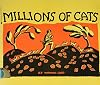
An old man wants a cat for his wife, but has trouble picking just one when he discovers a hill covered with millions of them, billions of them, trillions of them. When he tries to take them all home, the narrative suddenly veers into horror territory as they cut a swath across the land like locusts before turning on each other.
Dark and weird with too many evil cats, millions of evil cats, billions of evil cats, trillions of evil cats.
This is one of those books that we've had for twenty-plus show more years but never revisited after the first time we read it to our toddler.
FOR REFERENCE:
Rated “Indifferent" in our old book database by Rod and Adelia. show less
Dark and weird with too many evil cats, millions of evil cats, billions of evil cats, trillions of evil cats.
This is one of those books that we've had for twenty-plus show more years but never revisited after the first time we read it to our toddler.
FOR REFERENCE:
Rated “Indifferent" in our old book database by Rod and Adelia. show less
A childhood favourite, I had not read the book in many a decade. While mostly still delightful, I hadn't remembered how violent and genocidal it was, with millions and billions and trillions of cute cats and kittens brutally devouring each other to utter oblivion. With jaded adult eyes, it's a lot more tragic than triumphant.

One of only a few picture-books to have been chosen as a Newbery Honor title - Wanda Gág's own The ABC Bunny was another, in 1934 - Millions of Cats is the charming tale of a very old man and a very old woman who, lonely and childless, decide to get a cat. But when the very old man finds himself before a hill covered in cats - "Cats here, cats there, / Cats and kittens everywhere, / Hundreds of cats, / Thousands of cats, / Millions and billions and trillions of cats," he cannot decide which show more one to take home. Returning with a horde of felines in tow, the very old man is greeted with consternation by the very old woman, and a decision is reached: they will keep the prettiest. But which is the prettiest...?
This book seems to have evoked a strong negative reaction in a number of readers, who have decried the violent and disturbing nature of Gág's solution, but I confess that I saw little cause for concern here. Millions of Cats is so clearly written in a fairy-tale style - the nameless little old couple who long for a child (or child-substitute), the quest to find the child, the convenient disappearance of the rivals, as a result of their own flaws - that I think young readers will take it in stride, treating it as the fantasy it is so clearly meant to be. I myself was reminded, especially at the beginning, of one of my own childhood favorites, Gladys L. Adshead's What Miranda Knew, which also featured a lonely older couple living in a quaint little home. Of course, that story involved a group of angels descending with two little babies for the old couple to care for, rather than a winsome kitten, but the sense of surreal whimsy is very similar.
The narrative itself, with its sing-song refrain about the millions of cats, reads very well, and would make an excellent story-hour selection. The type, which looks hand-written, is charming, and the illustrations are simply adorable, with a folk motif style that really appealed to me. In short: I'm going to have to disagree with some of my friends, much though I respect their views. I think Millions of Cats is a picture-book winner - one that definitely deserves a place on the young reader's fairy-tale shelf! show less
This book seems to have evoked a strong negative reaction in a number of readers, who have decried the violent and disturbing nature of Gág's solution, but I confess that I saw little cause for concern here. Millions of Cats is so clearly written in a fairy-tale style - the nameless little old couple who long for a child (or child-substitute), the quest to find the child, the convenient disappearance of the rivals, as a result of their own flaws - that I think young readers will take it in stride, treating it as the fantasy it is so clearly meant to be. I myself was reminded, especially at the beginning, of one of my own childhood favorites, Gladys L. Adshead's What Miranda Knew, which also featured a lonely older couple living in a quaint little home. Of course, that story involved a group of angels descending with two little babies for the old couple to care for, rather than a winsome kitten, but the sense of surreal whimsy is very similar.
The narrative itself, with its sing-song refrain about the millions of cats, reads very well, and would make an excellent story-hour selection. The type, which looks hand-written, is charming, and the illustrations are simply adorable, with a folk motif style that really appealed to me. In short: I'm going to have to disagree with some of my friends, much though I respect their views. I think Millions of Cats is a picture-book winner - one that definitely deserves a place on the young reader's fairy-tale shelf! show less
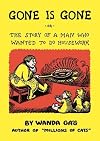
Gone Is Gone: or the Story of a Man Who Wanted to Do Housework by Wanda Gag, a Minnesota author and illustrator from the 1920s/30s who is probably most famous for Millions of Cats, which Wikipedia tells me is the oldest children's book still in print. Gone is Gone is the story of Fritzl and Liesi, a farming couple. Fritzl one day gets it in his head that Liesi--who runs the house, cares for their baby (who has the amazing name of Kinndli), and tends the animals--has it much easier than he show more does toiling in the fields. They decide to switch roles for a day, and you can almost guess where it's going to go.
I loved this book. It was funny and snarky. I loved its amazing black and white folksy illustrations, the fairy-tale mood, and the proto-feminist sensibilities. I'm so glad that the University of Minnesota is publishing some of Gag's less famous work as part of their effort to preserve MN heritage. show less
I loved this book. It was funny and snarky. I loved its amazing black and white folksy illustrations, the fairy-tale mood, and the proto-feminist sensibilities. I'm so glad that the University of Minnesota is publishing some of Gag's less famous work as part of their effort to preserve MN heritage. show less
Lists
Awards


You May Also Like


Associated Authors
Statistics
- Works
- 22
- Also by
- 9
- Members
- 6,963
- Popularity
- #3,514
- Rating
- 4.1
- Reviews
- 185
- ISBNs
- 136
- Languages
- 9
- Favorited
- 4