
Sondra Marshak
Author of Star Trek: The New Voyages
About the Author
Image credit: via Worlds Without End
Series
Works by Sondra Marshak
Star Trek [box set] 1 copy
Tagged
Common Knowledge
- Canonical name
- Marshak, Sondra
- Legal name
- Marshak, Sondra Hassan
- Birthdate
- 1942-07-15
- Gender
- female
- Nationality
- USA
- Associated Place (for map)
- USA
Members
Reviews

It's hard to put into words what this book brought to Star Trek fandom. It came out in March, 1976, just a few short months before Star Wars took us to strange, new galaxies. Until then there was nothing out there except what fans wrote themselves, and this book of short stories, probably the first published fan fiction in book form in the Star Trek universe, started a movement.
Who knew that ordinary fans could write about Kirk, Spock, McCoy, Sulu, Uhura, and Chekov as though they were show more personal friends? Who could come up with the various ideas of shore leave on planets and leaving your communicator behind? Or the vicious nature of the Klingon's Mind Sifter?
The writing is strong, the characters are drawn from the many, many re-runs we watched during those dark times, and how the editors were able to select these and only these stories is a superhuman effort. Read this time as the first time as an adult, and I gained so, so much from that experience.
Happy 50th, Star Trek! show less
Who knew that ordinary fans could write about Kirk, Spock, McCoy, Sulu, Uhura, and Chekov as though they were show more personal friends? Who could come up with the various ideas of shore leave on planets and leaving your communicator behind? Or the vicious nature of the Klingon's Mind Sifter?
The writing is strong, the characters are drawn from the many, many re-runs we watched during those dark times, and how the editors were able to select these and only these stories is a superhuman effort. Read this time as the first time as an adult, and I gained so, so much from that experience.
Happy 50th, Star Trek! show less

I really enjoy this duo's Star Trek novels for a number of reasons. They are excellent at reading and expanding upon the characters from the show. Their new characters are strong, unique and memorable. They are expert at using the wider bounds of the Star Trek universe to create ethical dilemmas possible nowhere in our universe. And they share with me a highly developed notion of the loyalty, valor and integrity of the main three characters. This book explores the ultimate worthiness of the show more human race, in light of its heritage as a savage ape. It introduces a powerful new character, the Vulcan Savaj who demotes Kirk to First Officer and promotes Spock to Captain, holding that humans are inherently inferior to Vulcans as leaders. What ensues is a major test of Kirk's willingness to accept and obey orders, and Spock's to finally command the frail human whom he so often followed into the jaws of death. An excellent philosophical quandry, resolved in inimitable fashion by this accomplished, if preachy writing duo. show less
This is one of those used-book-store finds that I picked up for completeness's sake and didn't expect much of. But it was great fun. The book is a 1976 collection of eight TOS stories written by fans. The quality is high on both the levels of story and sentence-level writing--I'd go so far as to say that most of these stories meet or exceed the quality of the Trek books written by professionals for the series in later years. Like much self-published fan fiction, these stories are the sorts show more that generally couldn't be told on the show--either because the budget couldn't handle the effects that would have been needed, or the show format wouldn't support the story, or the story deals too much with characterization and not enough with action for the typical TOS outing. I think this aspect enriches these stories, and allows them to avoid one of the major pitfalls of some of those professionally-written later books--that feel that it is "just another episode," that it's been done before, that it's nothing special. These stories are something special, precisely because they do what the show couldn't. Highly recommended for any TOS fans whose favorite bits of the show are the character development and interactions. show less
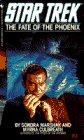
The first book in this duology was awful, but in an entertaining way. Its horrible writing was entertaining, and the overt slashiness even more so. (I love K/S, but these characters were pompous and so out of character that it could only be laughable.) And there were some interesting philosophical elements at play. So, I read the sequel, partly seeking entertainment and partly actually wanting to know how the story might carry on, what happened to Omne in the end.
Unfortunately, I did some show more Googling partway through, because I wanted to see what else the authors had written. I discovered that they're both staunch Objectivists, followers of Ayn Rand, and all of a sudden the books weren't much fun anymore. It's not just weird bad writing, it's that bizarre conviction that every character should be a pure elemental essence, and every conflict is a primal assessment between two unadulterated forces-as-people, and everyone just knows things by looking at each other, and everyone is a perfect specimen of something, and blah blah blah. No wonder the characters are so out of character; none of them were ever meant to be ultimate expressions of anything. Spock was never even implied to be "one of the best fighters in the galaxy," for instance, but of course he has to be because everyone here is THE BEST BAR NONE.
There were still some good elements, some sections where the writing actually got good. Some interesting stakes, and one long (literal) debate about the Prime Directive that worked really well. But it stopped being fun. show less
Unfortunately, I did some show more Googling partway through, because I wanted to see what else the authors had written. I discovered that they're both staunch Objectivists, followers of Ayn Rand, and all of a sudden the books weren't much fun anymore. It's not just weird bad writing, it's that bizarre conviction that every character should be a pure elemental essence, and every conflict is a primal assessment between two unadulterated forces-as-people, and everyone just knows things by looking at each other, and everyone is a perfect specimen of something, and blah blah blah. No wonder the characters are so out of character; none of them were ever meant to be ultimate expressions of anything. Spock was never even implied to be "one of the best fighters in the galaxy," for instance, but of course he has to be because everyone here is THE BEST BAR NONE.
There were still some good elements, some sections where the writing actually got good. Some interesting stakes, and one long (literal) debate about the Prime Directive that worked really well. But it stopped being fun. show less
Lists
Awards

You May Also Like


Associated Authors
Statistics
- Works
- 23
- Members
- 4,393
- Popularity
- #5,709
- Rating
- 3.4
- Reviews
- 50
- ISBNs
- 65
- Languages
- 3
- Favorited
- 1