
Peter Spier (1927–2017)
Author of People
About the Author
Peter Edward Spier was born in Amsterdam on June 6, 1927. His formal education ended in his early teens, about a year after the Nazis invaded the Netherlands in 1940. His father was imprisoned by the Nazis for an illustration of Hitler that speculated about what would have happened had he stayed a show more painter. Since the family was Jewish, they were all sent to the Theresienstadt concentration camp in Czechoslovakia. They were liberated by the Soviet Red Army in May 1945. Spier returned to the Netherlands after the war and served in the Royal Netherlands Navy for four years before immigrating to the United States in 1951. He worked in advertising before he began to write and illustrate children's books. His books included The Cow Who Fell in the Canal by Phyllis Krasilovsky, The Fox Went Out on a Chilly Night, Of Dikes and Windmills, and Circus! He received the Caldecott Medal for Noah's Ark. He died of congestive heart failure on April 27, 2017 at the age of 89. (Bowker Author Biography) show less
Image credit: Peter Spier in the Village Bookmarket, Palmyra, NY, on November 6 2010 to say hello and sign some copies of his book "The Erie Canal" - Photo by Marcia Marsille
Series
Works by Peter Spier
4 Board Books: Big Trucks, Little Trucks: Here Comes the Fire Trucks: Fast Cars, Slow Cars: Trucks That Dig and Dump (1988) 4 copies
雨、あめ (児童図書館・絵本の部屋) 3 copies
Hoe spreekt hij dan? 2 copies
No title 2 copies
Fox, The 1 copy
The Eerie Canal 1 copy
Uffa, che barba| 1 copy
Le villqge de Peter Spier 1 copy
Associated Works
Favorite Christmas Carols — Illustrator — 3 copies
Tagged
Common Knowledge
- Birthdate
- 1927-06-06
- Date of death
- 2017-04-27
- Gender
- male
- Education
- Rijksacademie voor Beeldende Kunsten, Amsterdam
- Occupations
- artist
author
illustrator - Organizations
- Royal Netherlands Navy
- Relationships
- Spier, Jo (father)
- Nationality
- Netherlands
USA - Birthplace
- Amsterdam, Netherlands
- Places of residence
- Theresienstadt concentration camp
Broek in Waterland, Netherlands
Long Island, New York, USA
Members
Reviews

Opening with his own translation of The Flood, a poem from Dutch poet and theologian Jacobus Revius (1586-1658), author/illustrator Peter Spier then proceeds to retell the story of Noah's Ark in this otherwise wordless picture book. Many of the pages are split into panels, usually with one large and several smaller paintings, although some two-page spreads contain only one massive painting. The events of the story—the gathering of the animals, their feeding and upkeep during the flood, the show more landing of the Ark on Mt. Ararat—are retold through the artwork, and the story concludes with an image of the abandoned Ark, all chaos inside...
Published in 1977, Noah's Ark won the Caldecott Medal in 1978, and it is not difficult to see why. The artwork here is detailed and expressive, capturing both the pathos and humor of the famous biblical story in unexpected ways. There are amusing scenes aplenty, including those in which Mrs Noah is terrified of some mice, and Noah himself tends to various animals, but what struck me most were the tragic ones. It may be odd to say it, as someone who has known this story since I was a little girl, but I'd never really considered all the animals who didn't make it onto the Ark. The people left behind to perish, yes, I'd thought of them, with pity and horror, but I'd never really thought of all of the OTHER animals, besides the lucky two from each species, that were abandoned to their fate. Here their fate was brought to my attention in a heartbreaking sequence of scenes, as the Ark is closed up and the rest of the animals stand there, slowly being submerged in water. That sequence hit me like a gut-punch, and will be with me for some time. The near-destruction of humanity is heartbreaking of course, but there one can argue (at least within the structure of the story) that their own actions caused their suffering. What wrong did the animals do? None—and yet they too suffered, their fate tied to that of humanity. I was reminded of Cú Rua the fox, from Pat O'Shea fantasy masterpiece, The Hounds of the Morrigan, who declared that "it is a sad and puzzling fate to share the world with man, but what can we do?"
I'm not sure my reaction here would be the common one, but I suspect it is not solely owing to my age, and that I would have been likewise struck, as a child. This is a beautiful book, and well worth the accolades it won, but I am rather glad I didn't encounter it as a child... show less
Published in 1977, Noah's Ark won the Caldecott Medal in 1978, and it is not difficult to see why. The artwork here is detailed and expressive, capturing both the pathos and humor of the famous biblical story in unexpected ways. There are amusing scenes aplenty, including those in which Mrs Noah is terrified of some mice, and Noah himself tends to various animals, but what struck me most were the tragic ones. It may be odd to say it, as someone who has known this story since I was a little girl, but I'd never really considered all the animals who didn't make it onto the Ark. The people left behind to perish, yes, I'd thought of them, with pity and horror, but I'd never really thought of all of the OTHER animals, besides the lucky two from each species, that were abandoned to their fate. Here their fate was brought to my attention in a heartbreaking sequence of scenes, as the Ark is closed up and the rest of the animals stand there, slowly being submerged in water. That sequence hit me like a gut-punch, and will be with me for some time. The near-destruction of humanity is heartbreaking of course, but there one can argue (at least within the structure of the story) that their own actions caused their suffering. What wrong did the animals do? None—and yet they too suffered, their fate tied to that of humanity. I was reminded of Cú Rua the fox, from Pat O'Shea fantasy masterpiece, The Hounds of the Morrigan, who declared that "it is a sad and puzzling fate to share the world with man, but what can we do?"
I'm not sure my reaction here would be the common one, but I suspect it is not solely owing to my age, and that I would have been likewise struck, as a child. This is a beautiful book, and well worth the accolades it won, but I am rather glad I didn't encounter it as a child... show less

A vulpine adventurer heads to town in this wonderful picture book presentation of the classic folk song from author/illustrator Peter Spier, winner of a Caldecott Honor in 1962. Traveling many miles, the fox passes a farm where he makes off with a grey goose and duck, and pursued by the farmer, heads home to feed his wife and ten little kits. The book closes with the music and lyrics for the song, and an afterword from Spier describing the Vermont countryside which inspired his show more illustrations...
Originally published in 1961, in an edition that alternated between color and black and white scenes, The Fox Went Out on a Chilly Night was republished in 2014 in a new edition featuring fully colorized artwork, created by Spier from his original illustrations. It is this latter edition that I read, and greatly enjoyed. The song which provides the text here is from England, and dates back to two 15th-century poems in Middle English, The Fox and the Goose and The False Fox. It was recorded as a song in 1810 in Joseph Ritson's Gammer Gurton's Garland, where it was entitled Dame Widdle Waddle. It's interesting to note that the farmer's wife in this modern version is "old mother Giggle-Gaggle." Although originating in England, the visual setting here is classic New England, with the steeple church and the Civil War memorial on the village green. According to Spier, a Dutch-born American author and artist, the setting was inspired by a drive through Vermont one autumn, and he later studied farms around Newfane, VT for specific details, as well as visiting the Farmers' Museum in Cooperstown, New York and Old Sturbridge Village in Massachusetts. All of this preparation certainly paid off, as the visuals here are an absolute delight! I enjoyed everything about this book, from the vulpine hero—foxes are a weakness of mine, and I wrote my masters dissertation on three centuries of Reynard retellings for children—to the autumnal setting (my favorite season), to the artwork in general, with its feeling of old-time authenticity and New England charm. After reading it the first time, I then found a wonderful recording of the song itself on Youtube, performed by Apollo's Fire and accompanied by pages from this book, which I also greatly enjoyed! Highly recommended to anyone who appreciates folk songs turned into picture books, foxy tales (and tails!), and gorgeous picture book art. show less
Originally published in 1961, in an edition that alternated between color and black and white scenes, The Fox Went Out on a Chilly Night was republished in 2014 in a new edition featuring fully colorized artwork, created by Spier from his original illustrations. It is this latter edition that I read, and greatly enjoyed. The song which provides the text here is from England, and dates back to two 15th-century poems in Middle English, The Fox and the Goose and The False Fox. It was recorded as a song in 1810 in Joseph Ritson's Gammer Gurton's Garland, where it was entitled Dame Widdle Waddle. It's interesting to note that the farmer's wife in this modern version is "old mother Giggle-Gaggle." Although originating in England, the visual setting here is classic New England, with the steeple church and the Civil War memorial on the village green. According to Spier, a Dutch-born American author and artist, the setting was inspired by a drive through Vermont one autumn, and he later studied farms around Newfane, VT for specific details, as well as visiting the Farmers' Museum in Cooperstown, New York and Old Sturbridge Village in Massachusetts. All of this preparation certainly paid off, as the visuals here are an absolute delight! I enjoyed everything about this book, from the vulpine hero—foxes are a weakness of mine, and I wrote my masters dissertation on three centuries of Reynard retellings for children—to the autumnal setting (my favorite season), to the artwork in general, with its feeling of old-time authenticity and New England charm. After reading it the first time, I then found a wonderful recording of the song itself on Youtube, performed by Apollo's Fire and accompanied by pages from this book, which I also greatly enjoyed! Highly recommended to anyone who appreciates folk songs turned into picture books, foxy tales (and tails!), and gorgeous picture book art. show less

Award-winning Dutch American children's author and artist Peter Spier offers an exuberant celebration of Christmas in this wordless picture book. A close-knit and loving family prepare for the holiday—shopping, decorating, baking cookies, and playing with friends—then celebrates it—church service, Christmas Day dinner with family—and finally recovers from all the festivity in these 90+ color illustrations, culminating in a scene in which the following year' holiday is already show more anticipated...
Published in 1983, Peter Spier's Christmas! evoked an instant and strong feeling of nostalgia in me, for my own childhood, and the Christmases my own family celebrated. The visuals here felt very much of that time—the cars, the way the stores looked, the appliances used in the home—transporting me back to my girlhood. The importance of religious observance at the holiday and how that was handled—a natural part of the celebration, it is emphasized in the church scene, and also in those featuring the family's Nativity set—also struck a chord. The church depicted here felt very familiar to me, having been raised a Congregationalist, and that too gave me a sense of home. All of that said, I didn't feel that the visuals here were so foreign (in either a temporal or cultural sense) that contemporary children couldn't understand them, and there is much that is still current and universal, from the warmth of the family circle—the grandparents coming struck another chord, as my own grandparents were always with us at Christmas—to the fun of the various activities. Recommended to fans of Peter Spier—I really need to read more of his work!—and to anyone seeking wordless Christmas books children can pore over, examining every detail. show less
Published in 1983, Peter Spier's Christmas! evoked an instant and strong feeling of nostalgia in me, for my own childhood, and the Christmases my own family celebrated. The visuals here felt very much of that time—the cars, the way the stores looked, the appliances used in the home—transporting me back to my girlhood. The importance of religious observance at the holiday and how that was handled—a natural part of the celebration, it is emphasized in the church scene, and also in those featuring the family's Nativity set—also struck a chord. The church depicted here felt very familiar to me, having been raised a Congregationalist, and that too gave me a sense of home. All of that said, I didn't feel that the visuals here were so foreign (in either a temporal or cultural sense) that contemporary children couldn't understand them, and there is much that is still current and universal, from the warmth of the family circle—the grandparents coming struck another chord, as my own grandparents were always with us at Christmas—to the fun of the various activities. Recommended to fans of Peter Spier—I really need to read more of his work!—and to anyone seeking wordless Christmas books children can pore over, examining every detail. show less
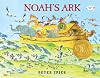
I have a love of all things Noah's Ark, and this is a standout "retelling". Spier's book starts with a translated Dutch poem, but the rest of the book is wordless. In place of prose are detailed, imaginative drawings that capture that ups and downs of the narrative. There's so much to look at and laugh over for both children and adults. Top of my list are the unique holding areas for different types of animals and the messes they leave behind! #relatable C definitely prefers books with show more words, but still spends a lot of time studying the images and reading the storyline in them. show less
Lists
Awards


You May Also Like


Associated Authors
Statistics
- Works
- 66
- Also by
- 26
- Members
- 12,644
- Popularity
- #1,851
- Rating
- 3.8
- Reviews
- 229
- ISBNs
- 303
- Languages
- 13
- Favorited
- 6
