
Gary Gygax (1938–2008)
Author of Official Advanced Dungeons & Dragons Players Handbook
About the Author
Image credit: Courtesy of Alan De Smet.
Series
Works by Gary Gygax
Advanced Dungeons & Dragons Dungeon Masters Guide (1st edition) (1979) — Author — 1,286 copies, 6 reviews
Original Adventures Reincarnated, Vol. 3: Expedition to The Barrier Peaks (2019) — Author — 62 copies
Dungeons & Dragons Supplement III: Eldritch Wizardry, Ancient and Powerful Magic (1976) — Author — 37 copies
Swords & Spells Fantastic Miniatures Rules on a 1:10/1:1 Scale for use with Dungeons & Dragons (1976) 25 copies
Dungeons & Dragons, Volume 3: The Underworld & Wilderness Adventures (1974) — Author — 17 copies, 1 review
Premium Original Dungeons & Dragons Fantasy Roleplaying Game (D&D Boxed Game) (2013) — Author — 12 copies
Worlds of Gary Gygax: The Hermit — Author — 5 copies
La fortaleza en la frontera 4 copies
Advanced Dungeons & Dragons 2nd Edition Official Game Accessory Character Record Sheets (1989) 4 copies
Celebration of Celene 3 copies
Warriors of Mars "The Warfare of Barsoom in Miniature" (rules for individual and large-scale land and aerial conflict) (1974) 3 copies
Mundos misteriosos: Tomos 1 Los asesinos de Anubis, 2. La clave es Samarcanda y 3. Muerte en Delhi. (1997) 3 copies
Dungeons & Dragons: Master DM's Book 3 copies
DONE The Strategic Review #4 2 copies
Evening Odds 2 copies
Swords & Spells: Fantastic Miniatures Rules On A 1:10/1:1 Scale For Use With Dungeons & Dragons 1 copy
Journeys, #6 — Contributor — 1 copy
Marmoreal Tomb: Appendices 1 copy
The Gnome Cache 1 copy
The book of marvelous magic 1 copy
Greyhawk Adventures: Saga of Old City, Artifact of Evil, Master Wolf, the Price of Power, the Demon Hand, the Name of the Game (1988) 1 copy
DONE The Strategic Review #2 1 copy
Duty 1 copy
Het fort in het grensgebied 1 copy
Uninvited Guests 1 copy
DONE The Strategic Review #3 1 copy
Monster HandbookI :AD&D 1 copy
Men & Magic 1 copy
Le Temple du Mal Elementaire 1 copy
Troll Lord Games Hermit — Author — 1 copy
Expert rules 1 copy
The World Of Greyhawk Folio 1 copy
Dungeons & Dragons: Greyhawk 1 copy
DONE The Strategic Review #1 1 copy
No title 1 copy
Dungeons & Dragons B/X Rules 1 copy
Marmoreal Tomb: Game Module 1 copy
Associated Works
Deities & Demigods: Cyclopedia of Gods and Heroes from Myth and Legend (Advanced Dungeons and Dragons) (1980) — Foreword, some editions — 558 copies, 5 reviews
The Odyssey of Gilthanas (1999) — Based on the original Dungeons & Dragons rules created by — 142 copies
Empire of the Petal Throne: The World of Tekumel (1987) — Foreword, some editions — 39 copies, 1 review
Experts v.3.5: A Comprehensive d20/OGL Sourcebook for Fantasy Role-Playing Games (2005) — Introduction, some editions — 4 copies, 1 review
La Suisse : Sa vie et son effort : Le pays tel qu'il est aujourd'hui — Contributor, some editions — 1 copy
Tagged
Common Knowledge
- Canonical name
- Gygax, Gary
- Legal name
- Gygax, Ernest Gary
- Other names
- Gygax, E. Gary
- Birthdate
- 1938-07-27
- Date of death
- 2008-03-04
- Gender
- male
- Education
- University of Chicago
- Occupations
- underwriter
cobbler
editor-in-chief
game designer - Organizations
- International Federation of Wargamers (co-founder)
Tactical Studies Rules (TSR, Inc.) - Awards and honors
- Origins Award (Academy of Adventure Gaming Arts and Design | 1980)
- Relationships
- Gygax, Lucion Paul (son)
Gygax, Ernie (son)
Gygax, Alex (son) - Short biography
- Gary is the co-creator of the Dungeons and Dragons game in 1974.
- Cause of death
- abdominal aortic aneurysm
- Nationality
- USA
- Birthplace
- Chicago, Illinois, USA
- Places of residence
- Hollywood, California, USA
Lake Geneva, Wisconsin, USA
Chicago, Illinois, USA - Place of death
- Lake Geneva, Wisconsin, USA
- Burial location
- Oak Hill Cemetery, Lake Geneva, Wisconsin, USA
- Associated Place (for map)
- Wisconsin, USA
Members
Reviews

This was the first role-playing game I was ever exposed to, aged probably 7 or 8 when my older brother was given a copy in 1979 or 1980. I re-read this in April 2026. I had just started playing 'Dolmenwood', an Old School Revival game heavily derivative of Basic D&D, and I wanted to revisit the source material. This Eric Holmes edition predates the Tom Moldvay Basic Dungeons & Dragons -- it is simply called 'Dungeons & Dragons'. It's clear that the Moldvay D&D is the direct ancestor of show more Dolmenwood (and its parent Old School Essentials), but Holmes' D&D is the ancestor of Moldvay's.
The structure of the book is a bit looser than that of more modern RPGs. Headings are fewer and long paragraphs can conceal rules. For example, this interesting snippet is found under the description of Magic Spells (p.13):
"This rule [that spell casters forget their spells when they cast them] places great limitations on the magic-user's power, but there are ways to partially overcome them. One is to have the spell written out on a magical scroll. Scrolls are written in magic runes that fade from the page as they are read, so a scroll also can only be used once. Magic-users may make a scroll of a spell they already "know" (ie. have in their magic book) at a cost of 100 gold pieces and 1 week's work for each spell of the first leve, 200 gold pieces and 2 weeks for a second level spell (if the magic-user is third level), etc."
The same 'Magic Spells' heading contains notes about the requirements for casting a spell (ie, must not be bound and gagged), the above-mentioned memory effect, how to research new spells and how many spells a magic-user starts with -- a 'chance to know' each spell in the entire list, with a minimum and maximum based on the magic-user's Intelligence.
Third level magic user spells were listed but not described "to give some idea of the range of magical possibilities" (p.16). This is a bit of a tease, but fair because the game only allows characters to reach 3rd level - you'd need to be a fifth level magic-user to cast 3rd level spells.
Other interesting rules that aren't the same as other old school Dungeons & Dragons:
- all weapons do 1d6 damage
- Dexterity determines fighting order, with ties broken by 1d6
- Descending Armour Class - the lower the AC the better the protection
- There are five alignments: Lawful Good, Lawful Evil, Neutral, Chaotic Good, Chaotic Evil
- High ability scores do very little except give you bonuses for experience
Experience points are awarded based on gold recovered and creatures killed or outwitted. There's a proviso for defeating weaker monsters which I don't recall seeing in other D&D versions:
"If the defeated monster is lower in level than the character who overcomes him, less experience is gained. The experience points for the kill are multiplied by a fraction: monster level/character's level. For example if a third level fighting man killed a first level orc he generates ⅓ the experience points." (p.11)
In the section 'Dungeon Mastering as a Fine Art' there is a some useful advice for new DMs about pacing, dramatics, preparation, and giving your players opportunities to turn around and go back to the surface. "Many gamesters start with a trip across country to get to the entrance of the dungeon -- a trip apt to be punctuated by attacks by brigands or wandering monsters, or marked by strange and unusual encounters. The party then enters the underworld, tries to capture the maximum treasure with the minimal risk and escape alive … Do not hesitate to have lawful or helpful characters chance by at times, your adventurers may need a little help!" Oh yes, and I don't know how many dungeons have been inspired by the awesome 'Stone Mountain' diagram in the 'Sample Cross Section of Levels' in this part of the book (p.39)!
"The imaginary universe of Dungeons & Dragons obviously [except to Gary Gygax and TSR, who never admitted it] lies not too far from the Middle Earth of J.R.R. Tolkien's great 'Lord of the Rings' trilogy. The D & D universe also impinges on the fantasy worlds of Fritz Leiber, Robert E. Howard, Gardner F. Fox, classical mythology and any other source of inspiration the Dungeon Master wants to use." (p.41)
Finally the 'Tower of Zenopus' sample adventure is a nice flavourful starting example which seems to have been an influence on the later 'Sinister Secret of Saltmarsh' module, in that it has an abandoned ruin, supposedly haunted near a port town (literally Portown in this book) with an evil wizard and smugglers in sea caves below. show less
The structure of the book is a bit looser than that of more modern RPGs. Headings are fewer and long paragraphs can conceal rules. For example, this interesting snippet is found under the description of Magic Spells (p.13):
"This rule [that spell casters forget their spells when they cast them] places great limitations on the magic-user's power, but there are ways to partially overcome them. One is to have the spell written out on a magical scroll. Scrolls are written in magic runes that fade from the page as they are read, so a scroll also can only be used once. Magic-users may make a scroll of a spell they already "know" (ie. have in their magic book) at a cost of 100 gold pieces and 1 week's work for each spell of the first leve, 200 gold pieces and 2 weeks for a second level spell (if the magic-user is third level), etc."
The same 'Magic Spells' heading contains notes about the requirements for casting a spell (ie, must not be bound and gagged), the above-mentioned memory effect, how to research new spells and how many spells a magic-user starts with -- a 'chance to know' each spell in the entire list, with a minimum and maximum based on the magic-user's Intelligence.
Third level magic user spells were listed but not described "to give some idea of the range of magical possibilities" (p.16). This is a bit of a tease, but fair because the game only allows characters to reach 3rd level - you'd need to be a fifth level magic-user to cast 3rd level spells.
Other interesting rules that aren't the same as other old school Dungeons & Dragons:
- all weapons do 1d6 damage
- Dexterity determines fighting order, with ties broken by 1d6
- Descending Armour Class - the lower the AC the better the protection
- There are five alignments: Lawful Good, Lawful Evil, Neutral, Chaotic Good, Chaotic Evil
- High ability scores do very little except give you bonuses for experience
Experience points are awarded based on gold recovered and creatures killed or outwitted. There's a proviso for defeating weaker monsters which I don't recall seeing in other D&D versions:
"If the defeated monster is lower in level than the character who overcomes him, less experience is gained. The experience points for the kill are multiplied by a fraction: monster level/character's level. For example if a third level fighting man killed a first level orc he generates ⅓ the experience points." (p.11)
In the section 'Dungeon Mastering as a Fine Art' there is a some useful advice for new DMs about pacing, dramatics, preparation, and giving your players opportunities to turn around and go back to the surface. "Many gamesters start with a trip across country to get to the entrance of the dungeon -- a trip apt to be punctuated by attacks by brigands or wandering monsters, or marked by strange and unusual encounters. The party then enters the underworld, tries to capture the maximum treasure with the minimal risk and escape alive … Do not hesitate to have lawful or helpful characters chance by at times, your adventurers may need a little help!" Oh yes, and I don't know how many dungeons have been inspired by the awesome 'Stone Mountain' diagram in the 'Sample Cross Section of Levels' in this part of the book (p.39)!
"The imaginary universe of Dungeons & Dragons obviously [except to Gary Gygax and TSR, who never admitted it] lies not too far from the Middle Earth of J.R.R. Tolkien's great 'Lord of the Rings' trilogy. The D & D universe also impinges on the fantasy worlds of Fritz Leiber, Robert E. Howard, Gardner F. Fox, classical mythology and any other source of inspiration the Dungeon Master wants to use." (p.41)
Finally the 'Tower of Zenopus' sample adventure is a nice flavourful starting example which seems to have been an influence on the later 'Sinister Secret of Saltmarsh' module, in that it has an abandoned ruin, supposedly haunted near a port town (literally Portown in this book) with an evil wizard and smugglers in sea caves below. show less

VIDEO VERSION:
Advanced Dungeons & Dragons by E. Gary Gygax
The first edition of the Advanced Dungeons & Dragons Player's Handbook, written by E. Gary Gygax, is only one of a trilogy of rulebooks necessary to play the seminal roleplaying game. My original intention was to do a review of this book alone. However, the more time I put into trying to write a review, the more I realized there is really no way to talk about this book without talking about Dungeons & Dragons as a whole. Because this show more single volume is only one piece of a larger encompassing game, it doesn't make any sense to just talk about one book. Therefore, this review will not focus exclusively on Player's Handbook, rather I will also discuss how the volume fits into the scope of the game, along with the other core rulebooks.
My virginity was lost at the age of 12. Not my sexual virginity, my Dungeons & Dragons virginity. That was when I was first seduced by dice and rulebooks.
The first time I ever heard of Dungeons & Dragons (D&D), I was in the 6th grade, and within my circle of friends, one of the boys was telling us stories about his uncle playing this really elaborate boardgame that supposedly took days to learn how to play. That was the most vivid thing I remember about it; learning that the game was so complicated, you didn't just read a pamphlet of rules in 10 minutes, but instead you spent days learning the instructions. At that time, we didn't understand the concept of a roleplaying game. We thought it was a boardgame like Monopoly or Clue or Chess or Checkers and I distinctly remember my friends and I laughing at the stupidity of playing a game that would take so long to learn. What was the point? We thought it was crazy. What kind of losers are going to waste days just to learn the rules of a boardgame? Why would you do that? How could the game possibly be any fun if it was that complicated?
Over the next few weeks, we learned more and more about it. Players would make up imaginary characters like elves and warriors. Another player, called a Dungeon Master was like a referee or a movie director and he would run the game and play all the other roles of monsters and describe imaginary environments and so forth. Playing the whole game was kind of like a table reading of an improvisational theatrical production, with a medieval storyline, where you get to play a character that you invented yourself. That was starting to sound a lot less stupid and kind of fun! My friend sat in on a game session with his uncle and we heard all about the mythological creatures and magic and wizards and adventures and it started to sound really, really cool. Learning the rules might take a long time, but we began to understand why it was worth it. So, we decided to give it a shot. Among my friends, I believe I may have been the first or second person to buy the Basic boxed set of Dungeons & Dragons. Eventually, all of my friends played D&D, but in the beginning, I'm pretty sure there were only two of us to buy the original boxed set. We both read the rules and we figured it out and we had a lot of telephone conversations trying to understand what the rulebooks were talking about. And what the hell do you do with the crayon? By the end of the week, we tried to play that first game module, The Keep on The Borderlands, and it was awful. We had no idea what we were doing. We thought the Dungeon Master was supposed to actually read the module verbatim to the players. It was terrible. Total disaster. Wasn't fun at all. We didn't even use the crayon to color the dice. Never figured that out until months later. Instead I used it to underline rules in the rulebooks. That was a bad idea. It was a black crayon.
Yet, for some reason, we stuck with it. We didn't give up on Dungeons & Dragons even though that first game session sucked so bad. I think maybe the simple fact that we had spent an entire week reading the rules made us determined to not give up.
Like many kids back then, we didn't realize that Dungeons & Dragons and Advanced Dungeons & Dragons (AD&D) were completely different games. We presumed they were a progression: Basic to Expert to Advanced. Makes sense, right? We didn't understand that the Expert Dungeons & Dragons box set was a sequel to the Basic Dungeons & Dragons box set, but the hardcover Advanced Dungeons & Dragons rulebooks were not a sequel to the Expert set, they were in fact, an entirely new system of rules.
So, we played the Basic game.
Then we progressed to the Expert game.
Then I became the first person among my friends to buy AD&D.
In order to play a proper game of the first edition of AD&D, you needed a bare minimum of three books:
1. Player's Handbook
2. Dungeon Master's Guide
3. Monster Manual
Those three books are the staples, the foundation of the game. As their names imply, Player's Handbook is for the players. It explains how to create different types of characters and what their capabilities are within the game. Dungeon Master's Guide is for the referee and it lays out all the rules of how gameplay works from random encounters with mythological creatures in the countryside to rolling dice to determine the outcome of epic battles and swordfights. Monster Manual is a reference book for the Dungeon Master to populate his fantasy world with his choice of hundreds of fantastical beasts from orcs to goblins and of course, dragons. The first edition of AD&D ended up being comprised of over a dozen hardcover rulebooks and I owned them all. However, the other 10 books in question are all optional supplements. Only those initial three are the essential ones.
Needless to say, since D&D and AD&D are different games, when I bought the Player's Handbook, I was right back to square one. My friends and I had been playing D&D for months and I knew the rules of D&D pretty well. Because we all presumed AD&D was just another expansion, when I hit those hardcover books, I had no clue what was going on. I was completely baffled. And this time, I didn't have any other friends to bounce chapters off of. Nobody else owned the hardcover books yet. I was on my own. Slowly, I began to realize that this was a totally different game, and it was a lot better! I was really excited and I couldn't wait for all my friends to get copies of the books too. Once that happened, once all my friends had collected the AD&D books, we left the Basic and Expert box sets behind and never looked back. We were all about AD&D (an acronym which may confuse those of you in the insurance industry).
Reading the AD&D rulebooks was truly kindling the tinder of my imagination. The magical aspect of roleplaying games is that once you read the book to understand the rules, you constantly go back to reference the rules. Simply reading about imaginary spells and monsters and magical items would set the wheels in motion. I'd start to visualize different plots and scenarios and ideas for characters and villages and storylines and dungeon maps and treasures and who was guarding those treasures and why. Over the years, I literally invented dozens of AD&D characters that I never even used in the game. Dreaming them up was just as fun as playing a campaign with them.
The game itself, and the joy of playing it, occupied my time for years. All through junior high, and well into highschool, AD&D was a huge part of my friendships and my fondest memories. During the 6th grade, instead of staying out on the playground during lunch, my friends Jerry Jarzabek, Chip Reynolds and Keith Riggs would sneak back into the school, so we could play AD&D for the lunch period. We had all night gaming sessions with Ted and Chris Smith and Aaron Reitz and Mike Rozack, where we had sleepovers and quite literally played all night until the sun came up. Those evenings are sepiatone Polaroids of cozy sleeping bags fluffed thick as summer clouds fogging the floors among piles of dice and rulebooks. Grand adventures and crazy schemes and silly plots and scary battles and thrilling characters and epic conclusions.
Back in 1983, Player's Handbook was unquestionably one of the most important books of my junior highschool days. One that I read over and over. One that shaped and informed my social interaction, enriched my imagination, and educated me in new ways to appreciate mathematics, history, geometry, spatial relations, cartography, illustration, and storytelling.
Thankfully, those original three AD&D rulebooks were reprinted in 2013, allowing for an entirely new class of 6th graders to start playing the roleplaying game that started all roleplaying games. The original. The venerable. The immortal. Advanced Dungeons & Dragons.
Pick up a copy for yourself. And don't forget to buy the dice. Don't worry, these days, the numbers are already colored in. No need for the crayon anymore.
"The secret we should never let the gamemasters know is that they don't need any rules."
- Gary Gygax show less
Advanced Dungeons & Dragons by E. Gary Gygax
The first edition of the Advanced Dungeons & Dragons Player's Handbook, written by E. Gary Gygax, is only one of a trilogy of rulebooks necessary to play the seminal roleplaying game. My original intention was to do a review of this book alone. However, the more time I put into trying to write a review, the more I realized there is really no way to talk about this book without talking about Dungeons & Dragons as a whole. Because this show more single volume is only one piece of a larger encompassing game, it doesn't make any sense to just talk about one book. Therefore, this review will not focus exclusively on Player's Handbook, rather I will also discuss how the volume fits into the scope of the game, along with the other core rulebooks.
My virginity was lost at the age of 12. Not my sexual virginity, my Dungeons & Dragons virginity. That was when I was first seduced by dice and rulebooks.
The first time I ever heard of Dungeons & Dragons (D&D), I was in the 6th grade, and within my circle of friends, one of the boys was telling us stories about his uncle playing this really elaborate boardgame that supposedly took days to learn how to play. That was the most vivid thing I remember about it; learning that the game was so complicated, you didn't just read a pamphlet of rules in 10 minutes, but instead you spent days learning the instructions. At that time, we didn't understand the concept of a roleplaying game. We thought it was a boardgame like Monopoly or Clue or Chess or Checkers and I distinctly remember my friends and I laughing at the stupidity of playing a game that would take so long to learn. What was the point? We thought it was crazy. What kind of losers are going to waste days just to learn the rules of a boardgame? Why would you do that? How could the game possibly be any fun if it was that complicated?
Over the next few weeks, we learned more and more about it. Players would make up imaginary characters like elves and warriors. Another player, called a Dungeon Master was like a referee or a movie director and he would run the game and play all the other roles of monsters and describe imaginary environments and so forth. Playing the whole game was kind of like a table reading of an improvisational theatrical production, with a medieval storyline, where you get to play a character that you invented yourself. That was starting to sound a lot less stupid and kind of fun! My friend sat in on a game session with his uncle and we heard all about the mythological creatures and magic and wizards and adventures and it started to sound really, really cool. Learning the rules might take a long time, but we began to understand why it was worth it. So, we decided to give it a shot. Among my friends, I believe I may have been the first or second person to buy the Basic boxed set of Dungeons & Dragons. Eventually, all of my friends played D&D, but in the beginning, I'm pretty sure there were only two of us to buy the original boxed set. We both read the rules and we figured it out and we had a lot of telephone conversations trying to understand what the rulebooks were talking about. And what the hell do you do with the crayon? By the end of the week, we tried to play that first game module, The Keep on The Borderlands, and it was awful. We had no idea what we were doing. We thought the Dungeon Master was supposed to actually read the module verbatim to the players. It was terrible. Total disaster. Wasn't fun at all. We didn't even use the crayon to color the dice. Never figured that out until months later. Instead I used it to underline rules in the rulebooks. That was a bad idea. It was a black crayon.
Yet, for some reason, we stuck with it. We didn't give up on Dungeons & Dragons even though that first game session sucked so bad. I think maybe the simple fact that we had spent an entire week reading the rules made us determined to not give up.
Like many kids back then, we didn't realize that Dungeons & Dragons and Advanced Dungeons & Dragons (AD&D) were completely different games. We presumed they were a progression: Basic to Expert to Advanced. Makes sense, right? We didn't understand that the Expert Dungeons & Dragons box set was a sequel to the Basic Dungeons & Dragons box set, but the hardcover Advanced Dungeons & Dragons rulebooks were not a sequel to the Expert set, they were in fact, an entirely new system of rules.
So, we played the Basic game.
Then we progressed to the Expert game.
Then I became the first person among my friends to buy AD&D.
In order to play a proper game of the first edition of AD&D, you needed a bare minimum of three books:
1. Player's Handbook
2. Dungeon Master's Guide
3. Monster Manual
Those three books are the staples, the foundation of the game. As their names imply, Player's Handbook is for the players. It explains how to create different types of characters and what their capabilities are within the game. Dungeon Master's Guide is for the referee and it lays out all the rules of how gameplay works from random encounters with mythological creatures in the countryside to rolling dice to determine the outcome of epic battles and swordfights. Monster Manual is a reference book for the Dungeon Master to populate his fantasy world with his choice of hundreds of fantastical beasts from orcs to goblins and of course, dragons. The first edition of AD&D ended up being comprised of over a dozen hardcover rulebooks and I owned them all. However, the other 10 books in question are all optional supplements. Only those initial three are the essential ones.
Needless to say, since D&D and AD&D are different games, when I bought the Player's Handbook, I was right back to square one. My friends and I had been playing D&D for months and I knew the rules of D&D pretty well. Because we all presumed AD&D was just another expansion, when I hit those hardcover books, I had no clue what was going on. I was completely baffled. And this time, I didn't have any other friends to bounce chapters off of. Nobody else owned the hardcover books yet. I was on my own. Slowly, I began to realize that this was a totally different game, and it was a lot better! I was really excited and I couldn't wait for all my friends to get copies of the books too. Once that happened, once all my friends had collected the AD&D books, we left the Basic and Expert box sets behind and never looked back. We were all about AD&D (an acronym which may confuse those of you in the insurance industry).
Reading the AD&D rulebooks was truly kindling the tinder of my imagination. The magical aspect of roleplaying games is that once you read the book to understand the rules, you constantly go back to reference the rules. Simply reading about imaginary spells and monsters and magical items would set the wheels in motion. I'd start to visualize different plots and scenarios and ideas for characters and villages and storylines and dungeon maps and treasures and who was guarding those treasures and why. Over the years, I literally invented dozens of AD&D characters that I never even used in the game. Dreaming them up was just as fun as playing a campaign with them.
The game itself, and the joy of playing it, occupied my time for years. All through junior high, and well into highschool, AD&D was a huge part of my friendships and my fondest memories. During the 6th grade, instead of staying out on the playground during lunch, my friends Jerry Jarzabek, Chip Reynolds and Keith Riggs would sneak back into the school, so we could play AD&D for the lunch period. We had all night gaming sessions with Ted and Chris Smith and Aaron Reitz and Mike Rozack, where we had sleepovers and quite literally played all night until the sun came up. Those evenings are sepiatone Polaroids of cozy sleeping bags fluffed thick as summer clouds fogging the floors among piles of dice and rulebooks. Grand adventures and crazy schemes and silly plots and scary battles and thrilling characters and epic conclusions.
Back in 1983, Player's Handbook was unquestionably one of the most important books of my junior highschool days. One that I read over and over. One that shaped and informed my social interaction, enriched my imagination, and educated me in new ways to appreciate mathematics, history, geometry, spatial relations, cartography, illustration, and storytelling.
Thankfully, those original three AD&D rulebooks were reprinted in 2013, allowing for an entirely new class of 6th graders to start playing the roleplaying game that started all roleplaying games. The original. The venerable. The immortal. Advanced Dungeons & Dragons.
Pick up a copy for yourself. And don't forget to buy the dice. Don't worry, these days, the numbers are already colored in. No need for the crayon anymore.
"The secret we should never let the gamemasters know is that they don't need any rules."
- Gary Gygax show less
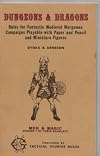
Considering that I've been playing Dungeons & Dragons since I was 8 (back in 1978), it's kind of crazy that I'm just reading this now. I guess part of it is that I didn't own a white boxed set until a couple weeks ago. But then I'm back to, how did I not own a white boxed set until just recently?
It was fun and nostalgic to read this, but also quite painful. It really has the feel of someones random notes about a game that he wants to create. Things like spells that give no description of show more what they actually do, an "alternate" combat system, but no "initial" combat system because they assume you already play Chainmail and will be using that system. Before you even know how to roll up a character there's a section on creating magic items.
Probably the biggest problem I have with this is that there's no "example of play". He never really talks about how the game is played, so someone who had never played an RPG (and I believe this was the first one), would be totally lost. Anyway, I've always said that you should always learn how to play RPGs from people who already know how to play. So maybe Mr. Gygax was writing from that perspective.
Anyway, it's super short and was a "blast from the past". It's really cool to see that many of the ideas still exist in the newest edition of D&D more than 40 years later. show less
It was fun and nostalgic to read this, but also quite painful. It really has the feel of someones random notes about a game that he wants to create. Things like spells that give no description of show more what they actually do, an "alternate" combat system, but no "initial" combat system because they assume you already play Chainmail and will be using that system. Before you even know how to roll up a character there's a section on creating magic items.
Probably the biggest problem I have with this is that there's no "example of play". He never really talks about how the game is played, so someone who had never played an RPG (and I believe this was the first one), would be totally lost. Anyway, I've always said that you should always learn how to play RPGs from people who already know how to play. So maybe Mr. Gygax was writing from that perspective.
Anyway, it's super short and was a "blast from the past". It's really cool to see that many of the ideas still exist in the newest edition of D&D more than 40 years later. show less

This is a wonderful example of sword and sorcery, and because it was written by Gary Gygax, the original architect of Dungeons and Dragons, it has a privileged position in my heart.
The best aspect of this novel is its scope. Rather than simply focus in on action and fight scenes--like Salvatore seems to do--Gygax adopts a broad perspective, describing Gord the Rogue's adventures from a more historical perspective. Whole weeks will pass by in a paragraph. Years of adventure will be show more characterized in a single chapter.
But this is not to say there aren't great battle scenes in the novel. To the contrary, there is one particular scene near the end of the novel--a scene where Gord, Curley, and Chert face a demon--that is genuinely exciting. I knew Gord wasn't going to die, but Gygax under-characterized his two companions just enough for me to fear for their deaths. I knew they weren't invicible, and I anticipated their demise. When they lived I was genuinely relieved.
Gygax strikes a good balance in his characterization techniques. He fleshes out his characters just enough so that you never expect them to be invincible--like, say, a Drizzt Do'Urden--and their success and safety is never guaranteed.
If you love D&D, read this book. It makes it clear how much the game is more indebted to American Sword and Sorcery over British fantasy in the spirit of J.R.R. Tolkien. show less
The best aspect of this novel is its scope. Rather than simply focus in on action and fight scenes--like Salvatore seems to do--Gygax adopts a broad perspective, describing Gord the Rogue's adventures from a more historical perspective. Whole weeks will pass by in a paragraph. Years of adventure will be show more characterized in a single chapter.
But this is not to say there aren't great battle scenes in the novel. To the contrary, there is one particular scene near the end of the novel--a scene where Gord, Curley, and Chert face a demon--that is genuinely exciting. I knew Gord wasn't going to die, but Gygax under-characterized his two companions just enough for me to fear for their deaths. I knew they weren't invicible, and I anticipated their demise. When they lived I was genuinely relieved.
Gygax strikes a good balance in his characterization techniques. He fleshes out his characters just enough so that you never expect them to be invincible--like, say, a Drizzt Do'Urden--and their success and safety is never guaranteed.
If you love D&D, read this book. It makes it clear how much the game is more indebted to American Sword and Sorcery over British fantasy in the spirit of J.R.R. Tolkien. show less
Lists
Awards
You May Also Like


Associated Authors
Statistics
- Works
- 225
- Also by
- 57
- Members
- 12,496
- Popularity
- #1,876
- Rating
- 3.9
- Reviews
- 63
- ISBNs
- 187
- Languages
- 7
- Favorited
- 13