
John Kekes
Author of The Morality of Pluralism
About the Author
John Kekes is professor emeritus of philosophy at the University at Albany, State University of New York, and research professor at Union College. He is the author of many books, including How Should We Live?, also published by the University of Chicago Press, as well as, most recently, Hard show more Questions: Facing The problems of Life. show less
Works by John Kekes
Associated Works
Tagged
Common Knowledge
- Gender
- male
- Education
- Australian National University (Ph.D., Philosophy)
- Occupations
- Professor Emeritus of Philosophy, SUNY Albany
Members
Reviews
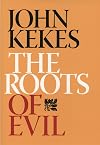
'The Roots of Evil' (2005) might be regarded as part of a wider trend of conservative moral revolt against American liberalism. The shadow of 9/11 is there. The conclusions could, at least in part, have come to us in a lecture by Jordan Peterson.
Kekes is a moralist masquerading to some extent as moral philosopher but his position is coherent. He makes his case painstakingly, analytically point by point, in order to justify his conclusions which are essentially that evil is part of our show more condition and morality its containment.
He is clearly not interested in going deeper into the metaphysics of evil beyond (rightly in my view) eliminating theological-supernatural and rational-Enlightenment models for what evil might be with certain logical conclusions emerging from his analysis regarding our handling of it.
Certainly (and I welcome this) Kekes has done us a service by reviving consideration of what had been largely a theological construct and secularising it. We have been in denial for far too long about this thing we call 'evil' - it exists as modes of human behaviour harmful to others.
The question (unaddressed by Kekes) is the gnostic one of whether evil is inherent in the waste and cruelty of existence itself and human evil merely an expression of the natural. I think it is but without in any way accepting it. The struggle against evil and against nature is the central ethical position.
However, I have my doubts about Kekes' rather formalistic approach to the problem. He is concerned with making an analytical case that leads inexorably, according to his reasoning, to a socially conservative and mildly authoritarian social order that comes off just a little too pat.
Sometimes (though not often) his reasoning falters but only because his six type cases seem to be carefully fitted into a pre-arranged scheme. There is a regrettable a-historicism that constantly diminishes the cultural and social contexts of evil acts in order to create those exemplars.
Even though I found it unsatisfactory, as if I was being carefully led down a polemical garden path, I would still recommend it to others, both because Kekes has at least had the courage to raise the problem of evil for discussion and because the 'scholastic' reasoning from his assumptions is useful.
His six type cases are the slaughter of the Cathars in the Middle Ages, Robespierre, Franz Stangl at Treblinka, the Argentinian 'Dirty War', Charles Manson and a criminal psychopath. His dark exemplars would probably all be considered evil actors by any reasonable human being.
[We covered Franz Stangl in our review of Gitta Sereny's collection of essays, 'The German Trauma' on GoodReads - https://www.goodreads.com/review/show/3262436322 ]
The point is less that these people did 'bad' things than that they did 'evil' things wholly disproportionately for their ostensible aims or failed to see the absurdity of what they were doing in terms of the good life. I refer you to Kekes for his very detailed arguments.
I find myself wondering, however, whether Kekes (now nearly 90) would apply his reasoning to events in Gaza, being already suspicious that the reasoning in the book has too many let-out clauses for certain kinds of behaviour acceptable to the American conservative mind.
The flaw in the type-cases is that of a moralism concerned with specific acts by specific people in specific time frames whereas evil grows in reality out of (as he admits) many causes of which the neglect here is such causes operating over time - an historical context.
This does not justify evil acts so let us not make that error but it restores external causes as historical conditions in the context of the evolved nature of our humanity. It is right to be pessimistic about the human condition and the omnipresence of evil throughout history but its 'flow' is what is neglected.
By concentrating on, say, the clinical bureaucratic administrator Stangl's behaviour, we neglect the fact that his capacity for evil emerged out of a conservative culture that went horribly wrong or we might fail to see the accumulated outrage and rage of a French lower class often without bread.
When looking at evil I would consider Kekes book an excellent starting point for the construction of a social morality that might be required to prempt evil or restore good in a decaying society but I would not consider it to be an account of the 'truth of the matter'.
Worse, such a conservative society, with a morality 'in aspic', is unlikely to be able to do more than hold the line against the most egregious of evil acts. It might also risk not seeing the tensions (as populism is showing us) that bubble up inside any static unresponsive system run by 'experts'.
Evil (which we might agree is deliberate harm to others) has no easy cut-off point. It grows from small acts of resentment and frustration that can lead to appalling atrocities based on a will not so much to evil itself (though this exists) as to imposing different orders or personalities on the world.
The eternal presence of evil is built into the world by our own deep psychological frustrations and struggle for resources and is mostly kept under check. What this book does not deal with is the systemic and explosive expression of those crises within our species when conditions permit.
This is, as Kekes notes, points to complexity and multicausality but it is a product of our being in time along many other such beings in time, clashing and colliding. Evil breaks out when either social order collapses or social order transmutes into an enabler of evil as a logical result of its own nature.
National socialism unfolded into evil not because it was 'evil' but because its conformation inevitably led to evil as its absurd 'romantic' ideology clashed with its desperate struggle for survival. There are always going to be coppers of moderate intelligence ready to fit in with the flow.
Although most extreme in the case of a psychopath, our biology is also a biology of propensity. The hard wiring of brains as much as the soft programming of culture will indicate who does monstrous things and who does not. Moral responsibility has had to be invented to restore order.
What Kekes dearly wants to do is restore that moral responsibility and appropriate punishment. He is right to want to do so as 'necessary fictions'. Some evil doers are just people in the wrong place at the wrong time but social order requires that action be taken regardless of abstract truth.
The case of Lucy Letby is an interesting example of the tensions this creates in society. The social 'hive' decided she was evil. Yet there is mounting evidence to raise questions about her guilt and the possible malignity of some who brought her to trial. Where does the evil lie?
If she is innocent but is not admitted as such, who is evil? Would a conservative moralist make her a type case of evil in a book? Of course, Kekes' examples are not like this - they are documented acts of demonstrable evil but the tension between the true and the convenient overlies all moralism.
It is, however, possible for two truths to co-exist. The truth that evil unfolds as part of a process of cause and effect where absolute moral responsibility can sometimes be denied by historical conditions and the truth that social order necessitates that we believe otherwise and order things accordingly.
I belong to the first school of thought. holding to a form of existential despair about our unfolding historical condition. Kekes grows out of the second school of thought. I may think I am right but I also know he is right (with caveats). He probably does not think I am and should not say so if he does.
Human society requires many such lies to maintain itself. Morality is one of the most necessary of those lies. Without morality of some sort, the protective force of the social collapses. Since God is dead and Reason no longer central to our species, Kekes thus takes a necessary step in the right direction.
But it is only a step. His post-9/11 American pragmatism still declines to ask the deeper questions which go beyond the attempt to impose a decent conservative morality in favour of this issue of unfolding - forwards in time rather than foolishly excusing what happened in the past.
As interesting to me as Franz Stangl are the bureaucratic administrators, so convinced that Stalin was evil, that they not merely exonerated national socialists but put significant amongst their number in charge of the Bundesbank and in prominent positions in NATO. Was that moral responsibility?
American morality tends to want to punish without thinking about the conditions that would lead to evil's resurgence in the future. Then suddenly it forgets the past when it is convenient for the 'deal' or to counter some external abstract evil it has invented.
I will take American moral conservatism seriously when it learns to contextualise Palestine and condemn the disproportionate evil coming out of Jerusalem. Indeed, I will take it seriously when it asks the right questions about the evils in its own society and those it has undertaken against others. show less
Kekes is a moralist masquerading to some extent as moral philosopher but his position is coherent. He makes his case painstakingly, analytically point by point, in order to justify his conclusions which are essentially that evil is part of our show more condition and morality its containment.
He is clearly not interested in going deeper into the metaphysics of evil beyond (rightly in my view) eliminating theological-supernatural and rational-Enlightenment models for what evil might be with certain logical conclusions emerging from his analysis regarding our handling of it.
Certainly (and I welcome this) Kekes has done us a service by reviving consideration of what had been largely a theological construct and secularising it. We have been in denial for far too long about this thing we call 'evil' - it exists as modes of human behaviour harmful to others.
The question (unaddressed by Kekes) is the gnostic one of whether evil is inherent in the waste and cruelty of existence itself and human evil merely an expression of the natural. I think it is but without in any way accepting it. The struggle against evil and against nature is the central ethical position.
However, I have my doubts about Kekes' rather formalistic approach to the problem. He is concerned with making an analytical case that leads inexorably, according to his reasoning, to a socially conservative and mildly authoritarian social order that comes off just a little too pat.
Sometimes (though not often) his reasoning falters but only because his six type cases seem to be carefully fitted into a pre-arranged scheme. There is a regrettable a-historicism that constantly diminishes the cultural and social contexts of evil acts in order to create those exemplars.
Even though I found it unsatisfactory, as if I was being carefully led down a polemical garden path, I would still recommend it to others, both because Kekes has at least had the courage to raise the problem of evil for discussion and because the 'scholastic' reasoning from his assumptions is useful.
His six type cases are the slaughter of the Cathars in the Middle Ages, Robespierre, Franz Stangl at Treblinka, the Argentinian 'Dirty War', Charles Manson and a criminal psychopath. His dark exemplars would probably all be considered evil actors by any reasonable human being.
[We covered Franz Stangl in our review of Gitta Sereny's collection of essays, 'The German Trauma' on GoodReads - https://www.goodreads.com/review/show/3262436322 ]
The point is less that these people did 'bad' things than that they did 'evil' things wholly disproportionately for their ostensible aims or failed to see the absurdity of what they were doing in terms of the good life. I refer you to Kekes for his very detailed arguments.
I find myself wondering, however, whether Kekes (now nearly 90) would apply his reasoning to events in Gaza, being already suspicious that the reasoning in the book has too many let-out clauses for certain kinds of behaviour acceptable to the American conservative mind.
The flaw in the type-cases is that of a moralism concerned with specific acts by specific people in specific time frames whereas evil grows in reality out of (as he admits) many causes of which the neglect here is such causes operating over time - an historical context.
This does not justify evil acts so let us not make that error but it restores external causes as historical conditions in the context of the evolved nature of our humanity. It is right to be pessimistic about the human condition and the omnipresence of evil throughout history but its 'flow' is what is neglected.
By concentrating on, say, the clinical bureaucratic administrator Stangl's behaviour, we neglect the fact that his capacity for evil emerged out of a conservative culture that went horribly wrong or we might fail to see the accumulated outrage and rage of a French lower class often without bread.
When looking at evil I would consider Kekes book an excellent starting point for the construction of a social morality that might be required to prempt evil or restore good in a decaying society but I would not consider it to be an account of the 'truth of the matter'.
Worse, such a conservative society, with a morality 'in aspic', is unlikely to be able to do more than hold the line against the most egregious of evil acts. It might also risk not seeing the tensions (as populism is showing us) that bubble up inside any static unresponsive system run by 'experts'.
Evil (which we might agree is deliberate harm to others) has no easy cut-off point. It grows from small acts of resentment and frustration that can lead to appalling atrocities based on a will not so much to evil itself (though this exists) as to imposing different orders or personalities on the world.
The eternal presence of evil is built into the world by our own deep psychological frustrations and struggle for resources and is mostly kept under check. What this book does not deal with is the systemic and explosive expression of those crises within our species when conditions permit.
This is, as Kekes notes, points to complexity and multicausality but it is a product of our being in time along many other such beings in time, clashing and colliding. Evil breaks out when either social order collapses or social order transmutes into an enabler of evil as a logical result of its own nature.
National socialism unfolded into evil not because it was 'evil' but because its conformation inevitably led to evil as its absurd 'romantic' ideology clashed with its desperate struggle for survival. There are always going to be coppers of moderate intelligence ready to fit in with the flow.
Although most extreme in the case of a psychopath, our biology is also a biology of propensity. The hard wiring of brains as much as the soft programming of culture will indicate who does monstrous things and who does not. Moral responsibility has had to be invented to restore order.
What Kekes dearly wants to do is restore that moral responsibility and appropriate punishment. He is right to want to do so as 'necessary fictions'. Some evil doers are just people in the wrong place at the wrong time but social order requires that action be taken regardless of abstract truth.
The case of Lucy Letby is an interesting example of the tensions this creates in society. The social 'hive' decided she was evil. Yet there is mounting evidence to raise questions about her guilt and the possible malignity of some who brought her to trial. Where does the evil lie?
If she is innocent but is not admitted as such, who is evil? Would a conservative moralist make her a type case of evil in a book? Of course, Kekes' examples are not like this - they are documented acts of demonstrable evil but the tension between the true and the convenient overlies all moralism.
It is, however, possible for two truths to co-exist. The truth that evil unfolds as part of a process of cause and effect where absolute moral responsibility can sometimes be denied by historical conditions and the truth that social order necessitates that we believe otherwise and order things accordingly.
I belong to the first school of thought. holding to a form of existential despair about our unfolding historical condition. Kekes grows out of the second school of thought. I may think I am right but I also know he is right (with caveats). He probably does not think I am and should not say so if he does.
Human society requires many such lies to maintain itself. Morality is one of the most necessary of those lies. Without morality of some sort, the protective force of the social collapses. Since God is dead and Reason no longer central to our species, Kekes thus takes a necessary step in the right direction.
But it is only a step. His post-9/11 American pragmatism still declines to ask the deeper questions which go beyond the attempt to impose a decent conservative morality in favour of this issue of unfolding - forwards in time rather than foolishly excusing what happened in the past.
As interesting to me as Franz Stangl are the bureaucratic administrators, so convinced that Stalin was evil, that they not merely exonerated national socialists but put significant amongst their number in charge of the Bundesbank and in prominent positions in NATO. Was that moral responsibility?
American morality tends to want to punish without thinking about the conditions that would lead to evil's resurgence in the future. Then suddenly it forgets the past when it is convenient for the 'deal' or to counter some external abstract evil it has invented.
I will take American moral conservatism seriously when it learns to contextualise Palestine and condemn the disproportionate evil coming out of Jerusalem. Indeed, I will take it seriously when it asks the right questions about the evils in its own society and those it has undertaken against others. show less
Awards

You May Also Like


Statistics
- Works
- 23
- Also by
- 1
- Members
- 374
- Popularity
- #64,495
- Rating
- 3.5
- Reviews
- 1
- ISBNs
- 76
- Languages
- 2