
P. W. Hammond
Author of Food and Feast in Medieval England
About the Author
Works by P. W. Hammond
Tagged
Common Knowledge
- Legal name
- Hammond, Peter W.
- Gender
- male
- Places of residence
- London, England, UK
New Earswick, York, England, UK - Map Location
- UK
Members
Reviews
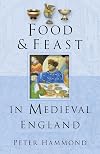
"What did people eat and drink in medieval times? How healthy was their diet?" As Hammond states, while they did not quite understand vitamins and nutrition, English medieval households were not ignorant of maintaining a "healthy" diet. Food was not left out to spoil and cooked in well ventilated kitchens. A variety of "fish" was served to all classes: herring, eel, mullet, plaice, haddock, mackerel, ling and oysters, and could be locally caught or imported from Ireland and Iceland. Most show more peasants suffered from nutritional deficiencies - consuming mostly carbohydrates - but were not regularly starving. The reader will learn the traditional days of halting sheep milking and removing cattle from the meadows. One will also become familiar with terms like "cubebs," "citronade," "butlerage," "jannock," "furmentie," and "malvesie." Images of lavish feasts and near-constant drunkenness are thoroughly debunked.
However, instead of outlining the book by "what was eaten," like vegetables, beer, fruit," wine etc, rather it is sorted by "who ate what," and consequently, there's a lot of repetition and overlap. The expenses of 14th, 16th, 15th households jump to and fro in a single page. Hammond certainly "examines the extraordinary range of food" but fails in explaining its"production and distribution." There's no progressive timeline of accessibility - and obviously, whether one is a peasant, yeoman or gentleman, a meal in 1312 versus 1512 is certainly not the same experience. That being said, if you're willing to sift through, Hammond's book is a great jumping off point. Hammond does provide a generous bibliography and covers the medieval English diet well enough. At 155 pages, it's a quick, easy read and could serve as a reliable resource for a DM's next campaign or a historical fiction author. show less
However, instead of outlining the book by "what was eaten," like vegetables, beer, fruit," wine etc, rather it is sorted by "who ate what," and consequently, there's a lot of repetition and overlap. The expenses of 14th, 16th, 15th households jump to and fro in a single page. Hammond certainly "examines the extraordinary range of food" but fails in explaining its"production and distribution." There's no progressive timeline of accessibility - and obviously, whether one is a peasant, yeoman or gentleman, a meal in 1312 versus 1512 is certainly not the same experience. That being said, if you're willing to sift through, Hammond's book is a great jumping off point. Hammond does provide a generous bibliography and covers the medieval English diet well enough. At 155 pages, it's a quick, easy read and could serve as a reliable resource for a DM's next campaign or a historical fiction author. show less
I read this book because I like food and I like history, mostly Medieval to Renaissance history. I am looking for detailed information on it. Perhaps I was expecting too much from this book. The author has written many books on medieval history so I guess I should not be surprised that it was more about history then about food. I mean, yes it was about food but it is defiantly a history book not foodie book and I want a historical foodie book.
The period covered is 1250 to about 1550, and as show more the author says ‘there is a bias towards the fifteenth century’. I find this interesting since the author also did a Food and Feast in Tudor England which since the Tudor period should start in 1485 when Henry VII became the first Tudor king and end with the death of Elizabeth I in 1603. The author also states that ‘cooking is not covered at all’, because he doesn’t cook. What he does cover is - what was eaten, who ate what, the manners of the people while they are and whether it was nutritious or not.
The impression I had when I finished this book was as if I watched a movie through a veil, I could get a general idea of what was going on, but not a clear picture. I remember thinking as I was reading it that maybe if things were organized in a different way it might be easier to get a better picture of what was eaten etc. About the only section that really stood out was the one on table manners.
I think that it would have been nice to have had more details, more on the guilds that governed food, more about the doctrine of the ‘humours’ which is the medieval equivalent of the food pyramid, to name just a few examples.
There are 7 pages worth of bibliography which I am sure that I will find helpful as I look further into this subject.
DS show less
The period covered is 1250 to about 1550, and as show more the author says ‘there is a bias towards the fifteenth century’. I find this interesting since the author also did a Food and Feast in Tudor England which since the Tudor period should start in 1485 when Henry VII became the first Tudor king and end with the death of Elizabeth I in 1603. The author also states that ‘cooking is not covered at all’, because he doesn’t cook. What he does cover is - what was eaten, who ate what, the manners of the people while they are and whether it was nutritious or not.
The impression I had when I finished this book was as if I watched a movie through a veil, I could get a general idea of what was going on, but not a clear picture. I remember thinking as I was reading it that maybe if things were organized in a different way it might be easier to get a better picture of what was eaten etc. About the only section that really stood out was the one on table manners.
I think that it would have been nice to have had more details, more on the guilds that governed food, more about the doctrine of the ‘humours’ which is the medieval equivalent of the food pyramid, to name just a few examples.
There are 7 pages worth of bibliography which I am sure that I will find helpful as I look further into this subject.
DS show less
You May Also Like


Associated Authors
Statistics
- Works
- 8
- Members
- 314
- Popularity
- #75,176
- Rating
- 3.9
- Reviews
- 2
- ISBNs
- 15