
Larry Bossidy (1955–2025)
Author of Execution: The Discipline of Getting Things Done
About the Author
Image credit: NNDB
Works by Larry Bossidy
Tagged
Common Knowledge
- Canonical name
- Bossidy, Larry
- Legal name
- Bossidy, Lawrence A.
- Birthdate
- 1955-03-05
- Date of death
- 2025-07-22
- Gender
- male
- Education
- Colgate University (BA|Economics|1957)
- Occupations
- businessman
executive - Organizations
- General Electric
AlliedSignal
Honeywell - Nationality
- USA
- Associated Place (for map)
- USA
Members
Reviews
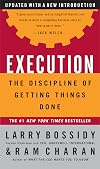
Larry Bossidy and Ram Charan have written a fine management book with “Execution” and I can't see why other reviewers find it lacking in usefulness. It's true that their systems require a good deal of uncomfortable frank talk between managers but the whole thing is really concerned with getting outside the comfort zone.
Strategy focuses firmly on the company's environment and competitor actions with the core being very open (non-political) decision making with clearly defined actions and show more a timetable with specific personal responsibilities.
I'm not a great fan of management books in general but I can recommend this one and it has similarities to one of my longtime favourites, Sam Walton's “Made in America” (bad title) and like him, they emphasise the personal touch and a high level of personal involvement.
A downside is the strange neo-liberal economic environment that these systems are designed to exploit (not really their fault they are an important part of it).
For example the idea that outsourcing may damage US industry/ skills and employment is completely absent as is concern with the influence of special interest (of which they are certainly one). Line workers also don't get a single mention.
Try the following quotes from the book:
P196 “Do we have people who know how to source? Do we have people who can run a supply chain that extends worldwide?”
P197 “The short and medium term milestones were to develop programs to move to low-cost manufacturing locations .”
P247 “We also had a program to promote sales of high tech globally, using China as a low cost supply base.”
P223 “You must continue to involve our lobbyist group to show congressional leaders the advantages of the product and dispel some of the current misconceptions.”
P250 “Or maybe you wanted to shut down a plant this year and transfer production to a lower cost country.”
Etc. etc. It's all in line with Jack Welch's 70/70/70 rule (70% of research and development should be outsourced, 70% of that should be outsourced offshore, 70% should be outsourced overseas and sent to India) = A tragedy of the commons, where the Commons is the non-shareholder/non-top executive part of the U.S.A. show less
Strategy focuses firmly on the company's environment and competitor actions with the core being very open (non-political) decision making with clearly defined actions and show more a timetable with specific personal responsibilities.
I'm not a great fan of management books in general but I can recommend this one and it has similarities to one of my longtime favourites, Sam Walton's “Made in America” (bad title) and like him, they emphasise the personal touch and a high level of personal involvement.
A downside is the strange neo-liberal economic environment that these systems are designed to exploit (not really their fault they are an important part of it).
For example the idea that outsourcing may damage US industry/ skills and employment is completely absent as is concern with the influence of special interest (of which they are certainly one). Line workers also don't get a single mention.
Try the following quotes from the book:
P196 “Do we have people who know how to source? Do we have people who can run a supply chain that extends worldwide?”
P197 “The short and medium term milestones were to develop programs to move to low-cost manufacturing locations .”
P247 “We also had a program to promote sales of high tech globally, using China as a low cost supply base.”
P223 “You must continue to involve our lobbyist group to show congressional leaders the advantages of the product and dispel some of the current misconceptions.”
P250 “Or maybe you wanted to shut down a plant this year and transfer production to a lower cost country.”
Etc. etc. It's all in line with Jack Welch's 70/70/70 rule (70% of research and development should be outsourced, 70% of that should be outsourced offshore, 70% should be outsourced overseas and sent to India) = A tragedy of the commons, where the Commons is the non-shareholder/non-top executive part of the U.S.A. show less
What a completely over-rated book. I suspect this made the top 20 best-ever booklist that led me to it on the basis that the title sounds good, like something a knowledgeable business person should advocate. Bossidy has earned the right to write on this topic, but the story lacks any sense of instructive meat. It's really more suited to a motivational speech or a Tom Peters interview. Reading 250+ pages was painful. Some business books are thoughtful; others make me really dislike business show more culture in general. This was exemplary of the latter. Bossidy and Charan's pompous tone was omnipresent, but the pinnacle came with Bossidy's way of explaining that every employee assessment should include something developmental, since even "The Good Lord had some development needs." I was slightly amused at their summary of the typical strategy review (a boring 4-hour sleeper that ends up decorating a credenza), but then sobered by the discussion about the engagement and discussion that should happen. Their 3 fundamental tasks where the leader must see execution: picking leaders, setting strategic direction, and running operations. They also made uncomfortable points about "emotional fortitude." show less
The building blocks and the core process described in this book are still very valid concepts - and will be as long as there are free enterprise companies. The ideas are somewhat 'dreamy' in the real world because in true capitalism the workers are expendable and as our national culture drifts further and further away from a work ethic, workers see no problem is trashing the company they work for. Nevertheless, the book's points are valid and will work if applied.
This book is not a detailed list of steps to take in order to ensure execution. However the first half of the book has a lot of very interesting and useful management ideas. Think "Good to Great" but from people who have been on the inside living it. The second half of the book focuses on strategic planning and operational planning, which I found less useful.
Lists
Awards


You May Also Like


Associated Authors
Statistics
- Works
- 4
- Members
- 2,638
- Popularity
- #9,738
- Rating
- 3.5
- Reviews
- 19
- ISBNs
- 48
- Languages
- 11
- Favorited
- 1