
David J. Hand
Author of The Improbability Principle: Why Coincidences, Miracles, and Rare Events Happen Every Day
About the Author
David J. Hand is emeritus professor of mathematics and senior research investigator at Imperial College London. His many books include Statistics: A Very Short Introduction.
Works by David J. Hand
The Improbability Principle: Why Coincidences, Miracles, and Rare Events Happen Every Day (2014) 344 copies, 6 reviews
Discrimination and Classification (Wiley Series in Probability and Statistics - Applied Probability and Statistics Section) (1981) 4 copies
Multivariate Analysis of Variance and Repeated Measures: A Practical Approach for Behavioural Scientists (Chapman & Hall (1987) 3 copies
Associated Works
Tagged
Common Knowledge
- Birthdate
- 1950
- Gender
- male
- Occupations
- statistician
- Short biography
- rofessor David Hand is Senior Research Investigator and Emeritus Professor of Mathematics at Imperial College, London, where he formerly held the Chair in Statistics. He is also Chief Scientific Advisor to Winton Capital Management. He is a Fellow of the British Academy, and an Honorary Fellow of the Institute of Actuaries, and has served (twice) as President of the Royal Statistical Society. He is a non-executive director of the UK Statistics Authority, and is Chair of the Board of the UK Administrative Data Research Network. He has published 300 scientific papers and 28 books, including Principles of Data Mining, Information Generation, Measurement Theory and Practice, The Improbability Principle, and The Wellbeing of Nations. In 2002 he was awarded the Guy Medal of the Royal Statistical Society, and in 2012 he and his research group won the Credit Collections and Risk Award for Contributions to the Credit Industry. He was awarded the George Box Medal in 2016. In 2013 he was made OBE for services to research and innovation.
http://www.imperial.ac.uk/people/d.j....
Members
Reviews
The Improbability Principle: Why Coincidences, Miracles, and Rare Events Happen Every Day by David J. Hand
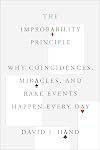
The titular principle, that extremely improbable events are commonplace, logically follows from math-based laws of what Hand dubs "inevitability", "truly large numbers", "selection", "the probability lever", and "near enough"; nothing supernatural is involved*. Many of the same points are made more concisely in Jordan Ellenberg's much broader book _How Not to Be Wrong_. Hand's book is hobbled and lengthened by being extremely formula- and equation-phobic; even the P(...) notation goes show more unmentioned. I guess it's aimed at rank beginners, though.
(* A good thing, since nothing supernatural exists, and any argumentation that uses it is "not so much an explanation as an evasion of the question" (p 203).) show less
(* A good thing, since nothing supernatural exists, and any argumentation that uses it is "not so much an explanation as an evasion of the question" (p 203).) show less
The Improbability Principle: Why Coincidences, Miracles, and Rare Events Happen Every Day by David J. Hand
Helped me understand even better than before, how not everything happens for a reason. Or, how the reasons, when there are reasons for an event, may be so varied and contingent, that we can never expect to know all of them.
The Improbability Principle: Why Coincidences, Miracles, and Rare Events Happen Every Day by David J. Hand
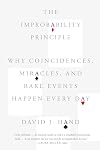
The Improbability Principle by David Hand This is a an understandable explanation of basic probability principles like the Law of Large numbers, and the effects of small changes in assumptions upon probabilities. He reviews several odd and miraculous occurences and explains how although they are improbable, they are not impossible. Establishing and explaining these principles, he then tackles the improbabilities involved in life, the universe, and evolution. He explains how evolution works, show more with many small steps achieving a big change. He also tackles the Anthropic principle, which states this universe's laws are necessary for life and humanity to exist.
Overall, this is a good, accessible explanation of the topic of statistics and probabilities and how they interact with daily life. show less
Overall, this is a good, accessible explanation of the topic of statistics and probabilities and how they interact with daily life. show less
Completely inadequate explanations and details, didn't learn ANYTHING from reading this.
Awards


You May Also Like


Associated Authors
Statistics
- Works
- 25
- Also by
- 1
- Members
- 915
- Popularity
- #28,030
- Rating
- 3.5
- Reviews
- 10
- ISBNs
- 78
- Languages
- 5
- Favorited
- 1
