
Brian Francis Slattery
Author of Spaceman Blues: A Love Song
About the Author
Works by Brian Francis Slattery
Liberation: Being the Adventures of the Slick Six After the Collapse of the United States of America (2008) 234 copies, 11 reviews
Associated Works
Tagged
Common Knowledge
- Birthdate
- 1975
- Gender
- male
- Education
- Williams College
Columbia University - Nationality
- USA
- Birthplace
- New York, USA
- Associated Place (for map)
- New York, USA
Members
Reviews

I really really liked this. I admit to have been a bit skeptical of the serial format of this novel, particularly since each part was written by a different author. I was concerned that the plot would be too episodic, or that it would feel disjointed. Fortunately, this was not the case. In fact, this flowed extremely well, and it is a testament to the hard work of the writers that I only got thrown out of the story once -- and well-into the book -- because the writing style changed enough show more for me to notice.
The story is really cool. The Vatican has a super secret series of task forces that protect the world from supernatural things, and those things usually end up being demonic books. I loved everybody on Team Three (aka the Bookburners). Even though Sal is ostensibly the main character, everybody is fully fleshed out with a backstory and agency. Even better, it's a diverse cast. There's the Latin American priest, the Indian grandmother archivist, the Chinese woman fighter, and the Irish hacker. All have had encountered the supernatural in their past, leading them to the team.
The book does start off a bit episodically as a way to get Sal (and the reader) up to speed with how things work in this new magical world, but it soon it becomes apparent that things are starting to link together into a much bigger and more apocalyptic plot.
I loved this and think I'll be subscribing to Season Two. When I first came across Serial Box, I had balked because of the price. Now that I see the high quality of the plotting and writing, I am fully 100% on board.
Review copy courtesy of the publisher via NetGalley. show less
The story is really cool. The Vatican has a super secret series of task forces that protect the world from supernatural things, and those things usually end up being demonic books. I loved everybody on Team Three (aka the Bookburners). Even though Sal is ostensibly the main character, everybody is fully fleshed out with a backstory and agency. Even better, it's a diverse cast. There's the Latin American priest, the Indian grandmother archivist, the Chinese woman fighter, and the Irish hacker. All have had encountered the supernatural in their past, leading them to the team.
The book does start off a bit episodically as a way to get Sal (and the reader) up to speed with how things work in this new magical world, but it soon it becomes apparent that things are starting to link together into a much bigger and more apocalyptic plot.
I loved this and think I'll be subscribing to Season Two. When I first came across Serial Box, I had balked because of the price. Now that I see the high quality of the plotting and writing, I am fully 100% on board.
Review copy courtesy of the publisher via NetGalley. show less
Liberation: Being the Adventures of the Slick Six After the Collapse of the United States of America by Brian Francis Slattery
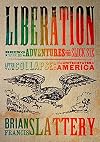
I could explain the plot but it's complicated and wide-ranging and, ultimately, irrelevant.
This book is Funny. Only the second book I've ever laughed out loud at (One Jump Ahead by Mark Van Name is the other). Smart (you feel like you're actually picking up tips for surviving the economic Armageddon). Trippy and expansive (a murderous, mechanized Circus marauds the midwest, a Native American ghost army makes the horrible karma of the Dakotas mainfest). Plus it has the best quote of all time show more that captures the feeling of the 60s without miring us hopelessly in its annoyingly long shadow:
"Peaches en Regalia" flows over him, the bugle call for a hippie army that marched at the peak of the American parabola, that moment when physics held its breath to allow levitation, a small reward before the descent. The hippies knew it then...they couldn't build it into words but they could feel it; a floating in the stomach as history shifted direction...and America was prying off the shackles of its past. The vision opened up to them and winked out again, and those it blinded staggered through their lives unable to see anything else, while the rest of them wondered if they had only dreamed it."
A must read for anyone who thinks about levitating the pentagon. show less
This book is Funny. Only the second book I've ever laughed out loud at (One Jump Ahead by Mark Van Name is the other). Smart (you feel like you're actually picking up tips for surviving the economic Armageddon). Trippy and expansive (a murderous, mechanized Circus marauds the midwest, a Native American ghost army makes the horrible karma of the Dakotas mainfest). Plus it has the best quote of all time show more that captures the feeling of the 60s without miring us hopelessly in its annoyingly long shadow:
"Peaches en Regalia" flows over him, the bugle call for a hippie army that marched at the peak of the American parabola, that moment when physics held its breath to allow levitation, a small reward before the descent. The hippies knew it then...they couldn't build it into words but they could feel it; a floating in the stomach as history shifted direction...and America was prying off the shackles of its past. The vision opened up to them and winked out again, and those it blinded staggered through their lives unable to see anything else, while the rest of them wondered if they had only dreamed it."
A must read for anyone who thinks about levitating the pentagon. show less
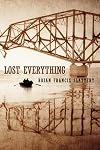
Reviewing Slattery's Lost Everything will seem rather convenient in light of Elizabeth Bear's Clarkesworld post on the doom and gloom nature of SF. How awful of me to love another work that makes us all sad and boo hoo inside! Except Lost Everything isn't terribly boo hoo, unless the only thing you pay attention to is the central premise: the United States has gone to pot -- global collapse, climate change, and civil war, along with the looming threat of an immense, monstrous storm that will show more supposedly destroy everything.
But underneath that dark premise is something that I think the best SF always draws out: the pure wonder of the human condition. The novel follows a diverse cast of characters from different and sometimes opposing backgrounds: Reverend Bauxite and Sunny Jim, who have set off together to retrieve Jim's son, Aaron, and escape the Big One (a massive, deadly storm weaving in from the west); Sergeant Foote, who has been tasked with hunting down Bauxite and Jim to determine if
they're a threat against the military, and neutralize that threat if necessary; Faisal Jenkins, captain of the Carthage, who wants to ferry people down the river to safety and listens to the river for the day when it will consume him and his ship; and an eclectic mix of secondary characters, from a con artist to a ship's first and second mates to military men and resistance fighters, all searching for a sense of home, a sense of who they were and who they have become, and a sense of what it means to have lost everything but not the will to find it all again.
Lost Everything is about survival, of adapting to dangerous situations and finding a way to still find love, friendship, companionship, trust, and all those things that have helped us form a civilization. It's about faith, not just in a higher power, but in fellow man. There is something profoundly optimistic about finding these human elements in a time that seems to have no future. We're conditioned to assume the worst of humanity at the end of days. Our movies tell us that we can't trust anyone, that any one of them could sell us up the river. But Lost Everything reminds us of the beautiful nature of human interaction: that even in the darkest of times, the best of what makes us human springs forward. Optimism at its finest, and handled by Slattery with simple, but beautiful prose and through a narrative that collapses the past and present to show us who people were and who they have become.
Slattery's narrative structure amplifies this thematic content. Split largely between three spaces -- the house, the river, and the highway (iconic spaces in American literature from Twain to Kerouac and so on) -- Slattery moves seamlessly between a character's past and present, doing so in a way that perhaps seems tedious at first, but quickly lifts the veil to reveal the purpose. Each storyline moves towards a similar idea, albeit expressed through a variety of hopes and dreams (finding family here, discovering home there, and so on). The result is a narrative that snakes its way like a river towards an "future" that, as the narrative reminds us, has already happened, and which we're being shown so we know what kinds of people lived before, and the kinds of people that have been left behind. The structure might jar some readers, but I found it refreshing. Whereas many SF novels follow the now-traditional conventions of plot, Lost Everything evades all of that, perhaps to explore characters in ways traditional writing makes unavailable, or to simply break apart the notion that there is anything like a stable narrative when humanity's connection to place has been ruptured. Call it postmodern or literary; whatever it is, I found myself hooked not just by the characters, but by these very structural choices.
Perhaps these stylistic and narrative choices are why some have compared this novel to Cormac McCarthy's The Road, though it seems to me that the comparison rests primarily on theme. Slattery is not Cormac McCarthy. Nor is he Mark Twain. He is something else entirely -- a unique voice in genre who transcends generic tradition entirely, who pulls up the roots of the ancient and the new, plucks them from the tree of knowledge itself and weaves them into twisted creations which never forget that we are dealing with human beings in terrible situations. While Spaceman Blues adapted the Orpheus myth to the landscape of a city beset with conspiratorial sensawunda, Lost Everything draws upon a long history of river novels, river myths, and river tropes to remind us of how humanity adapts to an uncontrollable natural world and a species struggling with its compulsive nature, with its unchecked neuroses.
In other words: this is a novel that will haunt me for years to come. Its mark will never go away. For that reason alone, Lost Everything will sit at the top of my list of WISB Award hopefuls. And it will take a herculean effort of literary genius to strip this book of its place as the best novel of the year. show less
But underneath that dark premise is something that I think the best SF always draws out: the pure wonder of the human condition. The novel follows a diverse cast of characters from different and sometimes opposing backgrounds: Reverend Bauxite and Sunny Jim, who have set off together to retrieve Jim's son, Aaron, and escape the Big One (a massive, deadly storm weaving in from the west); Sergeant Foote, who has been tasked with hunting down Bauxite and Jim to determine if
they're a threat against the military, and neutralize that threat if necessary; Faisal Jenkins, captain of the Carthage, who wants to ferry people down the river to safety and listens to the river for the day when it will consume him and his ship; and an eclectic mix of secondary characters, from a con artist to a ship's first and second mates to military men and resistance fighters, all searching for a sense of home, a sense of who they were and who they have become, and a sense of what it means to have lost everything but not the will to find it all again.
Lost Everything is about survival, of adapting to dangerous situations and finding a way to still find love, friendship, companionship, trust, and all those things that have helped us form a civilization. It's about faith, not just in a higher power, but in fellow man. There is something profoundly optimistic about finding these human elements in a time that seems to have no future. We're conditioned to assume the worst of humanity at the end of days. Our movies tell us that we can't trust anyone, that any one of them could sell us up the river. But Lost Everything reminds us of the beautiful nature of human interaction: that even in the darkest of times, the best of what makes us human springs forward. Optimism at its finest, and handled by Slattery with simple, but beautiful prose and through a narrative that collapses the past and present to show us who people were and who they have become.
Slattery's narrative structure amplifies this thematic content. Split largely between three spaces -- the house, the river, and the highway (iconic spaces in American literature from Twain to Kerouac and so on) -- Slattery moves seamlessly between a character's past and present, doing so in a way that perhaps seems tedious at first, but quickly lifts the veil to reveal the purpose. Each storyline moves towards a similar idea, albeit expressed through a variety of hopes and dreams (finding family here, discovering home there, and so on). The result is a narrative that snakes its way like a river towards an "future" that, as the narrative reminds us, has already happened, and which we're being shown so we know what kinds of people lived before, and the kinds of people that have been left behind. The structure might jar some readers, but I found it refreshing. Whereas many SF novels follow the now-traditional conventions of plot, Lost Everything evades all of that, perhaps to explore characters in ways traditional writing makes unavailable, or to simply break apart the notion that there is anything like a stable narrative when humanity's connection to place has been ruptured. Call it postmodern or literary; whatever it is, I found myself hooked not just by the characters, but by these very structural choices.
Perhaps these stylistic and narrative choices are why some have compared this novel to Cormac McCarthy's The Road, though it seems to me that the comparison rests primarily on theme. Slattery is not Cormac McCarthy. Nor is he Mark Twain. He is something else entirely -- a unique voice in genre who transcends generic tradition entirely, who pulls up the roots of the ancient and the new, plucks them from the tree of knowledge itself and weaves them into twisted creations which never forget that we are dealing with human beings in terrible situations. While Spaceman Blues adapted the Orpheus myth to the landscape of a city beset with conspiratorial sensawunda, Lost Everything draws upon a long history of river novels, river myths, and river tropes to remind us of how humanity adapts to an uncontrollable natural world and a species struggling with its compulsive nature, with its unchecked neuroses.
In other words: this is a novel that will haunt me for years to come. Its mark will never go away. For that reason alone, Lost Everything will sit at the top of my list of WISB Award hopefuls. And it will take a herculean effort of literary genius to strip this book of its place as the best novel of the year. show less
What will happen to America as the effects of global warming continue to wreak havoc? Brian Francis Slattery imagines a much different country in Lost Everything, which has been nominated for a Philip K. Dick Award for 2012 for the best paperback original novel. Slattery imagines that the country we know as the United States is gone, replaced by smaller, regional countries that are engaged in civil war. The Susquehanna River Valley is in the middle of such a war, about which we are told show more little save that it is ravaging the land and the people. Sunny Jim has lost his wife Aline to the war -- not as a victim, but as a saboteur who died by her own bomb. Down the Susquehanna paddle Sunny Jim and the Reverend Bauxite, for Sunny Jim refuses to fight. They are trying to reach Sunny Jim's sister and his son. They must do so quickly, before the Big One hits -- a storm so severe that it leaves nothing in its wake at all:
"Just a boiling wall of clouds, gray and green and sparked with red lightning, and underneath it, a curtain of flying black rain, rippling with wild wind from one end of the earth to the other... I watched it take a town in the valley, far away below, and it was as though a wave were rolling across the ground, lifting houses, roads, trees, and all -- anything that was still there -- up into the air, into the mouth of the storm."
Along the banks of the river are communities that have suffered from both flooding and the war. Sandbags are piled to keep the river back, but over them the boaters can see smoke from gasoline fires and hear grieving families wailing over their dead. Some days the river banks instead offer markets, capitalism rising from the ashes. But soldiers swarm over the markets, and Jim and the Reverend are wary of getting on the highway instead of sticking to the river. When they hear about the Carthage, a ferryboat headed up the river, though, they decide to take the risk of going overland long enough to catch the boat.
The Carthage is a traveling menagerie: horses, camels, cows, birds, monkeys all over the deck. It's full of people, too, with a band playing belowdecks, squeezing out room among the heavy furniture, the fabric, all the belongings of those who have taken to the river. The captain agrees to take Sunny Jim because she knew his wife, long before she met Sunny Jim.
And so this peculiar book hits its stride, telling of the adventures of those on the boat as it heads upriver. The parallels to Mark Twain's masterpiece, Huckleberry Finn, are unmistakable: both books depict people escaping unbearable conditions (slavery for Twain's Jim, drafting into the army for Slattery's Sunny Jim) and using a river for their travel. But there are also differences: Sunny Jim and Reverend Bauxite travel north, not south; they ride against the current instead of with it; and they are passengers on a riverboat with the company of others, not a raft by themselves. Despite the violence both behind and before the travelers, the book is oddly quiet and elegiacal, a mourning for the loss of a better world and an inability to see any future. Indeed, the only future possible seems to be one of the world starting over once the Big One has scrubbed the face of the earth clean.
It's easy to see why the Philip K. Dick Award judges' panel chose Lost Everything. The book has a lot of strangeness to it, even in the manner in which it is told (there is a first person narrator who appears every now and then to address the readers directly for a few paragraphs, without us ever finding out much about this individual or how he or she fits into the story). And it is beautifully written, with vivid descriptions of people, places, weather, and horrific violence. But while I appreciate this book, I do not like it. The characters are not very likeable or particularly interesting. Despite the war, the river, the weather, little happens, and nothing is resolved. Perhaps Slattery was seeking to write a meditation on T.S. Eliot's famous concluding line to "The Hollow Men," in which the world ends "not with a bang, but a whimper." In the end, what I'm left with is an appreciation of Slattery's talent, and a hope that his next book will be more to my liking.
Originally published at http://www.fantasyliterature.com/reviews/lost-everything-2/. show less
"Just a boiling wall of clouds, gray and green and sparked with red lightning, and underneath it, a curtain of flying black rain, rippling with wild wind from one end of the earth to the other... I watched it take a town in the valley, far away below, and it was as though a wave were rolling across the ground, lifting houses, roads, trees, and all -- anything that was still there -- up into the air, into the mouth of the storm."
Along the banks of the river are communities that have suffered from both flooding and the war. Sandbags are piled to keep the river back, but over them the boaters can see smoke from gasoline fires and hear grieving families wailing over their dead. Some days the river banks instead offer markets, capitalism rising from the ashes. But soldiers swarm over the markets, and Jim and the Reverend are wary of getting on the highway instead of sticking to the river. When they hear about the Carthage, a ferryboat headed up the river, though, they decide to take the risk of going overland long enough to catch the boat.
The Carthage is a traveling menagerie: horses, camels, cows, birds, monkeys all over the deck. It's full of people, too, with a band playing belowdecks, squeezing out room among the heavy furniture, the fabric, all the belongings of those who have taken to the river. The captain agrees to take Sunny Jim because she knew his wife, long before she met Sunny Jim.
And so this peculiar book hits its stride, telling of the adventures of those on the boat as it heads upriver. The parallels to Mark Twain's masterpiece, Huckleberry Finn, are unmistakable: both books depict people escaping unbearable conditions (slavery for Twain's Jim, drafting into the army for Slattery's Sunny Jim) and using a river for their travel. But there are also differences: Sunny Jim and Reverend Bauxite travel north, not south; they ride against the current instead of with it; and they are passengers on a riverboat with the company of others, not a raft by themselves. Despite the violence both behind and before the travelers, the book is oddly quiet and elegiacal, a mourning for the loss of a better world and an inability to see any future. Indeed, the only future possible seems to be one of the world starting over once the Big One has scrubbed the face of the earth clean.
It's easy to see why the Philip K. Dick Award judges' panel chose Lost Everything. The book has a lot of strangeness to it, even in the manner in which it is told (there is a first person narrator who appears every now and then to address the readers directly for a few paragraphs, without us ever finding out much about this individual or how he or she fits into the story). And it is beautifully written, with vivid descriptions of people, places, weather, and horrific violence. But while I appreciate this book, I do not like it. The characters are not very likeable or particularly interesting. Despite the war, the river, the weather, little happens, and nothing is resolved. Perhaps Slattery was seeking to write a meditation on T.S. Eliot's famous concluding line to "The Hollow Men," in which the world ends "not with a bang, but a whimper." In the end, what I'm left with is an appreciation of Slattery's talent, and a hope that his next book will be more to my liking.
Originally published at http://www.fantasyliterature.com/reviews/lost-everything-2/. show less
Lists
Awards


You May Also Like


Associated Authors
Statistics
- Works
- 23
- Also by
- 3
- Members
- 977
- Popularity
- #26,369
- Rating
- 3.7
- Reviews
- 51
- ISBNs
- 38
- Languages
- 2
- Favorited
- 1