
Alan Kreider (1941–2017)
Author of The Patient Ferment of the Early Church: The Improbable Rise of Christianity in the Roman Empire
About the Author
Alan Kreider (PhD, Harvard University) is professor emeritus of church history and mission at Anabaptist Mennonite Biblical Seminary and has authored several books.
Series
Works by Alan Kreider
Associated Works
Constantine Revisited: Leithart, Yoder, and the Constantinian Debate (2013) — Contributor — 13 copies
Tagged
Common Knowledge
- Birthdate
- 1941-11-08
- Date of death
- 2017-05-08
- Gender
- male
- Education
- Goshen College
Harvard University - Occupations
- Mennonite missionary
- Cause of death
- multiple myeloma
- Nationality
- USA
- Place of death
- Goshen, Indiana, USA
- Associated Place (for map)
- Indiana, USA
Members
Reviews

This is a short book and an easy read. It is especially enjoyable if you haven't read a good bash of Constatinianism/Christendom in a while. Kreider's central argument is that in the early Church significant attention was given to proper catechetical instruction and the significant change required for converts to be considered converts. As time progresses, especially after the time of Constantine, conversion becomes less demanding, and easier. Thus, Kreider contends within the show more Post-Christendom world, the time is ripe for a recovery of early church practices surrounding conversion (i.e. catechesis, some liturgical practices, etc.).
I liked this book a lot. It was refreshing to read an early church historian with Anabaptist sensibilities because there is a certain amount of critical appropriation of the tradition (rather than blindly accepting the whole arc of doctrinal development). I also appreciated how much Kreider quotes source materials to build his case. I came away from this book interested in reading several patristic sources. show less
I liked this book a lot. It was refreshing to read an early church historian with Anabaptist sensibilities because there is a certain amount of critical appropriation of the tradition (rather than blindly accepting the whole arc of doctrinal development). I also appreciated how much Kreider quotes source materials to build his case. I came away from this book interested in reading several patristic sources. show less
The Patient Ferment of the Early Church: The Improbable Rise of Christianity in the Roman Empire by Alan Kreider
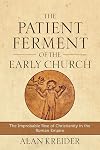
How did the church grow so quickly in the first three centuries – from 120 on the day of Pentecost to up to 10% of the six million-strong Roman Empire?
The late Alan Kreider, former Professor of Church History and Mission at the Anabaptist Mennonite Biblical Seminary in Indiana, disputes this number. He doubts that it was ever that high but affirms that the improbable but real growth in numbers of the early church has not been really explained. The Patient Ferment of the Early Church is show more Kreider’s attempt to clear up that mystery.
Professor Kreider shows that the early church concentrated on encouraging a cluster of Christ-like behaviours, especially those that demonstrated the virtue of patience. This cluster of habitual actions Kreider calls their habitus.
These Christians who were in business were patient. They resisted taking others to court to settle affairs. Following Matthew 5:37 (‘Simply let your yes be yes and your no no’) they refused to take oaths in a society were oaths were central. They refrained from taking life, and any soldiers who wished to be admitted to the years-long training before baptism, the catechumenate, had to convince the bishop that they would not kill. Usually they had to leave the army before they would be admitted as catechumens.
Kreider writes,
‘Habitually, Christians will share economically and care for the poor and the sick, widows and orphans; habitually, they will engage in business with truthfulness, without usury, and without pursuing profit to the extent of going before pagan judges; habitually, they will be a community of contentment and sexual restraint; habitually, they will behave with the multifaceted nonviolence of patience.’ (169)
The catechumens were not permitted to stay for worship. Three aspects of worship marked the early Christians as counter-cultural.
Firstly, the kiss of peace. Only equals in Roman society could kiss, and usually only in the family. For slaves and highborn, family and strangers to all kiss each other was shocking, and cemented the solidarity of the church.
Secondly, the prayers. Praying for one’s needs and the needs of others was a noisy and exuberant time. A poor man might pray for the day’s food and happen to be standing next to a rich man who could answer that prayer. Praying for those with the plague, led Christians outside their own community to nurse the sick. Praying for the dying led Christians to offer burial to those who could not afford it.
Because they believed God answers prayers, they could take risks, live lives that were eventful and imprudent, and be faithful to a superstitio that could get them into hot water. There was power here, and outsiders got a whiff of it and wanted in. 211)
Thirdly, they shared food. In early years, the food was a meal, and following Paul’s instructions, the rich were mandated to share with those with less. By the third century, the main worship had shifted from Saturday evening to early Sunday morning, and the food shared was symbolic, the bread and wine of communion.
(I was pleased to see Kreider reference my former colleague Andrew McGowan’s academic work on the subject of food and the Eucharist in the early church.)
Kreider calls this way of being church a ‘ferment’. Like yeast, the secret activity at the heart of the Christian family, changes the whole society, subtly, slowly, patiently, but thoroughly.
The emphasis in the first three centuries on patience and on habitus, behaviour, changed with Emperor Constantine and Bishop Augustine of Hippo. Constantine, who put off the catechumenate until shortly before his death, constantly intervened in the life of the church to make it grow.
Under Constantine, two classes of Christian evolved. The serious ones continued to refrain from taking life. Others, less rigid in their interpretation of the sixth commandment, could continue to serve in the army and kill if they had to. Some Christians continued to avoid oath-taking. Others, who wanted to get along in the new administration, relaxed this rule and took oaths when asked.
Augustine re-defined the virtue of patience as a sub-set of love, changing the emphasis from behaviour to intention, and creating situational ethics rather than an agreed habitus.
Alan Kreider credits both Constantine and Augustine with good intentions but regrets the outcomes of their actions.
This raised for me some questions.
• Is it idealistic to imagine we could return to a time where forming Christians is the church’s main activity, and allowing God to do God’s work of increase?
• Can we go back to a time where Christians are genuine in avoiding killing and oath-taking?
• Can we re-invest the liturgical kiss of peace with the intimacy and equality known by the early church?
I think, that as a Mennonite, Professor Kreider would have approved these questions! show less
The late Alan Kreider, former Professor of Church History and Mission at the Anabaptist Mennonite Biblical Seminary in Indiana, disputes this number. He doubts that it was ever that high but affirms that the improbable but real growth in numbers of the early church has not been really explained. The Patient Ferment of the Early Church is show more Kreider’s attempt to clear up that mystery.
Professor Kreider shows that the early church concentrated on encouraging a cluster of Christ-like behaviours, especially those that demonstrated the virtue of patience. This cluster of habitual actions Kreider calls their habitus.
These Christians who were in business were patient. They resisted taking others to court to settle affairs. Following Matthew 5:37 (‘Simply let your yes be yes and your no no’) they refused to take oaths in a society were oaths were central. They refrained from taking life, and any soldiers who wished to be admitted to the years-long training before baptism, the catechumenate, had to convince the bishop that they would not kill. Usually they had to leave the army before they would be admitted as catechumens.
Kreider writes,
‘Habitually, Christians will share economically and care for the poor and the sick, widows and orphans; habitually, they will engage in business with truthfulness, without usury, and without pursuing profit to the extent of going before pagan judges; habitually, they will be a community of contentment and sexual restraint; habitually, they will behave with the multifaceted nonviolence of patience.’ (169)
The catechumens were not permitted to stay for worship. Three aspects of worship marked the early Christians as counter-cultural.
Firstly, the kiss of peace. Only equals in Roman society could kiss, and usually only in the family. For slaves and highborn, family and strangers to all kiss each other was shocking, and cemented the solidarity of the church.
Secondly, the prayers. Praying for one’s needs and the needs of others was a noisy and exuberant time. A poor man might pray for the day’s food and happen to be standing next to a rich man who could answer that prayer. Praying for those with the plague, led Christians outside their own community to nurse the sick. Praying for the dying led Christians to offer burial to those who could not afford it.
Because they believed God answers prayers, they could take risks, live lives that were eventful and imprudent, and be faithful to a superstitio that could get them into hot water. There was power here, and outsiders got a whiff of it and wanted in. 211)
Thirdly, they shared food. In early years, the food was a meal, and following Paul’s instructions, the rich were mandated to share with those with less. By the third century, the main worship had shifted from Saturday evening to early Sunday morning, and the food shared was symbolic, the bread and wine of communion.
(I was pleased to see Kreider reference my former colleague Andrew McGowan’s academic work on the subject of food and the Eucharist in the early church.)
Kreider calls this way of being church a ‘ferment’. Like yeast, the secret activity at the heart of the Christian family, changes the whole society, subtly, slowly, patiently, but thoroughly.
The emphasis in the first three centuries on patience and on habitus, behaviour, changed with Emperor Constantine and Bishop Augustine of Hippo. Constantine, who put off the catechumenate until shortly before his death, constantly intervened in the life of the church to make it grow.
Under Constantine, two classes of Christian evolved. The serious ones continued to refrain from taking life. Others, less rigid in their interpretation of the sixth commandment, could continue to serve in the army and kill if they had to. Some Christians continued to avoid oath-taking. Others, who wanted to get along in the new administration, relaxed this rule and took oaths when asked.
Augustine re-defined the virtue of patience as a sub-set of love, changing the emphasis from behaviour to intention, and creating situational ethics rather than an agreed habitus.
Alan Kreider credits both Constantine and Augustine with good intentions but regrets the outcomes of their actions.
This raised for me some questions.
• Is it idealistic to imagine we could return to a time where forming Christians is the church’s main activity, and allowing God to do God’s work of increase?
• Can we go back to a time where Christians are genuine in avoiding killing and oath-taking?
• Can we re-invest the liturgical kiss of peace with the intimacy and equality known by the early church?
I think, that as a Mennonite, Professor Kreider would have approved these questions! show less
The Patient Ferment of the Early Church: The Improbable Rise of Christianity in the Roman Empire by Alan Kreider
How and why did the early church grow in the first four hundred years despite disincentives, harassment, and occasional persecution? In this unique historical study, veteran scholar Alan Kreider delivers the fruit of a lifetime of study as he tells the amazing story of the spread of Christianity in the Roman Empire. Challenging traditional understandings, Kreider contends the church grew because the virtue of patience was of central importance in the life and witness of the early Christians. show more They wrote about patience, not evangelism, and reflected on prayer, catechesis, and worship, yet the church grew--not by specific strategies but by patient ferment. show less
The Patient Ferment of the Early Church: The Improbable Rise of Christianity in the Roman Empire by Alan Kreider
How and why did the early church grow in the first four hundred years despite disincentives, harassment, and occasional persecution? In this unique historical study, veteran scholar Alan Kreider delivers the fruit of a lifetime of study as he tells the amazing story of the spread of Christianity in the Roman Empire. Challenging traditional understandings, Kreider contends the church grew because the virtue of patience was of central importance in the life and witness of the early Christians. show more They wrote about patience, not evangelism, and reflected on prayer, catechesis, and worship, yet the church grew--not by specific strategies but by patient ferment. show less
You May Also Like


Associated Authors
Statistics
- Works
- 21
- Also by
- 2
- Members
- 675
- Popularity
- #37,410
- Rating
- 4.0
- Reviews
- 7
- ISBNs
- 34
- Languages
- 1