

Ernest Callenbach (1929–2012)
Author of Ecotopia
About the Author
Ernest Callenbach was born on April 3, 1929. He received a bachelor's degree in English in 1949 and a master's degree in English in 1953 from the University of Chicago. Two years later, after studying at the Sorbonne in Paris, he became an assistant editor for the University of California Press. He show more founded Film Quarterly in 1958 and edited it for 33 years. He also edited books on film for the university. He wrote several books including Ecotopia, Ecotopia Emerging, and Living Cheaply with Style. He died of cancer on April 16, 2012 at the age of 83. (Bowker Author Biography) show less
Image credit: david silver
Series
Works by Ernest Callenbach
Ecotopia. The Notebooks and Reports of William Weston. (Lernmaterialien) (1996) — Author — 32 copies, 1 review
The Art of Friendship 1 copy
Associated Works
Tagged
Common Knowledge
- Legal name
- Callenbach, Ernest William
- Birthdate
- 1929-04-03
- Date of death
- 2012-04-16
- Gender
- male
- Education
- University of Chicago (Chicago ∙ Illinois ∙ USA)
Sorbonne - Occupations
- copywriter (University of California Press)
editor (University of California Press) - Organizations
- Film Quarterly
University of California Press - Nationality
- USA
- Birthplace
- Williamsport, Pennsylvania, USA
- Places of residence
- Williamsport, Pennsylvania, USA (birth)
Boalsburg, Pennsylvania, USA
California, USA - Place of death
- Berkeley, California, USA
- Associated Place (for map)
- USA
Members
Reviews

Written in 1975 and set in 1999, Ecotopia is -- like Bellamy's [Looking Backward], Wright's [Islandia], or Heinlein's [For Us the Living] -- a tour of an idealized fictional society thinly disguised as a novel so that the viewpoint character (a representative of the author's own time and place, and a stand-in for the audience) can enter it and have it explained to them.
The viewpoint character in Ecotopia is William Weston: a journalist, dispatched to the titular nation 19 years after it show more seceded from the United States. The text alternates between the dispatches, written for publication, that Weston sends to his editor in New York and the private thoughts he confides to his diary. Callenbach makes good use of the contrast. The "public" sections of the narrative are more probing and dispassionate, and the "private" sections more conflicted and emotional, than narration of a typical utopian novel. Callenbach is also remarkably effective in conveying Weston's feeling of perpetual (and entirely plausible) culture shock.
Callenbach's vision of utopia -- a wild mashup of high-tech handwavium, small-is-beautiful ecological thinking, an all-in commitment to sustainability, and late 60s/early 70s communal-living idealism -- couldn't be any more of a period piece if it was wearing a white turtleneck and standing on a hillside earnestly crooning "I'd Like to Teach the World To Sing." It is psychologically, sociologically, and economically incoherent. The idea that the fully-developed society Weston explores evolved out of the late-70s United States in only nineteen years -- and that none of the adult characters remember, or speak about, the "Old Days" -- is patently ludicrous.
I can't, in good conscience, recommend Ecotopia as entertainment unless you're a hardcore fan of utopian novels . . . but for those interested in American culture in the 1970s, it's as weirdly fascinating (in a time capsule-y way) as a Sears Roebuck catalog.. show less
The viewpoint character in Ecotopia is William Weston: a journalist, dispatched to the titular nation 19 years after it show more seceded from the United States. The text alternates between the dispatches, written for publication, that Weston sends to his editor in New York and the private thoughts he confides to his diary. Callenbach makes good use of the contrast. The "public" sections of the narrative are more probing and dispassionate, and the "private" sections more conflicted and emotional, than narration of a typical utopian novel. Callenbach is also remarkably effective in conveying Weston's feeling of perpetual (and entirely plausible) culture shock.
Callenbach's vision of utopia -- a wild mashup of high-tech handwavium, small-is-beautiful ecological thinking, an all-in commitment to sustainability, and late 60s/early 70s communal-living idealism -- couldn't be any more of a period piece if it was wearing a white turtleneck and standing on a hillside earnestly crooning "I'd Like to Teach the World To Sing." It is psychologically, sociologically, and economically incoherent. The idea that the fully-developed society Weston explores evolved out of the late-70s United States in only nineteen years -- and that none of the adult characters remember, or speak about, the "Old Days" -- is patently ludicrous.
I can't, in good conscience, recommend Ecotopia as entertainment unless you're a hardcore fan of utopian novels . . . but for those interested in American culture in the 1970s, it's as weirdly fascinating (in a time capsule-y way) as a Sears Roebuck catalog.. show less
Of course, it's fun to read SF novels that prophesize about a future date that we're either at now or have already passed. This utopian novel is set in 1999, published in 1975. SF is full of dystopian novels that're projective critiques of the present tense. This is one of the rarer ones that critiques (what was) the present tense by postulating a utopia (of sorts) that's presumably rooted in the hopes that counterculture had for communes, eg. It's, perhaps, in the company of some of the show more work of Ursula LeGuin & Joan Slonczewski but I think I like their work more.
On page 115, under a heading of "Workers' Control, Taxes, and Jobs in Ecotopia" it's explained that "the people, seeing the former owners depart, realized that a new era was indeed upon them and began spontaneously taking over farms, factories, and stores. The process was chaotic, but it was not anarchic; it was controlled by the local governments and local courts." Did I say "utopia"? I take that back. show less
On page 115, under a heading of "Workers' Control, Taxes, and Jobs in Ecotopia" it's explained that "the people, seeing the former owners depart, realized that a new era was indeed upon them and began spontaneously taking over farms, factories, and stores. The process was chaotic, but it was not anarchic; it was controlled by the local governments and local courts." Did I say "utopia"? I take that back. show less
'Ecotopia' has been on my to-read list for at least ten years, but only this week did I finally find a copy of it. Thank you, eBay. I was concerned that it might prove dry, which turned out to be entirely unfounded. I was gripped throughout the short novel, which I read in one sitting. It is rather fascinating both on its own merits and as a historical document. Callenbach first published 'Ecotopia' in 1975. It follows the long tradition of [b:Utopia|18414|Utopia|Thomas show more More|https://i.gr-assets.com/images/S/compressed.photo.goodreads.com/books/1388190168l/18414._SY75_.jpg|2798280], [b:Millenium Hall|90244|Millenium Hall|Sarah Scott|https://i.gr-assets.com/images/S/compressed.photo.goodreads.com/books/1387723632l/90244._SY75_.jpg|87091], [b:Erewhon|516570|Erewhon (Erewhon , #1)|Samuel Butler|https://i.gr-assets.com/images/S/compressed.photo.goodreads.com/books/1175460304l/516570._SY75_.jpg|924128] et al of sending a man into an isolated society very different from his own to investigate how it runs. The reader is invited to contrast the society favourably with the one in which they live. Unlike its antecedents, 'Ecotopia' does not involve the discovery of a previously unknown enclave. Rather, it provides an alternate history in which a big chunk of the US West Coast seceded in 1980 and established an independent nation-state called Ecotopia. The book begins in 2000, when a journalist is sent to visit Ecotopia and send back reports. The narrative is structured around the reportage and private diary written by this journalist, Will Weston. I appreciated the conceit of his being a journalist, as his investigations therefore felt less artificial than those of 18th and 19th century explorer-types.
I have to commend Callenbach on the detailed design of Ecotopia, which remains inspiring 45 years later. Indeed, I was both struck by his prescience and saddened that his suggestions for low-impact living are often still treated like new and wild ideas. It is frequently forgotten that throughout the history of capitalism people have opposed its damaging effects on the environment and proposed alternatives. On the other hand, I was heartened that some aspects of Ecotopia have started to become normal, notably recycling. Will is shocked that Ecotopians bother to separate their rubbish into recycling bins; I do that regularly. Indeed, Edinburgh has a more complex set of rubbish categories than Ecotopia: six of them, each with a colour coded bin (food waste, garden waste, paper, glass, packaging, and non-recyclable waste). Other measures discussed in Ecotopia that are starting to edge into the mainstream include biodegradable plastics, reusable packaging, electric vehicles, car-free city centres, urban tree-planting, 3D printed modular buildings, land tax, large scale solar and wind energy, legal marijuana, Universal Basic Income, and slow fashion. Callenbach also predicted video calling, as everyone in Ecotopia uses 'picturephones'. No mobile phones, but there is a partial version of the internet as all university courses are available as recorded videos via TV or picturephone.
Part of my reason for reading 'Ecotopia' right now was to compare it with [b:The Future We Choose: Surviving the Climate Crisis|52117860|The Future We Choose Surviving the Climate Crisis|Christiana Figueres|https://i.gr-assets.com/images/S/compressed.photo.goodreads.com/books/1577771399l/52117860._SX50_SY75_.jpg|73597978], a non-fiction book published this year that is of the same length and has the same intended message. Despite it being 45 years older, I found 'Ecotopia' a more encouraging and convincing argument that humanity can live within environmental limits. Although climate change was little researched and not an environmental priority in 1975, the Ecotopian way of life is definitely low carbon. They use no fossil fuels and have a steady-state, circular economy. Unlike [b:The Future We Choose: Surviving the Climate Crisis|52117860|The Future We Choose Surviving the Climate Crisis|Christiana Figueres|https://i.gr-assets.com/images/S/compressed.photo.goodreads.com/books/1577771399l/52117860._SX50_SY75_.jpg|73597978], 'Ecotopia' makes clear that a post-capitalist system is required to achieve this because extreme wealth is politically corrosive and environmentally destructive. After succession, most of the wealthy fled and all their capital was expropriated. Businesses, universities, and schools are communally owned and controlled by their employees; no wealth can be inherited. Inequality has been dramatically reduced. Will discusses with an Ecotopian whether their economic system is socialist, concluding that it's a mixed economy. Of course, you could say the same for any country, as nowhere has a pure market economy or a total absence of markets. Ecotopia definitely isn't capitalist, however, and in many ways resembles theoretical models of communism. Decision-making is decentralised and consensus-based, although political parties remain and there is a (female) president.
One paragraph on page 18 of 'Ecotopia' very neatly summarises the environmental economics course I took in 2005:
The material on economics is really good, although one significant area that went unmentioned is banking. Does Ecotopia have banks and credit? I'd posit it has personal banking, with strict limits on interest rates for both saving and lending, but absolutely no speculative investment banking. In fact, I bet it only has building societies owned and controlled by their members.
While I was more interested in the technological and economic details of Ecotopia, the social and cultural aspects also proved thought-provoking. The former have aged better, whereas the latter reflect mid-1970s America. Most notably, Will writes a piece about Ecotopia's racial politics. There is a kind of voluntary apartheid, as most black people live in their own enclave. The problems of racial inequality and racial prejudice have mysteriously been solved, but apparently integration was much harder to envisage. I assume this reflects the political context of America in the 1970s. Another striking feature is the replacement of competitive team sports with war games, so the young men can express their violent urges without damage to society. I was rather dubious about these, as they reminded me of Fukuyama's arguments about 'thymos' in [b:The End of History and the Last Man|57981|The End of History and the Last Man|Francis Fukuyama|https://i.gr-assets.com/images/S/compressed.photo.goodreads.com/books/1566832175l/57981._SX50_.jpg|56476]. The gender politics also inevitably look a bit dated. Despite stating that Ecotopia has achieved gender equality, Callenbach still depicts a society with significantly different gender roles for men and women. The role of women has undoubtedly expanded, notably into politics, though. Extended family units/polycules are a more radical development. The willingness of Ecotopians to show and share their emotions is an intriguing consequence of an egalitarian, less competitive, and more cooperative culture. Both of these presumably suggest the legacy of the Hippy movement.
'Ecotopia' has more concrete ideas for low carbon living than any 21st century books on the topic that I've read recently. It's therefore still a rewarding and thought-provoking read 45 years after publication. I considered deducting one star because the parallels between Will falling in love with Ecotopia and with an Ecotopian woman are very heavy-handed. Ultimately I decided this would be mean-spirited, as Callenbach packs so many good ideas into 166 pages. While I don't think everything he describes would necessarily work, overall his suggestions are highly promising. Would I live in Ecotopia? Fuck yeah. show less
I have to commend Callenbach on the detailed design of Ecotopia, which remains inspiring 45 years later. Indeed, I was both struck by his prescience and saddened that his suggestions for low-impact living are often still treated like new and wild ideas. It is frequently forgotten that throughout the history of capitalism people have opposed its damaging effects on the environment and proposed alternatives. On the other hand, I was heartened that some aspects of Ecotopia have started to become normal, notably recycling. Will is shocked that Ecotopians bother to separate their rubbish into recycling bins; I do that regularly. Indeed, Edinburgh has a more complex set of rubbish categories than Ecotopia: six of them, each with a colour coded bin (food waste, garden waste, paper, glass, packaging, and non-recyclable waste). Other measures discussed in Ecotopia that are starting to edge into the mainstream include biodegradable plastics, reusable packaging, electric vehicles, car-free city centres, urban tree-planting, 3D printed modular buildings, land tax, large scale solar and wind energy, legal marijuana, Universal Basic Income, and slow fashion. Callenbach also predicted video calling, as everyone in Ecotopia uses 'picturephones'. No mobile phones, but there is a partial version of the internet as all university courses are available as recorded videos via TV or picturephone.
Part of my reason for reading 'Ecotopia' right now was to compare it with [b:The Future We Choose: Surviving the Climate Crisis|52117860|The Future We Choose Surviving the Climate Crisis|Christiana Figueres|https://i.gr-assets.com/images/S/compressed.photo.goodreads.com/books/1577771399l/52117860._SX50_SY75_.jpg|73597978], a non-fiction book published this year that is of the same length and has the same intended message. Despite it being 45 years older, I found 'Ecotopia' a more encouraging and convincing argument that humanity can live within environmental limits. Although climate change was little researched and not an environmental priority in 1975, the Ecotopian way of life is definitely low carbon. They use no fossil fuels and have a steady-state, circular economy. Unlike [b:The Future We Choose: Surviving the Climate Crisis|52117860|The Future We Choose Surviving the Climate Crisis|Christiana Figueres|https://i.gr-assets.com/images/S/compressed.photo.goodreads.com/books/1577771399l/52117860._SX50_SY75_.jpg|73597978], 'Ecotopia' makes clear that a post-capitalist system is required to achieve this because extreme wealth is politically corrosive and environmentally destructive. After succession, most of the wealthy fled and all their capital was expropriated. Businesses, universities, and schools are communally owned and controlled by their employees; no wealth can be inherited. Inequality has been dramatically reduced. Will discusses with an Ecotopian whether their economic system is socialist, concluding that it's a mixed economy. Of course, you could say the same for any country, as nowhere has a pure market economy or a total absence of markets. Ecotopia definitely isn't capitalist, however, and in many ways resembles theoretical models of communism. Decision-making is decentralised and consensus-based, although political parties remain and there is a (female) president.
One paragraph on page 18 of 'Ecotopia' very neatly summarises the environmental economics course I took in 2005:
"Our system is considerably cheaper than yours, if we add in all the costs. Many of your costs are ignored, or passed through subterfuge to posterity or the general public. We on the other hand must acknowledge all costs. Otherwise we could not hope to achieve the stable-state life systems which are our fundamental ecological and political goal. If, for instance, we had continued your practise of 'free' disposal of wastes in watercourses, sooner or later somebody else would have had to calculate (and bear) the costs of the resulting dead rivers and lakes. We prefer to do it ourselves. It is obviously not easy to quantify certain of these costs. But we have been able to approximate them in workable political terms - especially since our country is relatively sensible in scale.
The material on economics is really good, although one significant area that went unmentioned is banking. Does Ecotopia have banks and credit? I'd posit it has personal banking, with strict limits on interest rates for both saving and lending, but absolutely no speculative investment banking. In fact, I bet it only has building societies owned and controlled by their members.
While I was more interested in the technological and economic details of Ecotopia, the social and cultural aspects also proved thought-provoking. The former have aged better, whereas the latter reflect mid-1970s America. Most notably, Will writes a piece about Ecotopia's racial politics. There is a kind of voluntary apartheid, as most black people live in their own enclave. The problems of racial inequality and racial prejudice have mysteriously been solved, but apparently integration was much harder to envisage. I assume this reflects the political context of America in the 1970s. Another striking feature is the replacement of competitive team sports with war games, so the young men can express their violent urges without damage to society. I was rather dubious about these, as they reminded me of Fukuyama's arguments about 'thymos' in [b:The End of History and the Last Man|57981|The End of History and the Last Man|Francis Fukuyama|https://i.gr-assets.com/images/S/compressed.photo.goodreads.com/books/1566832175l/57981._SX50_.jpg|56476]. The gender politics also inevitably look a bit dated. Despite stating that Ecotopia has achieved gender equality, Callenbach still depicts a society with significantly different gender roles for men and women. The role of women has undoubtedly expanded, notably into politics, though. Extended family units/polycules are a more radical development. The willingness of Ecotopians to show and share their emotions is an intriguing consequence of an egalitarian, less competitive, and more cooperative culture. Both of these presumably suggest the legacy of the Hippy movement.
'Ecotopia' has more concrete ideas for low carbon living than any 21st century books on the topic that I've read recently. It's therefore still a rewarding and thought-provoking read 45 years after publication. I considered deducting one star because the parallels between Will falling in love with Ecotopia and with an Ecotopian woman are very heavy-handed. Ultimately I decided this would be mean-spirited, as Callenbach packs so many good ideas into 166 pages. While I don't think everything he describes would necessarily work, overall his suggestions are highly promising. Would I live in Ecotopia? Fuck yeah. show less
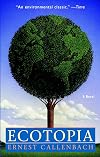
A novel both timely and prophetic, Ernest Callenbach’s Ecotopia is a hopeful antidote to the environmental concerns of today, set in an ecologically sound future society. Hailed by the Los Angeles Times as the “newest name after Wells, Verne, Huxley, and Orwell,” Callenbach offers a visionary blueprint for the survival of our planet . . . and our future.Ecotopia was founded when northern California, Oregon, and Washington seceded from the Union to create a “stable-state” ecosystem: show more the perfect balance between human beings and the environment. Now, twenty years later, this isolated, mysterious nation is welcoming its first officially sanctioned American visitor: New York Times-Post reporter Will Weston.Skeptical yet curious about this green new world, Weston is determined to report his findings objectively. But from the start, he’s alternately impressed and unsettled by the laws governing Ecotopia’s earth-friendly agenda: energy-efficient “mini-cities” to eliminate urban sprawl, zero-tolerance pollution control, tree worship, ritual war games, and a woman-dominated government that has instituted such peaceful revolutions as the twenty-hour workweek and employee ownership of farms and businesses. His old beliefs challenged, his cynicism replaced by hope, Weston meets a sexually forthright Ecotopian woman and undertakes a relationship whose intensity will lead him to a critical choice between two worlds. show less
Lists
You May Also Like


Associated Authors
Statistics
- Works
- 25
- Also by
- 7
- Members
- 2,030
- Popularity
- #12,660
- Rating
- 3.6
- Reviews
- 44
- ISBNs
- 61
- Languages
- 9
- Favorited
- 3