
Linda Babcock
Author of Women Don't Ask: Negotiation and the Gender Divide
About the Author
Image credit: Linda Babcock
Works by Linda Babcock
Ask For It: How Women Can Use the Power of Negotiation to Get What They Really Want (2008) 159 copies, 1 review
Tagged
Common Knowledge
- Birthdate
- 1961
- Gender
- female
- Education
- University of Wisconsin-Madison (MS - Economics, PhD - Economics)
University of California, Irvine (BS - Economics) - Occupations
- professor (Economics)
economist - Organizations
- American Economic Association
Society for Judgment and Decision Making
Economic Science Association
International Association for Conflict Management
American Law and Economics Association
Committee on the Status of Women in the Economics Profession (show all 10)
Carnegie Mellon University (H. John Heinz III School of Public Policy and Management)
Harvard University (Visiting Professor - Business School)
California Institute of Technology (Visiting Professor)
University of Chicago (Visiting Professor - Graduate School of Business) - Awards and honors
- Jeffrey Z. Rubin Theory-To-Practice Award (2007)
- Nationality
- USA
- Places of residence
- Altadena, California, USA
Pittsburgh, Pennsylvania, USA - Map Location
- USA
Members
Reviews

The studies presented in this book are eye opening, and I consider myself an informed feminist. I referenced a few when my fellow engineering graduate students were getting job offers, even my male friends needed some support negotiating.
Nevertheless, the organization of this book is awful. There are anecdotes mixed in with studies, and topics of studies and anecdotes are intermingled. At pg 54, I nearly sprang out of my chair grasping back to pg 42 to compare two studies. The two studies show more describe pay expectations and requests by men and women given the same job. In the first, men and women are given salary ranges and jobs. Given this information, women still expected 3-32% lower wages. In the second study, men and women are assigned a task and paid whatever they ask. Given lists of wages requested by others, the difference in wages requested disappears. The two studies conflict! There is something about the conditions here. The two studies are 12 pages apart, albeit the same chapter, yet the authors seem to have forgotten their earlier example, perhaps because the inserted a section on the valuation of child-care. They instead conclude: "gender differences disappear when men and women receive information about the going rates for different jobs." I believe that conclusion is well supported, but what happened in the study on page 42!!! Did they not have avgs?? Come on, it's chapter one! show less
Nevertheless, the organization of this book is awful. There are anecdotes mixed in with studies, and topics of studies and anecdotes are intermingled. At pg 54, I nearly sprang out of my chair grasping back to pg 42 to compare two studies. The two studies show more describe pay expectations and requests by men and women given the same job. In the first, men and women are given salary ranges and jobs. Given this information, women still expected 3-32% lower wages. In the second study, men and women are assigned a task and paid whatever they ask. Given lists of wages requested by others, the difference in wages requested disappears. The two studies conflict! There is something about the conditions here. The two studies are 12 pages apart, albeit the same chapter, yet the authors seem to have forgotten their earlier example, perhaps because the inserted a section on the valuation of child-care. They instead conclude: "gender differences disappear when men and women receive information about the going rates for different jobs." I believe that conclusion is well supported, but what happened in the study on page 42!!! Did they not have avgs?? Come on, it's chapter one! show less
This is one of the best, and life-affecting, books I've ever read. It was written for me and all other people-pleasing, self sacrificing, women. Women who find it difficult to stand up for themselves in difficult situations or would rather sacrifice themselves than cause a conflict or awkward confrontation regarding something they deserve or need. This is a book for both professional and personal spheres of life... I should read it again.
Ask For It: How Women Can Use the Power of Negotiation to Get What They Really Want by Linda Babcock
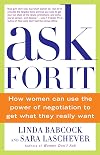
Interesting, practical guide to getting more out of negotiations, including convincing yourself to negotiate in the first place. Women too often assume that we’ll get what we deserve, which means we get a lot less than men do, because men ask for more. Small initial differences add up into huge gaps over time. And still I feel like I have an awful lot—but I’m trying to figure out what I should be asking for, just to see if I can get it.
A must read for any working girl - an eye opener on how women's tendency to wait for their just reward instead of asking for it can lead to unintended inequality.
Lists
Awards


You May Also Like


Associated Authors
Statistics
- Works
- 3
- Members
- 532
- Popularity
- #46,803
- Rating
- 3.8
- Reviews
- 7
- ISBNs
- 23
- Languages
- 2