
Auður Ava Ólafsdóttir
Author of The Greenhouse
About the Author
Works by Auður Ava Ólafsdóttir
Eden Roman 4 copies
Upphækkuð jörð 1 copy
Sigurdur Arni Sigurdsson 1 copy
Associated Works
Tagged
Common Knowledge
- Canonical name
- Ólafsdóttir, Auður Ava
- Birthdate
- 1958
- Gender
- female
- Nationality
- Iceland
- Birthplace
- Reykjavik, Iceland
- Map Location
- Iceland
Members
Reviews

Coming of age as a lady writer in the 60s, in Iceland. Super gorgeously written, packed with an incredible sense of place, psychological landscape, and national art/literature. Almost felt like an early Jarmusch movie, with its wandering qualities. Really, really loved this novel.

In the claustrophobic world of early 1960s Reykjavik, a young woman writer struggles to make a living as a waitress whilst her friend Ísey manages to scribble down odd pages in between changing nappies and cooking for her dyslexic husband, and their Gay Best Friend, Jón John, dreams of a life in fashion in between deeply unpleasant spells of work on a fishing trawler.
We are still in a period where women workers are expected to put up with low wages and at least moderate amounts of sexual show more harassment, gay men have no right to exist, and everyone in Iceland knows everyone else’s business. Copies of The bell jar and Le deuxième sexe are beginning to find their way across the North Atlantic, however, and there’s a glimmer of hope for a more positive life, provided one can somehow scrape together the cost of a ticket to the mainland. But, please, not by signing up for a beauty contest where competitors will be judged on their willingness to oblige the middle-aged male judges…
As usual, Auður manages to take an unpromising situation and put an interesting twist on it. This isn’t just a novel about how bad the world was sixty years ago, even in places we now think of as particularly enlightened: there are all kinds of surprising glimpses of the power of words to make the world more bearable, and an interesting array of positive and negative aspects of belonging to a small and cohesive national culture. show less
We are still in a period where women workers are expected to put up with low wages and at least moderate amounts of sexual show more harassment, gay men have no right to exist, and everyone in Iceland knows everyone else’s business. Copies of The bell jar and Le deuxième sexe are beginning to find their way across the North Atlantic, however, and there’s a glimmer of hope for a more positive life, provided one can somehow scrape together the cost of a ticket to the mainland. But, please, not by signing up for a beauty contest where competitors will be judged on their willingness to oblige the middle-aged male judges…
As usual, Auður manages to take an unpromising situation and put an interesting twist on it. This isn’t just a novel about how bad the world was sixty years ago, even in places we now think of as particularly enlightened: there are all kinds of surprising glimpses of the power of words to make the world more bearable, and an interesting array of positive and negative aspects of belonging to a small and cohesive national culture. show less
The Publisher Says: Iceland in the 1960s. Hekla is a budding female novelist who was born in the remote district of Dalir. After packing her few belongings, including James Joyces's Ulysses and a Remington typewriter, she heads for Reykjavik with a manuscript buried in her bags. There, she intends to become a writer. Sharing an apartment with her childhood and queer friend Jón John, Hekla comes to learn that she will have to stand alone in a small male dominated community that would rather show more see her win a pageant than be a professional artist. As the two friends find themselves increasingly on the outside, their bond shapes and strengthens them artistically in the most moving of ways.
I RECEIVED A DRC FROM THE PUBLISHER VIA NETGALLEY. THANK YOU.
My Review: It's always been true that, to be a success, a woman must do twice as much and can expect half the reward a man would get for the same labor. Hekla, cursed with both attractiveness and intelligence in a smugly patriarchal culture, learns that to be a writer who is taken seriously while also being a pretty female is a Sisyphean task. The 1960s were not yet times of change in Iceland....
Hekla's ambitions lure her away from her rural home and, when she arrives in Reykjavík, her efforts are...Herculean. Yes, lots of mythology referred to here, and honestly it's only down to the fact that there isn't a better metaphor for what she is required to expend. Jón John, her gay BFF, preceded her to Reykjavík because if there's a worse thing to be in rural Iceland than a smart, ambitious, pretty woman, it's a queer man. They take up residence together while he does the kind of labor he can find, gets laid when someone's horny and their wife isn't willing, and ponders with her why they should be reduced to such crummy exigencies for getting mere crumbs of what they really want.
I was ready to give the book five stars until I got to the ending. What happened there, I fear, was me smacking my nose on the sad, true realization that Jón John's deeply ingrained homophobia will, in fact, be the death of him; and that Hekla, in accepting a very terrible and unfair life for herself, has resigned herself to the way the world is. Is this how the book should end? Yes, I can certainly see that it would make the most sense for it to end as it has. I still wanted, on an emotional level, to feel the striving I'd seen the characters enact pay off. I expected Surtsey to come roaring up faster than it did and give the characters new, hot, fire-powered land to live their new, hot, fire-powered lives on.
No, not for humans as fully, honestly drawn as these humans were, to be given a fairy-tale ending. They got reality. It felt like a cheat; it wasn't, of course, but it felt like one. I will say that the emotional core of the book is sadness and that was not the source of my half-star docking. It was the changes Jón John and Hekla made not amounting to an improvement of their lives. It could have; it seemed to me that, once the Faustian bargain of marriage was struck between them, they could've used that energy to propel themselves to happier endings. But the core of sadness was too powerful. The end of the story is, in this book, really and truly an end. Hekla's book being published? A major achievement! And it's all her ex-boyfriend Starkadur's because otherwise, without his man's name on it, the book won't *get* published. Miss Iceland was beautifully, poignantly sad all the way through. But when a story has one note, it's hard to maintain one's taste for that, and only that, note.
Understand your journey, don't undertake it if you're not in the mood for exactly that journey. If you are, this will repay your attention with exquisitely lovely, painfully honest images and you'll be honestly unable to see for sad tears that won't quite fall. show less
I RECEIVED A DRC FROM THE PUBLISHER VIA NETGALLEY. THANK YOU.
My Review: It's always been true that, to be a success, a woman must do twice as much and can expect half the reward a man would get for the same labor. Hekla, cursed with both attractiveness and intelligence in a smugly patriarchal culture, learns that to be a writer who is taken seriously while also being a pretty female is a Sisyphean task. The 1960s were not yet times of change in Iceland....
Hekla's ambitions lure her away from her rural home and, when she arrives in Reykjavík, her efforts are...Herculean. Yes, lots of mythology referred to here, and honestly it's only down to the fact that there isn't a better metaphor for what she is required to expend. Jón John, her gay BFF, preceded her to Reykjavík because if there's a worse thing to be in rural Iceland than a smart, ambitious, pretty woman, it's a queer man. They take up residence together while he does the kind of labor he can find, gets laid when someone's horny and their wife isn't willing, and ponders with her why they should be reduced to such crummy exigencies for getting mere crumbs of what they really want.
I was ready to give the book five stars until I got to the ending. What happened there, I fear, was me smacking my nose on the sad, true realization that Jón John's deeply ingrained homophobia will, in fact, be the death of him; and that Hekla, in accepting a very terrible and unfair life for herself, has resigned herself to the way the world is. Is this how the book should end? Yes, I can certainly see that it would make the most sense for it to end as it has. I still wanted, on an emotional level, to feel the striving I'd seen the characters enact pay off. I expected Surtsey to come roaring up faster than it did and give the characters new, hot, fire-powered land to live their new, hot, fire-powered lives on.
“Men are born poets. By the time of their confirmation, they’ve taken on the inescapable role of being geniuses. It doesn’t matter whether they write books or not. Women, on the other hand, grapple with puberty and have babies, which prevents them from being able to write.”
No, not for humans as fully, honestly drawn as these humans were, to be given a fairy-tale ending. They got reality. It felt like a cheat; it wasn't, of course, but it felt like one. I will say that the emotional core of the book is sadness and that was not the source of my half-star docking. It was the changes Jón John and Hekla made not amounting to an improvement of their lives. It could have; it seemed to me that, once the Faustian bargain of marriage was struck between them, they could've used that energy to propel themselves to happier endings. But the core of sadness was too powerful. The end of the story is, in this book, really and truly an end. Hekla's book being published? A major achievement! And it's all her ex-boyfriend Starkadur's because otherwise, without his man's name on it, the book won't *get* published. Miss Iceland was beautifully, poignantly sad all the way through. But when a story has one note, it's hard to maintain one's taste for that, and only that, note.
The skylight has misted up in the night, a white patina of snow has formed on the windowsill. I drape {Starkadur}'s sweater over me, move into the kitchen to get a cloth to wipe it up. A trail of sleet streams down the glass, I traced it with my finger. Apart from the squawk of seagulls, a desolate stillness reigns over Skolavordustigur.
Understand your journey, don't undertake it if you're not in the mood for exactly that journey. If you are, this will repay your attention with exquisitely lovely, painfully honest images and you'll be honestly unable to see for sad tears that won't quite fall. show less
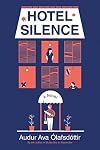
Auður Ava Ólafsdóttir’s bittersweet novel, Hotel Silence, tells an uplifting and slightly surreal tale of Icelander Jónas Ebeneser’s mid-life crisis. Jónas, in his late 40s, is spiralling into a depression sparked by the discovery that his adult daughter, Waterlily, is not his biological child. Jónas, divorced and living alone, has lost his sense of purpose and has decided to end his life. Having made up his mind, the problem he now faces is a practical one: how to accomplish this show more without causing his daughter the distress and inconvenience of discovering his body and having to clear the house of his possessions. Then, in a flash of inspiration, he decides he will make himself “vanish.” Jónas buys a one-way ticket off the island, traveling to an unnamed country that is in the early stages of rebuilding following a war that wreaked devastation on much of its territory. Under the assumption that he won’t need much since he’s going to do away with himself, Jónas brings with him a bare minimum of belongings: a single change of clothes, his diaries, and his toolbox (in case he needs to jerry-rig some method to kill himself). Taking a room at the enigmatic Hotel Silence, Jónas finds himself among people who are adjusting to life during a fragile truce, living amidst the destruction wrought by war. The town is in ruins, very few shops have reopened, popular tourist activities like walking in the park or forest are forbidden because of land mines. The hotel is being run by a young man (Fifi) and woman (May), siblings, who are doing what they can to revive the business, but are obviously in over their heads. Alone in his room, Jónas immediately discovers a use for his tools, quickly making a couple of minor repairs—fixing a closet door that’s fallen off its hinges, flushing out the water pipes in the bathroom. When May sees what he’s done, she asks Jónas to help around the hotel, explaining that so many men perished in the war that it’s rare to find anyone with that sort of knowhow. It doesn’t take long for word of his handyman skills to spread. Suddenly, Jónas, now a staff member of Hotel Silence, is in hot demand, his efforts appreciated. More important, looking at Fifi, May and the town’s other residents, what they’ve endured and their determination to pick up the pieces and move on, he realizes that the despair that almost pushed him over the brink to suicide was a trivial self-indulgence compared to what they must be feeling. Jónas narrates the tale of his own personal journey, one that renews his sense of purpose and gives him the strength to carry on. In Brian FitzGibbon’s capable translation, Ólafsdóttir’s novel is rendered in unadorned prose that gets to the heart of the matter in few words. The author’s lightly humorous touch makes the novel’s heavy themes—the horrors of war, bearing life’s scars with dignity and grit—easy to digest. Hotel Silence, understated, moving, entertaining, endearingly quirky, won the Icelandic Literary Prize in 2016. show less
Lists
Awards


You May Also Like


Associated Authors
Statistics
- Works
- 20
- Also by
- 1
- Members
- 1,791
- Popularity
- #14,366
- Rating
- 3.7
- Reviews
- 103
- ISBNs
- 161
- Languages
- 18
- Favorited
- 5
