
Stuart R. Schram (1924–2012)
Author of Mao Tse-tung
About the Author
Series
Works by Stuart R. Schram
Authority, Participation and Cultural Change in China: Essays by a European Study Group (1973) 12 copies
Mao's Road to Power: Revolutionary Writings, 1912-1949: Volume I, Pre-Marxist period, 1912-1920 (1992) 11 copies
Mao's Road to Power: Revolutionary Writings, 1912-1949: Volume IV, The Rise and Fall of the Chinese Soviet Republic, 1931-1934 (1997) — Editor — 5 copies
Ideology and Policy in China Since the Third Plenum, 1978-84 (Contemporary China Institute: research notes & studies) (1984) 3 copies
Mao Tse-tung e la Cina moderna 3 copies
Mao's Road to Power: Revolutionary Writings, 1912-1949: Volume VIII, From Rectification to Coalition Government, 1942-July 1945 (2015) 3 copies
Mao Tse-tung (Pelican) 2 copies
Associated Works
Tagged
Common Knowledge
- Canonical name
- Schram, Stuart R.
- Legal name
- Schram, Stuart Reynolds
- Birthdate
- 1924-02-27
- Date of death
- 2012-07-08
- Gender
- male
- Nationality
- USA
- Birthplace
- Excelsior, Minnesota, USA
- Place of death
- France
- Associated Place (for map)
- Minnesota, USA
Members
Reviews
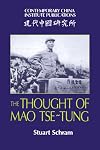
An excellent history of the variations as well as the continuities in Mao's thought. Somewhat assumes a basic knowledge of Chinese history from the last century but is readable without. Emphasises and illustrates his strong anti-imperialism, belief in the importance of the masses and his inclusion of the peasantry. At the same time provides a good account of his attempts to resolve contradictions in his thought, most notably his belief in the masses and his belief in the importance of show more central guidance. It doesn't provide a full elucidation of his ideology but this would be impossible given the length and the complexity and changes of his thought - it does an excellent job within its constraints.
Probably my biggest problem is that although the book talks often about his influence from traditional Chinese thought it only gives a few quotes from Mao himself directly relating to it and extrapolates. Although this is understandable, it makes a distinct change from the rest of the commentary about his thought which is generally well sourced from Mao's writings and speeches. show less
Probably my biggest problem is that although the book talks often about his influence from traditional Chinese thought it only gives a few quotes from Mao himself directly relating to it and extrapolates. Although this is understandable, it makes a distinct change from the rest of the commentary about his thought which is generally well sourced from Mao's writings and speeches. show less

A title in Penguin's Political Leaders of the Twentieth Century series. Originally published in 1966, I read the revised edition, published 1967.
Here is the description from the back cover: "By any reckoning Mao Tse-tung must be regarded as one of the greatest and most remarkable statesmen of modern times. As a poet of distinction, as a political philosopher of major importance, and as a strategist whose 6000-mile trek across China has become a legend, Mao has devoted his life to China and show more the Chinese peasants. Indeed the Chinese People's Republic has shaped a whole pattern of revolution for poor peasant societies. In this new biography, Stuart Schram sifts fact from fiction in the long story of Mao's struggle to free the greatness of China and to give a new meaning to Marxism."
As I said, written in 1966, if you couldn't tell from this book description.
Given its date, it does not cover the Cultural Revolution or the amazing turn of events when Nixon visited China. But when it appeared, it was a useful overview of Mao's life until then. show less
Here is the description from the back cover: "By any reckoning Mao Tse-tung must be regarded as one of the greatest and most remarkable statesmen of modern times. As a poet of distinction, as a political philosopher of major importance, and as a strategist whose 6000-mile trek across China has become a legend, Mao has devoted his life to China and show more the Chinese peasants. Indeed the Chinese People's Republic has shaped a whole pattern of revolution for poor peasant societies. In this new biography, Stuart Schram sifts fact from fiction in the long story of Mao's struggle to free the greatness of China and to give a new meaning to Marxism."
As I said, written in 1966, if you couldn't tell from this book description.
Given its date, it does not cover the Cultural Revolution or the amazing turn of events when Nixon visited China. But when it appeared, it was a useful overview of Mao's life until then. show less

Written 40 years ago and until the same type of access to the archives as in Russia after the fall of communism, suspect its not a wholly accurate account!
Department of History, University of Hong Kong
You May Also Like


Associated Authors
Statistics
- Works
- 24
- Also by
- 1
- Members
- 359
- Popularity
- #66,804
- Rating
- 3.1
- Reviews
- 4
- ISBNs
- 29
- Languages
- 3