
Julius Rudolf Weinberg (1908–1971)
Author of A Short History of Medieval Philosophy
About the Author
Series
Works by Julius Rudolf Weinberg
Tagged
Common Knowledge
Members
Reviews
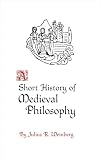
A Short Story of Medieval Philosophy is not your general introduction. No interesting 'facts' about the philosophers life that gives you a better insight (some anecdotal knowledge works for me as memorizing technique). Instead you get a summery of the main (Christian & Islamic) philosophers of the medieval era.
Weinberg as educator?
All chapters are thoroughly research, but feel like eating a dish of cardboard. The writer makes absolutely no effort to tell an exiting story, he is an analytic show more academic who seems to be proud in stripping the text to the philosophical (logic!) discussions.
The chapters are composed as a long summary of philosophers such as Augustine, Thomas, Scotus or Bacon. I would've appreciated when chapters where divided with subtitles, such as the Cognitive theory of Augustine, or the Thomas proof of God. This would made it easy for the reader to compare the different thinkers without having to scan the whole text. It is a missed chance that the form of this book is uncommitted to teaching. I am glad to say Weinberg was not my teacher in high school.
On the other hand, the content is fascinating. The axiomatic acceptance of God and the the view to reconcile philosophy with revelation invites the reader into a different world with a lot of relevant discussion. Questions about the nature of God (for none of the philosophers a man with a beard, but 'oneness', 'the first mover' the 'absolute') evokes beautiful discussions on the nature of reality. Are there immaterial substances? How can there be unity and differentiation? What is the status of causality? Reflection on belief and knowledge give interesting views about the role of memory, sense experience, the relation between personal experience and wisdom.
Why you should read this book
The fascination I felt for the human mind, a fascination that felt similar contemporary discussion on infinity and causality in modern physics ([1]: Individualfrog's review) made it worth the effort to eat this dish.
I recommend this book to everybody with an interest in philosophy. Especially when you want to learn more about the tradition the classical modern philosophers as Descartes or Spinoza started in. You will get a better grasp of concepts such as substance, essence, necessity and causality.
2 stars for the writing
4 stars for the research quality
-------
[1] Individualfrog's wrote an excellent review that goes a little deeper into the form and content of the book. show less
Weinberg as educator?
All chapters are thoroughly research, but feel like eating a dish of cardboard. The writer makes absolutely no effort to tell an exiting story, he is an analytic show more academic who seems to be proud in stripping the text to the philosophical (logic!) discussions.
The chapters are composed as a long summary of philosophers such as Augustine, Thomas, Scotus or Bacon. I would've appreciated when chapters where divided with subtitles, such as the Cognitive theory of Augustine, or the Thomas proof of God. This would made it easy for the reader to compare the different thinkers without having to scan the whole text. It is a missed chance that the form of this book is uncommitted to teaching. I am glad to say Weinberg was not my teacher in high school.
On the other hand, the content is fascinating. The axiomatic acceptance of God and the the view to reconcile philosophy with revelation invites the reader into a different world with a lot of relevant discussion. Questions about the nature of God (for none of the philosophers a man with a beard, but 'oneness', 'the first mover' the 'absolute') evokes beautiful discussions on the nature of reality. Are there immaterial substances? How can there be unity and differentiation? What is the status of causality? Reflection on belief and knowledge give interesting views about the role of memory, sense experience, the relation between personal experience and wisdom.
Why you should read this book
The fascination I felt for the human mind, a fascination that felt similar contemporary discussion on infinity and causality in modern physics ([1]: Individualfrog's review) made it worth the effort to eat this dish.
I recommend this book to everybody with an interest in philosophy. Especially when you want to learn more about the tradition the classical modern philosophers as Descartes or Spinoza started in. You will get a better grasp of concepts such as substance, essence, necessity and causality.
2 stars for the writing
4 stars for the research quality
-------
[1] Individualfrog's wrote an excellent review that goes a little deeper into the form and content of the book. show less
When I met Weinberg, years after he had written this (I now understand) he had moved on and was only vague aware of what he had said about the topic.

You May Also Like


Associated Authors
Statistics
- Works
- 13
- Members
- 315
- Popularity
- #74,964
- Rating
- 3.3
- Reviews
- 3
- ISBNs
- 21
- Languages
- 2