
Steve Martin (1) (1945–)
Author of Shopgirl
For other authors named Steve Martin, see the disambiguation page.
About the Author
Steve Martin was born on August 14, 1945 in Waco, Texas. He studied at Long Beach State College. He has acted in such films as The Jerk; Roxanne; Planes, Trains and Automobiles; Bowfinger; Father of the Bride; Cheaper by the Dozen; and Shopgirl, which was adapted from a novel he wrote. He has won show more an Emmy for his comedy writing and Grammies for his comedy albums. He has made several appearances on The Tonight Show and Saturday Night Live. He has written several books including Shopgirl, Cruel Shoes, Pure Drivel, The Pleasure of My Company, and An Object of Beauty. He also wrote a play entitled Picasso at the Lapin Agile and a memoir entitled Born Standing Up. During the 1990s, he wrote various pieces for The New Yorker. In 2002, he adapted the Carl Sternheim play The Underpants, which ran Off-Broadway at Classic Stage Company and in 2008, co-wrote and produced Traitor. In 2013 he published a memoir entitled Born Standing Up: A Comic's Life. This book tells the story of his beginnings as a magician and comedian at a young age and follows through his career lifetime. (Bowker Author Biography) show less
Image credit: David Shankbone
Series
Works by Steve Martin
Picasso at the Lapin Agile and Other Plays: Picasso at the Lapin Agile, The Zig-Zag Woman, Patter for the Floating Lady, WASP (1996) — Author — 693 copies, 10 reviews
The Ten, Make That Nine, Habits of Very Organized People. Make That Ten. The Tweets of Steve Martin (2012) 114 copies, 12 reviews
Steve Martin Writes the Written Word: Collected Written Word Works by Steve Martin (2025) 49 copies, 2 reviews
Dear Amanda [short story] 18 copies
Steve Martin And The Steep Canyon Rangers Featuring Edie Brickell Live [CD/DVD Combo] (2014) 4 copies
Only Murders in the Building: Seasons 1-3 — Creator/Actor — 3 copies
Only Murders in the Building: Seasons 1-4 — Creator/Actor — 2 copies
An Object of Beauty: First Chapter 2 copies
STEVE MARTIN - Grandmother's Song / Let's Get Small (45 RPM Vinyl) [Warner Bros. Records WBS 8503, 1977] (1977) 1 copy
Steve Martin and Martin Short: An Evening You Will Forget for the Rest of Your Life [2018 TV special] (2018) — Screenwriter/Self — 1 copy
Only Murders in the Building: Seasons 1-2 — Creator/Actor — 1 copy
King Tut/Sally Goddin 1 copy
Associated Works
Fierce Pajamas: An Anthology of Humor Writing from The New Yorker (2001) — Contributor — 790 copies, 5 reviews
Secret Ingredients: The New Yorker Book of Food and Drink (2007) — Contributor — 595 copies, 10 reviews
Best of The Oxford American: Ten Years from the Southern Magazine of Good Writing {anthology} (2002) — Contributor — 45 copies
Little Shop of Horrors: Original Motion Picture Soundtrack (1986) — Preformer, some editions — 25 copies
Best Of The Muppet Show: Vol. 6: Steve Martin / Carol Burnett / Gilda Radner (2001) — Guest Star — 20 copies
The Smothers Brothers Comedy Hour: The Best of Season 3 (2008) — Writer, Performer, some editions — 11 copies, 1 review
Movie Marathon Collection: Steve Martin (Bowfinger / Parenthood / Housesitter / Dead Men Don't Wear Plaid / The Lonely Guy) (2010) — Actor — 11 copies
4 Film Favorites: Classic Comedy (The Man Who Knew Too Little, The Man with Two Brains, Spies Like Us, Vegas Vacation) — Actor — 5 copies
True Crime [2021 Only Murders in the Building TV episode] — Actor — 1 copy
Only Murders in the Building: Season 3 (Original Soundtrack) — Performer, some editions — 1 copy
Tagged
Common Knowledge
- Canonical name
- Martin, Steve
- Legal name
- Martin, Stephen Glenn
- Birthdate
- 1945-08-14
- Gender
- male
- Education
- University of California, Los Angeles (theater)
Long Beach State University (philosphy)
Santa Ana College - Occupations
- comedian
actor
banjoist
art collector
art curator - Awards and honors
- Mark Twain Prize for American Humor (2005)
Kennedy Center Honors (2007)
Honorary Academy Award (2013)
Grammy Award (5x)
Primetime Emmy Award (1969)
AFI Life Achievement Award (2015) - Short biography
- Stephen Glenn "Steve" Martin (born August 14, 1945) is an American actor, comedian, writer, playwright, producer, musician and composer.
Martin was born in Waco, Texas, and raised in Southern California, where his early influences were working at Disneyland and Knott's Berry Farm and working magic and comedy acts at these and other smaller venues in the area. His ascent to fame picked up when he became a writer for the Smothers Brothers Comedy Hour, and later became a frequent guest on The Tonight Show. In the 1970s, Martin performed his offbeat, absurdist comedy routines before packed houses on national tours. Since the 1980s, having branched away from stand-up comedy, he has become a successful actor, playwriter, pianist, banjo player, and juggler, eventually earning Emmy, Grammy, and American Comedy awards. - Nationality
- USA
- Birthplace
- Waco, Texas, USA
- Places of residence
- Los Angeles, California, USA
- Associated Place (for map)
- USA
Members
Reviews
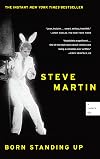
I remember watching The Sunday Show in 1996 when Dennis Pennis buttonholed Steve Martin at a red carpet do somewhere – ‘Steve! Steve! Just one question—’ and then as Martin leaned in expectantly: ‘How come you're not funny anymore?’
He looked genuinely distraught as he turned away (in fact it later emerged that he had cancelled all his press engagements as a result), but the trajectory he was on is one that's become familiar – from live stand-up to film comedies, and from film show more comedies to more bittersweet roles, and finally to worthy passion projects. We can admire Steve Martin the banjo virtuoso like we can admire Hugh Laurie the pianist, but the primary feeling is one of tolerance rather than enthusiasm. In our heart of hearts we want Steve to put on a white suit and wear an arrow through his head, just like we want Hugh to be eternally getting punched in the face by Rowan Atkinson.
Like it or not, they're past all that, and the perspective is an important one for this book. Comedians frequently refer to Born Standing Up as the finest memoir of its kind, but the most striking thing about it is that – unlike a lot of stand-up memoirs I've read – it is not the analysis of a working comic about how their act has been honed, but rather the reflections of someone looking back in a tone of melancholy forbearance on a distant period of their youth. Sometimes, typing out his performance notes from the 70s, he seems unsure of the jokes, and eventually admits to the reader that he no longer gets the material.
At his prime, though, in the late 1970s, Steve Martin changed everything, inventing a new kind of stand-up comedy based on absurdist nonsequiturs, exuberant physical gags, and a constant, simmering hilarity which had been stripped of punchlines so that the audience was never allowed to release the tension. Watching him gradually arrive at this style, by fortuitous increments and occasional ‘intuitive leaps’, is fascinating, although it's told rather dispassionately, without any of the thrill that must have accompanied it at the time.
More vivid are his descriptions of the banal exigencies of touring, the exciting anonymity of life on the road and the exposure it gave him to different oddball characters – and girls, of whom he seems to have had one in every port. He is rather charming on this subject.
One night I opened the show for Linda Ronstadt; she sang barefoot on a raised stage and wore a silver lamé dress that stopped a millimeter below her panties, causing the floor of the Troubadour to be slick with drool. Linda and I saw each other for a while, but I was so intimidated by her talent and street smarts that, after the ninth date, she finally said, “Steve, do you often date girls and not try to sleep with them?” We parted chaste.
You can see that Martin is graceful enough to recognise the primary reason people read autobiographies, namely to find out who you were sleeping with back in the day. This winning anecdote, from his days of obscurity, contrasts interestingly with another story from some chapters later, when, now as the most famous comedian on the planet, he tries to take someone out on date.
After the salad course, she started talking about her boyfriend.
“You have a boyfriend?” I asked, puzzled.
“Yes, I do.”
“Does he know you're out with me?” I asked.
“Yes, he does.”
“And what does he think of that?”
“He thinks it's great!”
I was now famous, and the normal rules of social interaction no longer applied.
The distance Martin, as writer, has from his material may be a little disconcerting at times, but it does allow him to organise and streamline his material without getting distracted. He stopped doing stand-up overnight and – he says – never looked back once until he sat down to write this book. He should look back more often, because this is a joy to read – I just bought it a few hours ago in a bookshop outside Detroit, and I've bombed through the whole thing in a single afternoon. He may not be funny anymore, at least not in the same way, but his creativity and wit haven't gone anywhere. show less
He looked genuinely distraught as he turned away (in fact it later emerged that he had cancelled all his press engagements as a result), but the trajectory he was on is one that's become familiar – from live stand-up to film comedies, and from film show more comedies to more bittersweet roles, and finally to worthy passion projects. We can admire Steve Martin the banjo virtuoso like we can admire Hugh Laurie the pianist, but the primary feeling is one of tolerance rather than enthusiasm. In our heart of hearts we want Steve to put on a white suit and wear an arrow through his head, just like we want Hugh to be eternally getting punched in the face by Rowan Atkinson.
Like it or not, they're past all that, and the perspective is an important one for this book. Comedians frequently refer to Born Standing Up as the finest memoir of its kind, but the most striking thing about it is that – unlike a lot of stand-up memoirs I've read – it is not the analysis of a working comic about how their act has been honed, but rather the reflections of someone looking back in a tone of melancholy forbearance on a distant period of their youth. Sometimes, typing out his performance notes from the 70s, he seems unsure of the jokes, and eventually admits to the reader that he no longer gets the material.
At his prime, though, in the late 1970s, Steve Martin changed everything, inventing a new kind of stand-up comedy based on absurdist nonsequiturs, exuberant physical gags, and a constant, simmering hilarity which had been stripped of punchlines so that the audience was never allowed to release the tension. Watching him gradually arrive at this style, by fortuitous increments and occasional ‘intuitive leaps’, is fascinating, although it's told rather dispassionately, without any of the thrill that must have accompanied it at the time.
More vivid are his descriptions of the banal exigencies of touring, the exciting anonymity of life on the road and the exposure it gave him to different oddball characters – and girls, of whom he seems to have had one in every port. He is rather charming on this subject.
One night I opened the show for Linda Ronstadt; she sang barefoot on a raised stage and wore a silver lamé dress that stopped a millimeter below her panties, causing the floor of the Troubadour to be slick with drool. Linda and I saw each other for a while, but I was so intimidated by her talent and street smarts that, after the ninth date, she finally said, “Steve, do you often date girls and not try to sleep with them?” We parted chaste.
You can see that Martin is graceful enough to recognise the primary reason people read autobiographies, namely to find out who you were sleeping with back in the day. This winning anecdote, from his days of obscurity, contrasts interestingly with another story from some chapters later, when, now as the most famous comedian on the planet, he tries to take someone out on date.
After the salad course, she started talking about her boyfriend.
“You have a boyfriend?” I asked, puzzled.
“Yes, I do.”
“Does he know you're out with me?” I asked.
“Yes, he does.”
“And what does he think of that?”
“He thinks it's great!”
I was now famous, and the normal rules of social interaction no longer applied.
The distance Martin, as writer, has from his material may be a little disconcerting at times, but it does allow him to organise and streamline his material without getting distracted. He stopped doing stand-up overnight and – he says – never looked back once until he sat down to write this book. He should look back more often, because this is a joy to read – I just bought it a few hours ago in a bookshop outside Detroit, and I've bombed through the whole thing in a single afternoon. He may not be funny anymore, at least not in the same way, but his creativity and wit haven't gone anywhere. show less
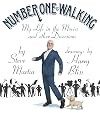
William James said, “A sense of humor is just common sense dancing.” And anyone who has seen Steve Martin become a “wild and crazy guy” knows that he definitely has a sense of humor . . . I mean common sense. Thank you, Mr. Martin, for providing comedy’s healing perspective throughout so many stand-ups, books, plays and television programs.
But wait, there’s more! Number One is Walking is Martin’s account of an abundance of very funny moments in the movie-making world. show more Recalling being “Number One” and what happened on the sets of his movies often took me from a smile to an outright, out loud laugh. He is world-famous and #1 for millions, but he also has the humility to admit that on a film set with Meryl Streep and Alec Baldwin, he became “Number Three walking.”
The set-up is that Martin is talking either to Penny, the dog, or his friend Harry Bliss, The New Yorker cartoonist who contributes over half of the contents of this book. Bliss creates single panel or strips in the style of his Bliss comics in newspapers, but these contain Martin’s reminiscences. The second half of the book contains Bliss’s Other Diversions, many more of Bliss’s own hilarious cartoons. Bliss and Martin previously created A Wealth of Pigeons, which I plan to read soon.
I don’t necessarily care that Steve Martin knows Paul McCartney, Diane Keaton, Harrison Ford and probably all the other stellar entertainers in the world. I just enjoyed reading the Academy, Emmy and Grammy award winner explain what happened when he was around them. He’s just too witty and charming for his own good, you know?
I received an advance copy of this book from Celadon Books. This is an honest review. show less
But wait, there’s more! Number One is Walking is Martin’s account of an abundance of very funny moments in the movie-making world. show more Recalling being “Number One” and what happened on the sets of his movies often took me from a smile to an outright, out loud laugh. He is world-famous and #1 for millions, but he also has the humility to admit that on a film set with Meryl Streep and Alec Baldwin, he became “Number Three walking.”
The set-up is that Martin is talking either to Penny, the dog, or his friend Harry Bliss, The New Yorker cartoonist who contributes over half of the contents of this book. Bliss creates single panel or strips in the style of his Bliss comics in newspapers, but these contain Martin’s reminiscences. The second half of the book contains Bliss’s Other Diversions, many more of Bliss’s own hilarious cartoons. Bliss and Martin previously created A Wealth of Pigeons, which I plan to read soon.
I don’t necessarily care that Steve Martin knows Paul McCartney, Diane Keaton, Harrison Ford and probably all the other stellar entertainers in the world. I just enjoyed reading the Academy, Emmy and Grammy award winner explain what happened when he was around them. He’s just too witty and charming for his own good, you know?
I received an advance copy of this book from Celadon Books. This is an honest review. show less
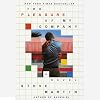
An interesting read (and because of the short length and straightforward writing style, a quick one, too!) To me, it is like a mix of "Rear Window" and "Waiting for Godot" (although I enjoyed this much more than "Godot"), in that this novella causes us to stop and see what happens when essentially nothing happens. And we find that a lot happens when nothing happens! Martin explores a lot of deep themes in this novella, while covering a range of emotions from love to grief to heartbreak. What show more makes this even more interesting is that we view everything through the eyes of a neurotic narrator. He views the seemingly everyday issues we all face with a different perspective than ours – looking much more closely at some many things we take for granted. I particularly found it funny when he quite seriously wanted a mediator to find the common language between himself and the 1-year-old child he is babysitting. The ending is a bit abrupt and ties up a lot of problems a bit too neatly, but overall I enjoyed this book and liked the many questions that the novella inevitably raises for the reader about the nature of love and obsessions and the challenges presented by language. show less
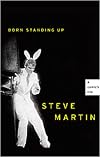
Steve Martin, one of the most obviously intelligent comedy artists of his generation, has written a genial and serious book about the art of stand-up comedy as he saw it during his development in the 1960s and his enormous success in the 1970s. The book is charming and funny, yet it trades easy laughs for a real look at what went into the building of a spectacular career. Martin is authentic in his description of his upbringing in a family that didn't discover closeness until almost too show more late. It's a lovely and sometimes touching book. show less
Lists
Awards


You May Also Like


Associated Authors
Statistics
- Works
- 71
- Also by
- 63
- Members
- 18,569
- Popularity
- #1,179
- Rating
- 3.7
- Reviews
- 594
- ISBNs
- 349
- Languages
- 14
- Favorited
- 36

