
John Powell (2) (1955–)
Author of How Music Works: The Science and Psychology of Beautiful Sounds, from Beethoven to the Beatles and Beyond
For other authors named John Powell, see the disambiguation page.
About the Author
John Powell holds a master's degree in music composition and a phd in physics; and he has taught musical acoustics at sheffield University and physics at the Universities of Nottingham and Lulea (Sweden) He lives in England.
Image credit: youtube
Works by John Powell
How Music Works: The Science and Psychology of Beautiful Sounds, from Beethoven to the Beatles and Beyond (2010) 487 copies, 16 reviews
Why You Love Music: From Mozart to Metallica--The Emotional Power of Beautiful Sounds (2016) 84 copies, 3 reviews
Tagged
Common Knowledge
Members
Reviews
How Music Works: The Science and Psychology of Beautiful Sounds, from Beethoven to the Beatles and Beyond by John Powell
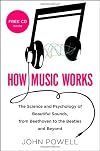
If there's one thing that can be said about music, it's that as much as we may love it we generally don't want to think about it. After all, music speaks to the emotions, not logic. That's why if you ask someone about the music they like, you will get a list of genres or artists far more quickly than an explanation why they like it.
John Powell, though, believes that knowledge can actually enhance a person's experience with music. The problem is that understanding the building blocks of music show more involves discussing other, sometimes difficult topics, such as physics, neuroscience and even psychology. With How Music Works: The Science and Psychology of Beautiful Sounds, from Beethoven to the Beatles and Beyond, Powell may have arrived at something that could be called music theory for the common man. Although he is actually explaining music theory and the science behind it, he does so in a very conversational tone with practical examples and analogies. Readers are not engulfed by academic tones but more in the manner of a one-on-one discussion of what music is -- with even a few "I didn't know that!" moments thrown in. (Famed songwriter Irving Berlin couldn't write music so he paid musicians to watch his fingers on the piano and write down what he played.)
As such, How Music Works seems to address a gap in the music-related edification of the average reader or listener. It does not look at one or more particular styles of music like music appreciation books. At the same time, it is a broader, perhaps more fundamental look at music theory than books like Daniel Levitin's This Is Your Brain on Music, which looks at how and why music works in the brain. It ends up as a great resource for those who want to gain a basic yet better understanding of something that is important in our lives.
Powell, who has taught both musical acoustics and physics in England, deserves credit for the manner in which he expresses and helps readers understand audio concepts through written words or material that could be easily lost in jargon or theory. For example, he calls the penultimate note in a scale the "almost there" note, almost perfectly capturing the feel and sense of the note when we hear a scale. Similarly, he frequently uses two tunes we all can hum ("Baa Baa Black Sheep" and "For He’s A Jolly Good Fellow") to help readers translate the written explanation into our own audio comprehension. (The book also includes a CD with examples from the book for those who desire more audio explanation or stimulation.) Most important, he does an excellent job of explaining fundamental yet crucial music elements.
How Music Works is not limited to the building blocks of music. Powell broadens the scope beyond music theory. For example, he explores how and why different instruments make the sounds they do and how they create what we consider musical notes or tones. He even looks at what type of instrument those interested in playing one might want to consider. Still, the focus is on the fundamental elements of music and how and why Western music developed and is created.
My major criticisms of the book may be largely personal. First, part of Powell's conversational tone is frequent jocularity and humor. Some, though, may find too large a dose or that a large number are distracting or even sophomoric. For example, a discussion about why and how our ears function as they becomes a bit more banal with the aside that they "are also useful for supporting your sunglasses." Then there's occasional lines like, "I have no proof of this, but I think the decibel was invented in a bar, late one night, by a committee of drunken electrical engineers who wanted to take revenge on the world for their total lack of dancing partners." Because humor is a question of taste, any nonfiction writer is going to run the risk his or her taste clashes with that of any number of readers.
The other criticism may reflect the personal psychic trauma of hours spent as a young piano student practicing with and attempting to memorize a device I felt embodied pure evil, "the circle of fifths." As How Music Works explores scales and their history and variations, my eyes started glazing over and my brain shut down. It may simply be the damage caused by that experience is too great or that there is no easier or other way to explain scales and their relationships. Yet there were one or two other occasions in the book where I had a similar feeling and the length and detail of the scale discussion makes it even more noticeable.
Yet, odd as it may be, the section of the book giving rise to this criticism still reflects the value of Powell's approach. His basic, core explanation of a scale boils down to a simple line of abbreviations for tones and semitones, two terms far easier to understand than they may sound here. Had my childhood piano teacher ever used that approach, I might actually have grasped what was behind and the importance of the circle of fifths. In fact, Powell earned my esteem in asking "why generations of unhappy children have been forced at knife-point to practice playing scales on their instruments when they could be having much more fun playing real pieces of music" and arguing the rationale for doing so is "feeble" compared to the damage it causes in kids abandoning music.
That may be the strength of How Music Works. It puts what can be difficult concepts in language and examples most anyone could understand. In so doing, Powell gives sustenance to a wide range of people who may be interested in the why and how of music, whether those with no background whatsoever to the many put off by the music pedagogy of their time.
(Originally posted at A Progressive on the Prairie.) show less
John Powell, though, believes that knowledge can actually enhance a person's experience with music. The problem is that understanding the building blocks of music show more involves discussing other, sometimes difficult topics, such as physics, neuroscience and even psychology. With How Music Works: The Science and Psychology of Beautiful Sounds, from Beethoven to the Beatles and Beyond, Powell may have arrived at something that could be called music theory for the common man. Although he is actually explaining music theory and the science behind it, he does so in a very conversational tone with practical examples and analogies. Readers are not engulfed by academic tones but more in the manner of a one-on-one discussion of what music is -- with even a few "I didn't know that!" moments thrown in. (Famed songwriter Irving Berlin couldn't write music so he paid musicians to watch his fingers on the piano and write down what he played.)
As such, How Music Works seems to address a gap in the music-related edification of the average reader or listener. It does not look at one or more particular styles of music like music appreciation books. At the same time, it is a broader, perhaps more fundamental look at music theory than books like Daniel Levitin's This Is Your Brain on Music, which looks at how and why music works in the brain. It ends up as a great resource for those who want to gain a basic yet better understanding of something that is important in our lives.
Powell, who has taught both musical acoustics and physics in England, deserves credit for the manner in which he expresses and helps readers understand audio concepts through written words or material that could be easily lost in jargon or theory. For example, he calls the penultimate note in a scale the "almost there" note, almost perfectly capturing the feel and sense of the note when we hear a scale. Similarly, he frequently uses two tunes we all can hum ("Baa Baa Black Sheep" and "For He’s A Jolly Good Fellow") to help readers translate the written explanation into our own audio comprehension. (The book also includes a CD with examples from the book for those who desire more audio explanation or stimulation.) Most important, he does an excellent job of explaining fundamental yet crucial music elements.
How Music Works is not limited to the building blocks of music. Powell broadens the scope beyond music theory. For example, he explores how and why different instruments make the sounds they do and how they create what we consider musical notes or tones. He even looks at what type of instrument those interested in playing one might want to consider. Still, the focus is on the fundamental elements of music and how and why Western music developed and is created.
My major criticisms of the book may be largely personal. First, part of Powell's conversational tone is frequent jocularity and humor. Some, though, may find too large a dose or that a large number are distracting or even sophomoric. For example, a discussion about why and how our ears function as they becomes a bit more banal with the aside that they "are also useful for supporting your sunglasses." Then there's occasional lines like, "I have no proof of this, but I think the decibel was invented in a bar, late one night, by a committee of drunken electrical engineers who wanted to take revenge on the world for their total lack of dancing partners." Because humor is a question of taste, any nonfiction writer is going to run the risk his or her taste clashes with that of any number of readers.
The other criticism may reflect the personal psychic trauma of hours spent as a young piano student practicing with and attempting to memorize a device I felt embodied pure evil, "the circle of fifths." As How Music Works explores scales and their history and variations, my eyes started glazing over and my brain shut down. It may simply be the damage caused by that experience is too great or that there is no easier or other way to explain scales and their relationships. Yet there were one or two other occasions in the book where I had a similar feeling and the length and detail of the scale discussion makes it even more noticeable.
Yet, odd as it may be, the section of the book giving rise to this criticism still reflects the value of Powell's approach. His basic, core explanation of a scale boils down to a simple line of abbreviations for tones and semitones, two terms far easier to understand than they may sound here. Had my childhood piano teacher ever used that approach, I might actually have grasped what was behind and the importance of the circle of fifths. In fact, Powell earned my esteem in asking "why generations of unhappy children have been forced at knife-point to practice playing scales on their instruments when they could be having much more fun playing real pieces of music" and arguing the rationale for doing so is "feeble" compared to the damage it causes in kids abandoning music.
That may be the strength of How Music Works. It puts what can be difficult concepts in language and examples most anyone could understand. In so doing, Powell gives sustenance to a wide range of people who may be interested in the why and how of music, whether those with no background whatsoever to the many put off by the music pedagogy of their time.
(Originally posted at A Progressive on the Prairie.) show less
 This review was written for LibraryThing Early Reviewers.
How music works : the science and psychology of beautiful sounds, from Beethoven to the Beatles and beyond by John Powell
With a lot of humor and avoidance of technical detail, Powell breaks down everything about music including physics, acoustics, decibels, rhythm and melody, and musical scores. Despite the simplicity of the book, I still find myself challenged in remembering all that I learned, but I suspect that this is a good introduction to music for most readers.
How Music Works: The Science and Psychology of Beautiful Sounds, from Beethoven to the Beatles and Beyond by John Powell
As the title says, this is a book about how music works -- but about how it works in physical sense, not in an artistic or emotional sense. This took me aback, since I'd expected (having foolishly failed toread the write up or the reviews) something about sense and sensibility.
But I am very glad I got the book, and read it. The author sets out to make the mechanics of music clear even to readers with no musical education. I am just such a one, and the book does indeed make a lot of things show more very clear, starting with what makes a sound musical. It proceeds through picth and frequency, tonality, intervals and scales, keys, modes, and on and on.
I learned a lot from the book, and enjoyed doing so. The style is very clear and simple, the organization is excellent, and the examples are well chosen. Only time will tell whether or not having read the book enhances my appreciation of music, In the meantime, I have learned a lot of stuff that is fun to know.
My only question about this book is whether it might be TOO clear and simple for readers who already know a lot about music. I can"t judge that, but such readers might want to read reviews by their peers. show less
But I am very glad I got the book, and read it. The author sets out to make the mechanics of music clear even to readers with no musical education. I am just such a one, and the book does indeed make a lot of things show more very clear, starting with what makes a sound musical. It proceeds through picth and frequency, tonality, intervals and scales, keys, modes, and on and on.
I learned a lot from the book, and enjoyed doing so. The style is very clear and simple, the organization is excellent, and the examples are well chosen. Only time will tell whether or not having read the book enhances my appreciation of music, In the meantime, I have learned a lot of stuff that is fun to know.
My only question about this book is whether it might be TOO clear and simple for readers who already know a lot about music. I can"t judge that, but such readers might want to read reviews by their peers. show less
John Powell’s How Music Works starts with the basics and does a good job of explaining the difference between sounds we accept as musical and those we reject as noise. The secret is that music has a regular repeating waveform. He then goes on to provide a hodgepodge of other interesting information, such as how two instruments (say a xylophone and a saxophone) can play the same note but sound different. (It has to do with the harmonics, or secondary frequencies that each instrument show more generates.) All of this is pretty interesting if you, like me, have a child who is very interested in music and you want to understand some of the basics a little better. He goes on to deal with such interesting subjects as why ten instruments don’t sound ten times as loud as one instrument. (Since they aren’t all exactly in phase, some of the waves cancel each other out. Just the way your noise-canceling headphones work.)
If these examples sound interesting, you’ll enjoy the book. It is as easy read, though it does give the impression of being thrown together somewhat haphazardly, and occasionally the author oversimplifies things too much. Powell throws one-liners into almost every paragraph, which becomes a bit old after a while, making me want to check to make sure this volume didn’t have a yellow and black cover with the word “Dummies” in the title. To his great credit, he is wide-ranging in his tastes and understands the virtues of all types of music from classical to jazz to rock to folk.
On the accompanying CD, Powell provides some examples, mostly using his guitar, that illustrate things such as the difference between a major and minor key, vibrato and rubato, etc. All in all the short time it takes to read this book is well worthwhile. show less
If these examples sound interesting, you’ll enjoy the book. It is as easy read, though it does give the impression of being thrown together somewhat haphazardly, and occasionally the author oversimplifies things too much. Powell throws one-liners into almost every paragraph, which becomes a bit old after a while, making me want to check to make sure this volume didn’t have a yellow and black cover with the word “Dummies” in the title. To his great credit, he is wide-ranging in his tastes and understands the virtues of all types of music from classical to jazz to rock to folk.
On the accompanying CD, Powell provides some examples, mostly using his guitar, that illustrate things such as the difference between a major and minor key, vibrato and rubato, etc. All in all the short time it takes to read this book is well worthwhile. show less
This review was written for LibraryThing Early Reviewers.Lists
You May Also Like


Associated Authors
Statistics
- Works
- 2
- Members
- 571
- Popularity
- #43,840
- Rating
- 3.8
- Reviews
- 19
- ISBNs
- 235
- Languages
- 21
