
Rob Walker (1)
Author of The Art of Noticing: 131 Ways to Spark Creativity, Find Inspiration, and Discover Joy in the Everyday
For other authors named Rob Walker, see the disambiguation page.
About the Author
Image credit: Journalist Rob Walker at the 2019 Texas Book Festival in Austin, Texas, United States. By Larry D. Moore, CC BY-SA 4.0, https://commons.wikimedia.org/w/index.php?curid=84741923
Works by Rob Walker
The Art of Noticing: 131 Ways to Spark Creativity, Find Inspiration, and Discover Joy in the Everyday (2019) 291 copies, 8 reviews
Significant Objects: 100 Extraordinary Stories about Ordinary Things (2012) — Editor — 64 copies, 1 review
Amateur Hour, Web Style 1 copy
Associated Works
Tagged
Common Knowledge
- Gender
- male
- Occupations
- journalist
- Organizations
- The New York Times Magazine
Members
Reviews
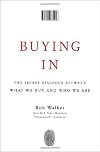
One of the best book on behavioral economics and identity I’ve read. Walker benefits from the wisdom of earlier writers, such as Ariely and Atkins, but brings his own ability to ask great questions to the table. Much better than more superficial works like Buyology, it is Walker's questions that elevate him above many others. Seeing modern marketing as targeting the ideal balance between empowering individual identity and fostering community, Walker finally brings advertisers onto a show more playing field that should be very familiar to religious professionals. Like Gladwell’s Tipping Point, Walker’s Buying In is analysis and reflection that is as helpful to those seeking to build meaningful spiritual communities as those seeking to hawk their wares. show less
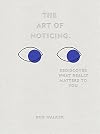
Rating:
3.5 Stars
In a nutshell:
A series of very short suggestions for ways to reconnect with one’s self and the world.
Best for:
Those of us who may find ourselves easily distracted and/or hoping to focus more on what is important in our lives.
Quote that made me think:
“What, among everything you encounter, could be made better somehow?”
Why I chose it:
I spend so much time on my phone, multi-tasking, and sort of floating through life, and I was hoping this would give me some ideas of how to show more be more intentional with my time and attention.
Review:
This book was not quite what I expected, which is my own fault, as I didn’t spend enough time looking through it when I bought it. Instead of containing traditional chapters, it has five sections, each containing suggested projects along a theme. Each project is rated on a scale of 1-4, with one being very easy to do and four being challenging / very involved.
The areas of focus are ‘looking,’ ‘sensing,’ ‘going places,’ ‘connecting with others,’ and ‘being alone.’
The book feels a bit more like a collection of bits of performance art, and indeed the author very openly borrows many of the suggested practices from performance and other types of artists. Which isn’t quite what I was expecting, but it was still interesting to contemplate nonetheless. Example projects are as basic as ‘notice something new every day’ and as complex as ‘exhaust a place.’
There are definitely some projects in here that I plan to pursue, but it will require some intentionality. Unlike, say, a ‘do this each day’ type of book, where each day you’re assigned a new task, this book is just a catalog of ideas, and its up to me to actually pick one and go with it. For me, the easiest ones would probably be in the ‘looking’ and ‘being alone’ sections, which probably means I should start with the other sections.
Would I recommend it to its target audience:
Yes, with the understanding that some of the suggestions will likely be a bit much. show less
3.5 Stars
In a nutshell:
A series of very short suggestions for ways to reconnect with one’s self and the world.
Best for:
Those of us who may find ourselves easily distracted and/or hoping to focus more on what is important in our lives.
Quote that made me think:
“What, among everything you encounter, could be made better somehow?”
Why I chose it:
I spend so much time on my phone, multi-tasking, and sort of floating through life, and I was hoping this would give me some ideas of how to show more be more intentional with my time and attention.
Review:
This book was not quite what I expected, which is my own fault, as I didn’t spend enough time looking through it when I bought it. Instead of containing traditional chapters, it has five sections, each containing suggested projects along a theme. Each project is rated on a scale of 1-4, with one being very easy to do and four being challenging / very involved.
The areas of focus are ‘looking,’ ‘sensing,’ ‘going places,’ ‘connecting with others,’ and ‘being alone.’
The book feels a bit more like a collection of bits of performance art, and indeed the author very openly borrows many of the suggested practices from performance and other types of artists. Which isn’t quite what I was expecting, but it was still interesting to contemplate nonetheless. Example projects are as basic as ‘notice something new every day’ and as complex as ‘exhaust a place.’
There are definitely some projects in here that I plan to pursue, but it will require some intentionality. Unlike, say, a ‘do this each day’ type of book, where each day you’re assigned a new task, this book is just a catalog of ideas, and its up to me to actually pick one and go with it. For me, the easiest ones would probably be in the ‘looking’ and ‘being alone’ sections, which probably means I should start with the other sections.
Would I recommend it to its target audience:
Yes, with the understanding that some of the suggestions will likely be a bit much. show less
We try to find our karass by adopting brands as granfalloons. Walker doesn't use [[Kurt Vonnegut]]'s terminology, but I think that's a fair summary of his analysis of how brands work in the era of the 'click'.
The bulk of the book is a very gentle, pleasantly anecdotal series of debunkings. Walker brings up things that are Said about branding, or purchasing, or consumers nowadays, e.g. advertising is harder than it used to be; or, people don't buy based on brands; or, consumers control the show more market; and provides mostly contrary evidence on the macro- and micro- scales. The macro evidence is generally the increasing profit of big branded concerns, with some studies done on just how effective brands are. The micro evidence is stories of all the consumers and coolhunters and marketers he's interviewed over the course of a decade writing about advertising.
This is not a scholarly or statistical book, but it rises above catchy stories. The prose is slightly bloggy (paragraphs that start with 'So', for instance), but clear. Walker's summary of human, especially late-modern adolescent human, nature is simple but sturdy: we all want to (a) be unique individuals and (b) be part of something bigger than ourselves. And, in consumer society, we mostly do this by choosing which brands to surround ourselves with. No brand can afford to gamble on whether we're choosing it for Unique Rebellion or Belonging, so the most successful ones now try not to say anything explicitly; 'murketing'. Successful brands that convince us we're separate but are successful because they're used as symbols general enough for lots of people to 'belong'. Rap and skate-punk culture are both here, and Hello Kitty, and Walker manages to be sort of affectionately respectful towards all their fans. He's even pleasant about paid and volunteer buzz-marketers, the people who write online reviews and shill things to their friends for no explicit reward (although the agencies that coordinate them get paid a lot).
Walker manages to be respectful on two grounds; first, that our conflicting desires are real problems and our attempts to resolve them therefore worthy of respect, however innately doomed; and second, that almost everything in the market is now about equally good, so it doesn't matter which brand we choose, scorn, or shill. He has a third half-reason, that trying to base consumer behavior on deeper ethical grounds (that covers anything that affects anyone else) doesn't work, since it's weaker than our personal needs and harder to be sure of.
On the other hand, the only 'brand' Walker describes as bringing happiness in the long run is that of Saddleback Church, which arranges small long-lived groups, and expects them to do some good outside the group. There's nothing like a long time in a small group to throw our real individualities into high relief; and doing good in the world really is belonging to a project larger than ourselves. Walker adds that many of our favorite objects are so because they remind us of real relations; or that we make real relations while following, or inventing, brands.
The crafters on Etsy have another story, that they express their art for others to live with beautifully, not in mass-production sweatshops; but that seems as dependent on mass-production of half-finished source materials. Also, as Walker points out, the commonest success story for an online craft seller is to make herself a subsistence pieceworker -- no health insurance and no leisure, and she can't scale up because that changes the story.
I was increasingly anxious as the book went on not just because Young People Today assume there's nothing better than a good brand, but because the whole thing paints a picture of a US economy based entirely on selling altered T-shirts and iPod cases. That doesn't seem sustainable. I'm also suspicious of the assumption that, because all commodities (stoves, etc) are currently very similar in quality, they're as good as they could be for the price. It seems to me that most objects are only as good as they need to be to last until the next expected kitchen makeover; and because we expect to update the 'stories we tell to ourselves about ourselves', that's not very long. We've made advertising constant instead of replacing it, just as constant email access makes work constant without reducing it. show less
The bulk of the book is a very gentle, pleasantly anecdotal series of debunkings. Walker brings up things that are Said about branding, or purchasing, or consumers nowadays, e.g. advertising is harder than it used to be; or, people don't buy based on brands; or, consumers control the show more market; and provides mostly contrary evidence on the macro- and micro- scales. The macro evidence is generally the increasing profit of big branded concerns, with some studies done on just how effective brands are. The micro evidence is stories of all the consumers and coolhunters and marketers he's interviewed over the course of a decade writing about advertising.
This is not a scholarly or statistical book, but it rises above catchy stories. The prose is slightly bloggy (paragraphs that start with 'So', for instance), but clear. Walker's summary of human, especially late-modern adolescent human, nature is simple but sturdy: we all want to (a) be unique individuals and (b) be part of something bigger than ourselves. And, in consumer society, we mostly do this by choosing which brands to surround ourselves with. No brand can afford to gamble on whether we're choosing it for Unique Rebellion or Belonging, so the most successful ones now try not to say anything explicitly; 'murketing'. Successful brands that convince us we're separate but are successful because they're used as symbols general enough for lots of people to 'belong'. Rap and skate-punk culture are both here, and Hello Kitty, and Walker manages to be sort of affectionately respectful towards all their fans. He's even pleasant about paid and volunteer buzz-marketers, the people who write online reviews and shill things to their friends for no explicit reward (although the agencies that coordinate them get paid a lot).
Walker manages to be respectful on two grounds; first, that our conflicting desires are real problems and our attempts to resolve them therefore worthy of respect, however innately doomed; and second, that almost everything in the market is now about equally good, so it doesn't matter which brand we choose, scorn, or shill. He has a third half-reason, that trying to base consumer behavior on deeper ethical grounds (that covers anything that affects anyone else) doesn't work, since it's weaker than our personal needs and harder to be sure of.
On the other hand, the only 'brand' Walker describes as bringing happiness in the long run is that of Saddleback Church, which arranges small long-lived groups, and expects them to do some good outside the group. There's nothing like a long time in a small group to throw our real individualities into high relief; and doing good in the world really is belonging to a project larger than ourselves. Walker adds that many of our favorite objects are so because they remind us of real relations; or that we make real relations while following, or inventing, brands.
The crafters on Etsy have another story, that they express their art for others to live with beautifully, not in mass-production sweatshops; but that seems as dependent on mass-production of half-finished source materials. Also, as Walker points out, the commonest success story for an online craft seller is to make herself a subsistence pieceworker -- no health insurance and no leisure, and she can't scale up because that changes the story.
I was increasingly anxious as the book went on not just because Young People Today assume there's nothing better than a good brand, but because the whole thing paints a picture of a US economy based entirely on selling altered T-shirts and iPod cases. That doesn't seem sustainable. I'm also suspicious of the assumption that, because all commodities (stoves, etc) are currently very similar in quality, they're as good as they could be for the price. It seems to me that most objects are only as good as they need to be to last until the next expected kitchen makeover; and because we expect to update the 'stories we tell to ourselves about ourselves', that's not very long. We've made advertising constant instead of replacing it, just as constant email access makes work constant without reducing it. show less
The Art of Noticing: 131 Ways to Spark Creativity, Find Inspiration, and Discover Joy in the Everyday by Rob Walker
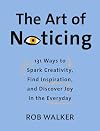
One of my favorite books for this year.
I had been looking for a book like this: instruction manual for a more wakeful meditation, a practical sequel to Ways of Seeing by John Berger, and a sympathetic view of observing the obvious. A companion to Burrough's essay Doing Easy. Something to remind me of William James' focus on attention. Or of:
To see a World in a Grain of Sand
And a Heaven in a Wild Flower
Hold Infinity in the palm of your hand
And Eternity in an hour
I had been doing similar show more exercises for a while, and wanted more of these. It's like practicing scales if you want to perform and exist in this world with more attention.
What did I not like... some of the exercises are really... "frivolous". Anything referencing John Cage, for example. But it's all good. I will just modify those, use them as inspiration. show less
I had been looking for a book like this: instruction manual for a more wakeful meditation, a practical sequel to Ways of Seeing by John Berger, and a sympathetic view of observing the obvious. A companion to Burrough's essay Doing Easy. Something to remind me of William James' focus on attention. Or of:
To see a World in a Grain of Sand
And a Heaven in a Wild Flower
Hold Infinity in the palm of your hand
And Eternity in an hour
I had been doing similar show more exercises for a while, and wanted more of these. It's like practicing scales if you want to perform and exist in this world with more attention.
What did I not like... some of the exercises are really... "frivolous". Anything referencing John Cage, for example. But it's all good. I will just modify those, use them as inspiration. show less
Lists
Awards


You May Also Like


Associated Authors
Statistics
- Works
- 10
- Also by
- 1
- Members
- 715
- Popularity
- #35,475
- Rating
- 3.7
- Reviews
- 27
- ISBNs
- 72
- Languages
- 2
