
John Simpson (1) (1944–)
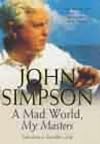
Author of A Mad World, My Masters: Tales from a Traveller's Life
For other authors named John Simpson, see the disambiguation page.
About the Author
John Simpson is widely regarded as one of our foremost commentators. Now, after almost forty years of groundbreaking journalism, he turns his piercing eye for a story to his own profession, revealing what really happened behind the headlines and asking some searching questions of his own industry.
Series
Works by John Simpson
Associated Works
The Art of Fact: A Historical Anthology of Literary Journalism (1997) — Contributor — 225 copies, 1 review
Tagged
Common Knowledge
- Legal name
- Fidler-Simpson, John Cody
- Birthdate
- 1944-08-09
- Gender
- male
- Education
- St Paul's School, London, UK
University of Cambridge (Magdalene College) - Occupations
- journalist
- Organizations
- British Broadcasting Corporation
Roehampton University
Granta
Garrick Club (member) - Awards and honors
- Commander of the Order of the British Empire
International Emmy Award
BAFTA Award
Ischia International Journalism Award
Bayeux Prize
Golden Nymph (show all 7)
Peabody Award - Relationships
- Diane Jean Petteys (1965-1995)
Adele Kruger (1996-present) - Nationality
- UK
Ireland - Birthplace
- Cleveleys, Lancashire
Members
Reviews
Some people just aren't cut out for the suburbs. As one of the BBC's top foreign correspondents, John Simpson has been at the epicentre of many of the world's flashpoints for more than 30 years. Afghanistan, Belgrade, Hong Kong, Baghdad; you name it, he's been there. And what's more, he hasn't just met the great and the good, such as Clinton and Blair, he's met the top bogey men, too. He's had Osama Bin Laden pleading with some Afghani guerrillas to kill him and his crew, he's interviewed show more Emperor Bokassa, Colonel Gadhafi and Arkan and had close up dealings with Saddam Hussein. And it goes without saying he was one of the first people in the entire world to see in the new millennium on the specially named Millennium Island, which the Kiribati government claimed just squeezed inside the international date line.
Small wonder, then, that Simpson is a source of dozens of good stories. Many of these have been written up elsewhere in his autobiographical Strange Places, Questionable People, but there are plenty left over for this latest book in which Simpson eschews chronology and just sticks to some plain old-fashioned story telling, with sections on villains, spies, icons etc. Unsurprisingly, Simpson has a journalistic eye for detail and nuance and never holds back from telling you the things you want to know; so when he went to interview Bokassa, he managed to sneak a look inside his giant deep freeze to see if there were any human body parts. It sounds trivial but it isn't; in a strange sort of way the examination of the contents of a deep freeze can be every bit as revealing as an hour on a shrink's couch.
Simpson is a genial companion, not much given to introspection, and the book races seamlessly from anecdote to anecdote. And yet underpinning the narrative is Simpson's global malaise, a feeling that everywhere in the world is becoming more and more similar and that it's increasingly hard to find anywhere genuinely wild and remote. Simpson has been to many of those places, but the way he describes them makes them seem fairly similar in their own kind of way. McDonalds and the Gap may be thin on the ground, but there are bullets and danger aplenty. To have been to so many of these places is an achievement in itself; to have returned unscathed is a minor miracle; John Simpson has led a charmed life in more ways than one. --John Crace
The best-selling second volume of autobiography, updated with a new chapter.
There are only a handful of places left on this earth where you can't buy a McDonald's hamburger or stay in a Holiday Inn - and John Simpson has been to them all. This hugely successful volume of writing is a celebration of some of the world's wilder places. His extraordinary experiences include stories about a television camera that killed people, about how Colonel Gadhaffi farted his way through an interview and how he - Simpson - mooned the Queen. show less
Small wonder, then, that Simpson is a source of dozens of good stories. Many of these have been written up elsewhere in his autobiographical Strange Places, Questionable People, but there are plenty left over for this latest book in which Simpson eschews chronology and just sticks to some plain old-fashioned story telling, with sections on villains, spies, icons etc. Unsurprisingly, Simpson has a journalistic eye for detail and nuance and never holds back from telling you the things you want to know; so when he went to interview Bokassa, he managed to sneak a look inside his giant deep freeze to see if there were any human body parts. It sounds trivial but it isn't; in a strange sort of way the examination of the contents of a deep freeze can be every bit as revealing as an hour on a shrink's couch.
Simpson is a genial companion, not much given to introspection, and the book races seamlessly from anecdote to anecdote. And yet underpinning the narrative is Simpson's global malaise, a feeling that everywhere in the world is becoming more and more similar and that it's increasingly hard to find anywhere genuinely wild and remote. Simpson has been to many of those places, but the way he describes them makes them seem fairly similar in their own kind of way. McDonalds and the Gap may be thin on the ground, but there are bullets and danger aplenty. To have been to so many of these places is an achievement in itself; to have returned unscathed is a minor miracle; John Simpson has led a charmed life in more ways than one. --John Crace
The best-selling second volume of autobiography, updated with a new chapter.
There are only a handful of places left on this earth where you can't buy a McDonald's hamburger or stay in a Holiday Inn - and John Simpson has been to them all. This hugely successful volume of writing is a celebration of some of the world's wilder places. His extraordinary experiences include stories about a television camera that killed people, about how Colonel Gadhaffi farted his way through an interview and how he - Simpson - mooned the Queen. show less
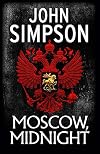
I was very disappointed with this novel. I have admired John Simpson as one of the BBC’s leading foreign news correspondents for many years, so my expectations were all for a well written topical thriller, bristling with acute insights. Somehow, despite an intriguing opening, it never quite came to fruition.
Veteran journalist Jon Swift is called to attend the scene of death of Patrick Macready, a prominent backbench Conservative MPO who appears to have succumbed to a misjudged attempt at show more autoeroticism. Swift is shocked as Macready had been one of his closest friends. The circumstances of the death appal him, seeming entirely at odds with the man whom he knew. Shortly after the death, Swift comes into possession of Macready’s iPad, which contains details of certain investigations he had been following. Swift becomes increasingly convinced that the bizarre death was actually a murder, arranged to stop Macready’s research while publicly discrediting him.
So far, so good, but a potentially strong plot scenario was smothered by unexpectedly turgid writing. Swift himself is a particularly unpleasant character, and the book might have been more enjoyable if it had been him who was found dead at the beginning. Given that he was the narrator, it would all have been over a lot more quickly, too. show less
Veteran journalist Jon Swift is called to attend the scene of death of Patrick Macready, a prominent backbench Conservative MPO who appears to have succumbed to a misjudged attempt at show more autoeroticism. Swift is shocked as Macready had been one of his closest friends. The circumstances of the death appal him, seeming entirely at odds with the man whom he knew. Shortly after the death, Swift comes into possession of Macready’s iPad, which contains details of certain investigations he had been following. Swift becomes increasingly convinced that the bizarre death was actually a murder, arranged to stop Macready’s research while publicly discrediting him.
So far, so good, but a potentially strong plot scenario was smothered by unexpectedly turgid writing. Swift himself is a particularly unpleasant character, and the book might have been more enjoyable if it had been him who was found dead at the beginning. Given that he was the narrator, it would all have been over a lot more quickly, too. show less
The plot here is nothing new - our hero journalist does not believe the official report of his friend’s death and determines to find the truth. This leads him to dirty dealings in Russia and lots of conspiracy, double-dealing and jeopardy.
The book is strongly plotted, well-written and drives with enough force to pull the reader in and make you want to turn just one more page.
The real strength of the book come from its provenance. The author, John Simpson, is a senior member of the BBC News show more organisation and is very well known to many readers. The hero, Jon Swift, is clearly modelled on himself - the physical description matches Simpson exactly and he has a similar background in international news and television reporting. The book is narrated by Jon Swift and the voice is very clearly that of Simpson, in fact, reading the book it is difficult not to hear the whole thing in your head as a report by Simpson on the Ten O’Clock News.
This is an excellent example of how writing what you know brings believability and truth to the story. This reds like it could be reportage rather than fiction. show less
The book is strongly plotted, well-written and drives with enough force to pull the reader in and make you want to turn just one more page.
The real strength of the book come from its provenance. The author, John Simpson, is a senior member of the BBC News show more organisation and is very well known to many readers. The hero, Jon Swift, is clearly modelled on himself - the physical description matches Simpson exactly and he has a similar background in international news and television reporting. The book is narrated by Jon Swift and the voice is very clearly that of Simpson, in fact, reading the book it is difficult not to hear the whole thing in your head as a report by Simpson on the Ten O’Clock News.
This is an excellent example of how writing what you know brings believability and truth to the story. This reds like it could be reportage rather than fiction. show less
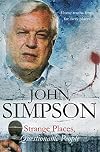
This book runs up to 1997 and descrIbes the great TV reporter, John Simpson's "adventures" in search of new stories from his start at the BBC IN 1966. I have already read the next volume in Simpson's memoirs and I really enjoyed it, but I think this book is at a higher level. At the core of the book is Simpson's relationship, very difficult at times, with the BBC and the latter's relationships with governments, including that of the UK. It is amazing how in the 18 years since this book was show more written so little has changed. The Conservative Party remains highly suspicious of the BBC and, this time, seems bold enough to do something about it, guided by the Murdoch press and the dreadful Daily Mail. Simpson stresses throughout this book his apolitical position, but because he seeks the truth out of every situation, this makes him and many of his colleagues, unpopular with politicians, to many of whom, truth is a difficult concept to grasp. What differentiates Simpson from many of his contemporaries is that he is clearly a writer as well as a broadcaster who puts himself "in harm's way" to improve our understanding of the way the world works. In doing so he often makes us very angry; often makes us cry; and often makes us laugh. This is a very enjoyable read as well as being very informative. show less
You May Also Like


Associated Authors
Statistics
- Works
- 24
- Also by
- 4
- Members
- 1,648
- Popularity
- #15,585
- Rating
- 3.6
- Reviews
- 9
- ISBNs
- 242
- Languages
- 3
- Favorited
- 3