
Christopher Lee (1) (1941–2021)
Author of 1603: The Death of Queen Elizabeth I, the Return of the Black Plague, the Rise of Shakespeare, Piracy, Witchcraft, and the Birth of the Stuart Era
For other authors named Christopher Lee, see the disambiguation page.
Series
Works by Christopher Lee
1603: The Death of Queen Elizabeth I, the Return of the Black Plague, the Rise of Shakespeare, Piracy, Witchcraft, and the Birth of the Stuart Era (2003) 276 copies, 4 reviews
This Sceptred Isle 55 BC-1901: From the Roman Invasion to the Death of Queen Victoria (1997) 229 copies, 3 reviews
This Sceptred Isle 1327-1547 v3: The Black Prince to Henry VIII (BBC Radio Collection) (1998) 10 copies
This Sceptred Isle 55BC-1087: Julius Caesar to William the Conqueror, v1 (BBC Radio Collection) (1998) 9 copies, 1 review
This Sceptred Isle: Elizabeth I to Cromwell 1547-1660 v.4: Elizabeth I to Cromwell 1547-1660 Vol 4 (BBC Radio Collection) (1996) 8 copies
This Sceptred Isle: The Twentieth Century v.3: The Twentieth Century Vol 3 (BBC Radio Collection) (1999) 5 copies
This Sceptred Isle: The Dynasties: Britain's Most Powerful Families v.4 (BBC Radio Collection) (2002) 4 copies
This Sceptred Isle: The Twentieth Century v.5: The Twentieth Century Vol 5 (BBC Radio Collection) (1999) 4 copies
This Sceptred Isle: The First British Empire 1702-1760 v.6: The First British Empire 1702-1760 Vol 6 (BBC Radio Collection) (1998) 3 copies
Associated Works
Tagged
Common Knowledge
- Legal name
- Lee, Christopher Robin James
- Birthdate
- 1941-10-13
- Date of death
- 2021-02-14
- Gender
- male
- Education
- Dartford Technical High School, Wilmington, Kent
Wool witch Poly
Goldsmiths College, University of London - Occupations
- historian
broadcaster
writer - Organizations
- Emmanuel College, Cambridge University (Quatercentenary fellow in Contemporary History)
Birkbeck College, University of London
BBC - Awards and honors
- Reserve Forces Decoration
- Short biography
- Christopher Lee is a British writer, historian and broadcaster, best known for writing the radio documentary series This Sceptred Isle for the BBC read by the late Anna Massey and directed by Pete Atkin.
Lee's career began after expulsion from school and running away to sea in an old tramp steamer built for the duration of WWII. In his Twenties he re-started education reading history at London University. He later joined the BBC as a defence and foreign affairs correspondent and was posted to Moscow and the Middle East. Leaving his career in journalism for academia, Lee was the first Quatercentenary Fellow in Contemporary History and Gomes Lecturer in Emmanuel College, Cambridge. He went on to research the history of ideas at Birkbeck College in the University of London.
Lee is the originator and writer of the BBC Radio 4 trilogy This Sceptred Isle, which recounts the history of Britain from the Romans to the death of Queen Victoria, the 20th century and the British Empire.
His recent books include the three accompanying volumes of This Sceptred Isle. In 2003 was published 1603, the history of the death of Elizabeth I and the arrival of the Stuarts. In 2005, Nelson and Napoleon described the events that led to the Battle of Trafalgar and also in the same year he published the autobiographic Eight Bells and Top Masts the story of his time as a deck boy and his circumnavigation of the globe and the Bath Detective thriller trilogy.
In 2006, he gave a "Platform" talk on history writing and teaching at the National Theatre as a prelude to Alan Bennett's play The History Boys and a new stage play set in the London of 1912. His study of the British monarchy and its future was published in spring 2014 and his book on Royal Ceremony and Regalia is to be published early 2015. He is currently writing an authorised biography of Lord Carrington and the history of the Viceroys of India with illustrations by his wife, the royal portrait and landscape painter Fiona Graham-Mackay He is also the writer of more than 100 Radio 4 plays and series including, The House for Timothy West, Julian Glover and Isla Blair, Colvil & Soames for Christopher Benjamin and Amanda Redman, Our Brave Boys for Martin Jarvis and Fiona Shaw and the Los Angeles production of his The Trial of Walter Ralegh which Rosalind Ayres produced with Michael York in the title role. His play, "A Pattern in Shrouds" was broadcast on Radio 4 in the summer of 2009 and deals with the consequences of the assassination of the Queen's uncle, Lord Mountbatten in 1979. In 2013 the BBC ran his play Air Force One that questioned the events during the 90 minutes between the assassination of President Kennedy and swearing in of Lyndon B Johnson aboard the presidential plane. In December 2014 Lee was commissioned as the Climate Change Analyst and policy director of the Fort Foundation examination of Climate Change and Global Warming data in preparation for the 2015 Paris Conference. Through the Fort Foundation he was linked also as an observer to Climate Change work initiated by projects made possible by the work of a team lead by HSH Prince Albert II of Monaco. Lee's direct interest in the global tapestry is the migration of masses due to global warming and the secuity consequences.Throughthe Fort Foundation, Lee is working on a new handbook of the universe.
His next major project is the constitutional future of the British Royal Family
When not in London, Christopher Lee moves between Florence and his house in Sussex or sailing his old East Coast sloop from the River Beaulieu in southern England skippered by his wife, Fiona (see above)the artist-in-residence for the Beaulieu Estate.
http://en.wikipedia.org/wiki/Christop... - Cause of death
- COVID-19
- Nationality
- UK
- Birthplace
- Dartford, Kent, England, UK
- Places of residence
- Sussex, England, UK
London, England, UK
Florence, Tuscany, Italy - Place of death
- Sussex, England (at home)
- Associated Place (for map)
- England, UK
Members
Reviews
1603: The Death of Queen Elizabeth I, the Return of the Black Plague, the Rise of Shakespeare, Piracy, Witchcraft, and the Birth of the Stuart Era by Christopher Lee
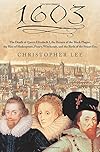
The author, Christopher Lee, presents a convincing argument that the year 1603 should be considered an important turning point in English history. With the passing of Queen Elizabeth I, the last of the Tudors, and the crowning of James VI of Scotland as James I of England and the beginning of the Stuart monarchy, the year 1603 represented the dawning of an eventual clash of ideas. James I will cling to an increasingly discredited belief in the Divine Right of Kings while the growing show more influence of Puritanism within Parliament begins to lead to an inevitable clash that will manifest itself in the coming decades.
Besides the differences in ruling philosophies, Christopher Lee describes the devastation on London's population of the Plague, rampant in 1603, and efforts to combat it; James' fascination with witch trials, and his efforts to avoid war with Spain by withdrawing Elizabeth's Sea Dogs from the oceans (which, along with some contrived rumors, falsehoods, and failed overseas adventures), will cost one of her favorite Sea Dogs his head.
The English people had a deep respect for the Monarchy, as Lee points out, but not necessarily the Monarch. And as James I's reign draws to an end, he is deeply despised and England is rife with dissent among those who would strive for power.
An insightful book and a compelling argument for the year 1603. show less
Besides the differences in ruling philosophies, Christopher Lee describes the devastation on London's population of the Plague, rampant in 1603, and efforts to combat it; James' fascination with witch trials, and his efforts to avoid war with Spain by withdrawing Elizabeth's Sea Dogs from the oceans (which, along with some contrived rumors, falsehoods, and failed overseas adventures), will cost one of her favorite Sea Dogs his head.
The English people had a deep respect for the Monarchy, as Lee points out, but not necessarily the Monarch. And as James I's reign draws to an end, he is deeply despised and England is rife with dissent among those who would strive for power.
An insightful book and a compelling argument for the year 1603. show less
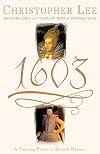
Lee has chosen to take 1603 as a great turning point in British history, akin to 1066. There is no argument that the death of Elizabeth I and the accession of James I and VI, bringing England and Scotland under one monarch, did entail a change for Great Britain - most obviously civil war and eventual unification.
Although Lee has written an interesting book, it is a little choppy in places, and 1603 doesn't seem to provide enough material in itself, there being no great focus, such as the show more battle of Hastings is for 1066.
There are plenty of extracts from original documents included. It is very interesting to see these in the original English they were written in, although the number of extracts does at times make it heavy going and perhaps not for the casual reader. show less
Although Lee has written an interesting book, it is a little choppy in places, and 1603 doesn't seem to provide enough material in itself, there being no great focus, such as the show more battle of Hastings is for 1066.
There are plenty of extracts from original documents included. It is very interesting to see these in the original English they were written in, although the number of extracts does at times make it heavy going and perhaps not for the casual reader. show less

I did not mean to read this book just yet – I am working through one of Simon Schama’s tomes – but I opened it to see if I would like the author’s “voice”. The following afternoon I finished and shelved the book.
Within just a few paragraphs I was excitedly telling my wife, “This book is my story too! I could have written it myself”. Well, perhaps, but not as well as Christopher Lee. As his story developed it drew away from my own similar experience, in the same time and on show more the same shores and seas. Lee had just the one trip – abruptly terminated in a Singapore hospital with acute appendicitis. He was flown home, and went to University, launching a new ‘trip’ as a career journalist and becoming the foreign affairs correspondent for the BBC. My own sea-going continued a further seven years, as Christopher Lee became a history professor and author.
This story is the authors description of his fist, and it was to transpire, only, trip on ”deep sea” articles aboard a ‘Tramp’ – one of that once huge fleet of wandering traders whose time was fast approaching an end, with giant ‘Container’ ships already looming above the blue horizons. It is built around his scribbled notes in school text-books, his memories and crafted with creative humour.
As a Kentish lad Lee worked the Thames barges around the estuaries and coastal towns in which we both grew up … Whitstable, Sheerness and up to the London docks. He joins the Merchant Navy to go ‘deep sea’ and in joining his first ship, he describes crossing the Thames to the docks on a ferry filled with early morning Stevedores. On reading this I recalled those dreich morning crossings with those darkly flat-capped Dockies with their wet ‘Old Holbourn’ fag ends, hacking out the smokers early-morning chorus of hawks and gasps! His words vividly brought back the weight and roughness of a kit-bag on the shoulder, and the excited but dreading anticipation of both ship and trip.
The author crafts a great tale, deeply involves the reader from the first page and leaves a void when the book is closed.
Even if you never hankered to run away to sea you should enjoy this well told tale of ocean wandering and, of course, of a young lad maturing. show less
Within just a few paragraphs I was excitedly telling my wife, “This book is my story too! I could have written it myself”. Well, perhaps, but not as well as Christopher Lee. As his story developed it drew away from my own similar experience, in the same time and on show more the same shores and seas. Lee had just the one trip – abruptly terminated in a Singapore hospital with acute appendicitis. He was flown home, and went to University, launching a new ‘trip’ as a career journalist and becoming the foreign affairs correspondent for the BBC. My own sea-going continued a further seven years, as Christopher Lee became a history professor and author.
This story is the authors description of his fist, and it was to transpire, only, trip on ”deep sea” articles aboard a ‘Tramp’ – one of that once huge fleet of wandering traders whose time was fast approaching an end, with giant ‘Container’ ships already looming above the blue horizons. It is built around his scribbled notes in school text-books, his memories and crafted with creative humour.
As a Kentish lad Lee worked the Thames barges around the estuaries and coastal towns in which we both grew up … Whitstable, Sheerness and up to the London docks. He joins the Merchant Navy to go ‘deep sea’ and in joining his first ship, he describes crossing the Thames to the docks on a ferry filled with early morning Stevedores. On reading this I recalled those dreich morning crossings with those darkly flat-capped Dockies with their wet ‘Old Holbourn’ fag ends, hacking out the smokers early-morning chorus of hawks and gasps! His words vividly brought back the weight and roughness of a kit-bag on the shoulder, and the excited but dreading anticipation of both ship and trip.
The author crafts a great tale, deeply involves the reader from the first page and leaves a void when the book is closed.
Even if you never hankered to run away to sea you should enjoy this well told tale of ocean wandering and, of course, of a young lad maturing. show less
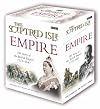
a series of 90 short radio programmes about the history of the British Empire, narrated by Juliet Stevenson with additional voice work by Christopher Ecclestone, Anna Massey, Jack Davenport, and others, a sequel to the earlier This Sceptred Isle which dealt with the history of Britain in the same way.
I was a bit underwhelmed, to be honest. I suspect that the subject is too big to treat in this way; I had picked it up in the first place to listen to the bits about Ireland, which for the show more earlier period were fairly decent, but rather tailed off towards the end (Irish history apparently stopped in 1916), and the other ex-colonies I've dealt with professionally (Cyprus, Somaliland) were barely mentioned. The focus of the narrative was generally, though not always, on the effect that the colonies and colonised had on the British rather than the other way round. I was particularly frustrated by the sections about Warren Hastings, which lionised him as an innocent hero without making it terribly clear why he was anything more than a venal administrator set up by rivals in office politics who played hardball. Macaulay was much clearer (if more long-winded), but I missed really any Indian account of whether Hastings was any good.
There are also serious limitations to the straight narrative-with-actors style. Probably if I'd been listening to it at a rate of one instalment every day or so, rather than in bursts of several at a time, it might not have irritated me as much. But I've now started the more recent and excellent History Of The World In 100 Objects, and I'm stunned by how dull the format of Scepterd Isle is, in comparison. It would hardly have killed the producers to include, like, music, or even original sound tracks in the later period when they become available.
So, all in all, not really recommended listening. show less
I was a bit underwhelmed, to be honest. I suspect that the subject is too big to treat in this way; I had picked it up in the first place to listen to the bits about Ireland, which for the show more earlier period were fairly decent, but rather tailed off towards the end (Irish history apparently stopped in 1916), and the other ex-colonies I've dealt with professionally (Cyprus, Somaliland) were barely mentioned. The focus of the narrative was generally, though not always, on the effect that the colonies and colonised had on the British rather than the other way round. I was particularly frustrated by the sections about Warren Hastings, which lionised him as an innocent hero without making it terribly clear why he was anything more than a venal administrator set up by rivals in office politics who played hardball. Macaulay was much clearer (if more long-winded), but I missed really any Indian account of whether Hastings was any good.
There are also serious limitations to the straight narrative-with-actors style. Probably if I'd been listening to it at a rate of one instalment every day or so, rather than in bursts of several at a time, it might not have irritated me as much. But I've now started the more recent and excellent History Of The World In 100 Objects, and I'm stunned by how dull the format of Scepterd Isle is, in comparison. It would hardly have killed the producers to include, like, music, or even original sound tracks in the later period when they become available.
So, all in all, not really recommended listening. show less
Lists
You May Also Like


Associated Authors
Statistics
- Works
- 46
- Also by
- 1
- Members
- 1,018
- Popularity
- #25,308
- Rating
- 3.7
- Reviews
- 18
- ISBNs
- 171
- Languages
- 3

