
Christopher Knight (1) (1950–)
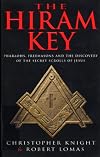
Author of The Hiram Key: Pharaohs, Freemasons and the Discovery of the Secret Scrolls of Jesus
For other authors named Christopher Knight, see the disambiguation page.
About the Author
Christopher Knight is the co-author of The Hiram Key, Uriel's Machine, Civilization One, Who Built The Moon? and many more. He is the chairman of an international technology innovations company.
Series
Works by Christopher Knight
The Hiram Key: Pharaohs, Freemasons and the Discovery of the Secret Scrolls of Jesus (1996) 1,242 copies, 16 reviews
The Book of Hiram: Freemasonry, Venus, and the Secret Key to the Life of Jesus (2003) 327 copies, 2 reviews
Associated Works
Tagged
Common Knowledge
- Canonical name
- Knight, Christopher
- Birthdate
- 1950
- Gender
- male
- Relationships
- Lomas, Robert (co-author)
- Short biography
- Christopher Knight invested seven years conducting research into the origins of Freemasonic rituals. His first book, The Hiram Key (1996), co-authored with Robert Lomas, became an instant bestseller and has since been translated into 37 languages selling over a million copies worldwide. Alan Butler, an engineer, but fascinated by history, also became an expert in astrology and astronomy. He has researched ancient cultures, pagan beliefs and comparative religion and has published four successful books the Knights Templar and the Grail legend. They are co-authors of the best selling Civilization One.
- Nationality
- UK
- Associated Place (for map)
- UK
Members
Reviews
The Hiram Key: Pharoahs,Freemasons and the Discovery of the Secret Scrolls of Christ by Christopher Knight
I loved this book. I have no idea whether anything that the authors claim is true or even accurately researched, but it reads well and the ideas are largely plausible. I'm certain that Dan Brown derived a lot of his material from this book. But most essentially it is a gripping yarn.
I also have a soft spot for this book as I was reading it in conjunction with Umberto Eco's Foucault's Pendulum, which is not only an extremely concise and informative text on the Abrahamic cults, sects and show more religious orders since time immemorial but also the greatest piss-take thereof. So yes, I would recommend Hiram Key, but do yourself a favour, and if you have the patience, and read Foucault's Pendulum. show less
I also have a soft spot for this book as I was reading it in conjunction with Umberto Eco's Foucault's Pendulum, which is not only an extremely concise and informative text on the Abrahamic cults, sects and show more religious orders since time immemorial but also the greatest piss-take thereof. So yes, I would recommend Hiram Key, but do yourself a favour, and if you have the patience, and read Foucault's Pendulum. show less

This book has been the source of some heat, if little light, among students of esoteric history.
The scholarship in The Hiram Key is not profound, and it compares poorly with other books that treat similar themes and topics, such as Robertson's Born in Blood or Assmann's Moses the Egyptian. It is certainly wide-ranging, and seems to incorporate a dozen other recent theories on the Shroud of Turin, Templar survival in Scotland, Egyptian elements in Hebrew religion, lost Christian scriptures, show more and Masonic origins.
The picture of Gnosticism presented by Knight and Lomax is a caricature. Their theories of Egyptian origins for Masonry are in many cases laughable, such as using the ancient Egyptian doctrine of Ma'at (denoting both physical/architectural and metaphysical/moral order) as proof that the central metaphors of Masonry must descend directly from Egypt.
Perhaps the most novel and interesting material in the book concerns the authors' readings of Hebrew scripture, and their theories of Hebrew custody of "the Sequenere resurrection ritual." Fortunately for serious students who may become impatient with the irritating journalistic style of the book, each chapter has a single-page "Conclusion" which can substitute as a summary for the chapter as a whole. I recommend reading the "Conclusions," and only going back to the actual details of the chapter for those that strike a personal interest.
The authors state in their first chapter that they "are very aware that the information which [they] give here may be considered by some Masons a betrayal of those secrets" which they have sworn to conceal. In fact, they give very detailed accounts of the Craft ceremonies as they received them in English lodges. We are expected to forgive them these willful exposures and violations of their oaths for two reasons:
1. "The United Grand Lodge of England considers only the means of recognition to be the protected secrets of the Order." (So much the worse for the United Grand Lodge of England! Masonry benefits from a stricter reading of the obligation of secrecy, where initiates acquire and demonstrate the discipline of confidentiality.)
2. The authors took their obligations on the condition that "they would not interfere with [their] freedom as moral, civil or religious agents," and they claim that to maintain secrecy on the matters discussed in the book would violate that condition.
Having read the book, I can find nothing in it which would create a moral, civil, or religious imperative for ritual exposure. The action agenda to which the authors' thesis builds, is to excavate under Rosslyn Chapel in search of early Christian MSS. The real imperative for the authors must surely have been the prospect of making some money off of a book to be sold to the general public. That being so, I recommend that Masons interested in the book check it out of a public library or buy a used copy, in order to avoid contributing to the royalty stream for the authors. show less
The scholarship in The Hiram Key is not profound, and it compares poorly with other books that treat similar themes and topics, such as Robertson's Born in Blood or Assmann's Moses the Egyptian. It is certainly wide-ranging, and seems to incorporate a dozen other recent theories on the Shroud of Turin, Templar survival in Scotland, Egyptian elements in Hebrew religion, lost Christian scriptures, show more and Masonic origins.
The picture of Gnosticism presented by Knight and Lomax is a caricature. Their theories of Egyptian origins for Masonry are in many cases laughable, such as using the ancient Egyptian doctrine of Ma'at (denoting both physical/architectural and metaphysical/moral order) as proof that the central metaphors of Masonry must descend directly from Egypt.
Perhaps the most novel and interesting material in the book concerns the authors' readings of Hebrew scripture, and their theories of Hebrew custody of "the Sequenere resurrection ritual." Fortunately for serious students who may become impatient with the irritating journalistic style of the book, each chapter has a single-page "Conclusion" which can substitute as a summary for the chapter as a whole. I recommend reading the "Conclusions," and only going back to the actual details of the chapter for those that strike a personal interest.
The authors state in their first chapter that they "are very aware that the information which [they] give here may be considered by some Masons a betrayal of those secrets" which they have sworn to conceal. In fact, they give very detailed accounts of the Craft ceremonies as they received them in English lodges. We are expected to forgive them these willful exposures and violations of their oaths for two reasons:
1. "The United Grand Lodge of England considers only the means of recognition to be the protected secrets of the Order." (So much the worse for the United Grand Lodge of England! Masonry benefits from a stricter reading of the obligation of secrecy, where initiates acquire and demonstrate the discipline of confidentiality.)
2. The authors took their obligations on the condition that "they would not interfere with [their] freedom as moral, civil or religious agents," and they claim that to maintain secrecy on the matters discussed in the book would violate that condition.
Having read the book, I can find nothing in it which would create a moral, civil, or religious imperative for ritual exposure. The action agenda to which the authors' thesis builds, is to excavate under Rosslyn Chapel in search of early Christian MSS. The real imperative for the authors must surely have been the prospect of making some money off of a book to be sold to the general public. That being so, I recommend that Masons interested in the book check it out of a public library or buy a used copy, in order to avoid contributing to the royalty stream for the authors. show less

If you are a fan of Dan Brown-style conspiracy theories; if you think there is a secret society that holds the forbidden secrets of ‘real history;’ or if you enjoy a rollicking good trip around the looney bin, then you will love this book. If you are interested in actual history—be it the history of Christianity, the Church, the Templars, the Freemasons, or pretty much anything else—don’t even bother with this book (or anything else by its author, come to think of it). After all, show more if some historian actually DID prove that history isn’t like we always thought, historians everywhere would be scrambling for a piece of that pie. Who doesn’t want to the be actual academic that blows the lid off of a historical mystery? It’s the same principle by which if things like acupuncture really worked, acupuncturists would be richer than MDs. Of course, the author of this book would counter that the ‘establishment’ is trying to suppress the truth for….well, reasons. They’re not really clear on the advantage of this monumental cover up, but it must be a doozie, to have kept it all secret this long, right?
The author, Christopher Knight, together with Robert Lomas, Michael Baigent, and a small handful of loosely related armchair historians have all contributed to this field of pseudo-history. The essential narrative is that Freemasonry has its origins not in the bored upper classes of Victorian England, but in the mystical initiations of ancient Egyptian priests. This magical knowledge was so powerful that it was hidden in coded allegories and mysterious rituals, and eventually its true meaning was lost over time to all but a tiny, persecuted few, who jealously guarded their secret knowledge. From there, you can really improvise at will; toss in a wife and child for Christ, make Jesus a Freemason, whatever suits your fancy. In this book, it’s an unidentified Egyptian mummy that provides the missing link between the long-lost mysteries of the ancients and the opaque rituals of Freemasonry. But don’t stop there; you more or less have to get the Templars involved somehow, and bonus points if you can work in the Priory of Scion, the Cathars, Rosslyn Chapel, the Dead Sea Scrolls, some highly improbable astronomy, or time-traveling space aliens.
OK, maybe that’s a little hyperbolic; I don’t think there are actually time traveling space aliens in *this* book, but the rest are there. But Christopher Knight IS known for his claim that humans from the future traveled back in time to build the moon. (I am not making this up; click here if you doubt me!) And really, that’s all you need to know about this “history.” (I gave it three stars for entertainment value!) show less
The author, Christopher Knight, together with Robert Lomas, Michael Baigent, and a small handful of loosely related armchair historians have all contributed to this field of pseudo-history. The essential narrative is that Freemasonry has its origins not in the bored upper classes of Victorian England, but in the mystical initiations of ancient Egyptian priests. This magical knowledge was so powerful that it was hidden in coded allegories and mysterious rituals, and eventually its true meaning was lost over time to all but a tiny, persecuted few, who jealously guarded their secret knowledge. From there, you can really improvise at will; toss in a wife and child for Christ, make Jesus a Freemason, whatever suits your fancy. In this book, it’s an unidentified Egyptian mummy that provides the missing link between the long-lost mysteries of the ancients and the opaque rituals of Freemasonry. But don’t stop there; you more or less have to get the Templars involved somehow, and bonus points if you can work in the Priory of Scion, the Cathars, Rosslyn Chapel, the Dead Sea Scrolls, some highly improbable astronomy, or time-traveling space aliens.
OK, maybe that’s a little hyperbolic; I don’t think there are actually time traveling space aliens in *this* book, but the rest are there. But Christopher Knight IS known for his claim that humans from the future traveled back in time to build the moon. (I am not making this up; click here if you doubt me!) And really, that’s all you need to know about this “history.” (I gave it three stars for entertainment value!) show less
The Hiram Key - Pharaohs, Freemasons And The Discovery Of The Secret Scrolls Of Jesus by Christopher Knight
I love ideas that involve thinking outside the box. Ergo, I have a soft spot for alternative history, especially that involving religion, secret societies, and events beyond the canon of history we are taught in school.
Therefore, I found this book to be an interesting and plausible account of the history and origins of Freemasonry. However, there is very little in the way of serious scholarship here -- no citing of sources, no bibliography, and some of the leaps they take and the connections show more they make are giant steps indeed.
So, the book is entertaining, plausible as far as it goes, but unless some further discovery is made, still extremely speculative. show less
Therefore, I found this book to be an interesting and plausible account of the history and origins of Freemasonry. However, there is very little in the way of serious scholarship here -- no citing of sources, no bibliography, and some of the leaps they take and the connections show more they make are giant steps indeed.
So, the book is entertaining, plausible as far as it goes, but unless some further discovery is made, still extremely speculative. show less
You May Also Like


Associated Authors
Statistics
- Works
- 11
- Also by
- 1
- Members
- 3,022
- Popularity
- #8,452
- Rating
- 3.2
- Reviews
- 34
- ISBNs
- 130
- Languages
- 11
- Favorited
- 4