
John Carey (1) (1934–2025)
Author of Eyewitness to History
For other authors named John Carey, see the disambiguation page.
About the Author
John Carey is Merton Professor of English at Oxford University. A distinguished critic, reviewer, & broadcaster, he is the author of several books, including "The Intellectuals & the Masses". (Bowker Author Biography)
Image credit: Photograph: David Levenson/Getty Images
Works by John Carey
Associated Works
Vanity Fair (1877) — Editor, some editions; Introduction, some editions — 16,356 copies, 201 reviews
The Pleasure of Reading: 43 Writers on the Discovery of Reading and the Books That Inspired Them (2015) — Contributor — 103 copies, 2 reviews
The Cambridge Companion to Apocalyptic Literature (Cambridge Companions to Religion) (2020) — Contributor — 26 copies
Tagged
Common Knowledge
- Birthdate
- 1934-04-05
- Date of death
- 2025-12-11
- Gender
- male
- Education
- University of Oxford (St. John's College)
Richmond and East Sheen Boys’ Grammar School - Occupations
- professor (Emeritus Merton Professor of English Literature ∙ St. John's College ∙ Oxford ∙ 1975-2001)
literary critic - Nationality
- UK
- Birthplace
- Barnes, London, England, UK
- Places of residence
- London, England, UK
- Map Location
- UK
Members
Reviews

It seems an odd idea to get an English professor to edit an anthology of science writing, but it actually works rather well. Carey obviously has an eye for pieces that are sufficiently self-explanatory to be accessible to non-professional readers, but he also succeeds rather well at finding texts that show us scientists actually doing science, reasoning from observations and testing hypotheses experimentally.
Of course we get all the “big moments” — Galileo, Newton, Mendeleev, Darwin, show more Mme Curie, Einstein and so on — and we get pieces by most of the well-known “popularisers” (Gould, Dawkins, Feynman, etc.) but he also picks out some less obvious moments of discovery, and salts the mixture of science writing by scientists with a few teasing bits of science from poets and novelists. We probably know about Steinbeck’s marine biology and Nabokov’s butterflies, but what about George Orwell on toads, or Ted Hughes on cosmology?
Fittingly, the book finishes with Asimov’s chilling piece about the limits of world population, written half a century ago and truer (and scarier) than ever.
It’s a great book for anyone to dip into and will probably send you off down a few rabbit holes that are new to you, whatever your background, but I should think it would also be a very good choice if you need something to give to a non-scientific friend to help them understand what science is really about (besides wearing white coats and destroying the world, of course…). show less
Of course we get all the “big moments” — Galileo, Newton, Mendeleev, Darwin, show more Mme Curie, Einstein and so on — and we get pieces by most of the well-known “popularisers” (Gould, Dawkins, Feynman, etc.) but he also picks out some less obvious moments of discovery, and salts the mixture of science writing by scientists with a few teasing bits of science from poets and novelists. We probably know about Steinbeck’s marine biology and Nabokov’s butterflies, but what about George Orwell on toads, or Ted Hughes on cosmology?
Fittingly, the book finishes with Asimov’s chilling piece about the limits of world population, written half a century ago and truer (and scarier) than ever.
It’s a great book for anyone to dip into and will probably send you off down a few rabbit holes that are new to you, whatever your background, but I should think it would also be a very good choice if you need something to give to a non-scientific friend to help them understand what science is really about (besides wearing white coats and destroying the world, of course…). show less

In one of his last books, John Carey has a lot of fun taking us through the history of Western poetry from Gilgamesh to Les Murray in under 300 pages. Poets are grouped by periods and styles in short chapters, each headed with a charming linocut by Nick Morley (the Maya Angelou on the front cover is one of these). Carey briefly and discretely fills us in on the lives of the poets and their historical context, and gives us a feel for what and how they wrote and why it matters. Where it makes show more sense to do so, he lets their words speak for themselves; elsewhere he gives us a few helpful pointers to what we should be looking for. He doesn’t mind knocking down idols here and there, either: about Dante we are told that “of all world-famous poets none is less likely to appeal to the modern reader“.
It is quite an Oxford-centric selection, as you might expect: Carey tells us about all the great British and American poets, together with those poets from elsewhere who influenced English poetry and whom a non-specialist would be expected to have heard of. German poetry comprises Goethe, Heine and Rilke; French runs all the way from Baudelaire to Mallarmé. Chinese and Japanese poetry is introduced only through the translations of Arthur Waley, and the Middle-East gets Hafez (who ingeniously gets to share a chapter with the Gawain poet and Langland). You’ve got to stop somewhere in a book this size, and that seems like a reasonable cut-off. show less
It is quite an Oxford-centric selection, as you might expect: Carey tells us about all the great British and American poets, together with those poets from elsewhere who influenced English poetry and whom a non-specialist would be expected to have heard of. German poetry comprises Goethe, Heine and Rilke; French runs all the way from Baudelaire to Mallarmé. Chinese and Japanese poetry is introduced only through the translations of Arthur Waley, and the Middle-East gets Hafez (who ingeniously gets to share a chapter with the Gawain poet and Langland). You’ve got to stop somewhere in a book this size, and that seems like a reasonable cut-off. show less
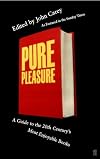
I acquired this book through a recommendation that I have subsequently forgotten, but am thankful for nonetheless. John Carey, whose fine book The Intellectuals and the Masses (St. Martin's 1993) I read some years ago, has prepared a guide to the "most enjoyable books" of the twentieth century. While tastes may differ I find I have already read almost half of the books he lists and of those there is only one that I remember not enjoying. Based on that evidence and the books I have enjoyed by show more writers for whom he includes different titles than those I have read, I must conclude that he truly has included at least some of the most enjoyable books of the century just past. He notes with apologies his methodology precluded more than one title per author in order to avoid a few authors taking up the whole list. He also consciously avoided "masterpieces" for less well-known works. The advantage for the reader being the inclusion of Mann's great picaresque novel Confessions of Felix Krull Confidence Man instead of The Magic Mountain or Buddenbrooks, or the listing of Decline and Fall, Waugh's great comic first novel instead of Brideshead Revisited. He thoughtfully includes both poetry and works in translation on this list to ensure the enjoyment of readers is not limited to novels written in english. This guide will provide me one more reason to never be without a good, and enjoyable, book. show less
Mixed feelings, in a positive vein. Carey takes us through a series of brief chapters, starting with the antique poets such as Homer and the Beowulf poet and then gearing up through the 18th, 19th and 20th centuries especially.
First of all, I think Carey makes it clear quite early on that this is a personal history, and a focus on a particular throughline of poetry, namely the Anglo-American sphere as inspired by the older Europeans. This is quite clear and indeed obvious; if you're going to show more broaden out to world poetry, you're going to have a very different book that becomes partly ethnographic since it can't possibly chart the growth of every movement. I say this because quite a few reviews here seem to be complaining about that fact and, frankly, I think they're being performative. As an Australian, I could equally bemoan that our rich poetic history isn't given its due here, but that's not the point of the book, and there are plenty of others on this subject. So perhaps a bit less with the deliberate complaining in lieu of actual commentary.
The core challenge with a book like this, though, is that it's inevitably a taste-tester. These chapters are so very brief that they cannot do justice to any of the poets contained herein. For the earlier chapters and those focusing on longer works, Carey gives us very little (even sometimes nothing) in the way of excerpts, meaning we're just being given his brief overview and an exhortation to read the works. Which is clearly his aim, so it's not a failure, but I think the volume would have benefited from attaching a single full poem to as many of the chapters as possible. The brevity of the chapters means that it isn't for complete novices to the written arts, but equally there's not much in the way of revelatory commentary for those of us who enjoy many of these works. And perhaps that's fine. Perhaps this book will reach its core audience - those who have dabbled in, or are genuinely open to, the reading of poetry - and provide them with dozens of points on which they can jump and begin new journeys. (The later chapters I found most pleasing, as the splintering of the poetic voice in the years around WWII makes for more challenging reading that rewards us hearing as many viewpoints on them as possible.)
A lovely volume in its way, but not one of the better broader overviews of poetry out there. show less
First of all, I think Carey makes it clear quite early on that this is a personal history, and a focus on a particular throughline of poetry, namely the Anglo-American sphere as inspired by the older Europeans. This is quite clear and indeed obvious; if you're going to show more broaden out to world poetry, you're going to have a very different book that becomes partly ethnographic since it can't possibly chart the growth of every movement. I say this because quite a few reviews here seem to be complaining about that fact and, frankly, I think they're being performative. As an Australian, I could equally bemoan that our rich poetic history isn't given its due here, but that's not the point of the book, and there are plenty of others on this subject. So perhaps a bit less with the deliberate complaining in lieu of actual commentary.
The core challenge with a book like this, though, is that it's inevitably a taste-tester. These chapters are so very brief that they cannot do justice to any of the poets contained herein. For the earlier chapters and those focusing on longer works, Carey gives us very little (even sometimes nothing) in the way of excerpts, meaning we're just being given his brief overview and an exhortation to read the works. Which is clearly his aim, so it's not a failure, but I think the volume would have benefited from attaching a single full poem to as many of the chapters as possible. The brevity of the chapters means that it isn't for complete novices to the written arts, but equally there's not much in the way of revelatory commentary for those of us who enjoy many of these works. And perhaps that's fine. Perhaps this book will reach its core audience - those who have dabbled in, or are genuinely open to, the reading of poetry - and provide them with dozens of points on which they can jump and begin new journeys. (The later chapters I found most pleasing, as the splintering of the poetic voice in the years around WWII makes for more challenging reading that rewards us hearing as many viewpoints on them as possible.)
A lovely volume in its way, but not one of the better broader overviews of poetry out there. show less
Lists
Awards


You May Also Like


Associated Authors
Statistics
- Works
- 27
- Also by
- 10
- Members
- 3,774
- Popularity
- #6,715
- Rating
- 3.8
- Reviews
- 41
- ISBNs
- 154
- Languages
- 6
- Favorited
- 2
