

Roy Campbell (1) (1901–1957)
Author of "Life Is a Dream" and Other Spanish Classics (Eric Bentley's Dramatic Repertoire Volume Two)
For other authors named Roy Campbell, see the disambiguation page.
About the Author
Image credit: the formalist.org
Works by Roy Campbell
"Life Is a Dream" and Other Spanish Classics (Eric Bentley's Dramatic Repertoire Volume Two) (1985) — Translator — 93 copies, 1 review
Roy Campbell, Selected Poems 5 copies
Associated Works
American Aphrodite: A Quarterly for the Fancy-Free (Volume 3, Number 9) (2013) — Contributor — 2 copies
Tagged
Common Knowledge
- Legal name
- Campbell, Ignatius Roy Dunnachie
- Other names
- Campbell, Royston Dunnachie (birth name)
- Birthdate
- 1901-10-02
- Date of death
- 1957-04-22
- Gender
- male
- Education
- Durban High School
Natal University College, Durban
University of Oxford (Merton College) - Occupations
- poet
translator
editor
bullfighter
horse breeder
British Army (1942-44) (show all 7)
reporter - Organizations
- British Army (1942-44)
- Awards and honors
- Royal Society of Literature (Fellow)
Honorary D.Litt., University of Natal, Durban (1957) - Relationships
- Kirk, Russell (friend)
Thomas, Dylan (friend)
Regnery, Henry (friend)
John, Augustus (friend)
Plomer, William (friend)
Van der Post, Laurens (friend) (show all 7)
Lewis, Wyndham (friend) - Nationality
- South Africa
- Birthplace
- Durban, South Africa
- Places of residence
- Provence, France
Toledo, Spain
London, England, UK
Aberdaron, Wales, UK - Place of death
- Setubal, Portugal
Members
Discussions
OT: Roy Campbell in Folio Society Devotees (June 2025)
Reviews

Campbell lead a rollicking life. Self-opinionated and not one to ever follow the crowd when it came to beliefs, he was the true adventurer. This being his autobiography from his birth in Durban in 1901 up to 1938, he does not shy from all the details that show him in that light. (Light on a Dark Horse is an apt title for these memoirs.)
He could hunt, fish, was a show horseman, soldier, an outspoken opponent of racial discrimination in South Africa, and as his experience in Toledo during the show more Spanish Civil War shows, a very brave man, alongside his solid and lasting reputation as a poet, translator, satirist.
This autobiography is a pleasure to read because his literary talent is on display. The truth of some of the narratives may sometimes be over-burnished, but as another review suggests, reading one of the two biographies about him may help iron out details that portray Campbell in too an heroic pose.
Recommended. show less
He could hunt, fish, was a show horseman, soldier, an outspoken opponent of racial discrimination in South Africa, and as his experience in Toledo during the show more Spanish Civil War shows, a very brave man, alongside his solid and lasting reputation as a poet, translator, satirist.
This autobiography is a pleasure to read because his literary talent is on display. The truth of some of the narratives may sometimes be over-burnished, but as another review suggests, reading one of the two biographies about him may help iron out details that portray Campbell in too an heroic pose.
Recommended. show less
There have been two biographies of Roy Cambell- by [Joseph Pearce] and [Peter Alexander] but this is Campbell's autobiography covering the period from the year of his birth in 1901 until 1935 and his involvement in the Spanish Civil War in Toledo when he hid Carmelite monks and later had to deal with the aftermath of their arrest. He is telling the story of his life his way and its a rambling, raconteur type of book in which characters are dropped in as part of memory, though the spine is show more more or less loosely chronological. Campbell has strong opinions about people and presents himself as the rather loud, romantic boasting hero of every situation. I enjoyed the reminiscences about his childhood in Durban as this was my husband's home town and his parents were the contemporaries of Campbell. Holidays in early Rhodesia and his description of the Matopos are lyrically related. Campbell presents himself as a linguist , interpreter and paternalist in the world of the African. The He left South Africa in 1918 as a young man to study at Oxford (clearly not a successful project, though that was not his account). He returned to South Africa but the sojourn was a literary disaster. His life was more exciting in France, Spain, Portugal and England. He enjoyed strong friendships with artist (Augustus John painted his portrait)and writers but also developed lasting emnities. He was bombastic, prejudiced and self opinionated. His poetry though was inspiring. Read "Horses of the Camargue" if you want to capture his enduring poetry.
If you have ever travelled in Spain and been touched by the horror of the history of the Spanish Civil War and the deep wounds left, Campbell is a writer and poet to read and understand. He was a contraversial figure in his lifetime because he slated the ways and values of the Bloomsbury Group ( his wife Mary had an affair with Vita Sackville West with Virginia Woolf being the ousted lover). He also became a supporter of Franco and was almost alone among his literary and political contemporaries in taking us such a fascist position. He became a Roman Catholic and endured much in Toledo. He was a romantic - something of an Ernest Hemingway type of African figure. His wartime exploits in the second world war show him to have been a fearless and brave man. He drank (too heavily) with Dylan Thomas ( the dust wrapper carries a promotional blurb by Thomas)- and alcoholism and disabling injury to a hip aged him prematurely. He claims a friendship with George Orwell and he was definitely friends with Laurie Lee. It is Lee who has written the sympathetic foreword in this 1969 edition of the Campbell autobiography ( the first edition came out in 1951 before Campbell's death in a car crash in 1957 at the relatively young age of 56. He's reputation is that of the most important South African poet of the 20th century. The autobiography is a pleasurable read , but should not be read as gospel truth. It shows that Campbell could write prose as well as poetry and it deserves to remain in print as a work of Anglo-African 20th century life and interesting time. To form a more balanced picture the autobiography should be read together with the Alexander biography. show less
If you have ever travelled in Spain and been touched by the horror of the history of the Spanish Civil War and the deep wounds left, Campbell is a writer and poet to read and understand. He was a contraversial figure in his lifetime because he slated the ways and values of the Bloomsbury Group ( his wife Mary had an affair with Vita Sackville West with Virginia Woolf being the ousted lover). He also became a supporter of Franco and was almost alone among his literary and political contemporaries in taking us such a fascist position. He became a Roman Catholic and endured much in Toledo. He was a romantic - something of an Ernest Hemingway type of African figure. His wartime exploits in the second world war show him to have been a fearless and brave man. He drank (too heavily) with Dylan Thomas ( the dust wrapper carries a promotional blurb by Thomas)- and alcoholism and disabling injury to a hip aged him prematurely. He claims a friendship with George Orwell and he was definitely friends with Laurie Lee. It is Lee who has written the sympathetic foreword in this 1969 edition of the Campbell autobiography ( the first edition came out in 1951 before Campbell's death in a car crash in 1957 at the relatively young age of 56. He's reputation is that of the most important South African poet of the 20th century. The autobiography is a pleasurable read , but should not be read as gospel truth. It shows that Campbell could write prose as well as poetry and it deserves to remain in print as a work of Anglo-African 20th century life and interesting time. To form a more balanced picture the autobiography should be read together with the Alexander biography. show less
"Life Is a Dream" and Other Spanish Classics (Eric Bentley's Dramatic Repertoire Volume Two) by Eric Bentley
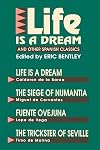
This is a collection of four Golden Age Spanish drama, ranging from 1585 to 1630 as translated by Roy Campbell, and, to my mind, varying widely in quality.
The Siege of Numantia by Miguel de Cervantes of Don Quixote fame is the first play in the book. Cervantes was a contemporary of Shakespeare and this play dates from just a few years before Shakespeare's earliest plays. According to the Wiki, it "has been hailed by many as a rare specimen of Spanish tragedy and even as the best Spanish show more tragedy not only from the period before Lope de Vega, but of all its literature." All I can say, if this is the best tragedy in Spanish literature, then I'll pass on reading more. Cervantes is no Shakespeare when it comes to drama, unless we're going to compare this to Titus Andronicus. I found it both tedious and overwrought, a great candidate for a spoof. There are long dramatic monologues from "Spain," a river, "War," "Pestilence" and "Hunger" and I thought the climax ridiculous. Admittedly, this is an old play and I've never seen it dramatized--that can make a difference, as can the translation. But that's true of all the plays here, all with the same translator, and I liked the middle two plays and loved the last play that gives the collection its title.
Fuente Ovejuna by Lope de Vega is by one of the most famed Spanish playwrights, and fared better in my estimation. It still seemed a bit over the top to me, though I rather appreciated a play from so early in the 17th century dealing with a peasant revolt against a tyrant. Even if it's a bit disconcerting in the end to have a torturer presented as an instrument of justice. It features some strong female characters too. This wasn't as fun as the third play, or as charming and thought-provoking as the last play, but I didn't finish feeling this was over an hour of my life I wanted back.
The Trickster of Seville by Tirso de Molina was a fun read on the page and I would love to see it on the stage. The Notes in the back call it a "great document of European civilization" given it "marks the entrance into literature of Don Juan." I've never read Byron's famous poem, but this play certainly reminded me a lot of the treatment in Mozart's Don Giovanni which obviously owes a dept to Molina.
Life is a Dream by Calderon de la Barca is the most celebrated play in the Spanish language--and it's the prize in this book in my opinion--the play in this book that to my mind could undoubtedly rank with Shakespeare. It's a great play--really unique for it's metaphysical dimensions. And it too features a strong female character. It left me smiling. I'd love to see this on film or stage. This book is rated as high as it is because of this play (and as low as it is because of Cervantes.) show less
The Siege of Numantia by Miguel de Cervantes of Don Quixote fame is the first play in the book. Cervantes was a contemporary of Shakespeare and this play dates from just a few years before Shakespeare's earliest plays. According to the Wiki, it "has been hailed by many as a rare specimen of Spanish tragedy and even as the best Spanish show more tragedy not only from the period before Lope de Vega, but of all its literature." All I can say, if this is the best tragedy in Spanish literature, then I'll pass on reading more. Cervantes is no Shakespeare when it comes to drama, unless we're going to compare this to Titus Andronicus. I found it both tedious and overwrought, a great candidate for a spoof. There are long dramatic monologues from "Spain," a river, "War," "Pestilence" and "Hunger" and I thought the climax ridiculous. Admittedly, this is an old play and I've never seen it dramatized--that can make a difference, as can the translation. But that's true of all the plays here, all with the same translator, and I liked the middle two plays and loved the last play that gives the collection its title.
Fuente Ovejuna by Lope de Vega is by one of the most famed Spanish playwrights, and fared better in my estimation. It still seemed a bit over the top to me, though I rather appreciated a play from so early in the 17th century dealing with a peasant revolt against a tyrant. Even if it's a bit disconcerting in the end to have a torturer presented as an instrument of justice. It features some strong female characters too. This wasn't as fun as the third play, or as charming and thought-provoking as the last play, but I didn't finish feeling this was over an hour of my life I wanted back.
The Trickster of Seville by Tirso de Molina was a fun read on the page and I would love to see it on the stage. The Notes in the back call it a "great document of European civilization" given it "marks the entrance into literature of Don Juan." I've never read Byron's famous poem, but this play certainly reminded me a lot of the treatment in Mozart's Don Giovanni which obviously owes a dept to Molina.
Life is a Dream by Calderon de la Barca is the most celebrated play in the Spanish language--and it's the prize in this book in my opinion--the play in this book that to my mind could undoubtedly rank with Shakespeare. It's a great play--really unique for it's metaphysical dimensions. And it too features a strong female character. It left me smiling. I'd love to see this on film or stage. This book is rated as high as it is because of this play (and as low as it is because of Cervantes.) show less
Lists
You May Also Like


Associated Authors
Statistics
- Works
- 36
- Also by
- 11
- Members
- 321
- Popularity
- #73,714
- Rating
- 4.1
- Reviews
- 3
- ISBNs
- 37
- Favorited
- 2
