

Peter Wright (1) (1916–1995)
Author of Spy Catcher: The Candid Autobiography of a Senior Intelligence Officer
For other authors named Peter Wright, see the disambiguation page.
Works by Peter Wright
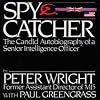
Spy Catcher: The Candid Autobiography of a Senior Intelligence Officer (1987) 1,904 copies, 19 reviews
Tagged
Common Knowledge
- Legal name
- Wright, Peter Maurice
- Birthdate
- 1916-08-09
- Date of death
- 1995-04-27
- Gender
- male
- Education
- Bishop's Stortford College
- Occupations
- intelligence officer
- Organizations
- MI5
- Nationality
- Australia
England (birth) - Birthplace
- Chesterfield, Derbyshire, England, UK
- Place of death
- Cygnet, Tasmania, Australia
Members
Reviews

I would really call this much more of a memoir than an autobiography, despite the subtitle, as Wright here deals almost entirely with his professional life as a member, and eventually assistant director, of MI5, the British counterespionage agency, from World War 2 through the late 1970s. For the non-British citizens (like me) in the room, Wright explains MI5 as being roughly the British equivalent of the FBI and MI6 as being the equivalent of the CIA. Wright was a true believer that the show more struggle against the significant espionage efforts of the Soviet Union was a crucial mission. And he is also adamant in this memoir that MI5 in many very important ways were doing this job very badly. For one thing, both MI5 and MI6 were run as clubby old boys' clubs, with upper class "gentlemen" bringing their chums on board without any proper vetting at all, despite the fact it was well known that there had been a significant disenchantment with the British class system and capitalism in general among these very upperclass clubmen in the 1930s. The result was a series of postwar defections and also a cadre of British spies working for the Soviet Union within the British intelligence agencies. The subsequent refusal of those in charge to, in many cases, prosecute their old club pals and/or risk further public scandal causes Wright no end of teeth gnashing. Wright speaks with scorn of what he calls the continued British "delusions of Empire" within government and intelligence circles that caused them to refuse to accept the fact that postwar Britain was no longer a first level world power and and had in fact become a junior partner to the United States. Wright came to his intelligence work through his scientific background, hired to help develop new technologies in spying microphones and radio interception techniques for counterintelligence. He spent his career in trying to root out Soviet spies within the British government, both the traitorous British moles and the Russian spies in place within and without the Russian diplomatic corps. He describes effectively and in great detail his frustrations over his inability to convince his colleagues that a mole remained inside MI5 even into the 70s. In fact, Wright thought he could prove that it was his boss, Sir Roger Hollis, the director of MI5, who had been passing information to the Soviets for decades, allowing the Soviets to thwart all sorts of British espionage efforts over the years. Wright reports that the British dug what they thought was a secret tunnel under the Berlin Wall, only to find upon the tunnel's completion that the Soviets had been tipped off from within the British government about the project from its inception.
Wright's writing is clear and easy to read, though the book may suffer from an overabundance of details. I found it interesting to read about all the spies and counterspies, the inter- and intra-agency jealousies and feuds that created additional impediments and disfunction, the casual willingness to spy on everyone and everything, including allies (MI5 had every embassy in England bugged, and many on the continent as well, and Wright is both matter of fact and unapologetic about it all), but also the technological successes and brainpower that occasionally allowed them to crack Soviet and Eastern Bloc encrypted communications to their operatives in England and sometimes even catch spies. Looked at from the perspective of hindsight, however (Spy Catcher was published in 1987 when memories of the era were still fresh), one has to wonder what it was all for, and whether anything of substance, on either side, was really accomplished. I recall reading a comment several years ago made by a former CIA official (I have no memory of the name of this person) that the whole Cold War espionage campaign was simply, in the end, a colossal waste of time for both camps. Who knows?
Reading Spy Catcher was fun, though, as I mentioned above, you do have to wade through a lot of detail. show less
Wright's writing is clear and easy to read, though the book may suffer from an overabundance of details. I found it interesting to read about all the spies and counterspies, the inter- and intra-agency jealousies and feuds that created additional impediments and disfunction, the casual willingness to spy on everyone and everything, including allies (MI5 had every embassy in England bugged, and many on the continent as well, and Wright is both matter of fact and unapologetic about it all), but also the technological successes and brainpower that occasionally allowed them to crack Soviet and Eastern Bloc encrypted communications to their operatives in England and sometimes even catch spies. Looked at from the perspective of hindsight, however (Spy Catcher was published in 1987 when memories of the era were still fresh), one has to wonder what it was all for, and whether anything of substance, on either side, was really accomplished. I recall reading a comment several years ago made by a former CIA official (I have no memory of the name of this person) that the whole Cold War espionage campaign was simply, in the end, a colossal waste of time for both camps. Who knows?
Reading Spy Catcher was fun, though, as I mentioned above, you do have to wade through a lot of detail. show less
I devoured this one in two days. I thought espionage movies are interesting, but was blown away by how much more intrigue, deceit, and flashy gadgets there are in the true stories!
Peter Wright was recruited into MI5 following World War II as their first staff scientist. He began in signals technology, designing new methods for detecting and decrypting soviet signals. A rising star, he quickly moved on to counterintelligence, where he spends the remainder of his career trying to ferret out show more moles in the system. Despite the ultimate futility of his work--every time he finds a mole, evidence of more arises--and what it means for the effectiveness of his organization, Wright passionately pursues his work, though near the end he admits to feeling like he is surrounded by enemies.
The characters in Wright's memoir are larger than life, as spies in the movies never are. There's Pete Harvey, a volatile, alcoholic CIA agent who wears cowboy boots and calls Wright a limey bastard. Anthony Blunt, cultured intellectual with a history for passionate love affairs with fellow spies (mostly men) who lives in quiet luxury after confessing to large scale espionage (Britian has a habit of granting moles immunity if they confess). And Jim Angleton, whose passion for his work and belief that the great game can be won leaves him looking more emaciated each time Wright sees him.
The sheer volume and stature of the moles Wright finds, some of whom are department directors, left me with the initial impression that the entire business of espionage, especially counterespionage, is futile and self defeating. Not only is it impossible to have a large number of people keep a secret, but the work itself damages the people who do it. Few can be in the business of deception and distrust without eventually becoming paranoid, deceitful, or misanthropic.
On the other hand, wiretaps and double agents were the weapons of the Cold War. Though it was, as Wright put it, just a great game, it's a far less destructive way to fight a war than with bombs and guns. show less
Peter Wright was recruited into MI5 following World War II as their first staff scientist. He began in signals technology, designing new methods for detecting and decrypting soviet signals. A rising star, he quickly moved on to counterintelligence, where he spends the remainder of his career trying to ferret out show more moles in the system. Despite the ultimate futility of his work--every time he finds a mole, evidence of more arises--and what it means for the effectiveness of his organization, Wright passionately pursues his work, though near the end he admits to feeling like he is surrounded by enemies.
The characters in Wright's memoir are larger than life, as spies in the movies never are. There's Pete Harvey, a volatile, alcoholic CIA agent who wears cowboy boots and calls Wright a limey bastard. Anthony Blunt, cultured intellectual with a history for passionate love affairs with fellow spies (mostly men) who lives in quiet luxury after confessing to large scale espionage (Britian has a habit of granting moles immunity if they confess). And Jim Angleton, whose passion for his work and belief that the great game can be won leaves him looking more emaciated each time Wright sees him.
The sheer volume and stature of the moles Wright finds, some of whom are department directors, left me with the initial impression that the entire business of espionage, especially counterespionage, is futile and self defeating. Not only is it impossible to have a large number of people keep a secret, but the work itself damages the people who do it. Few can be in the business of deception and distrust without eventually becoming paranoid, deceitful, or misanthropic.
On the other hand, wiretaps and double agents were the weapons of the Cold War. Though it was, as Wright put it, just a great game, it's a far less destructive way to fight a war than with bombs and guns. show less

As the subtitle indicates, this is "the candid autobiography of a senior intelligence officer" with Britain's MI5, the domestic intelligence service. My edition, a mass market paperback, is covered with plenty of laudatory quotes. The Financial Post believed that "Margaret Thatcher was quite right in trying to ban the book," while The New York Times said that "anyone with a taste for cloak-and-dagger mysteries should find Spycatcher a compelling read." I can't speak to the accuracy of the show more statement re Mrs Thatcher, but I will partly agree with the quote about cloak-and-dagger mysteries. Indeed, some parts, particularly in the early days when Wright chronicles the major surveillance operations he was involved in, are fascinating in the same way as a le Carré novel. (Given that le Carré himself worked as an intelligence officer around that time, this is not entirely surprising.)
Those who have read Christopher Andrew's Defence of the Realm may have a slight edge in knowing the major players and events in this book, which is definitely a more personal perspective than Andrew's book. Spycatcher is also a bit dated of course, given that it was published in 1987 (or rather my edition was). I think the book overall was pretty good, but for me personally my interest waned in the events once the 1970s rolled around. This also happened with Andrew's book so it's not necessarily Wright's fault that I find WW2 and the Kim Philby affair much more interesting.
If you plan to read this, beware of copious typographical errors in this edition. Also the chapters don't have any internal section breaks, so some can be tougher slogs than others. But overall I would say the content is good and worth a read if you're interested (at least the first half). show less
Those who have read Christopher Andrew's Defence of the Realm may have a slight edge in knowing the major players and events in this book, which is definitely a more personal perspective than Andrew's book. Spycatcher is also a bit dated of course, given that it was published in 1987 (or rather my edition was). I think the book overall was pretty good, but for me personally my interest waned in the events once the 1970s rolled around. This also happened with Andrew's book so it's not necessarily Wright's fault that I find WW2 and the Kim Philby affair much more interesting.
If you plan to read this, beware of copious typographical errors in this edition. Also the chapters don't have any internal section breaks, so some can be tougher slogs than others. But overall I would say the content is good and worth a read if you're interested (at least the first half). show less
Not a writer of genius, but the book is quite interesting. I wonder how much of the material covered is still state of the art, and I expect that very little of it is. There's quite a gap, one would hope, between escapist literature on this topic and the actual tradecraft of the current operations. But with Edward Snowdon throwing out great heaps of sensitive information, the future's probably full of changes for our invisible grey eminences. By writing this review, have I added to my file? show more Does anyone care? I'd like to be fully informed, but I'm afraid of knowing too much. A normal human, I think. show less
Lists
Awards

You May Also Like


Associated Authors
Statistics
- Works
- 2
- Members
- 1,930
- Popularity
- #13,342
- Rating
- 3.6
- Reviews
- 19
- ISBNs
- 148
- Languages
- 11