
Phillip Knightley (1929–2016)
Author of The First Casualty: The War Correspondent as Hero, Propagandist, and Myth Maker
About the Author
Phillip Knightley was an award-winning investigative journalist with the Sunday Times for twenty years
Works by Phillip Knightley
The First Casualty: The War Correspondent as Hero, Propagandist, and Myth Maker (1975) — Author — 486 copies, 5 reviews
The Second Oldest Profession: Spies and Spying in the Twentieth Century (1986) 210 copies, 2 reviews
Associated Works
My Silent War: The Autobiography of a Spy (1968) — Introduction, some editions — 393 copies, 12 reviews
The Philby Files: The Secret Life of Master Spy Kim Philby (1994) — Editor, some editions — 70 copies, 1 review
Tagged
Common Knowledge
- Legal name
- Knightley, Philip George
- Birthdate
- 1929-01-23
- Date of death
- 2016-12-07
- Gender
- male
- Occupations
- journalist
professor - Organizations
- University of Lincoln
- Nationality
- Australia
- Birthplace
- Sydney, New South Wales, Australia
- Place of death
- London, England, UK
- Associated Place (for map)
- Australia
Members
Reviews

This is one of the most shocking stories I’ve ever read. This biography shows how Philby went on to destroy British Intelligence as a governmental agency by the time he finally defected to the Soviet Union in 1963. The journalist author Knightly presents Philby very sympathetically. The book opens with Knightly interviewing Philby with almost complete deference. As the book progresses, Knightly becomes only slightly dubious as he realizes Philby is not being completely honest in his show more answers. By the book’s conclusion Knightly offers some mild criticisms as he lays out Philby’s rationale, not for treason, but for holding to his Communist belief system. Knightly says, “…treachery is an elastic concept and in Philby’s case has more to do with betrayal of his class interests than with betrayal of country.” (p. 262) Knightly goes on to say this his deception was necessary for his political beliefs. Aside from the uncritical assessment of Philby, Knightly has written an important book on the political context for Philby’s machinations. Knightly absolves Philby for being “a political animal,” albeit an abnormal one. This is an evasive judgment but one the author feels qualified to make. I as a reader do not accept it.
Philby’s conversation with Knightly often came to touch on his betrayal of agents who lost their lives. In specific cases Philby never accepts blame nor responsibility for them. Speaking generally he often times says that shedding blood for a political ideal was a virtue of sorts, something to be admired (p. 263). In the majority of the instances he falls back upon parallels with soldiers of war. This is a favorite of tactic of spies. They fancy themselves warriors of a different battlefield. Actually they are not. The Geneva Conventions make clear that only soldiers fall under its protections. Spies do not. For example, in 1944 Philby was said to have passed the names of German Catholic opposition leaders to his controller who had them all shot. The Albanian infiltrators (1951) were betrayed by Philby and he wondered why he was considered bloodthirsty when others were likewise ready “to contemplate bloodshed in the service of a political ideal.” Others may have contemplated it, but Philby carried it out. This is a not so subtle distinction that he was happy to gloss over. Philby said that he felt “very badly about it [betrayal to exceution]” “but then decent soldiers feel badly about the necessity of killing in wartime.” (p. 254) This again is a fallacy since Philby was not a soldier. Philby was involved in the taking of life, but not as a combatant. There is no honor in taking any life but at least the warrior on the battlefield knows that it is Kill! or Be Killed! No one was threatened by Philby but he had them secretly eliminated nonetheless. Essentially, Philby found the moral abyss within himself to place his personal responsibility for his duplicitous behavior. He wreaked violence upon others but not with his own hand. There is a kind of nobility (not glory) in meeting unjust violence with defensive force (basis of just war theory). Philby never claims he was resisting unjust force. He preferred to see himself in the work of supporting Communism (not Socialism) by subverting the Capitalist West. In his attempt to portray himself as outside of ethical condemnation as a Soviet agent, Philby was blind to see that he had been nothing more than foreign mercenary. Sadly for the British, he was the most destructive they had ever seen to be working against them. show less
Philby’s conversation with Knightly often came to touch on his betrayal of agents who lost their lives. In specific cases Philby never accepts blame nor responsibility for them. Speaking generally he often times says that shedding blood for a political ideal was a virtue of sorts, something to be admired (p. 263). In the majority of the instances he falls back upon parallels with soldiers of war. This is a favorite of tactic of spies. They fancy themselves warriors of a different battlefield. Actually they are not. The Geneva Conventions make clear that only soldiers fall under its protections. Spies do not. For example, in 1944 Philby was said to have passed the names of German Catholic opposition leaders to his controller who had them all shot. The Albanian infiltrators (1951) were betrayed by Philby and he wondered why he was considered bloodthirsty when others were likewise ready “to contemplate bloodshed in the service of a political ideal.” Others may have contemplated it, but Philby carried it out. This is a not so subtle distinction that he was happy to gloss over. Philby said that he felt “very badly about it [betrayal to exceution]” “but then decent soldiers feel badly about the necessity of killing in wartime.” (p. 254) This again is a fallacy since Philby was not a soldier. Philby was involved in the taking of life, but not as a combatant. There is no honor in taking any life but at least the warrior on the battlefield knows that it is Kill! or Be Killed! No one was threatened by Philby but he had them secretly eliminated nonetheless. Essentially, Philby found the moral abyss within himself to place his personal responsibility for his duplicitous behavior. He wreaked violence upon others but not with his own hand. There is a kind of nobility (not glory) in meeting unjust violence with defensive force (basis of just war theory). Philby never claims he was resisting unjust force. He preferred to see himself in the work of supporting Communism (not Socialism) by subverting the Capitalist West. In his attempt to portray himself as outside of ethical condemnation as a Soviet agent, Philby was blind to see that he had been nothing more than foreign mercenary. Sadly for the British, he was the most destructive they had ever seen to be working against them. show less
The first casualty: From the Crimea to Vietnam : the war correspondent as hero, propagandist, and myth maker by Phillip Knightley

4738. The First Casualty From the Crimea to Vietnam: The War Correspondent as Hero, Propagandist, and Myth Maker, by Phillip Knightley (read 14 Aug 2010) This is a 1975 book and covers reporting from the war zone in every war from the Crimean to Vietnam. The author, an Australian, finds war correspondents have generally done a poor job in getting facts to people--usually not the correspondent's fault. He states war cirrespondents in Vietnam did a better job than in any of the other wars he show more studies. The author is very critical of correspondents who are more interested in having their side win than in getting facts to the public--and I agree with him except when he expects the correspondent to not be "for" the side the correspondent feels is the right side. For instance, I deplore non-objective reporting in the Spanish Civil War, but can forgive such in World War II. The book covers a lot of ground and does a good job and I found it consistently worth reading--and often telling me startling things I did not know show less
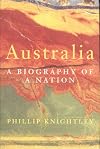
3687. Australia: A Biography of a Nation, by Phillip Knightley (read 27 Jan 2003) This book spends most of its time on Australia after federation in 1901, and I found it of great interest. Chapter 7, entitled "Black Australia", was especially eye-opening for me. I found this a great book, though maybe the author is not too objective, and there are no footnotes nor bibliography. A most worthwhile book, and some chapters are extremely informative and attention-holding.

In the early 1950s, two British intelligence agents defected to the Soviet Union, throwing suspicion on one of Britain's highest-placed intelligence officers, Kim Philby, whom many thought to have warned the defectors of their imminent arrest. But Philby was cleared, and it was not until several years later that he himself defected and the world learned the scope o the greatest disaster and embarrassment in the history of British national intelligence. Philby and the two other agents (Guy show more Burgess and Donald Maclean) had been fellow students at Cambridge and had there been recruited by the Soviets. Though each man was bedeviled by alcoholism, they all three rose to positions of prominence in the intelligence service, and all three cost England and the United States badly in terms of information and the lives of agents. This book, written not long after Philby's defection, was published before the full extent of the double-agent ring was known and the British government further humiliated. But it covers the lives of all three spies most effectively, and the story is richly detailed (despite the difficulties of researching the secret world of intelligence and counter-intelligence). This is a fascinating read. show less
Lists
Awards


You May Also Like


Associated Authors
Statistics
- Works
- 19
- Also by
- 5
- Members
- 1,654
- Popularity
- #15,535
- Rating
- 3.8
- Reviews
- 20
- ISBNs
- 74
- Languages
- 9