
John Taine (1883–1960)
Author of Men of Mathematics
About the Author
Disambiguation Notice:
Eric Temple Bell used his given name for his non-fiction writing; he used the pseudonym John Taine for his works of fiction.
Works by John Taine
The Time Stream, The Greatest Adventure, The Purple Sapphire: Three Science Fiction Novels (1964) 25 copies
Associated Works
The Yith Cycle: Lovecraftian Tales of the Great Race and Time Travel (Call of Cthulhu Fiction) (2010) — Contributor — 33 copies, 1 review
Millemondi Inverno 1992 — Contributor — 1 copy
Tagged
Common Knowledge
- Legal name
- Bell, Eric Temple
- Other names
- Taine, John (pseudonym)
Bell, E. T. - Birthdate
- 1883-02-07
- Date of death
- 1960-12-21
- Gender
- male
- Education
- Stanford University (AB with honors ∙ Mathematics ∙ 1904)
University of Washington (MS|Mathematics|1908)
Columbia University (PhD ∙ Mathematics ∙ 1912) - Occupations
- mathematician
science fiction writer
university professor - Organizations
- University of Washington
California Institute of Technology - Awards and honors
- Bôcher Memorial Prize, 1924
National Academy of Sciences, 1927 - Relationships
- Keyser, Cassius Jackson (doctoral advisor)
- Nationality
- UK
- Birthplace
- Peterhead, Scotland, UK
- Place of death
- Watsonville, California, USA
- Disambiguation notice
- Eric Temple Bell used his given name for his non-fiction writing; he used the pseudonym John Taine for his works of fiction.
- Associated Place (for map)
- UK
Members
Discussions
Ominous Illustrated in Good Show Sir! — bad science fiction and fantasy covers (July 2025)
Reviews
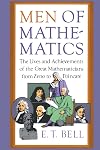
This was the book that piqued my interest in mathematics and the people who does mathematics for a living. Be aware that this book was written in the days when only caucasian western men did mathematics. Asian mathematics weren't considered and women mathematicians were considered to be novelties, not worthy of attention.
This book considered all of the heavy weights in mathematics at the time. From the Greeks onward until those mathematicians considered worthy at the time of Bell's writing. show more Bell's review of their lives are partly general biography, part assessment of their mathematics, and part psychological studies of why they did what they did. Bell is by no means an objective reporter of the facts. He definitely had his favorites and he had his not so favorites, and he was not shy about letting you know. That is partly why this is such a good book. He puts in his opinions of the foibles and genius of each of the men he is writing about and he puts their genius in a pecking order that he himself created. I found it informative and entertaining. Others may find it bothersome, but this is by far the most complete book of its kind for its day. I recommend it to anyone even remotely interested in mathematics and mathematicians. show less
This book considered all of the heavy weights in mathematics at the time. From the Greeks onward until those mathematicians considered worthy at the time of Bell's writing. show more Bell's review of their lives are partly general biography, part assessment of their mathematics, and part psychological studies of why they did what they did. Bell is by no means an objective reporter of the facts. He definitely had his favorites and he had his not so favorites, and he was not shy about letting you know. That is partly why this is such a good book. He puts in his opinions of the foibles and genius of each of the men he is writing about and he puts their genius in a pecking order that he himself created. I found it informative and entertaining. Others may find it bothersome, but this is by far the most complete book of its kind for its day. I recommend it to anyone even remotely interested in mathematics and mathematicians. show less
Don't let the introduction of this book fool you! While the front-matter is enticing and exciting, the rest of the book fails to live up to these expectations. This book manages to make an exciting topic boring and hard to suffer through via a combination of flowery, say-nothing prose and a focus on the people rather than the math.
OK, I get it -- for the most part, readers do want people stories over math, but those are not the people who are going to be reading this book. Know your show more audience, Eric Temple Bell. I would not recommend this book in the slightest.
If you're looking for a book that presents the history of nerdy shit well, treat yourself to "The Making of the Atomic Bomb" and skip over this drivel. show less
OK, I get it -- for the most part, readers do want people stories over math, but those are not the people who are going to be reading this book. Know your show more audience, Eric Temple Bell. I would not recommend this book in the slightest.
If you're looking for a book that presents the history of nerdy shit well, treat yourself to "The Making of the Atomic Bomb" and skip over this drivel. show less
When I was younger, I liked this book a lot. Later, however, it is easy to notice that there are several great mathematicians who are curiously omitted simply because they were female, and that some of the biographies have a few liberties taken with them to be more dramatic. As another reviewer said, this is a product of the times in which it was written. Still, a readable overview of the sometimes overly dramatic lives of the greatest male contributors to mathematics, but by now there are show more many more accurate and complete texts on the history of mathematics. show less

One of the many themes of science fiction is that of the super human ... people who have developed or evolved abilities beyond the norm. These super abilities can be explained by natural causes, intentional augmentation or even accident. Seeds of Life is an early twentieth century examplar of this theme.
The novel concerns the creation of a superior human using radiation. The author uses his knowledge of electronics and the inexorable logic of science to build up steadily mounting horror. show more For Bork, a lab assistant, accidentally discovers a secret of short x-ray waves that can mutate life -- pushing it millions of years ahead or equal millenniums back. He mutates almost overnight into a superman with a mind beyond any of the scientists for whom he had previously worked (it is reminiscent of the Keyes" Flowers for Algernon in this respect). He changes his name and uses his new powers to create amazing technological results, but the same accident also leads to other mutations including an incident where some brown hen eggs revert and what emerges is the common reptile-dinosaur ancestor of birds and mammals. His world becomes even more complicated when his mutations start to wear off and he comes to realize that what he’s set in motion is wrong, but he also can’t stop it.
The plot takes several more twists and turns, but that is not why I enjoyed this novel. Rather it is the imaginative take that it presents of the super human theme. In this it is an excellent early example and compares favorably with the work of later writers including my favorite, A. E. Van Vogt. His novel, Slan, considered a classic of this theme, used the concept of super-beings to explore the themes of racism, prejudice and what it means to be human. Other examples of the use of this theme include Philip Wylie's Gladiator (1930), Olaf Stapledon's Odd John (1935), Theodore Sturgeon's More Than Human (1953) and Frederick Pohl's Man Plus (1976).
The critic Everett F. Bleiler found the opening segment of Seeds of Life to be "fascinating," but that as a whole "it suffers from formal defects, inadequate development at times, superfluity at others, weak characterizations, and problems with tone." Still, he concluded, "the novel is well worth reading for its virtues. And I would agree, particularly in that its' virtues in its consistent pursuit of the super human theme make this a book that holds the science fiction aficionado's interest to this day. show less
The novel concerns the creation of a superior human using radiation. The author uses his knowledge of electronics and the inexorable logic of science to build up steadily mounting horror. show more For Bork, a lab assistant, accidentally discovers a secret of short x-ray waves that can mutate life -- pushing it millions of years ahead or equal millenniums back. He mutates almost overnight into a superman with a mind beyond any of the scientists for whom he had previously worked (it is reminiscent of the Keyes" Flowers for Algernon in this respect). He changes his name and uses his new powers to create amazing technological results, but the same accident also leads to other mutations including an incident where some brown hen eggs revert and what emerges is the common reptile-dinosaur ancestor of birds and mammals. His world becomes even more complicated when his mutations start to wear off and he comes to realize that what he’s set in motion is wrong, but he also can’t stop it.
The plot takes several more twists and turns, but that is not why I enjoyed this novel. Rather it is the imaginative take that it presents of the super human theme. In this it is an excellent early example and compares favorably with the work of later writers including my favorite, A. E. Van Vogt. His novel, Slan, considered a classic of this theme, used the concept of super-beings to explore the themes of racism, prejudice and what it means to be human. Other examples of the use of this theme include Philip Wylie's Gladiator (1930), Olaf Stapledon's Odd John (1935), Theodore Sturgeon's More Than Human (1953) and Frederick Pohl's Man Plus (1976).
The critic Everett F. Bleiler found the opening segment of Seeds of Life to be "fascinating," but that as a whole "it suffers from formal defects, inadequate development at times, superfluity at others, weak characterizations, and problems with tone." Still, he concluded, "the novel is well worth reading for its virtues. And I would agree, particularly in that its' virtues in its consistent pursuit of the super human theme make this a book that holds the science fiction aficionado's interest to this day. show less
Lists
Awards


You May Also Like


Associated Authors
Statistics
- Works
- 37
- Also by
- 10
- Members
- 1,803
- Popularity
- #14,278
- Rating
- 3.6
- Reviews
- 23
- ISBNs
- 64
- Languages
- 3
- Favorited
- 1

