
Richard Rohr
Author of Falling Upward: A Spirituality for the Two Halves of Life
About the Author
Richard Rohr is a globally recognized ecumenical teacher whose work is grounded in Christian mysticism, practices of contemplation and self-emptying, and compassion for the marginalized. He is a Franciscan priest of the New Mexico province and founder of the Center for Action and Contemplation in show more Albuquerque, where he also serves as academic dean of the Living School for Action and Contemplation. Fr. Richard is the author of many books, including the bestsellers Just This, What Do We Do with Evil?, The Universal Christ, and The Wisdom Pattern. show less
Image credit: Richard Rohr. Photo courtesy of Festival of Faiths Louisville.
Series
Works by Richard Rohr
The Universal Christ: How a Forgotten Reality Can Change Everything We See, Hope For, and Believe (2019) 750 copies, 9 reviews
Hope Against Darkness: The Transforming Vision of Saint Francis in an Age of Anxiety (2001) 197 copies, 1 review
Falling Upward, Revised and Updated: A Spirituality for the Two Halves of Life (2023) 84 copies, 2 reviews
Dancing Standing Still: Healing the World from a Place of Prayer; A New Edition of A Lever and a Place to Stand (2014) 60 copies
Perennial Wisdom for the Spiritually Independent: Sacred Teachings―Annotated & Explained (SkyLight Illuminations) (2013) 49 copies, 1 review
Embracing an Alternative Orthodoxy Participant's Workbook: Richard Rohr on the Legacy of St. Francis (2014) 29 copies
Contemplative Prayer 6 copies
Way of the Prophet 3 copies
Discharging Your Loyal Soldier 3 copies
How Men Change 3 copies
Beginner's mind [CD] 2 copies
The Path of Descent 2 copies
Living the eternal now [CD] 2 copies
Der göttliche Tanz: Wie uns ein Leben im Einklang mit dem dreieinigen Gott zutiefst verändern kann. (2017) 2 copies
O Cristo Universal - Como uma realidade esquecida pode mudar tudo o que vemos esperamos e acreditamos (Em Portugues do Brasil) (2019) 2 copies
The Great Themes of Scripture: Old Testament — Author — 2 copies
Embracing an Alternative Orthodoxy - DVD : Richard Rohr on the Legacy of St. Francis (2014) 2 copies
Spiral of Violence 2 copies
The Little Way 2 copies
Men and Grief - Men Matter Series 2 copies
Enneagram - devět tváří duše 1 copy
Božský tanec 1 copy
Richard Rohr on Scripture 1 copy
The Franciscan Opinion 1 copy
Sjelens 9 ansikter 1 copy
Hledání svatého Grálu 1 copy
Everthing Belongs 1 copy
Univerzální Kristus 1 copy
Entranceways (audiobook) 1 copy
The Reign of God 1 copy
Collected Talks on Church 1 copy
Emotional Sobriety 1 copy
Falling Upward Seminar 1 copy
An Interview with Fr. Richard Rohr, O.F.M. on Key Issues of the Charismatic Renewal [article] — Author — 1 copy
What To Do With Evil 1 copy
Levels of Spiritual Growth 1 copy
Exploring the naked now 1 copy
A New Way of Seeing, a New Way of Being: Jesus and Paul (Lead's Us to See God's Reality in a New Way) [2 Audio CDs] (2007) 1 copy
O Cristo Universal 1 copy
Healing Our Violence 1 copy
The Way of Peace 1 copy
Číst Bibli jako Ježíš 1 copy
Mary & Nonviolence 1 copy
Associated Works
The Sacred Enneagram: Finding Your Unique Path to Spiritual Growth (2017) — Foreword — 426 copies, 10 reviews
Homosexuality and Christian Faith: Questions of Conscience for the Churches (1999) — Contributor — 257 copies, 2 reviews
Tagged
Common Knowledge
- Birthdate
- 1943-03-20
- Gender
- male
- Education
- University of Dayton (1970, MA Theology)
- Occupations
- Roman Catholic priest (ordained 1970)
Franciscan friar - Organizations
- Order of Friars Minor
- Nationality
- USA
- Birthplace
- Topeka, Kansas, USA
- Places of residence
- Cincinnati, Ohio, USA
Albuquerque, New Mexico, USA - Associated Place (for map)
- USA
Members
Discussions
'Richard Rohr Reorders the Universe' in Catholic Tradition (February 2020)
Reviews
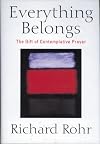
Richard can talk to me anytime he likes. Usually we meet in the early hours before my day picks up steam. When I say we meet, I mean I hold his book in one hand and a pencil in the other as I underline sentences or star particular paragraphs that he clearly wrote just for me.
The only sorrow of picking up a book by Rohr is knowing that it will end and I'll be left on my own until I find/order/borrow another. Of some comfort: his ideas are so fresh that I know I will be struck once more with show more the warmth of the Love of which he speaks. The perspective and understanding shared will make me blink and catch my breath as he invites me, yet again, into contemplation and the Unified Field where everything belongs.
Confession: I still have a spiritual crush on this writer and must admit that I hope I may be transformed into a mystic as his words and teachings soak into my soul. show less
The only sorrow of picking up a book by Rohr is knowing that it will end and I'll be left on my own until I find/order/borrow another. Of some comfort: his ideas are so fresh that I know I will be struck once more with show more the warmth of the Love of which he speaks. The perspective and understanding shared will make me blink and catch my breath as he invites me, yet again, into contemplation and the Unified Field where everything belongs.
Confession: I still have a spiritual crush on this writer and must admit that I hope I may be transformed into a mystic as his words and teachings soak into my soul. show less
Not a man I’ll read any more of, but this one was recommended to me by some friends and none other than my wife so I wasn’t about to refuse them. I’ll get the review of the book done first before I turn to a review of Rohr himself and why I’ll not read anymore of his stuff.
The basic premise in Falling is that life is like a box of chocolates game of two halves. The first half, which we all experience, is spent building the structures that allow us to determine who we are – and by show more ‘we’ he means most of us. We learn, we take on some kind of profession, we start a family, we establish ourselves in the world.
At this point, most of us, according to Rohr, settle for this as being the aim of our existence. But it is not. There is a door to another world, the world of the red pill, the world of reality.
However, as with the red pill, this door is a crisis. Rohr argues cogently that it has to be a crisis because to leave the first half of life is to move on from the security that you have built for yourself and the identity that you have forged and to step out into the unknown.
Rohr is, as I am, a man of faith. However, whereas my faith has been and always will be fixed firmly on the sole purpose of knowing Jesus, I’m sure that Rohr would agree when I say that the aim of his faith is a moving target. Consequently, faith is where the waters get muddied in Falling.
Although Rohr does refer to Biblical characters to illustrate his life of two halves metaphor, it was hard to see if there was any distinction in his mind between what is commonly called conversion and a crisis that forms part of our walk with Jesus after we have first met him. Not least because Jesus’ own life features as one illustration of this, perhaps in some Last Temptation of Christ kind of way.
But, for simplicity’s sake, take the Apostle Paul, for example. On p. 67, Rohr refers to Paul’s conversion as his crisis. He reinforces this idea as he leads up to this description by saying
Spiritually speaking, you will be, you must be, led to the edge of your own private resources. At that point you will stumble over a necessary stumbing stone, as Isaiah calls it…
p. 65
No reference to the book of Isaiah is given, but those familiar with Isaiah chapter 8 will know that the reference is to God himself and, as Paul explains in Romans chapter 9, this is none other than Jesus.
Does he mean that an encounter with Christ is the door between the first and second halves of life? If so, there are two problems with this. Firstly, some encounter Jesus and have their entire world reshaped before they have fashioned their first half. Secondly, others have their world reshaped again long after meeting Jesus. I don’t think I’m a unique example of this.
At the age of 21, when I had a miserably poor grasp on the world or my identity, I had an encounter with the living Christ that changed me literally overnight. It changed me so radically that I woke up the next morning uncertain about leaving the house knowing that everything I had been was gone forever.
But over 20 years later, I found myself at another crisis. Divorce is not an easy thing, and mine was not quick. From the time of my first being aware of the cracks in our marriage and my decree absolute, more than five years rolled by. And they rolled with excuciating slowness; imagine a steam roller moving over your body at one millimetre a week.
I have come out the other side of that into a life I barely recognise internally or externally. I bear almost no resemblance to the person I was prior to it. Now, does my life have three halves or have I confused one of these two crises for what Rohr writes of? Rohr goes to some lengths to clarify what the second half of life looks like, and I recognise discoveries of elements of it through both of my major life crises. Perhaps I’ve strained the metaphor.
Also strained at times are scriptural references. Halfway through, Rohr refers to Paul’s declaration to the Colossian church that our lives are ‘hidden with Christ in God’ (Colossians 3:3). Except that Rohr writes his biblical quotation exactly like this
hidden [with Christ] in God
p. 130
What can he mean by his use of square brackets? Can he mean that “with Christ” is somehow optional? Can he mean that “with Christ” is interchangeable with whatever we choose to place there? Tragically, he never clarifies his seemingly pointed and yet also seemingly frivolous use of punctuation here. It is tragic because Jesus himself claimed that it is of eternal significance (see John 10:9 for just one of many examples).
Glimpses of what Rohr may believe are seen here and there, though.
I quote Jesus because I consider him to be the spiritual authority of the Western world, whether we follow him or not.
p. 81
The additional phrase “of the Western world” is telling, but the “whether we follow him or not” seems confusing to me. You can’t on the one hand consider someone “the spiritual authority” [his emphasis] and then not follow him. But in his use of the inclusive pronoun “we” this is what Rohr seems to be suggesting he is able to do.
There are soundbites here which aren’t fully explained as if their full mystic meaning is perhaps beyond a literal explanation
Every time God forgives us, God is saying that God’s own rules do not matter as much as the relationship that God wants to create with us.
p. 57
But every instance of God’s forgiveness, from Genesis 3 to Revelation 21 is entirely dependent on Him upholding the rules He Himself has established (see Matthew 5:17). In a world where “God’s own rules do not matter” there is no measuring stick against which to gauge his love for us.
In fairness, I should say that the discerning reader is going to find much that is worthwhile here. I’ll remember this for the rest of my days and have resolved to adopt it:
I have prayed for years for one good humilation a day, and then I must watch my reaction to it.
p. 128
Or this
People do not see things as they are; rather, they see things as they are.
p. 148
But then we’re back into the morass again as he selectively quotes Jesus
Listen to his dangerous and inclusionary thinking: … “Don’t pull out the weeds or you might pull out the wheat with it. Let the weeds and the wheat both grow together until the harvest.” (Matthew 13:29-30)
p. 149
He includes the reference Matthew 13:30 but only quotes the first half of the verse. It’s hard not to think he did this because the verse ends in a less “inclusionary” way than he is comfortable with:
At that time I will tell the harvesters: First collect the weeds and tie them in bundles to be burned; then gather the wheat and bring it into my barn.
Matthew 13:30b
For an author whose entire work rests on a metaphor of two halves there’s a certain irony in him quoting only the first half of a verse.
Towards the end of the book he says
God will always give you exactly what you truly want and desire. So make sure you desire, desire deeply, desire yourself, desire God…
p. 160
What kind of earthly fathers always give their children exactly what they truly want and desire? Bad fathers, I’d suggest. That’s not to mention that you can either desire yourself or desire God. But in a quote so powerful that all four Gospel writers record it and Matthrew more than once, Jesus said
Those who try to gain their own life will lose it; but those who lose their life for my sake will gain it.
Matthew 10:39, Matthew 16:25, Mark 8:35, Luke 9:24, John 12:25
Now that to me seems a much more succinct formula for a second half of life worth experiencing. show less
The basic premise in Falling is that life is like a box of chocolates game of two halves. The first half, which we all experience, is spent building the structures that allow us to determine who we are – and by show more ‘we’ he means most of us. We learn, we take on some kind of profession, we start a family, we establish ourselves in the world.
At this point, most of us, according to Rohr, settle for this as being the aim of our existence. But it is not. There is a door to another world, the world of the red pill, the world of reality.
However, as with the red pill, this door is a crisis. Rohr argues cogently that it has to be a crisis because to leave the first half of life is to move on from the security that you have built for yourself and the identity that you have forged and to step out into the unknown.
Rohr is, as I am, a man of faith. However, whereas my faith has been and always will be fixed firmly on the sole purpose of knowing Jesus, I’m sure that Rohr would agree when I say that the aim of his faith is a moving target. Consequently, faith is where the waters get muddied in Falling.
Although Rohr does refer to Biblical characters to illustrate his life of two halves metaphor, it was hard to see if there was any distinction in his mind between what is commonly called conversion and a crisis that forms part of our walk with Jesus after we have first met him. Not least because Jesus’ own life features as one illustration of this, perhaps in some Last Temptation of Christ kind of way.
But, for simplicity’s sake, take the Apostle Paul, for example. On p. 67, Rohr refers to Paul’s conversion as his crisis. He reinforces this idea as he leads up to this description by saying
Spiritually speaking, you will be, you must be, led to the edge of your own private resources. At that point you will stumble over a necessary stumbing stone, as Isaiah calls it…
p. 65
No reference to the book of Isaiah is given, but those familiar with Isaiah chapter 8 will know that the reference is to God himself and, as Paul explains in Romans chapter 9, this is none other than Jesus.
Does he mean that an encounter with Christ is the door between the first and second halves of life? If so, there are two problems with this. Firstly, some encounter Jesus and have their entire world reshaped before they have fashioned their first half. Secondly, others have their world reshaped again long after meeting Jesus. I don’t think I’m a unique example of this.
At the age of 21, when I had a miserably poor grasp on the world or my identity, I had an encounter with the living Christ that changed me literally overnight. It changed me so radically that I woke up the next morning uncertain about leaving the house knowing that everything I had been was gone forever.
But over 20 years later, I found myself at another crisis. Divorce is not an easy thing, and mine was not quick. From the time of my first being aware of the cracks in our marriage and my decree absolute, more than five years rolled by. And they rolled with excuciating slowness; imagine a steam roller moving over your body at one millimetre a week.
I have come out the other side of that into a life I barely recognise internally or externally. I bear almost no resemblance to the person I was prior to it. Now, does my life have three halves or have I confused one of these two crises for what Rohr writes of? Rohr goes to some lengths to clarify what the second half of life looks like, and I recognise discoveries of elements of it through both of my major life crises. Perhaps I’ve strained the metaphor.
Also strained at times are scriptural references. Halfway through, Rohr refers to Paul’s declaration to the Colossian church that our lives are ‘hidden with Christ in God’ (Colossians 3:3). Except that Rohr writes his biblical quotation exactly like this
hidden [with Christ] in God
p. 130
What can he mean by his use of square brackets? Can he mean that “with Christ” is somehow optional? Can he mean that “with Christ” is interchangeable with whatever we choose to place there? Tragically, he never clarifies his seemingly pointed and yet also seemingly frivolous use of punctuation here. It is tragic because Jesus himself claimed that it is of eternal significance (see John 10:9 for just one of many examples).
Glimpses of what Rohr may believe are seen here and there, though.
I quote Jesus because I consider him to be the spiritual authority of the Western world, whether we follow him or not.
p. 81
The additional phrase “of the Western world” is telling, but the “whether we follow him or not” seems confusing to me. You can’t on the one hand consider someone “the spiritual authority” [his emphasis] and then not follow him. But in his use of the inclusive pronoun “we” this is what Rohr seems to be suggesting he is able to do.
There are soundbites here which aren’t fully explained as if their full mystic meaning is perhaps beyond a literal explanation
Every time God forgives us, God is saying that God’s own rules do not matter as much as the relationship that God wants to create with us.
p. 57
But every instance of God’s forgiveness, from Genesis 3 to Revelation 21 is entirely dependent on Him upholding the rules He Himself has established (see Matthew 5:17). In a world where “God’s own rules do not matter” there is no measuring stick against which to gauge his love for us.
In fairness, I should say that the discerning reader is going to find much that is worthwhile here. I’ll remember this for the rest of my days and have resolved to adopt it:
I have prayed for years for one good humilation a day, and then I must watch my reaction to it.
p. 128
Or this
People do not see things as they are; rather, they see things as they are.
p. 148
But then we’re back into the morass again as he selectively quotes Jesus
Listen to his dangerous and inclusionary thinking: … “Don’t pull out the weeds or you might pull out the wheat with it. Let the weeds and the wheat both grow together until the harvest.” (Matthew 13:29-30)
p. 149
He includes the reference Matthew 13:30 but only quotes the first half of the verse. It’s hard not to think he did this because the verse ends in a less “inclusionary” way than he is comfortable with:
At that time I will tell the harvesters: First collect the weeds and tie them in bundles to be burned; then gather the wheat and bring it into my barn.
Matthew 13:30b
For an author whose entire work rests on a metaphor of two halves there’s a certain irony in him quoting only the first half of a verse.
Towards the end of the book he says
God will always give you exactly what you truly want and desire. So make sure you desire, desire deeply, desire yourself, desire God…
p. 160
What kind of earthly fathers always give their children exactly what they truly want and desire? Bad fathers, I’d suggest. That’s not to mention that you can either desire yourself or desire God. But in a quote so powerful that all four Gospel writers record it and Matthrew more than once, Jesus said
Those who try to gain their own life will lose it; but those who lose their life for my sake will gain it.
Matthew 10:39, Matthew 16:25, Mark 8:35, Luke 9:24, John 12:25
Now that to me seems a much more succinct formula for a second half of life worth experiencing. show less
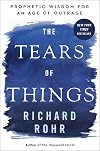
Richard Rohr always remains a compelling author and witness.
In The Tears of Things: Prophetic Wisdom for an Age of Outrage (galley received as part of early review program), Rohr considers the prophets of Israel and the prophetic role for at least some today.
He very much is playing with words with “tears”: it can be read as the tears (which come from the eyes) of things, the crying, mourning, and lamenting which is deeply embedded within the prophetic tradition, but also as the tears show more (ripping) of things, since the prophets work to uncover and expose the secretive ways of how things work against most people to the benefit of a few.
He would explore Amos, Elijah, Jonah, John the Baptist, the Isaianic traditions, and Ezekiel in some depth. He also would speak regarding the remnant, the holy disorder the prophets provide and which paradoxically sustains the faith of believers, learning sympathy and grace from the prophets, and all to the goal of growing in love.
His portrayal of the prophets is often arresting and compelling, and even where one might disagree with him, one can at least see who he is, where he’s coming from, and what he’s about. I do not feel as comfortable as he does in seeing some prophets as “less developed” and others as “more developed” according to the standards he’s establishing, and generally warn against such kinds of presumption, for instance; but I can understand the logic he is using and why he would believe as much, even if I still think it a bit dangerous to stand in that position of judgment.
Rohr will always work to shake you from your complacency in interpretation and application, and he does it well here. Recommended for at least consideration in terms of the prophets and the prophetic tradition. show less
In The Tears of Things: Prophetic Wisdom for an Age of Outrage (galley received as part of early review program), Rohr considers the prophets of Israel and the prophetic role for at least some today.
He very much is playing with words with “tears”: it can be read as the tears (which come from the eyes) of things, the crying, mourning, and lamenting which is deeply embedded within the prophetic tradition, but also as the tears show more (ripping) of things, since the prophets work to uncover and expose the secretive ways of how things work against most people to the benefit of a few.
He would explore Amos, Elijah, Jonah, John the Baptist, the Isaianic traditions, and Ezekiel in some depth. He also would speak regarding the remnant, the holy disorder the prophets provide and which paradoxically sustains the faith of believers, learning sympathy and grace from the prophets, and all to the goal of growing in love.
His portrayal of the prophets is often arresting and compelling, and even where one might disagree with him, one can at least see who he is, where he’s coming from, and what he’s about. I do not feel as comfortable as he does in seeing some prophets as “less developed” and others as “more developed” according to the standards he’s establishing, and generally warn against such kinds of presumption, for instance; but I can understand the logic he is using and why he would believe as much, even if I still think it a bit dangerous to stand in that position of judgment.
Rohr will always work to shake you from your complacency in interpretation and application, and he does it well here. Recommended for at least consideration in terms of the prophets and the prophetic tradition. show less
Wisdom wrapped around the reality of our most shared human experience: the unraveling of life, or what might be called failure.
Rohr's perspective on transformation found that place in me that recognizes truth when it shows up in words. Because of this I found his gentle arguments and observations simultaneously surprising and validating, refreshing and challenging, heartbreaking and affirming.
How do we move from the necessary ego-building and protecting of early life to a spacious trust in show more enough? What is the benefit of loss, failure, betrayal, grief? What does it mean to become an elder and live in the second journey (or second half) of life? These questions and more all find a safe and lively platform in Rohr's small, well-organized volume.
I own a copy and have read it through twice. Underlining and margin notes on almost every page attest to frequent resonance and occasional shock.
I'll be reading this book over again.
Highly recommend for small book groups. show less
Rohr's perspective on transformation found that place in me that recognizes truth when it shows up in words. Because of this I found his gentle arguments and observations simultaneously surprising and validating, refreshing and challenging, heartbreaking and affirming.
How do we move from the necessary ego-building and protecting of early life to a spacious trust in show more enough? What is the benefit of loss, failure, betrayal, grief? What does it mean to become an elder and live in the second journey (or second half) of life? These questions and more all find a safe and lively platform in Rohr's small, well-organized volume.
I own a copy and have read it through twice. Underlining and margin notes on almost every page attest to frequent resonance and occasional shock.
I'll be reading this book over again.
Highly recommend for small book groups. show less
Lists
Awards

You May Also Like


Associated Authors
Statistics
- Works
- 236
- Also by
- 6
- Members
- 12,544
- Popularity
- #1,868
- Rating
- 4.1
- Reviews
- 164
- ISBNs
- 397
- Languages
- 16
- Favorited
- 12