
Works by Kristen Green
Tagged
Common Knowledge
- Gender
- female
Members
Reviews
Something Must Be Done About Prince Edward County: A Family, a Virginia Town, a Civil Rights Battle by Kristen Green
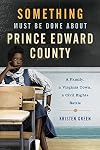
And yet NOTHING was done in Prince Edward County, Virginia - NOTHING to educate black students for four years, from 1960 - 1964, as white supremacists shut down the public schools rather than educating all children together. In Farmville, home of the author, this disgraceful, illegal, shameful chapter in American history has only one hero: Barbara Rose Johns, who led a walkout of black students to protest the appalling conditions in their stable-like school.
Kristen Green, reporter, is in an show more awkward situation - she benefited from Brown v Board of Education when her grandfather and other town "leaders" founded Prince Edward Academy, a private "academy" for white students. Now grown, returned back to Farmville as a parent married to a bi-racial man, she sets about speaking to residents and family about the events of 60 years ago, and it still ain't pretty.
Quotes: "Kenneth B. Clark wrote a brief explaining the psychological harm to black children from living in what was essentially a caste system, suggesting that segregation creates a feeling of inferiority and humiliation that leads to self hatred and the rejection of their own race."
"People reveal their racist beliefs in Farmville the way they do in towns across America: when they are comfortable, when they think they are among like-minded people, particularly when they have a glass of alcohol in hand."
"A teacher told her students that buses were integrated not because of Rosa Parks but because white women wanted their maids back and were tired of being inconvenienced by the Montgomery bus boycott."
"We do not oppose education for Negroes. We just oppose integrated education."
" Doug retired with a master's in business administration, but all he accomplished, none of it erased what he had endured as a child. He always wondered, "Where would I be if I had gone to school for those four years. How much further would I be in life?"
"Where would I have been, " Ricky wondered, "if my foundation had been built?"
"The school did not integrate. Rather, it changed its admission policy."
"The apologies to students shut out of school have never been adequate. Sometimes the community reminds me of a child who expects everything to return to normal once he says he is sorry. In this way, the town never grew up."
"Because I attended an all-white school for so many years, I was long uncomfortable around people of color. I equated being black with being poor. People of any race other than white were a curiosity, and I stared."
(CAPS, mine) "Historian David Blight: RESPONSIBILITY FOR HISTORY CAN BE GENERALIZED AND SPREAD AROUND SO DIFFUSELY THAT NO PERSON OR PEOPLE ARE EVER DEEMED THE SOURCE OF RADICAL EVIL."
This is as much of a must read as Ta-Nehisi Coates's love story to his son.
Please read, share, and challenge the minds of racists who say "I didn't do anything. I didn't own any slaves." show less
Kristen Green, reporter, is in an show more awkward situation - she benefited from Brown v Board of Education when her grandfather and other town "leaders" founded Prince Edward Academy, a private "academy" for white students. Now grown, returned back to Farmville as a parent married to a bi-racial man, she sets about speaking to residents and family about the events of 60 years ago, and it still ain't pretty.
Quotes: "Kenneth B. Clark wrote a brief explaining the psychological harm to black children from living in what was essentially a caste system, suggesting that segregation creates a feeling of inferiority and humiliation that leads to self hatred and the rejection of their own race."
"People reveal their racist beliefs in Farmville the way they do in towns across America: when they are comfortable, when they think they are among like-minded people, particularly when they have a glass of alcohol in hand."
"A teacher told her students that buses were integrated not because of Rosa Parks but because white women wanted their maids back and were tired of being inconvenienced by the Montgomery bus boycott."
"We do not oppose education for Negroes. We just oppose integrated education."
" Doug retired with a master's in business administration, but all he accomplished, none of it erased what he had endured as a child. He always wondered, "Where would I be if I had gone to school for those four years. How much further would I be in life?"
"Where would I have been, " Ricky wondered, "if my foundation had been built?"
"The school did not integrate. Rather, it changed its admission policy."
"The apologies to students shut out of school have never been adequate. Sometimes the community reminds me of a child who expects everything to return to normal once he says he is sorry. In this way, the town never grew up."
"Because I attended an all-white school for so many years, I was long uncomfortable around people of color. I equated being black with being poor. People of any race other than white were a curiosity, and I stared."
(CAPS, mine) "Historian David Blight: RESPONSIBILITY FOR HISTORY CAN BE GENERALIZED AND SPREAD AROUND SO DIFFUSELY THAT NO PERSON OR PEOPLE ARE EVER DEEMED THE SOURCE OF RADICAL EVIL."
This is as much of a must read as Ta-Nehisi Coates's love story to his son.
Please read, share, and challenge the minds of racists who say "I didn't do anything. I didn't own any slaves." show less
Something Must Be Done About Prince Edward County: A Family, a Virginia Town, a Civil Rights Battle by Kristen Green
Picked this one up because it ended up on a Washington Post list of best 2015 nonfiction. This book, in addition to being super-depressing, was a really strange read for me, because I have a good friend from Farmville and have spent a fair amount of time there. If you haven't read a work of nonfiction in which a small town you know well is described in clinical detail, it's a disorienting experience.
Green, a Farmville native, accurately and compassionately summarizes the history of the show more school closures in Prince Edward County. I knew a little about this but had not just not realized how important these events were to the civil rights movement. It's painful history to read about (I alternated between binge-reading and putting it down for weeks at a time), but there's also a lot of bravery and determination in this story.
Green, who is white, also discusses her own family's involvement in the school closures. Green's grandfather was on the board of the Prince Edward Academy (later Fuqua) and her grandparents actively supported segregation. I thought her exploration of their family's complicity and guilt was a lot less compelling than the historical chapters, as was her analysis of the continued racial tensions in Southside Virginia. Here, I felt a black co-writer would have been really valuable, because Green just does not have the depth of knowledge or experience to push beyond her personal regrets about her family history and give us a meaningful picture of how race operates in this community now.
Near the end of the book, Green interviews an older black man she meets in Farmville. I found his words to be the most haunting line of dialogue in the book - he says that Prince Edward County is waiting for his generation to die so that Farmville can become an upscale post-racial community. Of course, generational trauma doesn't work that way, although the new segregation of gentrified communities might make that trauma invisible.
This book didn't completely fulfill its promise, but it is absolutely worth a read. show less
Green, a Farmville native, accurately and compassionately summarizes the history of the show more school closures in Prince Edward County. I knew a little about this but had not just not realized how important these events were to the civil rights movement. It's painful history to read about (I alternated between binge-reading and putting it down for weeks at a time), but there's also a lot of bravery and determination in this story.
Green, who is white, also discusses her own family's involvement in the school closures. Green's grandfather was on the board of the Prince Edward Academy (later Fuqua) and her grandparents actively supported segregation. I thought her exploration of their family's complicity and guilt was a lot less compelling than the historical chapters, as was her analysis of the continued racial tensions in Southside Virginia. Here, I felt a black co-writer would have been really valuable, because Green just does not have the depth of knowledge or experience to push beyond her personal regrets about her family history and give us a meaningful picture of how race operates in this community now.
Near the end of the book, Green interviews an older black man she meets in Farmville. I found his words to be the most haunting line of dialogue in the book - he says that Prince Edward County is waiting for his generation to die so that Farmville can become an upscale post-racial community. Of course, generational trauma doesn't work that way, although the new segregation of gentrified communities might make that trauma invisible.
This book didn't completely fulfill its promise, but it is absolutely worth a read. show less
Something Must Be Done About Prince Edward County: A Family, a Virginia Town, a Civil Rights Battle by Kristen Green
Kristen Green's book is at its finest when she talks about her family and her personal connection to a hideous time in our county and Virginia's history. The story of her segregationist grandfather and his role in closing public schools rather than integrate is compelling. Green attempts to uncover and reconcile a very painful time; a task not easily accomplished in a book. While the story slows a bit as she ties it to the larger Civil Rights movement, she grounds it back into the community show more and make her racialized past personal. A great read. show less
Something Must Be Done About Prince Edward County: A Family, a Virginia Town, a Civil Rights Battle by Kristen Green
Following the Supreme Court’s 1954 decision in Brown v. Board of Education of Topeka, America’s public schools were instructed to work toward desegregation “with all deliberate speed”. However, in Prince Edward County, Virginia, the law was intentionally ignored through the closing of the county’s public schools. Rather than desegregate, White leaders in the community gathered together to keep the county’s public schools closed for close to a decade and ran a private, segregated show more academy in their place.
Rather than set aside knowledge of her family’s role in Prince Edward’s massive resistance, author Kristen Green writes Something Must Be Done… as a blend of her family’s history, the history of the town she grew up in, and a retelling of the events surrounding the creation of the county’s segregation academy. Though her efforts to set herself apart from her family’s history seem slightly overzealous at times, Green is not afraid to ask important and necessary questions, both of herself and the people around her.
One frustration I often have with historical nonfiction is a lack of connection between past and present, so I was pleasantly surprised to see Green highlighting the structural inequality in Richmond’s public school system—a truth I see reflected in my own Richmond neighborhood each day. While I would have loved to see the present-day examples expanded upon, particularly to include parallels between segregation academies and the modern voucher system, that topic has more than enough material for a book of its own. Recognizing that, Green finds balance in noting how problems of the past contribute to similar issues today while staying true to the focus of her book.
Both carefully researched and thoughtfully written, Something Must Be Done About Prince Edward County is a timely look at a shrouded history from some of our country’s darkest days.
More at rivercityreading.com. show less
Rather than set aside knowledge of her family’s role in Prince Edward’s massive resistance, author Kristen Green writes Something Must Be Done… as a blend of her family’s history, the history of the town she grew up in, and a retelling of the events surrounding the creation of the county’s segregation academy. Though her efforts to set herself apart from her family’s history seem slightly overzealous at times, Green is not afraid to ask important and necessary questions, both of herself and the people around her.
One frustration I often have with historical nonfiction is a lack of connection between past and present, so I was pleasantly surprised to see Green highlighting the structural inequality in Richmond’s public school system—a truth I see reflected in my own Richmond neighborhood each day. While I would have loved to see the present-day examples expanded upon, particularly to include parallels between segregation academies and the modern voucher system, that topic has more than enough material for a book of its own. Recognizing that, Green finds balance in noting how problems of the past contribute to similar issues today while staying true to the focus of her book.
Both carefully researched and thoughtfully written, Something Must Be Done About Prince Edward County is a timely look at a shrouded history from some of our country’s darkest days.
More at rivercityreading.com. show less
Lists
BLM (1)
Awards


You May Also Like


Statistics
- Works
- 3
- Members
- 284
- Popularity
- #82,066
- Rating
- 3.8
- Reviews
- 9
- ISBNs
- 12