

John Knowles (1) (1926–2001)
Author of A Separate Peace
For other authors named John Knowles, see the disambiguation page.
About the Author
John Knowles was born in Fairmont, W.Va., on September 16, 1926. He began prep school at Phillips Exeter Academy in New Hampshire from 1942 to 1944 and was then inducted into the U.S. Army Air Corps. After World War II ended, he attended Yale University, graduating in 1949, and then worked as a show more reporter for the Hartford Courant. He eventually turned to freelance writing, often writing articles about travel. This took him to Europe where he spent much of the 1950s. In addition to this writing, he served as editor for Holiday magazine for a time. A Separate Peace, his first novel, was published in 1959 in England and the United States. Set in a prep school much like Exeter, the novel takes place during World War II and is about the impact of the war on young men on the homefront; the troubled relationship of the two main characters symbolizes the fear and suspicion that can lead to war between nations. Knowles received the William Faulkner Foundation Award for a First Novel and the Independent School Education Board Award. A Separate Peace continues to be one of the most widely read novels in high schools and colleges. Knowles's subsequent novels include Morning in Antibes (1962), A Vein of Riches (1978), which is set in his native West Virginia, and Peace Breaks Out (1981) which returns to the setting of A Separate Peace. He also wrote a non-fiction book, Double Vision: American Thoughts Abroad (1964). He remains best known, however, for his first novel. John Knowles has lived on Long Island, N.Y. since the early 1960s. (Bowker Author Biography) show less
Image credit: Wikipedia
Works by John Knowles
Tagged
Common Knowledge
- Canonical name
- Knowles, John
- Birthdate
- 1926-09-16
- Date of death
- 2001-11-29
- Gender
- male
- Education
- Yale College (AB|1949)
Phillips Exeter Academy - Occupations
- novelist
short story writer
travel writer
journalist
editor
professor - Organizations
- Florida Atlantic University
University of North Carolina
Princeton University
Holiday
Hartford Courant
United States Army Air Forces (WWII) - Awards and honors
- William Faulkner Award (1961)
National Institute of Arts and Letters Rosenthal Award (1961) - Nationality
- USA
- Birthplace
- Fairmont, West Virginia, USA
- Places of residence
- Fairmont, West Virginia, USA
Southampton, New York, USA
Fort Lauderdale, Florida, USA - Place of death
- Fort Lauderdale, Florida, USA
- Associated Place (for map)
- USA
Members
Reviews

This is a frequently studied novel, and I can see its fertile ground. The relationship between Gene and Phineas is a complex one, viewed through a prism from Gene's point of view. Phineas is a rebellious rules flouter; or he's an innocent Pollyanna who doesn't understand the concept of rules; or he's manipulating a deeper game of one-upmanship with Gene, and his entire personality is a subterfuge. The background is World War II, providing a ticking clock as Gene and Phineas approach show more enlistment age. Gene shares in the general experience of the war as simultaneously dangerous and alluring. Phineas has a different kind of response, revelling in the peace they still enjoy in the moment. He is living in the present, while the rest of his classmates are swept up by their future. This becomes a kind of lifeline as Gene struggles with what's approaching.
The novel's primary fault is its blandness. At this all-white prep school there are no girls, no dating, no homosexuality; barely a hint of alcohol or driving; almost no music; no drugs, no gangs, no weapons. Everyone lives with their well-off parents, and the weirdest kid is only a naturalist who collects slugs and enjoys cross-country skiing. I am deeply surprised this book has been banned by anyone, ever (a teacher might want to lead with that mysterious fact, to keep the kids awake). But there's poignancy in scarcely being able to imagine coddled young men less well prepared for the horrors of war than these. show less
The novel's primary fault is its blandness. At this all-white prep school there are no girls, no dating, no homosexuality; barely a hint of alcohol or driving; almost no music; no drugs, no gangs, no weapons. Everyone lives with their well-off parents, and the weirdest kid is only a naturalist who collects slugs and enjoys cross-country skiing. I am deeply surprised this book has been banned by anyone, ever (a teacher might want to lead with that mysterious fact, to keep the kids awake). But there's poignancy in scarcely being able to imagine coddled young men less well prepared for the horrors of war than these. show less
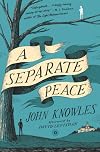
I recently re-read this book for the AP class that I'm teaching and I was reminded of what a deceptively simple book this appears to be on the surface. Set in an all boys prep school during WWII, A Separate Peace explores how the encroaching reality of war affects the psychological and social development of all the boys at the school. The poignant irony of providing these young men with a classics based education at a prestigious school just to be sent into war to kill and be killed show more effectively shows how, before they even make it to the battlefield, the war cripples them--for one physically, for the others psychologically. The book focuses on the relationship between Finny, the popular and perfect athlete, and Gene, the intelligent and dangerously introspective one. Gene's all-consuming envy toward Finny causes him to shake the tree limb both are standing in; Finny falls to the ground and breaks his leg. However, this is a metaphor for how Gene's betrayal of the friendship has broken Finny.
Effective use is made of Finny as a Christ figure and we witness as Gene grows psychologically in response to the realization that he has destroyed Finny. Gene comes to realize that the real enemy is the enemy within and, through Finny, Gene finds a form of salvation from his dark, neurotic tendencies.
Knowles does so much with setting and imagery in the book that I pick up on something new every time I read it. show less
Effective use is made of Finny as a Christ figure and we witness as Gene grows psychologically in response to the realization that he has destroyed Finny. Gene comes to realize that the real enemy is the enemy within and, through Finny, Gene finds a form of salvation from his dark, neurotic tendencies.
Knowles does so much with setting and imagery in the book that I pick up on something new every time I read it. show less
This is a terrific book. I'm not used to the boarding school genre (aside from "Harry Potter" and watching "The Emperor's Club"), and the Northeastern elitist culture is foreign to me, but the author did a thorough job painting the setting so that outsiders could understand and appreciate it. Phineas is like that Labrador Retriever everyone knows, a big, happy jock who chooses to see only the best in Gene. Gene, on the other hand, is a quiet, studious type who comes to regard his friend with show more suspicion, as if Phineas is knowingly mocking everyone around him. And in a split-second, Gene makes a decision that cripples Phineas. Only afterward does Gene learn that Phineas has been genuine all along. Eventually, the truth about the incident comes out, putting their friendship to the test.
It's not a long read by any means, and deserves to be reread several times. 5 stars. show less
It's not a long read by any means, and deserves to be reread several times. 5 stars. show less
I think a lot of people read this in high school, but I didn't. I decided to pick it up because I kept seeing it everywhere. My impressions:
1. There are almost no females in it. The lack of girls and the lack of interest in girls among these 16- to 18-year-old guys, made me think that the two main characters were in love with each other, which is probably just because I minored in gender studies. But, really, the total lack of anything sexual was an interesting choice.
2. This is a deep, show more dark book about living in wartime. I was reminded of how little the Iraq war affected my time in college compared to how tremendously WWII affected the boys at the boarding school in the story.
3. Obviously, this is also a story about the psychology of adolescence, particularly among young men, particularly in a competitive and isolated environment. The way they talked was so old-fashioned, though, that I kept picturing them as much younger, like 12 or 13.
4. How reliable of a narrator is Gene? Can Finny really be so perfect? I went back and forth on this. I kind of hated Gene, but I also felt so sorry for him.
5. Overall, a really fascinating book that I'm sorry to read all by myself with no professor to guide a discussion. show less
1. There are almost no females in it. The lack of girls and the lack of interest in girls among these 16- to 18-year-old guys, made me think that the two main characters were in love with each other, which is probably just because I minored in gender studies. But, really, the total lack of anything sexual was an interesting choice.
2. This is a deep, show more dark book about living in wartime. I was reminded of how little the Iraq war affected my time in college compared to how tremendously WWII affected the boys at the boarding school in the story.
3. Obviously, this is also a story about the psychology of adolescence, particularly among young men, particularly in a competitive and isolated environment. The way they talked was so old-fashioned, though, that I kept picturing them as much younger, like 12 or 13.
4. How reliable of a narrator is Gene? Can Finny really be so perfect? I went back and forth on this. I kind of hated Gene, but I also felt so sorry for him.
5. Overall, a really fascinating book that I'm sorry to read all by myself with no professor to guide a discussion. show less
Lists
Unread books (1)
1970s (1)
Nifty Fifties (1)
Overdue Podcast (1)
Read (1)
AP Lit (1)
1950s (1)
Carole's List (1)
Sonlight Books (1)
First Novels (1)
Books About Boys (1)
Five star books (1)
Awards


You May Also Like


Associated Authors
Statistics
- Works
- 19
- Members
- 15,235
- Popularity
- #1,498
- Rating
- 3.6
- Reviews
- 219
- ISBNs
- 109
- Languages
- 6
- Favorited
- 3