
Pedro Antonio de Alarcón (1833–1891)
Author of The Three-Cornered Hat
About the Author
Image credit: Courtesy of the NYPL Digital Gallery (image use requires permission from the New York Public Library)
Works by Pedro Antonio de Alarcón
El nino de la bola. El sombrero de tres picos. El capitan veneno (SC134) (Spanish Edition) (1991) 12 copies
Tres historias nacionales 3 copies
O menino da bola 3 copies
La mujer alta. La comendadora 2 copies
A pródiga 1 copy
Il cappello a tre punte. 1 copy
Armando Ocano 1 copy
El Final de Norma 1 copy
El capitán veneno 1 copy
EL CLAVO 1 copy
Comedias escogidas 1 copy
El corso 2010 1 copy
O escandalo 1 copy
EL ESCANDALO (86) 1 copy
Tales From the Spanish 1 copy
De mooie molenaarsvrouw 1 copy
El cuento azul 1 copy
Der Freund des Todes 1 copy
Třírohý klobouk 1 copy
Antología 1 copy
Pétalos líricos 221/24P 1 copy
El escándalo 1 copy
Novelas Cortas 1 copy
Das letzte Abenteuer 1 copy
El Libro Talonario 1 copy
El capitán Veneno 1 copy
De Madrid a Nápoles pasando por París, Ginebra, el Mont-Blanc ... y sitio de Gaeta en 1861 (2014) 1 copy
Le Tricorne 1 copy
Viajes por España: Explorando la España del siglo XIX a través de Viajes Literarios (Spanish Edition) (2019) 1 copy
clavo y otros relatos, El 1 copy
Cuentos 1 copy
Obras completas 1 copy
Associated Works
Library of the World's Best Mystery and Detective Stories: French, Italian, Spanish and Latin (2009) — Contributor — 18 copies
The Masterpiece Library of Short Stories Vol. XVIII: Spanish & Portuguese (1900) — Contributor — 5 copies
Modern Short Stories — Contributor — 3 copies
Tagged
Common Knowledge
- Canonical name
- Alarcón, Pedro Antonio de
- Legal name
- Alarcón, Pedro Ontonio de
- Other names
- Alarcón y Ariza, Pedro Antonio Joaquín Melitón
- Birthdate
- 1833-03-10
- Date of death
- 1891-07-19
- Gender
- male
- Education
- University of Granada (Law | Studied but did not graduate)
Gaudix Seminary (Latin & Philosophy) - Occupations
- novelist
physician
storyteller
reporter
poet
politician (show all 8)
playwright
travel writer - Organizations
- Real Academia Española (Spanish Royal Academy)
El Látigo (The Whip)
El Eco de Occidente - Nationality
- Spain
- Birthplace
- Guadix, Granada, Spain
- Places of residence
- Guadix, Granada, Spain
Madrid, Spain
Morocco - Place of death
- Valdemoro, Madrid, Spain
- Burial location
- Cementerio de San Justo, Madrid, España
- Associated Place (for map)
- Madrid, Spain
Members
Reviews

This book was hilarious!
I am glad to have given this story a chance. While I have enjoyed every book I read by Jane Austen, it is fun to give a chance to other contemporary writers that are far less known. On this occasion, I gave El Capítán Veneno (Captain Poison) a chance and started reading it with zero knowledge what the novella is about. Head's up, I read this story in Spanish. I am not sure if an English translation even exists.
Taking place in mid 1800's Madrid, our rom-com begins show more where a young 20-something woman (hilariously named Angustias which roughly translates to Anxieties in English) watches a terrible battle in the streets between pro monarchy factions and rebels.
Her mother, a recently widowed wife of a monarchist soldier who died in the name of duty named Teresa beckons her daughter to hide from errant bullets. Oh, but if Angustias didn't watch the street, we'd have no story. What happens next sets the stage for the hilarity to ensue. A 40 something man with mismatched civilian and officer attire ends up badly wounded defending their street.
Angustias ignores her mom's pleas, asks the house maid Rosa to drag the poor guy inside to safety and fetches the neighborhood doctor. The man is unconscious from a concussion and bleeding to death. Despite arriving immediately, the doctor isn't certain the soldier will survive the night.
Luckily for the story, the guy survives and... He is very, very, very pissed off he's being babysitted by three strange women. What is worse, the doctor stated he will need to live in Teresa's house for the next two months while his fractured leg wound heals. If he is taken by stretcher to a hospital or back to his own home, he'll end up needing a leg amputation.
Stuck in a house, Capitán Don Jorge de Córdoba is going to make their lives a living hell.
The book is zany, over-the-top and insanely funny. I do feel the romance side of the story could have been developed a bit better, which knocked down 1 star for me. However, this was a very funny quick read that was entertaining from beginning to the end. Given this book is now public domain, I am wondering when an author is willing to make a more modern version of this rom-com story. show less
I am glad to have given this story a chance. While I have enjoyed every book I read by Jane Austen, it is fun to give a chance to other contemporary writers that are far less known. On this occasion, I gave El Capítán Veneno (Captain Poison) a chance and started reading it with zero knowledge what the novella is about. Head's up, I read this story in Spanish. I am not sure if an English translation even exists.
Taking place in mid 1800's Madrid, our rom-com begins show more where a young 20-something woman (hilariously named Angustias which roughly translates to Anxieties in English) watches a terrible battle in the streets between pro monarchy factions and rebels.
Her mother, a recently widowed wife of a monarchist soldier who died in the name of duty named Teresa beckons her daughter to hide from errant bullets. Oh, but if Angustias didn't watch the street, we'd have no story. What happens next sets the stage for the hilarity to ensue. A 40 something man with mismatched civilian and officer attire ends up badly wounded defending their street.
Angustias ignores her mom's pleas, asks the house maid Rosa to drag the poor guy inside to safety and fetches the neighborhood doctor. The man is unconscious from a concussion and bleeding to death. Despite arriving immediately, the doctor isn't certain the soldier will survive the night.
Luckily for the story, the guy survives and... He is very, very, very pissed off he's being babysitted by three strange women. What is worse, the doctor stated he will need to live in Teresa's house for the next two months while his fractured leg wound heals. If he is taken by stretcher to a hospital or back to his own home, he'll end up needing a leg amputation.
Stuck in a house, Capitán Don Jorge de Córdoba is going to make their lives a living hell.
The book is zany, over-the-top and insanely funny. I do feel the romance side of the story could have been developed a bit better, which knocked down 1 star for me. However, this was a very funny quick read that was entertaining from beginning to the end. Given this book is now public domain, I am wondering when an author is willing to make a more modern version of this rom-com story. show less
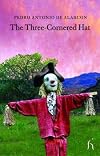
This is a new translation of Pedro Antonio de Alarcón's novella, by Inés Bou. I had not heard of this work before, which framed the subject for a 1919 ballet by Manuel de Falla with sets and costumes designed by Pablo Picasso.
The Three-Cornered Hat (El sombrero de tres picos) is a concise novella packed with political themes and comedic moments that are very helpfully supported by Bou's footnotes, which, as a non-expert in this area, helped me get much more out of this work than I would show more have otherwise. Bou keeps many details of the original by translating them specifically where possible, or keeping the Spanish where needed and explaining through footnotes. This helps transport the reader into the time and space of the story to better understand the meaning provided through subtle details.
This is a story, as noted in the introduction, focused on authority and corruption, wonderfully tied to the seemingly simple device of the hat and garments worn by the Corregidor (the local, royal-appointed authority). Through a series of comedic errors and misunderstandings, these clothes change hands, and what might seem to be largely a story of possible marital infidelity becomes one of social commentary. The Corredigor attempts to seduce the miller's wife, who rebukes him; the miller, misunderstanding the situation, takes the Corregidor's clothes to attempt to seduce the latter's wife, who rebukes him and guides the situation to a satisfying conclusion that sees the men outwitted by the women and the Corregidor both publicly humiliated and thrown by his wife out of her bedchamber.
The whole story is told by a narrator who claims to have heard it from a shepherd named Repeal over 35 years before the narrator relays it. The framing narrative is that the shepherd was telling this verse-tale at a wedding, a fitting locale for the story, and the narrator is relaying it forward in the written story. It does feel to me like an oral retelling in written form.
I enjoyed this brief story with many layers made clearer by the introduction, translation, and notes! show less
The Three-Cornered Hat (El sombrero de tres picos) is a concise novella packed with political themes and comedic moments that are very helpfully supported by Bou's footnotes, which, as a non-expert in this area, helped me get much more out of this work than I would show more have otherwise. Bou keeps many details of the original by translating them specifically where possible, or keeping the Spanish where needed and explaining through footnotes. This helps transport the reader into the time and space of the story to better understand the meaning provided through subtle details.
This is a story, as noted in the introduction, focused on authority and corruption, wonderfully tied to the seemingly simple device of the hat and garments worn by the Corregidor (the local, royal-appointed authority). Through a series of comedic errors and misunderstandings, these clothes change hands, and what might seem to be largely a story of possible marital infidelity becomes one of social commentary. The Corredigor attempts to seduce the miller's wife, who rebukes him; the miller, misunderstanding the situation, takes the Corregidor's clothes to attempt to seduce the latter's wife, who rebukes him and guides the situation to a satisfying conclusion that sees the men outwitted by the women and the Corregidor both publicly humiliated and thrown by his wife out of her bedchamber.
The whole story is told by a narrator who claims to have heard it from a shepherd named Repeal over 35 years before the narrator relays it. The framing narrative is that the shepherd was telling this verse-tale at a wedding, a fitting locale for the story, and the narrator is relaying it forward in the written story. It does feel to me like an oral retelling in written form.
I enjoyed this brief story with many layers made clearer by the introduction, translation, and notes! show less
 This review was written for LibraryThing Early Reviewers.
I appreciated this slightly more than I might have done because it followed Dickens’ The Signalman (see my review HERE) in Manguel’s anthology: both feature sightings that seems to predict, or maybe cause, disaster.
This one is set between Madrid and Segovia, and is nested and third-hand (not uncommon with ghost stories), hence an early reference to Hamlet.
“What do we know, my friends?”
I liked the symmetry and ambiguity of the opening and closing sentences explicitly inviting the show more listener or reader to make up their own minds about what really happened and why.
“I leave it to the judgment of every one of my readers.”
On the downside, although I realise it was published in 1881, the correlation between ugliness and assumed malign intent, the general misogyny, and his visceral fear of sex and the opposite sex, was unpleasant to the extent the twist and reveal did nothing for me.
Short story club
I read this in Black Water: The Anthology of Fantastic Literature, by Alberto Manguel, from which I’m reading one story a week with The Short Story Club, starting 4 September 2023.
You can read this story here. It’s the Schulz translation that matches the one in Manguel’s anthology.
You can join the group here. show less
This one is set between Madrid and Segovia, and is nested and third-hand (not uncommon with ghost stories), hence an early reference to Hamlet.
“What do we know, my friends?”
I liked the symmetry and ambiguity of the opening and closing sentences explicitly inviting the show more listener or reader to make up their own minds about what really happened and why.
“I leave it to the judgment of every one of my readers.”
On the downside, although I realise it was published in 1881, the correlation between ugliness and assumed malign intent, the general misogyny, and his visceral fear of sex and the opposite sex, was unpleasant to the extent the twist and reveal did nothing for me.
Short story club
I read this in Black Water: The Anthology of Fantastic Literature, by Alberto Manguel, from which I’m reading one story a week with The Short Story Club, starting 4 September 2023.
You can read this story here. It’s the Schulz translation that matches the one in Manguel’s anthology.
You can join the group here. show less

Well, "The Nail and Other Stories" turned out to be "The Nail and One Other Story Which Is Only Ten Pages Long and Is Much Better Than The Damn Nail". Too bad mr. Pedro Antonio de Alarcón was so infatuated with Poe. He could have written something better if he weren't trying so hard to imitate him. Thankfully, this was merely the first of his literary attempts. He was later to become one of Spain's most important novelists of the 19th century, certainly one of the most distinguished writers show more within the country's realist tradition. His books El Sombrero de Tres Picos (The Three-Cornered Hat) and El Escándalo (The Scandal), written during the 1870s gained him national and international fame. But, alas, this is still the 1850s and The Nail is predictable, unoriginal and, frankly, quite boring. What's funny is that the writer seems to be aware of this: in one of the rare moments where the narrator addresses the reader directly, he reveals the story's "dramatic" conclusion before it even happens by saying something like "you probably imagined, just like I did, that *insert dramatic ending* would happen". Yep, we did imagine it. So is Alarcón under the impression that we just want our suspicions confirmed? That we'll be interested in reading about something that we already knew would happen just because we want to hear it from the narrator himself? Sorry, hombre. Wrong again.
"La Corneta de Llaves" then follows 'El Clavo", and for a moment I'm thinking maybe I was too harsh on the guy. But unfortunately, it's too little, too late. show less
"La Corneta de Llaves" then follows 'El Clavo", and for a moment I'm thinking maybe I was too harsh on the guy. But unfortunately, it's too little, too late. show less
Lists
You May Also Like


Associated Authors
Statistics
- Works
- 132
- Also by
- 15
- Members
- 1,359
- Popularity
- #18,912
- Rating
- 3.9
- Reviews
- 46
- ISBNs
- 370
- Languages
- 11
- Favorited
- 1
